
In the realm of power transmission systems, gears play a pivotal role, and among them, miter gears—a specific type of bevel gear with a shaft angle of 90 degrees—are widely utilized in various mechanical applications such as automotive differentials and industrial machinery. The precision of miter gears directly influences transmission stability, efficiency, and noise levels. Traditional manufacturing methods for miter gears often involve machining processes, which are time-consuming, material-wasteful, and may compromise the mechanical properties due to cut fibers. In contrast, cold forging, a near-net-shape forming technique, offers significant advantages including enhanced material strength, improved grain flow, reduced waste, and higher production rates. However, achieving high dimensional accuracy in cold-forged miter gears remains challenging due to phenomena like springback, which occurs when elastic strains are released upon unloading, causing deviations from the intended gear geometry. This study focuses on analyzing springback behavior in cold-forged miter gears and developing an effective die modification strategy to compensate for these deviations, thereby ensuring the gears meet stringent precision requirements.
Cold forging of miter gears involves complex three-dimensional metal flow under high pressure, leading to non-uniform stress distributions and subsequent elastic recovery. Springback is influenced by multiple factors such as material properties, die elasticity, friction conditions, and process parameters. Understanding and controlling springback is crucial for producing high-precision miter gears without post-forming machining. In this work, we employ a combined approach of numerical simulation using finite element analysis (FEA) and practical die correction techniques to address springback in miter gear cold forging. The primary objectives are to: (1) simulate the cold forging process of a miter gear to analyze material flow and springback patterns, (2) quantify springback deviations across the gear tooth profile, and (3) apply a reverse compensation method to modify the die cavity iteratively, achieving gear geometry within acceptable tolerances. Through this research, we aim to demonstrate that numerical simulation can effectively predict springback and guide die design, ultimately reducing trial-and-error in模具制造 and lowering costs.
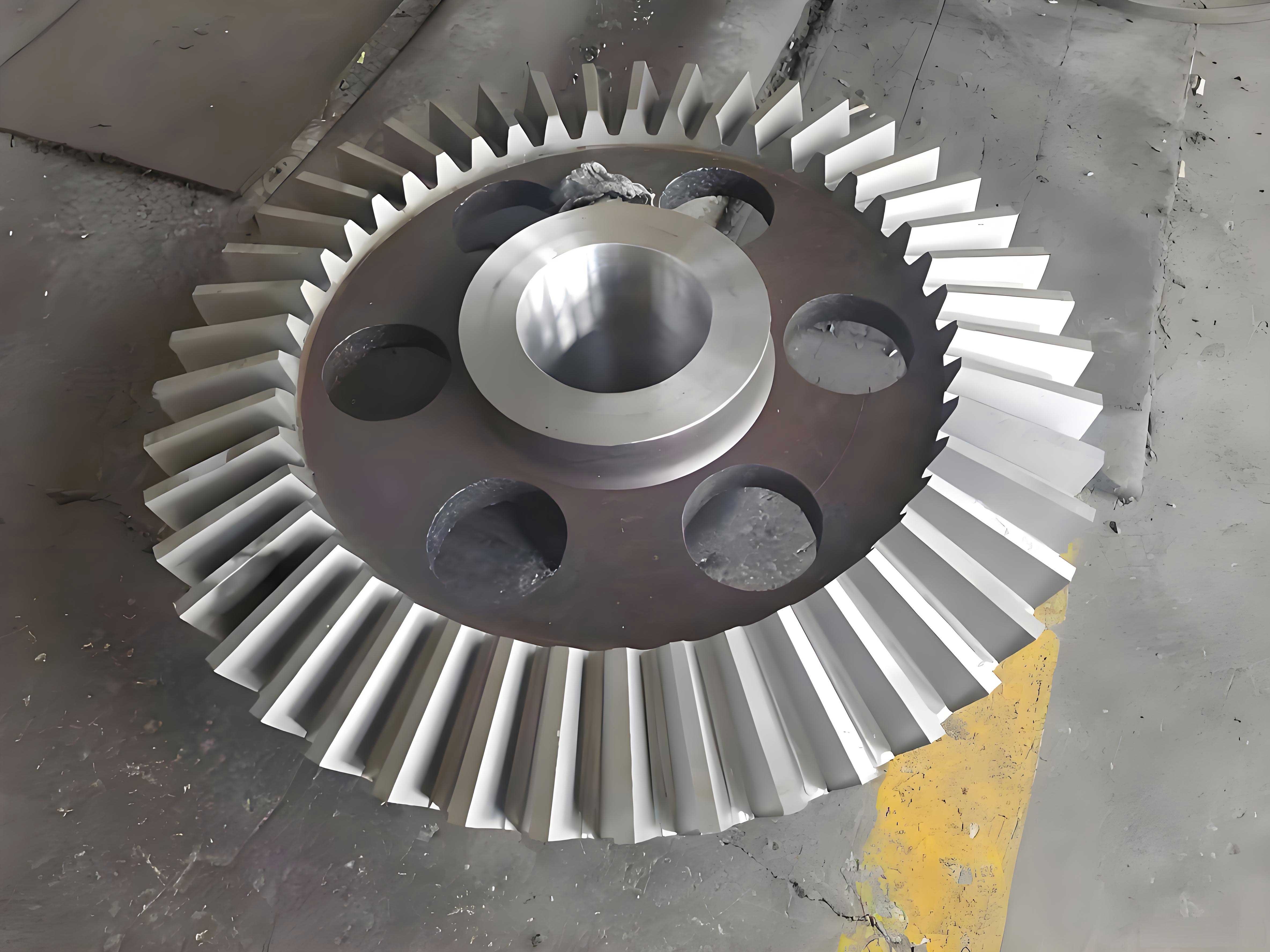
The miter gear considered in this study is a straight bevel gear with a 90-degree shaft angle, typically used in automotive differentials. The gear material is 20CrMnTi, a low-alloy steel known for its good hardenability and strength, commonly used in gear applications. The cold forging process for this miter gear involves several stages: annealing, phosphating and皂化 (coating for lubrication), cold forging, normalizing, and final finishing. The die assembly consists of a tooth-profile concave die, upper punch, lower punch, and lower concave die, as illustrated in the simulation model. To reduce computational cost, a symmetric segment model representing one-tenth of the full gear is used for FEA, assuming periodicity in the gear geometry. The simulation settings include: ambient temperature of 20°C, the workpiece modeled as rigid-plastic material (assuming negligible elastic deformation during forming), dies as rigid bodies, shear friction model with a coefficient of 0.12, and a forming speed of 30 mm/s. The FEA software Deform-3D is utilized to simulate the process, capturing the metal flow, stress distributions, and最终几何形状 after unloading.
The cold forging process of the miter gear can be divided into distinct phases. Initially, the upper punch and tooth-profile concave die move downward, causing radial upsetting of the billet against the lower punch. As the die cavity continues to descend, lateral deformation occurs, and the tooth surfaces at the small end of the miter gear begin to fill. Upon complete filling of the lower die cavity, radial deformation ceases, and all material flows into the tooth-profile concave die until it contacts the lower concave die. At this point, the tooth profile is nearly fully formed, and the forming load reaches its peak. Finally, the lower punch moves upward to perform a sizing operation, ensuring precise tooth geometry. The simulation results show that the miter gear tooth filling is satisfactory, with no defects like underfilling or laps. The forming load curve exhibits a sharp increase during initial filling, followed by a steady rise as the tooth cavities are filled, peaking at around 1200 kN for the segment model, which corresponds to approximately 12 MN for the full miter gear. This load profile indicates effective material flow and die filling.
To analyze springback, the simulation model is adjusted to account for elastic effects. The workpiece material is changed to elastoplastic, using a bilinear hardening model with Young’s modulus E = 210 GPa, Poisson’s ratio ν = 0.3, and yield strength σ_y = 350 MPa (for 20CrMnTi after annealing). The dies are modeled as elastic bodies with properties of tool steel (E = 210 GPa, ν = 0.3). After the forging simulation, the dies are removed, and the workpiece is allowed to elastically recover. The springback analysis involves comparing the coordinates of points on the tooth surface before and after unloading. Specifically, the tooth surface is divided into N sections from the small end to the large end of the miter gear, and along each section, M points are sampled on the intersection curves with the tooth profile. The deviation due to springback is calculated as the difference in coordinates. For a point i on the tooth surface, the springback vector Δu_i can be expressed as:
$$ \Delta \mathbf{u}_i = \mathbf{x}_i^{\text{after}} – \mathbf{x}_i^{\text{before}} $$
where \(\mathbf{x}_i^{\text{before}}\) and \(\mathbf{x}_i^{\text{after}}\) are the position vectors before and after unloading, respectively. The magnitude of springback, δ_i, is given by:
$$ \delta_i = \|\Delta \mathbf{u}_i\| $$
In practice, we focus on deviations normal to the intended tooth profile, as these directly affect gear meshing accuracy. The normal deviation δ_{n,i} can be computed by projecting Δu_i onto the unit normal vector n_i at point i on the target gear surface:
$$ \delta_{n,i} = \Delta \mathbf{u}_i \cdot \mathbf{n}_i $$
Positive values indicate outward springback (material expansion), while negative values indicate inward springback. For the miter gear, results show that springback is non-uniform across the tooth profile. In the direction of tooth height (from tooth root to tooth tip), the minimum springback occurs near the pitch line (where tooth thickness is maximum), with values as low as 0.02 mm. Towards the tooth tip and root, springback increases gradually, reaching a maximum of approximately 0.14 mm near the tooth tip. This pattern is consistent across different sections from the small end to the large end, though the magnitude varies slightly due to the conical geometry of the miter gear. The table below summarizes springback deviations at key points on the tooth profile for five representative sections (Section 1 near small end to Section 5 near large end).
| Section | Point Location (Tooth Height) | Springback δ_n (mm) | Comments |
|---|---|---|---|
| 1 (Small End) | Tooth Root | 0.08 | Moderate outward springback |
| Lower Flank | 0.05 | Near pitch line | |
| Pitch Line | 0.02 | Minimum springback | |
| Upper Flank | 0.06 | Increasing towards tip | |
| Tooth Tip | 0.12 | High outward springback | |
| 2 | Tooth Root | 0.09 | Slightly higher than Section 1 |
| Lower Flank | 0.06 | ||
| Pitch Line | 0.03 | ||
| Upper Flank | 0.07 | ||
| Tooth Tip | 0.13 | ||
| 3 (Mid) | Tooth Root | 0.10 | Representative of average behavior |
| Lower Flank | 0.07 | ||
| Pitch Line | 0.03 | ||
| Upper Flank | 0.08 | ||
| Tooth Tip | 0.14 | Maximum springback observed | |
| 4 | Tooth Root | 0.09 | Similar to Section 2 |
| Lower Flank | 0.06 | ||
| Pitch Line | 0.03 | ||
| Upper Flank | 0.07 | ||
| Tooth Tip | 0.13 | ||
| 5 (Large End) | Tooth Root | 0.08 | Slightly lower due to约束 |
| Lower Flank | 0.05 | ||
| Pitch Line | 0.02 | ||
| Upper Flank | 0.06 | ||
| Tooth Tip | 0.12 |
The springback behavior in miter gears can be attributed to the non-uniform stress distribution during forging. As material flows from the core towards the tooth tips, deformation resistance increases near the tips due to higher strain hardening and geometric constraints. This results in accumulated elastic strain energy in these regions. Upon unloading, the release of this energy causes material to flow back, primarily from the tooth root towards the tip and from the small end towards the large end, as evidenced by velocity vectors in the simulation. The springback magnitude δ_n can be related to the residual stresses σ_residual left in the gear after forming. According to elasticity theory, for a linear elastic material, the normal displacement due to residual stresses on a free surface is proportional to the stress integrated over the volume. However, for complex geometries like miter gears, analytical solutions are impractical, necessitating numerical methods. An empirical relation for springback in cold-forged gears can be expressed as:
$$ \delta_n = C \cdot \frac{\sigma_{\text{residual}} \cdot V}{E \cdot A} $$
where C is a geometry-dependent factor, σ_residual is the average residual stress in the region, V is the volume affected, E is Young’s modulus, and A is the area of the tooth surface. This highlights that springback increases with higher residual stresses and larger tooth dimensions, which is consistent with our findings for miter gears.
To compensate for springback and achieve the target gear geometry, die modification is essential. Common methods for gear die correction include profile shift modification, base circle modification, and reverse compensation modification. For miter gears with complex springback patterns that do not necessarily preserve the involute profile after elastic recovery, the reverse compensation method is most suitable. This method involves iteratively adjusting the die cavity based on the deviation between the formed gear (after springback) and the target gear. The steps are as follows:
- Springback Analysis: Obtain the coordinates of points on the tooth surface after springback from FEA, and compute deviations δ_n from the target gear surface.
- Reverse Application: Apply the negative of these deviations to the target gear surface to generate a modified die surface. For each point i on the target surface with position vector \(\mathbf{x}_i^{\text{target}}\) and normal vector \(\mathbf{n}_i\), the modified die point \(\mathbf{x}_i^{\text{die}}\) is given by:
$$ \mathbf{x}_i^{\text{die}} = \mathbf{x}_i^{\text{target}} – \delta_{n,i} \cdot \mathbf{n}_i $$
- Surface Fitting: Fit a smooth surface through the modified points to create the new die cavity geometry, ensuring continuity and avoiding sharp edges that could affect material flow or die life.
- Iterative Simulation: Simulate the forging process with the modified die, analyze springback again, and check if deviations are within tolerance (e.g., ±0.03 mm for precision miter gears). If not, repeat steps 1-3 with adjusted compensation factors.
In this study, we applied two iterations of reverse compensation to the tooth-profile concave die of the miter gear. After the first iteration, springback deviations were reduced but still exhibited negative values (i.e., underfill relative to target). After the second iteration, deviations were minimized, with the maximum deviation of -0.025 mm (slight underfill) and most points within ±0.01 mm. The table below compares deviations at key points for the initial design, after first correction, and after second correction, using Section 3 as an example.
| Point Location | Initial δ_n (mm) | After 1st Correction δ_n (mm) | After 2nd Correction δ_n (mm) |
|---|---|---|---|
| Tooth Root | 0.10 | -0.05 | -0.01 |
| Lower Flank | 0.07 | -0.03 | 0.00 |
| Pitch Line | 0.03 | -0.01 | 0.005 |
| Upper Flank | 0.08 | -0.04 | -0.01 |
| Tooth Tip | 0.14 | -0.08 | -0.025 |
The negative values after correction indicate that the die cavity was over-compensated, but the second iteration brought deviations close to zero. The gear tooth profile after the second correction closely matches the target geometry, as confirmed by contact pattern analysis using red lead inspection on physical prototypes, which showed proper contact patches at the mid-flank regions without edge loading, indicative of good meshing performance for miter gears.
The effectiveness of die correction for miter gears can be quantified by the reduction in springback error. Define the overall error metric E as the root mean square (RMS) of deviations over all sampled points:
$$ E = \sqrt{\frac{1}{N \cdot M} \sum_{i=1}^{N \cdot M} (\delta_{n,i})^2 } $$
For our miter gear, E decreased from 0.085 mm (initial) to 0.045 mm after the first correction, and to 0.012 mm after the second correction, demonstrating the efficacy of the reverse compensation method. Furthermore, the process parameters such as forming speed, friction, and billet temperature can influence springback. Additional simulations were conducted to assess sensitivity. For instance, increasing the forming speed from 30 mm/s to 50 mm/s resulted in a 10% increase in springback due to higher strain rates and adiabatic heating, while reducing friction coefficient from 0.12 to 0.08 decreased springback by 15% by promoting more uniform material flow. These insights can be integrated into the die correction process for optimizing miter gear production.
In comparison to other gear types, miter gears present unique challenges due to their conical shape and 90-degree intersection, which lead to asymmetric springback patterns. The reverse compensation method, while computationally intensive, is highly adaptive to such complexities. Alternative methods like profile shift modification assume that springback merely scales the gear geometry, which is not valid for miter gears as evidenced by our data. Base circle modification, often used for spur gears, is less effective for bevel gears because the tooth profile varies along the face width. Therefore, for high-precision miter gears, FEA-based reverse compensation is recommended.
Beyond springback, other factors affecting miter gear accuracy in cold forging include die wear, thermal expansion, and billet size variations. However, springback is the dominant effect for initial die design. The corrected die cavity, once manufactured, can produce miter gears with consistent quality. The use of numerical simulation also allows for virtual testing of different gear geometries, such as varying pressure angles or tooth counts for custom miter gears, without physical prototyping. This accelerates development cycles and reduces costs, making cold forging more viable for small batches or prototype miter gears.
In conclusion, this study demonstrates a comprehensive approach to springback analysis and die correction for cold-forged miter gears. Through detailed finite element simulation, we characterized the springback behavior, showing that deviations are minimal near the pitch line and increase towards the tooth tip, with maximum values around 0.14 mm for the studied miter gear. The reverse compensation method enabled effective die modification, reducing springback errors to within ±0.025 mm after two iterations. The methodology not only ensures high dimensional accuracy for miter gears but also provides a framework for optimizing cold forging processes for other complex gear geometries. Future work could explore the integration of machine learning algorithms to predict springback based on process parameters, further streamlining die design for miter gears. Additionally, experimental validation on industrial presses would reinforce the simulation findings. Ultimately, mastering springback control in cold forging is key to advancing the production of precision miter gears, enhancing their performance in critical applications like automotive transmissions and robotics.