
In modern mechanical transmission systems, the straight bevel gear plays a critical role due to its ability to transmit power between intersecting shafts efficiently. As industries strive for higher precision and cost-effectiveness, cold forging has emerged as a prominent near-net shape manufacturing method for producing straight bevel gears. This process minimizes material waste and enhances mechanical properties compared to traditional machining. However, achieving high dimensional accuracy in cold-forged straight bevel gears is challenging due to springback phenomena, where elastic recovery after unloading causes deviations from the intended geometry. In this article, I analyze the springback behavior in cold-forged straight bevel gears using finite element simulations and discuss an effective die modification technique to compensate for these deviations, ensuring the production of high-precision gears.
The cold forging process for straight bevel gears involves multiple stages, including annealing, phosphating, cold forging, normalizing, and finishing. For a typical straight bevel gear used in automotive differentials, the material is often 20CrMnTi steel, which offers good hardenability and strength. In the simulation setup, I employ a one-tenth symmetric model to reduce computational complexity while capturing essential deformation characteristics. The finite element model treats the billet as a rigid-plastic material and the dies as rigid bodies, with a shear friction coefficient of 0.12 and a forging speed of 30 mm/s. The deformation process can be divided into several phases: initial radial upsetting, lateral flow, and final tooth filling. As the upper die moves downward, the billet undergoes radial compression, followed by material flow into the tooth cavities of the die. The tooth profiles fill progressively from the small end to the large end, with the forming load peaking when the cavity is fully filled. A final sizing step ensures complete tooth formation. The simulation results indicate that the material flow is uniform, leading to well-filled tooth profiles without defects.
To quantify the springback, I model the billet as an elastoplastic material and the dies as elastic bodies in the finite element analysis. After unloading, the gear exhibits elastic recovery due to the release of stored strain energy. I extract coordinate data from points along the tooth surface, dividing the gear from the small end to the large end into N sections and selecting M points on each intersecting curve. The springback is calculated as the difference between the coordinates before and after unloading. The results show that springback varies along the tooth height direction, with the minimum value occurring at the location of maximum tooth thickness, approximately 0.02 mm. This deviation increases gradually toward the tooth tip and root, reaching a maximum of 0.14 mm near the tooth tip. The non-uniform springback is attributed to the direction of material flow during forging; deformation resistance increases near the tooth tip, accumulating higher elastic strain energy. Upon unloading, this energy releases, causing material particles to move from the root to the tip and from the small end to the large end. The velocity field post-unloading confirms this flow pattern, highlighting the complexity of springback in straight bevel gears.
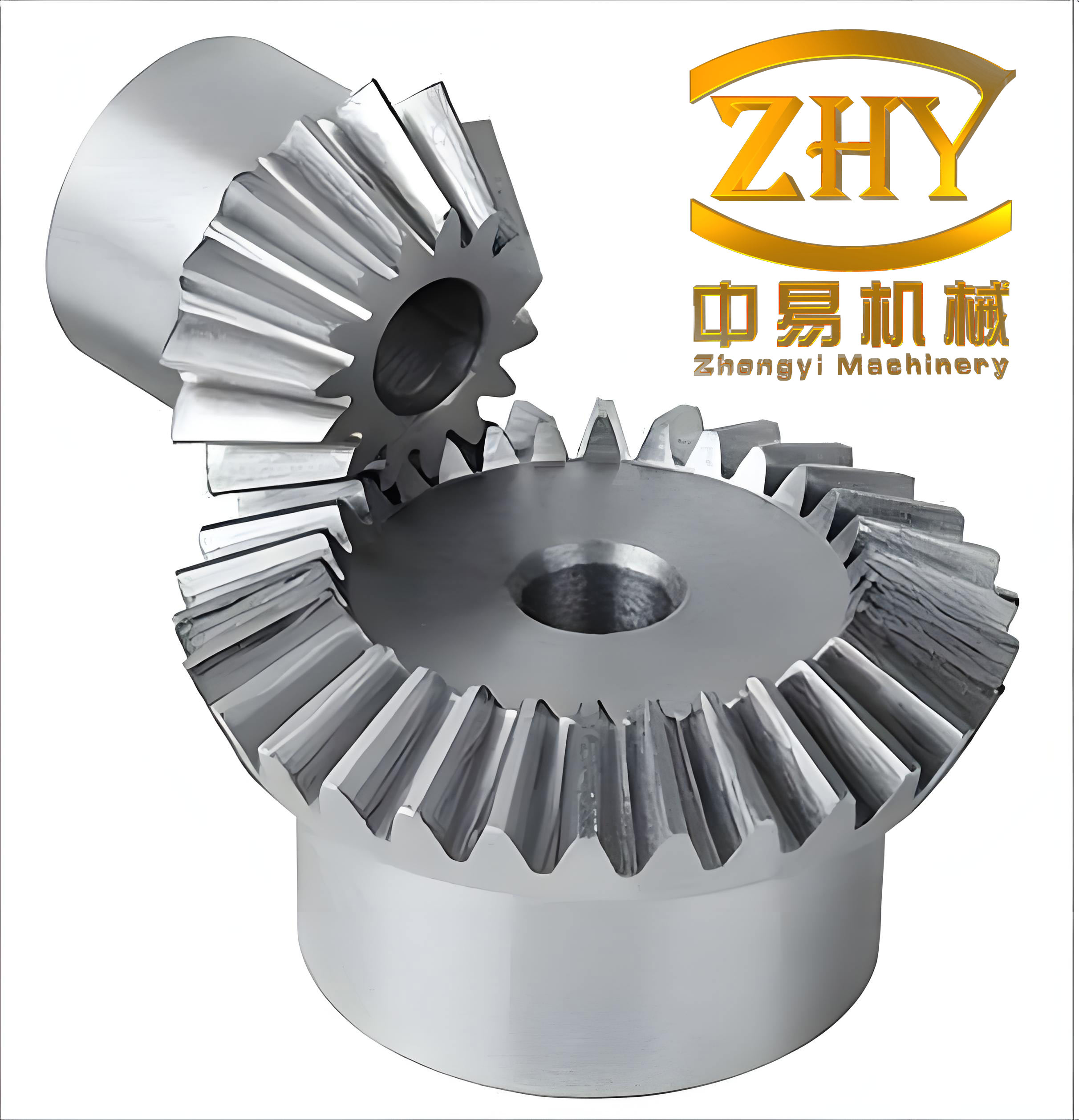
The springback behavior can be mathematically described using principles of elasticity and plasticity. For instance, the elastic strain energy stored during deformation is given by $$ U = \frac{1}{2} \int_V \sigma_{ij} \epsilon_{ij} dV $$ where $\sigma_{ij}$ is the stress tensor and $\epsilon_{ij}$ is the strain tensor. Upon unloading, this energy converts to kinetic energy, leading to displacement. The springback amount $\Delta$ at any point can be approximated by $$ \Delta = \frac{\sigma_r}{E} \cdot L $$ where $\sigma_r$ is the residual stress, $E$ is Young’s modulus, and $L$ is a characteristic length. However, due to the complex geometry of straight bevel gears, numerical methods like finite element analysis are essential for accurate predictions. Table 1 summarizes the springback values along the tooth height for different sections of the straight bevel gear, illustrating the trend from the drum to the tip.
| Section Position | Springback at Drum (mm) | Springback at Mid-Height (mm) | Springback at Tooth Tip (mm) |
|---|---|---|---|
| Small End | 0.02 | 0.06 | 0.12 |
| Mid-Range | 0.02 | 0.07 | 0.13 |
| Large End | 0.03 | 0.08 | 0.14 |
To address springback in straight bevel gears, I apply a reverse compensation method for die modification. This approach involves iteratively adjusting the die cavity based on the deviation between the forged gear and the target geometry. The steps are as follows: First, I process the coordinate data from the simulated tooth surface after springback to determine the deviation pattern. Second, I compute the deviation values between the deformed surface and the target surface, then apply these values in reverse to the target CAD model. This generates a new set of points for the modified die cavity. Third, I fit these points to create a smooth tooth profile curve, ensuring it meets gear meshing accuracy requirements. Fourth, I generate the modified tooth surface and update the die model. Finally, I simulate the forging process again to verify the improvement. If the deviation exceeds tolerances, I repeat the correction with adjusted compensation factors. After two iterations, the maximum deviation reduces to -0.025 mm, with most points接近 zero error. This demonstrates the effectiveness of the reverse compensation method for straight bevel gears, as it accounts for irregular springback without assuming ideal gear profiles.
The reverse compensation method can be expressed using a mathematical formulation. Let $P_{\text{target}}(x, y, z)$ represent the coordinates of the target tooth surface, and $P_{\text{deformed}}(x, y, z)$ be the coordinates after springback. The deviation vector $\vec{D}$ is given by $$ \vec{D} = P_{\text{deformed}} – P_{\text{target}} $$ For compensation, the modified die coordinates $P_{\text{modified}}$ are calculated as $$ P_{\text{modified}} = P_{\text{target}} – k \cdot \vec{D} $$ where $k$ is a compensation factor, typically starting at 1 and adjusted based on simulation results. After the first modification, the deviation often shifts from positive to negative values, indicating over-compensation. A second correction with a refined $k$ value further reduces errors. Table 2 compares the deviation values before and after modifications for a representative tooth curve near the small end of the straight bevel gear.
| Point on Tooth Curve | Initial Deviation (mm) | After First Modification (mm) | After Second Modification (mm) |
|---|---|---|---|
| 1 (Drum) | 0.02 | -0.01 | 0.00 |
| 2 | 0.05 | -0.03 | -0.01 |
| 3 | 0.08 | -0.05 | -0.02 |
| 4 | 0.11 | -0.07 | -0.03 |
| 5 (Tooth Tip) | 0.14 | -0.09 | -0.025 |
In addition to springback, other factors influence the accuracy of cold-forged straight bevel gears, such as die wear, billet size variations, and thermal effects. However, springback remains a dominant issue due to the high stiffness of the gear teeth. The success of the reverse compensation method hinges on accurate finite element simulations, which model the elastoplastic behavior of the material. For straight bevel gears, the material model includes hardening laws, such as the Hollomon equation $$ \sigma = K \epsilon^n $$ where $\sigma$ is the true stress, $\epsilon$ is the true strain, $K$ is the strength coefficient, and $n$ is the hardening exponent. Integrating this into the simulation allows for precise prediction of deformation and springback. Furthermore, the contact analysis between the forged straight bevel gear and its mating gear shows that the modified die produces optimal contact patterns, ensuring smooth transmission and longevity.
In conclusion, cold forging is a viable method for manufacturing high-precision straight bevel gears, but springback must be carefully managed. Through finite element analysis, I have identified that springback in straight bevel gears is minimal at the drum and increases toward the tooth tip, with values up to 0.14 mm. The reverse compensation die modification method effectively compensates for these deviations, reducing the maximum error to -0.025 mm after two iterations. This approach not only improves the dimensional accuracy of straight bevel gears but also shortens mold development cycles and reduces costs. Future work could explore the integration of machine learning algorithms to optimize the compensation factor automatically, further enhancing the efficiency of producing straight bevel gears. Overall, this research underscores the importance of numerical simulation in advancing the manufacturing of straight bevel gears for demanding applications in automotive and machinery industries.