
The pursuit of optimal performance, efficiency, and reliability in mechanical power transmission systems fundamentally hinges on understanding and controlling dynamic behavior. Among these systems, the spur and pinion gear pair remains a cornerstone due to its simplicity and effectiveness. A primary source of excitation within any gear mesh is the time-varying nature of its mesh stiffness, which directly influences vibration, noise, and load distribution. Traditionally, mesh stiffness is calculated using quasi-static methods, such as the potential energy method or static finite element analysis, where it is treated as a function solely of the gear’s angular position or the contact point along the line of action. This conventional approach, while useful, implicitly neglects a critical operational parameter: the rotational speed of the gear system itself.
The rotational speed is not merely a scalar multiplier in kinematics; it directly governs inertial forces, damping effects, and the frequency of loading. To overlook its influence on the very foundation of dynamic excitation—the mesh stiffness—is to accept a potential gap in predictive accuracy. This article addresses this gap by proposing and validating a novel computational framework for determining dynamic mesh stiffness that is intrinsically coupled with the rotational speed of the spur and pinion gear system. We move beyond the static stiffness paradigm to explore how speed modulates the gear pair’s resistance to deformation under dynamic conditions. Subsequently, we integrate this speed-dependent dynamic mesh stiffness into a nonlinear dynamic model of a spur gear pair to investigate its profound implications on system response, resonance characteristics, and vibrational periodicity. This comprehensive analysis provides critical insights for engineers aiming to enhance transmission performance and implement effective vibration and noise mitigation strategies in applications involving spur and pinion gears.
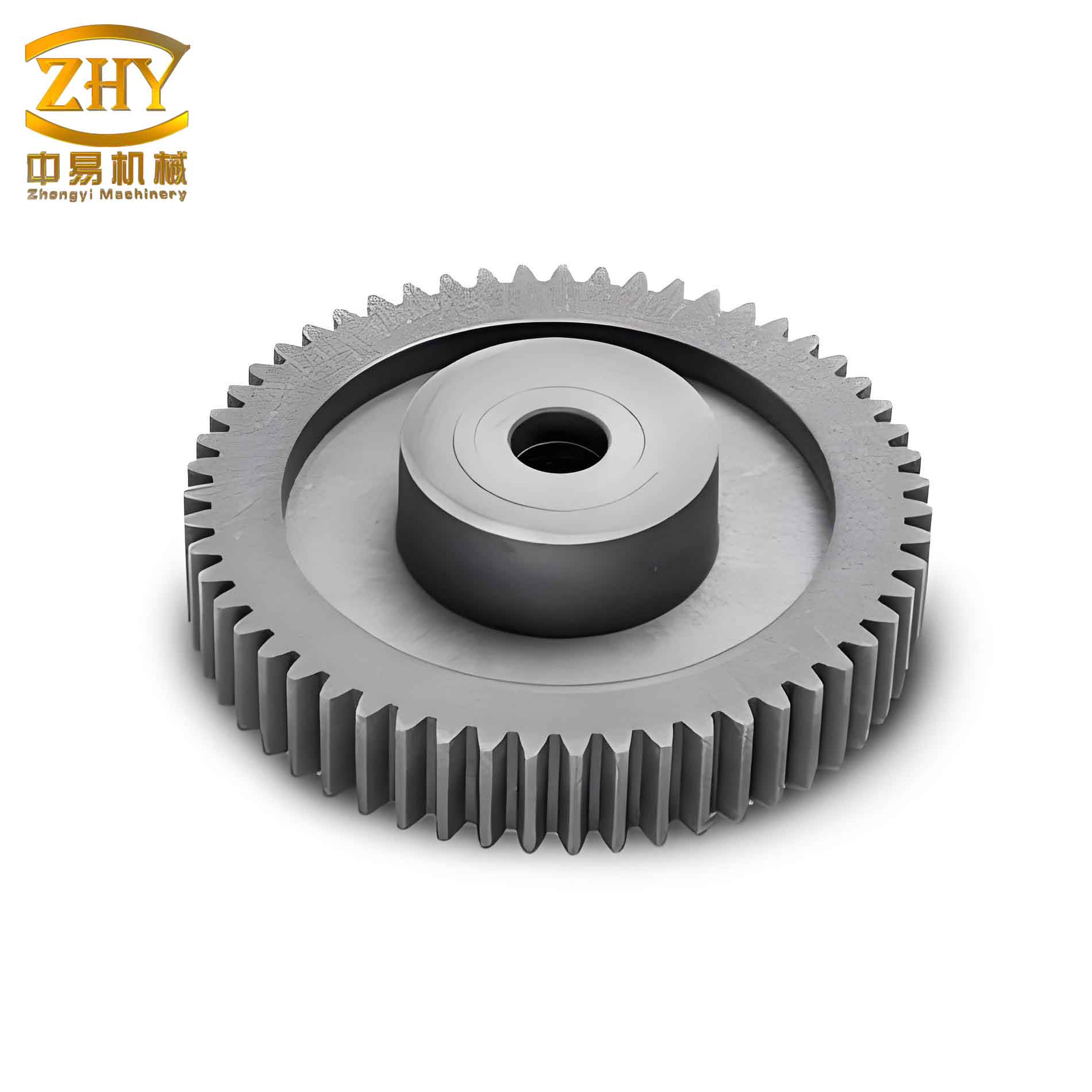
Fundamental Dynamics of a Spur and Pinion Gear System
The dynamic analysis of a spur and pinion gear train is typically approached using a lumped-parameter model. This simplification treats the gears as rigid disks with inertial properties, concentrating the compliance and damping at the meshing interface. The primary coordinate of interest is the dynamic transmission error (DTE), denoted as $\delta(t)$, which represents the relative displacement between the pinion and gear along the line of action, deviating from the perfect kinematic motion prescribed by the gear teeth.
The equation of motion for a two-degree-of-freedom system representing a spur and pinion gear pair can be derived from Newton’s second law. The governing equations for torsional vibration are:
$$
J_p \ddot{\theta}_p + R_{bp} \sum_{j=1}^{n} F_m^j – \sum_{j=1}^{n} R_{fp}^j F_f^j = T_p
$$
$$
J_g \ddot{\theta}_g – R_{bg} \sum_{j=1}^{n} F_m^j + \sum_{j=1}^{n} R_{fg}^j F_f^j = -T_g
$$
Here, $J_p$ and $J_g$ are the mass moments of inertia of the pinion and gear, respectively. $\theta_p$, $\theta_g$ and their derivatives represent angular displacements, velocities, and accelerations. $R_{bp}$ and $R_{bg}$ are the base circle radii. $T_p$ and $T_g$ are the external input and load torques. The index $j$ sums over the $n$ tooth pairs in simultaneous contact (typically 1 or 2 for spur gears). The meshing force for the $j$-th pair, $F_m^j$, consists of elastic and viscous damping components:
$$
F_m^j = k_m^j(t) \delta(t) + c_m^j \dot{\delta}(t)
$$
The damping coefficient $c_m$ is often modeled using an empirical formula based on the system’s natural frequency and a damping ratio $\zeta_g$:
$$
c_m = 2 \zeta_g \sqrt{ \frac{k_m R_{bp}^2 R_{bg}^2 J_p J_g}{R_{bp}^2 J_p + R_{bg}^2 J_g} }
$$
The term $F_f^j$ represents the sliding friction force on the tooth flank, often modeled as $F_f^j = \mu F_m^j \text{sign}(u_s)$, where $\mu$ is a friction coefficient and $u_s$ is the relative sliding velocity. The dynamic transmission error $\delta(t)$ is defined as:
$$
\delta(t) = R_{bp} \theta_p(t) – R_{bg} \theta_g(t)
$$
The central dynamic excitation in this model is the time-varying mesh stiffness $k_m^j(t)$. In conventional models, this is a periodic function determined only by the change in contact conditions (single vs. double pair contact) and tooth geometry as the gears rotate, independent of the speed $\dot{\theta}_p$. This article challenges that independence, proposing that $k_m^j$ is inherently a function of both position and speed: $k_m^j = k_m^j(\theta, \dot{\theta}_p)$. The following section details the methodology for calculating this speed-dependent dynamic mesh stiffness.
Computational Methodology for Speed-Dependent Dynamic Mesh Stiffness
To capture the influence of rotational speed on the mesh stiffness of a spur and pinion gear system, we develop an algorithm within a finite element framework, utilizing the average acceleration method (a type of Newmark-β method with γ=0.5 and β=0.25). This approach solves the transient dynamic response of a gear tooth to a moving mesh force, where the force’s traversal speed is dictated by the gear’s rotational velocity.
We model a single gear tooth, with its inner bore fixed, to simulate the meshing action. The meshing force $F_i$ is applied sequentially at discrete points $i$ along the tooth’s active profile, from the start of active profile (SAP) to the tip. The traversal velocity $v_i$ of this force at a point with coordinates $(x_i, y_i)$ relative to the gear center is given by:
$$
v_i = \frac{\pi \dot{\theta}_p \sqrt{x_i^2 + y_i^2}}{30}
$$
where $\dot{\theta}_p$ is the pinion rotational speed in rpm. The average velocity $v_a$ between two consecutive mesh points $i$ and $i+1$ is used to define the time step $\Delta t_i$ for the dynamic solver:
$$
\Delta t_i = \frac{2 \sqrt{(x_{i+1} – x_i)^2 + (y_{i+1} – y_i)^2}}{v_a}
$$
The finite element dynamic equation for the gear tooth under a moving force is:
$$
\mathbf{M} \ddot{\mathbf{X}}_i + \mathbf{C} \dot{\mathbf{X}}_i + \mathbf{K} \mathbf{X}_i = \mathbf{F}_i
$$
$\mathbf{M}$, $\mathbf{K}$, and $\mathbf{C}$ are the global mass, stiffness, and damping matrices, respectively. $\mathbf{C}$ is formulated as Rayleigh damping: $\mathbf{C} = \alpha \mathbf{M} + \beta \mathbf{K}$. $\mathbf{F}_i$ is the force vector with non-zero entries only at the degrees of freedom corresponding to the $i$-th contact point, oriented at the pressure angle $\beta_i$ for that point. The initial conditions for the iterative solver are set such that initial velocity and acceleration are zero, and the initial displacement $\mathbf{X}_1$ is found from a static solution for the first mesh point: $\mathbf{X}_1 = \mathbf{K}^{-1} \mathbf{F}_1$.
Using the average acceleration method with the computed time step $\Delta t_i$, we solve Equation (5) iteratively as the force moves from point to point. The solution yields the dynamic nodal displacement vector $\mathbf{X}_i$ for each mesh point $i$, which is inherently influenced by the speed $\dot{\theta}_p$ through the time step definition. From $\mathbf{X}_i$, the dynamic deflection components $(\Delta x_i, \Delta y_i)$ at the contact point are extracted. The dynamic stiffness for the pinion tooth at point $i$, $k_{p}^i$, is then calculated as:
$$
k_{p}^i = \frac{F_i}{\Delta x_i \cos(\pi/2 – \beta_i) + \Delta y_i \cos(\beta_i)}
$$
The same procedure is applied to the gear tooth to obtain $k_{g}^i$. The overall dynamic mesh stiffness for a single tooth pair at that instant is the series combination:
$$
k_{ms}^i = \left( \frac{1}{k_{p}^i} + \frac{1}{k_{g}^i} \right)^{-1}
$$
Finally, the total dynamic mesh stiffness $k_m(t)$ for the spur and pinion gear pair is assembled by superimposing the stiffness of all tooth pairs in contact at a given gear rotation angle, following the contact ratio. This algorithm produces a mesh stiffness that is not just a function of angular position but is dynamically modulated by the system’s rotational speed.
Model Validation and Analysis of Dynamic Stiffness Behavior
To validate the proposed algorithm, we first compare its results under quasi-static conditions ($\dot{\theta}_p \rightarrow 0$) with established methods. The parameters for the exemplary spur and pinion gear pair are listed below:
| Parameter | Pinion (Driving) | Gear (Driven) |
|---|---|---|
| Number of Teeth | 23 | 47 |
| Module (mm) | 2.5 | 2.5 |
| Pressure Angle (deg) | 20 | 20 |
| Face Width (mm) | 10 | 10 |
| Material (Young’s Modulus, Poisson’s Ratio) | Steel (211 GPa, 0.3) | |
At an extremely low speed (e.g., 0.01 rpm), the computed dynamic single tooth stiffness (DSTS) curve aligns perfectly with the static stiffness curve obtained from commercial finite element analysis (FEA) software. This confirms the baseline accuracy of the computational mechanics. As speed increases, a distinct dynamic effect emerges. The dynamic mesh stiffness (DTMS) oscillates around the static stiffness curve. The characteristics of these oscillations are strongly speed-dependent, as summarized qualitatively below:
| Rotational Speed Regime | Effect on Dynamic Mesh Stiffness (DTMS) vs. Static | Proposed Physical Mechanism |
|---|---|---|
| Low Speed (Quasi-Static) | DTMS converges to static stiffness; minimal oscillation. | Elastic deformation has sufficient time to reach steady-state before force moves. |
| Medium Speed | DTMS shows clear oscillation with amplitude less than 10% of mean; oscillation frequency content appears. | Inertial and damping forces become significant. The elastic wave from the previous mesh point has not fully dissipated when the force arrives at the next point, causing superposition effects. |
| High Speed | Oscillation amplitude increases significantly (>15% of mean); the number of major oscillation cycles per mesh period may decrease. | The force moves so rapidly that the tooth structure is in a persistent state of transient response. The recovery of deformation lags severely, and the cumulative effect of successive transient loads increases the fluctuation range. |
A critical observation is that the influence of speed is more pronounced in the double-tooth contact regions than in the single-tooth contact region. This is because the total mesh stiffness in double contact is the sum of two individual tooth stiffnesses, each undergoing its own speed-dependent dynamic transient. The superposition amplifies the dynamic variation. Furthermore, the phase of the DTMS oscillation—the positions of its peaks and troughs relative to the static curve—shifts with changing speed. This speed-dependent phase shift is a key factor that can alter the dynamic response of the spur and pinion gear system, potentially advancing or delaying the occurrence of resonant conditions.
Dynamic Response Analysis Under Speed-Dependent Mesh Stiffness
To quantify the impact of speed-modulated mesh stiffness on system behavior, we integrate both the traditional static stiffness model and the proposed dynamic stiffness model into the nonlinear equations of motion (Equations 1 & 2). The dynamic response, chiefly the Dynamic Transmission Error (DTE), is simulated across a wide range of pinion speeds (500 to 8000 rpm).
The bifurcation diagram, plotting the local maxima of DTE against speed, reveals the most striking differences. While both models predict a general trend of reduced vibration periodicity (e.g., from n-periodic to 2-periodic motion) as speed increases, the specific speed thresholds for these period changes differ.
| Vibration Period | Speed Range (Static Stiffness Model) [rpm] | Speed Range (Dynamic Stiffness Model) [rpm] | Interpretation |
|---|---|---|---|
| 5-Periodic Motion | ~3,349 – 4,356 | ~3,301 – 4,325 | Dynamic stiffness causes an earlier onset and a slightly earlier termination of this periodic regime. |
| 4-Periodic Motion | ~4,357 – 5,023 | ~4,326 – 4,999 | The regime shifts to a lower speed range and narrows slightly. |
| 3-Periodic Motion | ~5,024 – 6,821 | ~5,120 – 7,059 | Contrary to the previous trend, dynamic stiffness delays the onset and extends the range of 3-periodic motion. |
| 2-Periodic Motion | > ~6,822 | > ~7,060 | The transition to the final 2-periodic steady state occurs at a higher speed with dynamic stiffness. |
This non-monotonic shift in bifurcation structure—where some periodic boundaries advance and others lag—underscores the complex phase interaction introduced by the speed-dependent stiffness. It implies that a design or operational decision based on a static stiffness model could mistakenly place the spur and pinion gear system in a resonant condition or an unexpected periodic regime.
The frequency-domain analysis further elucidates the differences. At medium and high speeds, the dynamic stiffness model predicts stronger super-harmonic responses compared to the static model. The DTE spectrum under dynamic stiffness contains more pronounced higher-order harmonic components of the mesh frequency. This is a direct consequence of the additional frequency content and nonlinear modulation present in the DTMS signal itself. In the time domain, this manifests as DTE waveforms with altered amplitudes and shapes. The relationship between the amplitudes predicted by the two models is not consistent across speeds; at some speeds, the dynamic model predicts higher vibration levels, while at others, it predicts lower levels, again tied to the phasing between the dynamic stiffness fluctuation and the system’s natural response.
The dynamic response features for a spur and pinion gear system under different stiffness models can be contrasted as follows:
| Dynamic Characteristic | Static Mesh Stiffness Model | Speed-Dependent Dynamic Mesh Stiffness Model |
|---|---|---|
| Primary Excitation Source | Periodic stiffness variation from changing contact geometry. | Geometry-based variation + Speed-modulated amplitude/phase oscillation. |
| Resonance Prediction | Resonance peaks at fixed speed intervals based on static stiffness period. | Resonance peaks shift; intervals can be advanced or delayed. Prediction is speed-history aware. |
| High-Speed Response | Shows super-harmonics. | Exhibits significantly stronger and more complex super-harmonic and high-frequency content. |
| Bifurcation Structure | Period-doubling boundaries at specific speeds. | Boundaries are shifted in a non-uniform manner, potentially altering stable operating windows. |
| Amplitude Prediction | Provides a consistent baseline amplitude trend. | Amplitude trend has local variations; can be higher or lower than static prediction depending on speed. |
Conclusions
This investigation establishes that the mesh stiffness in a spur and pinion gear system is not a static property derivable from geometry alone, but a dynamic entity intrinsically linked to the system’s operational speed. The proposed computational algorithm, rooted in the finite element method and the average acceleration procedure, successfully captures this relationship by solving for the transient elastic response of gear teeth to a mesh force whose traversal velocity is governed by rotational speed.
The key findings are: The dynamic mesh stiffness (DTMS) oscillates around the classical static stiffness value. The amplitude of this oscillation increases with rotational speed, while the number of observable oscillations per mesh cycle may decrease due to the lag in structural recovery. The effect is more pronounced in double-tooth contact regions. The phase of the DTMS oscillation relative to the gear rotation angle changes with speed. This phase variability has a direct and significant impact on the nonlinear dynamics of the spur and pinion gear system. It causes non-uniform shifts in the speed ranges associated with different periodic vibrational regimes (e.g., 3-periodic, 2-periodic motion), meaning resonance conditions can occur at speeds different from those predicted by static models. Furthermore, models employing DTMS predict stronger super-harmonic responses at high speeds, indicating potentially richer and more intense vibrational spectra.
From a practical standpoint, this work highlights a critical consideration for gear design and diagnostics. For high-speed or highly dynamic applications, relying on static mesh stiffness calculations may lead to suboptimal design choices or inaccurate noise and vibration predictions. Incorporating the speed-dependent nature of stiffness, as demonstrated here, leads to a more faithful representation of the spur and pinion gear system’s behavior. This enhanced modeling fidelity is a crucial step towards developing more reliable, quieter, and higher-performance gear transmissions. Future work may explore the coupling of this dynamic stiffness model with other excitations such as tooth profile modifications, manufacturing errors, and evolving surface damage like pitting and cracking in spur and pinion gears.