
The dynamic behavior of spur and pinion gear pairs is fundamental to the reliability and performance of countless mechanical transmission systems found in aviation, marine, automotive, energy, and industrial machinery. These systems are inherently complex, multi-degree-of-freedom, parametrically excited vibratory systems. The primary source of this parametric excitation is the time-varying mesh stiffness, which fluctuates periodically as the number of gear teeth in contact changes during the meshing cycle—transitioning between single and double-tooth contact regions. This variation can be effectively approximated by a rectangular wave function. Superimposed on this parametric excitation are external excitations such as transmission error, arising from manufacturing and assembly inaccuracies, and in applications like wind turbines, nonlinear input torques proportional to the square of the input shaft speed. This work presents a comprehensive investigation into the parametric vibration characteristics of a spur and pinion gear meshing coupling system, integrating analytical methods with numerical simulations to delineate stability boundaries and system response.
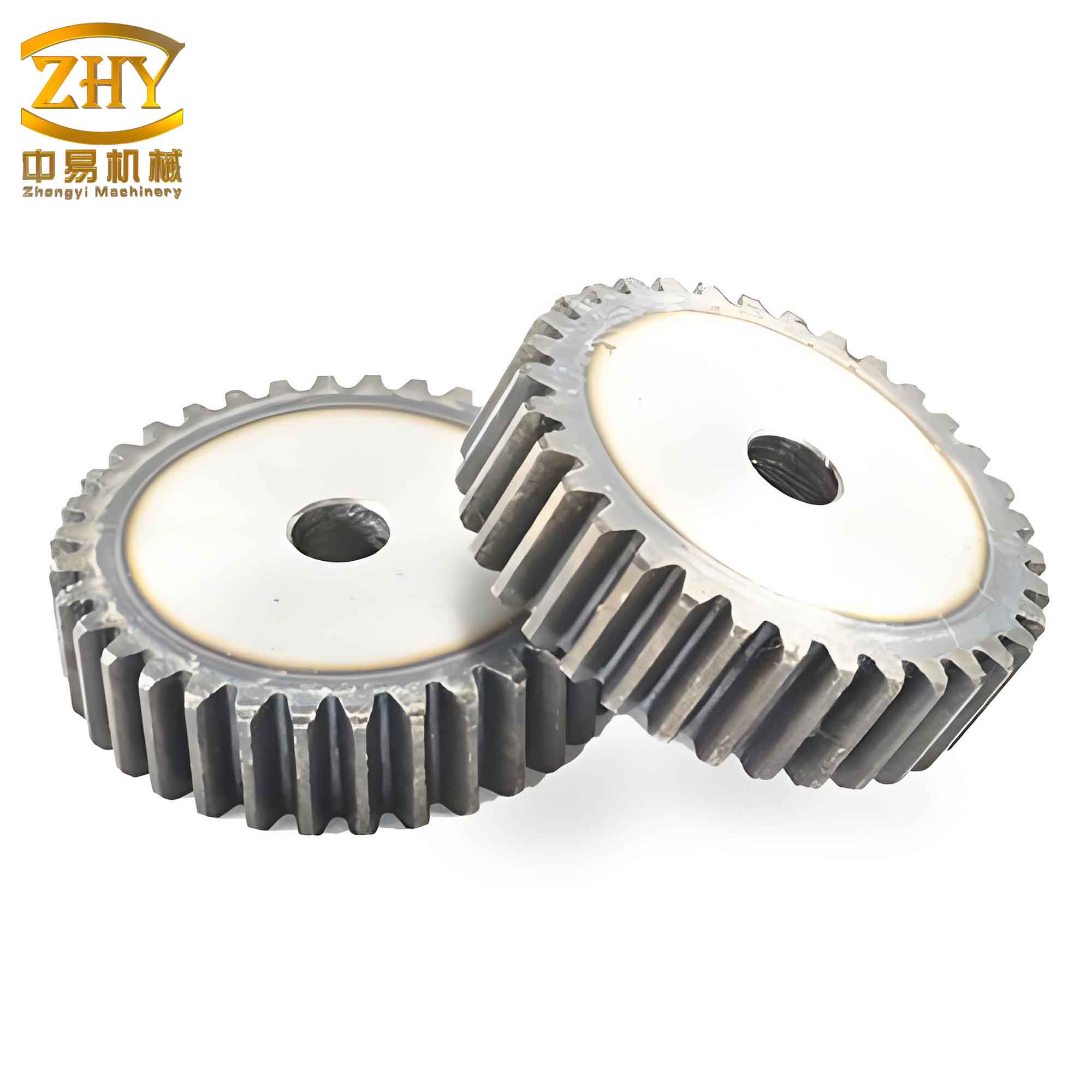
The dynamic model for the spur and pinion gear pair is established considering four degrees of freedom: the rotational displacements ($\theta_p$, $\theta_g$) and translational displacements ($y_p$, $y_g$) of the pinion and gear, respectively. The gear mesh is modeled along the line of action, with the dynamic mesh force comprising both an elastic component from the time-varying stiffness and a viscous damping component. The model also incorporates the supporting stiffness and damping from the shafts, bearings, and housing, represented by $k_{iy}$, $c_{iy}$ (for $i = p, g$), as well as the static transmission error $e(t)$ and the nonlinear input torque $T_p(\dot{\theta}_p)$.
The governing equations of motion derived from Newton’s second law are:
$$
\begin{aligned}
m_p \ddot{y}_p + c_{py} \dot{y}_p + k_{py} y_p &= -F_k – F_c, \\
I_p \ddot{\theta}_p &= -F_k R_p – F_c R_p – T_p(\dot{\theta}_p), \\
m_g \ddot{y}_g + c_{gy} \dot{y}_g + k_{gy} y_g &= F_k + F_c, \\
I_g \ddot{\theta}_g &= -F_k R_g – F_c R_g – T_g,
\end{aligned}
$$
where the elastic mesh force $F_k$ and viscous mesh force $F_c$ are given by:
$$
\begin{aligned}
F_k &= k_m(t) \left( y_p + R_p \theta_p – y_g – R_g \theta_g – e(t) \right), \\
F_c &= c_m \left( \dot{y}_p + R_p \dot{\theta}_p – \dot{y}_g – R_g \dot{\theta}_g – \dot{e}(t) \right).
\end{aligned}
$$
The time-varying mesh stiffness $k_m(t)$ is modeled as a periodic rectangular wave with a mean component $k_0$ and a varying component $k_v(t)$, expanded into a Fourier cosine series:
$$
k_m(t) = k_0 + k_v(t) = k_0 + \sum_{n=1}^{\infty} A_n \cos(n \omega_m t),
$$
where $\omega_m$ is the gear meshing frequency. The transmission error is taken as a sinusoidal excitation: $e(t) = e_r \sin(\omega_m t + \phi)$. The nonlinear input torque, relevant for systems like wind turbine gearboxes, is modeled as $T_p \propto \dot{\theta}_p^2$.
The equations are non-dimensionalized using the time scale $\tau = \omega_1 t$ (where $\omega_1$ is a characteristic frequency) and displacement scale $\eta_i = y_i / e_r$, leading to the matrix form:
$$
\mathbf{M} \ddot{\boldsymbol{\eta}} + \mathbf{C} \dot{\boldsymbol{\eta}} + (\mathbf{K} + \Delta \mathbf{K}(t)) \boldsymbol{\eta} = \mathbf{F},
$$
where $\mathbf{M}$ is the mass matrix, $\mathbf{C}$ is the damping matrix, $\mathbf{K}$ is the constant stiffness matrix, $\Delta \mathbf{K}(t)$ is the periodic stiffness variation matrix, and $\mathbf{F}$ is the forcing vector containing terms from transmission error and nonlinear torque.
Theoretical Analysis of Parametric Stability
The stability of the spur and pinion gear system is governed by the homogeneous form of the parametrically excited equations. Setting the forcing term $\mathbf{F}$ to zero and considering the first two harmonics of the stiffness variation ($n=1,2$), the system is analyzed for parametric instability.
$$ \mathbf{M} \ddot{\boldsymbol{\eta}} + \mathbf{C} \dot{\boldsymbol{\eta}} + (\mathbf{K} + \Delta \mathbf{K}_1 \cos(\Omega \tau) + \Delta \mathbf{K}_2 \cos(2\Omega \tau) ) \boldsymbol{\eta} = \mathbf{0}. $$
First, the system is decoupled by transforming to normal coordinates. Solving the eigenvalue problem $(\mathbf{K} – \omega_i^2 \mathbf{M})\boldsymbol{\zeta}_i = \mathbf{0}$ yields the natural frequencies $\omega_i$ and mode shapes $\boldsymbol{\zeta}_i$ ($i=1,2,3,4$). The mass-normalized modal matrix $\boldsymbol{\Phi} = [\hat{\boldsymbol{\zeta}}_1, \hat{\boldsymbol{\zeta}}_2, \hat{\boldsymbol{\zeta}}_3, \hat{\boldsymbol{\zeta}}_4]$ is constructed, where $\hat{\boldsymbol{\zeta}}_i = \boldsymbol{\zeta}_i / \sqrt{\boldsymbol{\zeta}_i^T \mathbf{M} \boldsymbol{\zeta}_i}$. Applying the transformation $\boldsymbol{\eta} = \boldsymbol{\Phi} \mathbf{x}$, where $\mathbf{x} = [x_1, x_2, x_3, x_4]^T$ are the modal coordinates, and pre-multiplying by $\boldsymbol{\Phi}^T$, yields the set of coupled modal equations:
$$
\ddot{x}_i + \omega_i^2 x_i + \epsilon \sum_{r=1}^{4} \left[ H_{ir} \cos(\Omega \tau) + G_{ir} \cos(2\Omega \tau) \right] x_r + \epsilon \, c_{ni} \dot{x}_i = 0,
$$
where $\epsilon$ is a small bookkeeping parameter, $H_{ir} = \boldsymbol{\hat{\zeta}}_i^T \Delta \mathbf{K}_1 \boldsymbol{\hat{\zeta}}_r$, $G_{ir} = \boldsymbol{\hat{\zeta}}_i^T \Delta \mathbf{K}_2 \boldsymbol{\hat{\zeta}}_r$, and $c_{ni}$ represents modal damping. The stability of this system is analyzed using the method of multiple scales. A first-order uniform approximation is sought in the form:
$$ x_i(\tau) = x_{i0}(T_0, T_1) + \epsilon \, x_{i1}(T_0, T_1) + \cdots, $$
where $T_0 = \tau$ and $T_1 = \epsilon \tau$. Substituting into the modal equations and separating coefficients of like powers of $\epsilon$ leads to a sequence of problems. The zeroth-order solution is $x_{i0} = A_i(T_1) e^{j \omega_i T_0} + \text{c.c.}$ Parametric resonances occur when a specific relationship exists between the meshing frequency $\Omega$ and the natural frequencies $\omega_i$, leading to secular terms in the higher-order equations. For the spur and pinion system, the most significant instabilities are combination resonances of the summed-type.
For a primary ($l=1$) summed-type resonance where the meshing frequency is near the sum of two natural frequencies, we introduce a detuning parameter $\sigma$:
$$ \Omega = \omega_i + \omega_r + \epsilon \sigma. $$
Solvability conditions for the first-order problem yield a set of equations for the complex amplitudes $A_i$ and $A_r$:
$$
\begin{aligned}
-2j\omega_i \frac{dA_i}{dT_1} – \frac{1}{2} H_{ir} \bar{A}_r e^{j\sigma T_1} &= 0, \\
-2j\omega_r \frac{dA_r}{dT_1} – \frac{1}{2} H_{ri} \bar{A}_i e^{j\sigma T_1} &= 0,
\end{aligned}
$$
where $\bar{A}$ denotes the complex conjugate. Assuming solutions of the form $A_i = a_i e^{\lambda T_1}$ and $A_r = a_r e^{\lambda T_1 – j\sigma T_1}$, the characteristic equation for the exponent $\lambda$ is found from the condition for non-trivial $a_i, a_r$:
$$ 4 \lambda^2 + 4j\sigma \lambda – \left( \sigma^2 – \frac{H_{ir}H_{ri}}{4\omega_i \omega_r} \right) = 0. $$
The solution for $\lambda$ is:
$$ \lambda = -\frac{j\sigma}{2} \pm \frac{1}{2} \sqrt{ -\sigma^2 + \frac{H_{ir}H_{ri}}{4\omega_i \omega_r} }. $$
The stability boundary, separating bounded (stable) from exponentially growing (unstable) solutions, occurs when the real part of $\lambda$ is zero. This leads to the condition:
$$ \sigma^2 > \frac{H_{ir}H_{ri}}{4\omega_i \omega_r}. $$
Thus, the instability region for the summed-type resonance is defined by:
$$ \omega_i + \omega_r – \frac{\epsilon}{2} \sqrt{\frac{H_{ir}H_{ri}}{\omega_i \omega_r}} < \Omega < \omega_i + \omega_r + \frac{\epsilon}{2} \sqrt{\frac{H_{ir}H_{ri}}{\omega_i \omega_r}}. $$
Similarly, for a subharmonic ($l=2$) summed-type resonance where $\Omega \approx (\omega_i + \omega_r)/2$, the instability boundary is governed by the matrix elements $G_{ir}$ and $G_{ri}$. Crucially, an instability of the summed-type occurs only when $H_{ir}H_{ri} > 0$ (or $G_{ir}G_{ri} > 0$). For difference-type resonances ($\Omega \approx |\omega_i – \omega_r|$), instability requires $H_{ir}H_{ri} < 0$.
The calculated natural frequencies and the corresponding elements of the parametric excitation matrices $\mathbf{H}$ and $\mathbf{G}$ for a representative spur and pinion gear system are presented in the tables below.
| Mode Index, i | Natural Frequency, $\omega_i$ (Hz) |
|---|---|
| 1 | 0.1533 |
| 2 | 1.1871 |
| 3 | 1.2892 |
| 4 | 2.4651 |
| Row i | $H_{i1}$ | $H_{i2}$ | $H_{i3}$ | $H_{i4}$ | $G_{i1}$ | $G_{i2}$ | $G_{i3}$ | $G_{i4}$ |
|---|---|---|---|---|---|---|---|---|
| 1 | 0.0140 | 0.6676 | 0.4785 | -0.8665 | 0.0076 | 0.3336 | 0.2043 | -0.7115 |
| 2 | 0.0111 | 1.0675 | 1.1462 | 0.0200 | 0.0055 | 0.5981 | 0.6197 | -0.5054 |
| 3 | 0.0068 | 0.9719 | 1.2653 | 1.4223 | 0.0029 | 0.5254 | 0.6754 | 0.3727 |
| 4 | -0.0033 | 0.0045 | 0.3888 | 3.6047 | -0.0027 | -0.1173 | 0.1018 | 2.2538 |
Observing the matrices, it is clear that for many mode pairs (e.g., i=2, r=3), the product $H_{ir}H_{ri}$ is positive. This indicates that the spur and pinion system is susceptible to summed-type parametric instabilities. The stability chart in the parameter plane ($\Omega$, $\epsilon$) can be constructed based on the derived boundary conditions, showing alternating stable and unstable regions (tongues) emanating from the points $\Omega = \omega_i + \omega_r$ and $\Omega = (\omega_i + \omega_r)/2$.
Numerical Simulation and System Response
To validate the analytical predictions and explore the dynamic response, the original dimensionless equations of motion are integrated numerically using a Runge-Kutta method. Parameters for the spur and pinion gear system are assigned typical values (e.g., masses, moments of inertia, mean stiffness $k_0$, stiffness variation $\Delta k$, damping ratios). The meshing frequency $\Omega$ is varied to probe different regions of the stability chart.
Non-Parametric Resonance Response (Stable Regions): When the meshing frequency $\Omega$ is chosen from a stable region (e.g., $\Omega = 0.7$, 1.2, or 3.2), the steady-state response of the system is a bounded, quasi-periodic oscillation. The time history exhibits a “beating” phenomenon, characteristic of the interaction between two or more incommensurate frequencies. The phase portrait shows a torus-like structure, and the Poincaré section (sampled at the meshing period $T_m = 2\pi/\Omega$) consists of a closed cluster of points, confirming quasi-periodicity. The frequency spectrum reveals discrete peaks not only at the meshing frequency $\Omega$ and the system’s natural frequencies $\omega_i$, but also at numerous combination frequencies such as $\Omega \pm \omega_i$ and $2\Omega \pm \omega_r$. This rich spectral content is a hallmark of the nonlinear coupling in the spur and pinion gear system, even in its stable operational regime.
Parametric Resonance Response (Unstable Regions): When the meshing frequency $\Omega$ is selected from within an instability tongue predicted by the theory (e.g., $\Omega = 1.1$, 2.8, or 3.82, corresponding to $\Omega \approx \omega_2+\omega_3$, $2\omega_3$, and $\omega_3+\omega_4$ respectively), the system exhibits a divergent response. The amplitude of vibration grows exponentially from the initial conditions, as predicted by the positive real part of the characteristic exponent $\lambda$ in the stability analysis. This unbounded growth, analogous to the solution of a simple Mathieu equation with parameters in an instability region, represents a critical failure mode for the spur and pinion gear pair. In a real system, this growth would be limited by nonlinearities not included in this linear stability analysis (e.g., backlash, contact loss, or bearing clearance), potentially leading to chaotic or severe impacting motions that are detrimental to gear life.
The contrast between the stable, quasi-periodic response and the unstable, exponentially growing response underscores the critical importance of avoiding operational conditions where the meshing frequency coincides with or is close to specific combinations of the system’s natural frequencies, particularly summed-type combinations.
Conclusion
This detailed analysis of a spur and pinion gear meshing coupling system has elucidated the fundamental mechanisms governing its parametric dynamic stability and response. By establishing a multi-degree-of-freedom model incorporating time-varying mesh stiffness, support stiffness/damping, transmission error, and nonlinear input torque, and by employing the method of multiple scales on the decoupled modal equations, precise analytical conditions for parametric instability were derived.
The key findings are: First, the spur and pinion gear system is prone to parametric instability via summed-type combination resonances (e.g., $\Omega \approx \omega_i + \omega_r$), while difference-type resonances generally do not lead to instability for typical system parameters. This is dictated by the sign of the products $H_{ir}H_{ri}$ and $G_{ir}G_{ri}$. Second, in stable operating regions away from these resonance conditions, the system exhibits a complex, quasi-periodic steady-state response. This response contains a rich spectrum of frequency components, including the meshing frequency, natural frequencies, and various sum and difference combinations, reflecting the inherent nonlinear coupling. Third, within the predicted instability regions, the linear system model exhibits unbounded, exponentially growing solutions, signifying the onset of severe vibrations that can lead to premature gear failure.
For the practical design and operation of spur and pinion gear drives, it is therefore paramount to carefully consider the relationship between the meshing frequency (determined by rotational speed and tooth count) and the system’s natural frequencies. The meshing frequency should be designed to avoid the summed-type combination resonance zones identified in the stability analysis. This work provides a foundational framework and analytical tools for assessing and mitigating parametric vibration in these essential mechanical components, contributing to the development of more reliable and quieter gear transmission systems across numerous engineering fields.