
In this article, I will elaborate on a comprehensive methodology for analyzing the contact stress in spur gears through the application of ANSYS finite element software. Spur gears are fundamental components in mechanical transmission systems, and understanding their stress distribution under load is critical for ensuring durability, reliability, and optimal design. The finite element method (FEM) offers a powerful numerical approach to simulate complex mechanical behaviors, and ANSYS provides a robust platform for such analyses. I will detail the precise modeling techniques, finite element setup, contact analysis procedures, and solution methods, emphasizing the accuracy and efficiency of this approach. Throughout this discussion, I will incorporate multiple tables and formulas to summarize key data and theoretical principles, ensuring a thorough exploration of spur gear contact mechanics.
The analysis begins with the geometric modeling of the spur gear pair. Accurate representation of the gear tooth profile is essential, as it directly influences contact stress calculations. The tooth flank of a spur gear is an involute surface, which can be mathematically defined in a Cartesian coordinate system. Consider a point K on the involute curve; its coordinates can be expressed using the following parametric equations:
$$x = r_b \sin u – r_b u \cos u$$
$$y = r_b \cos u + r_b u \cos u$$
Here, \(r_b\) denotes the base circle radius, and \(u\) represents the roll angle, which varies along the involute. These equations are derived from the geometry of an involute curve generated from a base circle. To implement this in ANSYS, I utilized the ANSYS Parametric Design Language (APDL), which allows for scripting and automation of geometry creation. The process involves generating a single tooth profile on one end face, translating and rotating it to create the profile on the opposite end face, and then using a “sweep blend” operation along the axial direction to form a complete tooth. This tooth is then copied or arrayed to construct the entire spur gear. For this analysis, I considered a spur gear pair with specific parameters, as summarized in Table 1.
| Parameter | Symbol | Value | Unit |
|---|---|---|---|
| Module | m | 2.5 | mm |
| Pressure Angle | α | 20 | degrees |
| Number of Teeth (Pinion) | z1 | 34 | – |
| Number of Teeth (Gear) | z2 | 102 | – |
| Face Width | b | 85 | mm |
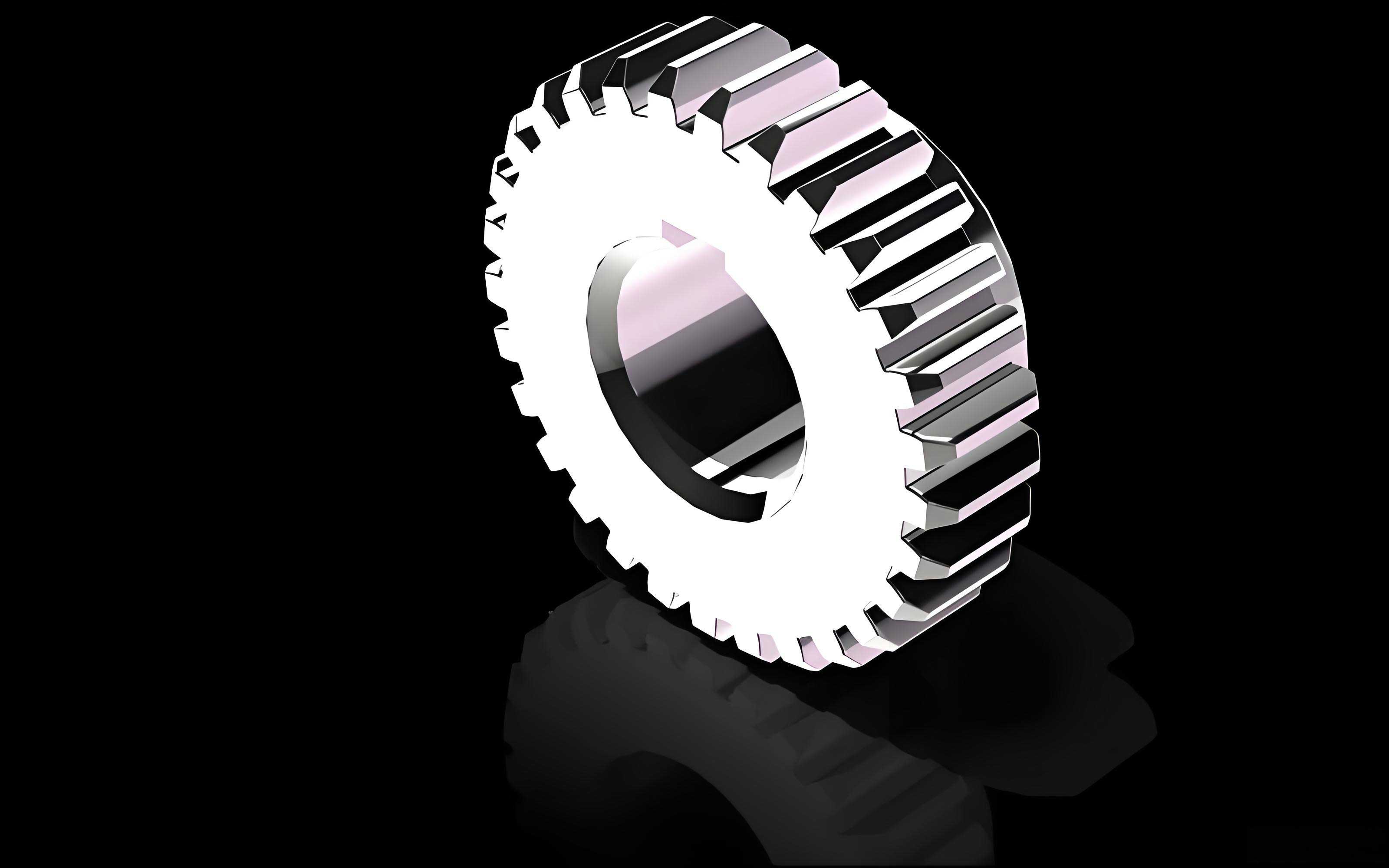
After generating the individual spur gears, they are assembled in a standard installation configuration. The center distance is set to 170 mm, calculated based on the module and tooth counts. To position the gears in meshing contact, I rotated them such that the pitch point alignment is achieved. Specifically, the pinion is rotated by \(90/z1\) degrees, and the gear by \(90/z2\) degrees, ensuring that the teeth engage at the pitch point. This results in a two-dimensional model of the spur gear pair, as the stress state in spur gears is uniform along the axial direction, allowing for a 2D approximation without significant loss of accuracy. The modeling outcome is visualized below, where the spur gear pair is ready for finite element discretization.
Next, I transition to the finite element analysis environment within ANSYS. ANSYS is a comprehensive finite element software suite capable of simulating structural, thermal, fluid, electromagnetic, and acoustic phenomena. For mechanical systems like spur gears, it enables detailed analysis of displacements, stresses, strains, and deformations under various loading conditions. The core steps involve defining material properties, meshing the geometry, applying boundary conditions and loads, and solving the governing equations. In this spur gear analysis, the material is selected as 45 steel, with properties outlined in Table 2.
| Property | Symbol | Value | Unit |
|---|---|---|---|
| Elastic Modulus | E | 2.06 × 10^5 | N/mm² |
| Poisson’s Ratio | ν | 0.3 | – |
| Friction Coefficient | μ | 0.3 | – |
Meshing is a critical phase in finite element analysis, as it converts the continuous geometry into discrete nodes and elements. For the spur gear model, I chose the PLANE182 element, which is a 4-node quadrilateral element suitable for 2D structural analyses. This element type offers a balance between computational efficiency and accuracy, as quadrilateral elements generally provide better stress resolution compared to triangular elements. The meshing process involved using a sweep method to generate a structured mesh across the gear domains. To capture the high stress gradients in the contact region, I refined the mesh locally around the meshing teeth. The mesh statistics are presented in Table 3.
| Component | Number of Elements | Number of Nodes |
|---|---|---|
| Pinion (Spur Gear) | 63,380 | 75,735 |
| Gear (Spur Gear) | 63,379 | 75,735 |
| Total | 126,759 | 151,470 |
Following meshing, I established contact pairs to simulate the interaction between the meshing spur gear teeth. In ANSYS, surface-to-surface contact elements are employed, with one surface designated as the contact surface and the other as the target surface. For this spur gear pair, I defined two contact pairs: one between the pinion tooth flank and the gear tooth flank during engagement. The contact properties were configured with a normal stiffness factor (FKN) of 1.0 and a maximum allowable penetration (FTOLN) of 0.1, ensuring realistic contact behavior without excessive numerical penetration. The contact algorithm uses Gauss integration points for contact detection, which enhances accuracy compared to node-based integration.
Boundary conditions and loads are then applied to replicate the operational scenario. The gear is fixed by constraining all degrees of freedom on its inner bore surface, simulating a mounted condition. The pinion, acting as the driver, is constrained to allow only rotational motion about its axis; thus, radial and axial displacements are restricted, but rotation is permitted. A tangential load is applied to the nodes on the pinion’s bore surface to represent the transmitted torque. The load magnitude is derived from the torque calculation. For instance, if the input torque is \(T\), the tangential force \(F_t\) per node can be computed as:
$$F_t = \frac{T}{r_p \cdot N}$$
where \(r_p\) is the pitch radius of the pinion spur gear, and \(N\) is the number of nodes on the bore surface. In this analysis, a torque of 119.375 N·m is assumed, leading to a tangential force of approximately -119.375 N (negative indicating clockwise rotation). The applied constraints and loads are illustrated in the finite element model, ensuring that the spur gear pair is properly loaded for stress evaluation.
The solution phase employs the Newton-Raphson iterative method to solve the nonlinear contact problem. ANSYS uses a full Newton-Raphson algorithm with equilibrium iterations at each load step. The residual force vector, which is the difference between internal forces (from element stresses) and external loads, is minimized iteratively until convergence criteria are met. This process accounts for geometric and material nonlinearities arising from contact. The analysis is performed as a static structural analysis with a single load step, utilizing default solver settings for stability and accuracy. The convergence tolerance is set to ensure that the solution accurately reflects the contact stress distribution in the spur gears.
Upon solving, the results are post-processed to extract contact stresses. The maximum contact stress occurs at the meshing interface of the spur gear teeth. For validation, I compare the finite element results with analytical calculations based on Hertzian contact theory. The Hertzian contact stress formula for two cylindrical bodies in contact, adapted for spur gears, is given by:
$$\sigma_H = \sqrt{\frac{F_t}{b \cdot d_1} \cdot \frac{u+1}{u} \cdot \frac{2E}{1-\nu^2}}$$
where \(F_t\) is the tangential force, \(b\) is the face width, \(d_1\) is the pinion pitch diameter, \(u\) is the gear ratio (\(z2/z1\)), \(E\) is the elastic modulus, and \(\nu\) is Poisson’s ratio. Substituting the values from Tables 1 and 2, the calculated Hertzian stress is approximately 681 MPa. The finite element analysis yields a maximum contact stress of 682.068 MPa, as shown in the contour plots. The discrepancy is less than 1%, demonstrating the high accuracy of the finite element model. This close agreement validates the modeling and analysis methodology for spur gear contact stress evaluation.
To further elucidate the stress distribution, I examine various meshing positions of the spur gear pair, from initial engagement to disengagement. By rotating the gears incrementally, I can analyze transient contact stresses throughout the meshing cycle. This dynamic insight is crucial for designing spur gears that withstand cyclic loading and fatigue. The finite element approach automates this process, allowing for efficient parametric studies. For instance, varying the module or pressure angle of the spur gear can be easily simulated to optimize tooth geometry for reduced stress concentrations.
In addition to contact stresses, I investigate other mechanical responses, such as deformation and strain energy. The deformation of spur gear teeth under load affects transmission error and noise, making it a vital design consideration. The finite element model provides detailed displacement contours, showing that maximum deformation occurs at the tooth tips. The strain energy density, which relates to fatigue life, can also be derived from the results. These outputs enable a holistic assessment of spur gear performance, surpassing the limitations of analytical methods that often simplify geometry and loading conditions.
The robustness of the ANSYS finite element software for spur gear analysis is further highlighted by its capability to handle complex material models. For example, if the spur gears are made of composite materials or undergo heat treatment, nonlinear material properties can be incorporated. ANSYS allows for defining multilinear isotropic hardening or anisotropic elasticity, enabling simulations of advanced spur gear designs. Moreover, thermal effects from friction in spur gear meshing can be coupled with structural analysis for a multiphysics approach, though this extends beyond the current scope.
To summarize the methodological advantages, I present a comparative table of different analysis techniques for spur gear contact stress, emphasizing the benefits of finite element analysis.
| Method | Accuracy | Computational Cost | Flexibility | Applicability |
|---|---|---|---|---|
| Analytical (Hertz) | Moderate | Low | Low | Simple geometries |
| Experimental | High | High | Low | Physical prototypes |
| Finite Element (ANSYS) | High | Moderate to High | High | Complex designs |
As evident, finite element analysis strikes an optimal balance, providing high accuracy and flexibility for spur gear design iterations. The computational cost is justified by the depth of insights gained, especially when simulating multiple spur gear configurations or loading scenarios.
Looking ahead, the integration of finite element analysis with optimization algorithms can revolutionize spur gear design. Techniques like topology optimization or shape optimization can be applied to minimize weight while maintaining strength, leading to more efficient spur gear systems. ANSYS offers built-in optimization tools that can automate this process, leveraging the finite element models developed here. Additionally, the rise of additive manufacturing for spur gears necessitates precise stress analysis to validate novel geometries, further underscoring the value of this methodology.
In conclusion, I have demonstrated a detailed framework for spur gear contact stress analysis using ANSYS finite element software. From precise involute modeling to advanced contact simulations, each step is crucial for obtaining reliable results. The agreement between finite element outputs and theoretical Hertzian calculations confirms the validity of this approach. Spur gears are ubiquitous in machinery, and enhancing their design through such analyses contributes to improved performance, durability, and innovation in mechanical transmissions. Future work may extend to three-dimensional models for helical or bevel gears, but the principles established here for spur gears remain foundational. By leveraging ANSYS capabilities, engineers can accelerate the development of robust spur gear systems, reducing reliance on physical prototyping and fostering digital twin methodologies.