
Spur gears are among the most fundamental and widely used components in mechanical transmission systems due to their simplicity, reliability, and ease of manufacturing. As industries increasingly prioritize energy efficiency and sustainability, understanding the power loss mechanisms in spur gears has become critical. In this article, we delve into the theoretical and practical aspects of power loss in spur gears, focusing on churning and windage losses, and explore how factors such as rotational speed, lubricant viscosity, and immersion depth impact overall efficiency. We employ advanced simulation techniques, including Smooth Particle Hydrodynamics (SPH), to model these phenomena and validate our findings with experimental data. Through detailed formulas, tables, and analyses, we aim to provide a comprehensive resource for engineers and researchers working with spur gears.
Spur gears operate by transmitting torque through meshing teeth that are parallel to the axis of rotation, resulting in high efficiency under ideal conditions. However, in real-world applications, power losses occur due to various factors, including friction, lubricant interactions, and aerodynamic effects. These losses can significantly reduce the overall efficiency of gear systems, leading to increased energy consumption and operational costs. For instance, in automotive and wind energy sectors, even minor improvements in spur gear efficiency can yield substantial economic and environmental benefits. Our analysis begins by examining the fundamental principles of spur gear operation and the primary sources of power loss.
The power loss in spur gears is predominantly categorized into load-dependent and load-independent losses. Load-dependent losses arise from tooth friction and meshing inefficiencies, while load-independent losses include churning (due to lubricant agitation) and windage (due to air resistance). In high-speed applications, such as those involving spur gears in turbines or high-performance vehicles, windage and churning losses can constitute a significant portion of the total power dissipation. We focus on the latter, as they are often overlooked in traditional design processes. The following sections break down the theoretical foundations, simulation approaches, and experimental validations for these losses in spur gears.
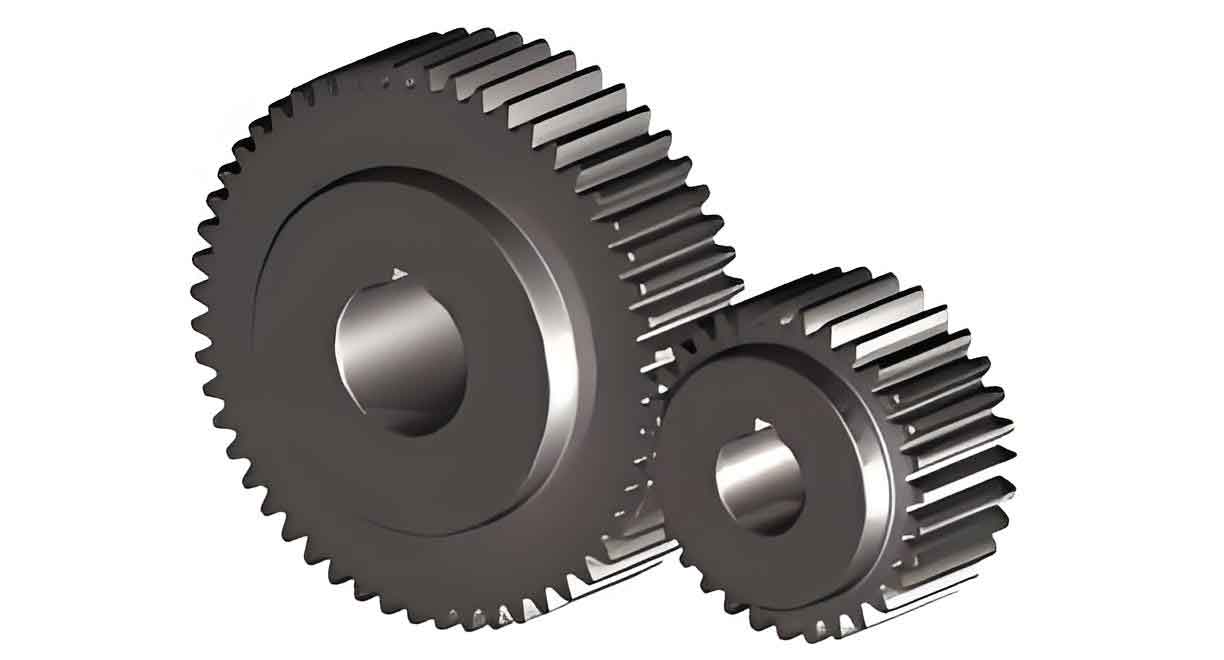
Churning power loss in spur gears results from the interaction between the gear teeth and the lubricant, leading to viscous drag and fluid agitation. This loss is influenced by gear geometry, lubricant properties, and operational conditions. For spur gears, the churning loss can be modeled using hydrodynamic principles. The total churning power loss, \( P_{\text{churning}} \), is the sum of losses from the gear periphery (\( P_1 \)), gear faces (\( P_2 \)), and meshing effects (\( P_3 \)). The formulas for these components are derived from empirical and analytical studies:
$$ P_1 = \frac{7.37 f_g v n^3 d^{4.7} L}{A_g \times 10^{26}} $$
$$ P_2 = \frac{1.474 f_g v n^3 d^{5.7}}{A_g \times 10^{26}} $$
$$ P_3 = \frac{7.37 f_g v n^3 d^{4.7} B R_f / \tan \beta}{A_g \times 10^{26}} $$
$$ P_{\text{churning}} = P_1 + P_2 + P_3 $$
where \( f_g \) is the immersion factor (\( f_g = h / d_a \), with \( h \) as immersion depth and \( d_a \) as tip diameter), \( v \) is the kinematic viscosity of the lubricant, \( n \) is the rotational speed, \( d \) is the pitch diameter, \( L \) is the wetted shaft length, \( A_g \) is a gear arrangement constant (typically 0.2 for spur gears), \( B \) is the face width, \( R_f \) is the surface roughness factor, and \( \beta \) is the helix angle (zero for spur gears). These equations highlight that churning loss increases with speed and lubricant viscosity, emphasizing the need for optimized lubricant selection in spur gear systems.
Windage power loss, on the other hand, arises from the drag exerted by the surrounding air or oil-air mixture on the rotating spur gears. This loss becomes particularly significant at high speeds, where aerodynamic forces dominate. The windage loss for a spur gear pair can be estimated using the following equations, which account for the driver and follower gears:
$$ P_{\text{driver}} = C \left(1 + 2.3 \frac{B}{R_{\text{driver}}}\right) \rho^{0.8} n^{2.8} R_{\text{driver}}^{4.6} v^{0.2} $$
$$ P_{\text{follower}} = C \left(1 + 2.3 \frac{B}{R_{\text{follower}}}\right) \rho^{0.8} \left(\frac{n}{u}\right)^{2.8} R_{\text{follower}}^{4.6} v^{0.2} $$
$$ P_{\text{windage}} = P_{\text{driver}} + P_{\text{follower}} $$
Here, \( C \) is a proportionality constant (\( 2.4 \times 10^{-8} \)), \( \rho \) is the density of the oil-air mixture, \( u \) is the gear ratio, and \( v \) is the kinematic viscosity of the mixture. The mixture properties are calculated as:
$$ \rho = \frac{\rho_0 + 34.25 \rho_a}{35.25} $$
$$ v = \frac{v_0 + 34.25 v_a}{35.25} $$
with \( \rho_0 \) and \( v_0 \) being the density and viscosity of the lubricant, and \( \rho_a \) and \( v_a \) for air. These formulas demonstrate that windage loss scales with the fourth power of the gear radius and approximately the cube of speed, underscoring the importance of gear size and operational velocity in spur gear design.
To illustrate the impact of various parameters on spur gear power loss, we present a series of tables summarizing key relationships. Table 1 outlines the basic parameters of a typical spur gear pair used in our analysis, while Table 2 provides simulation conditions for different scenarios involving rotational speed, immersion depth, and lubricant viscosity.
| Parameter | Driver Gear | Follower Gear |
|---|---|---|
| Number of Teeth | 21 | 29 |
| Module (mm) | 4 | 4 |
| Pressure Angle (°) | 20 | 20 |
| Face Width (mm) | 80 | 80 |
| Pitch Diameter (mm) | 84 | 116 |
| Elastic Modulus (GPa) | 203 | 203 |
| Poisson’s Ratio | 0.3 | 0.3 |
This table emphasizes the geometric and material properties that influence the performance of spur gears. For instance, the face width and pitch diameter directly affect the churning and windage losses, as seen in the formulas above.
| Case | Immersion Depth (mm) | Rotational Speed (rpm) | Lubricant Viscosity (m²/s) | Lubricant Density (kg/m³) |
|---|---|---|---|---|
| 1 | 0 | 600 | 7.95 × 10⁻⁵ | 831.2 |
| 2 | 0 | 1200 | 7.95 × 10⁻⁵ | 831.2 |
| 3 | 0 | 1800 | 7.95 × 10⁻⁵ | 831.2 |
| 4 | 0 | 3000 | 7.95 × 10⁻⁵ | 831.2 |
| 5 | 0 | 1200 | 7.95 × 10⁻⁵ | 831.2 |
| 6 | -10 | 1200 | 7.95 × 10⁻⁵ | 831.2 |
| 7 | -20 | 1200 | 7.95 × 10⁻⁵ | 831.2 |
| 8 | -20 | 200 | 7.95 × 10⁻⁵ | 831.2 |
| 9 | -20 | 200 | 3.01 × 10⁻⁵ | 812.1 |
| 10 | -20 | 200 | 1.52 × 10⁻⁵ | 792.8 |
These simulation cases allow us to analyze the individual effects of speed, immersion depth, and lubricant viscosity on spur gear power loss. For example, Cases 1-4 focus on speed variations, while Cases 5-7 examine immersion depth, and Cases 8-10 investigate lubricant viscosity. The negative immersion depths indicate levels below the gear centerline, which is common in practical applications of spur gears.
In our simulation approach, we use the Smooth Particle Hydrodynamics (SPH) method to model the two-phase flow of lubricant and air within a gearbox housing. SPH is a mesh-free Lagrangian technique that effectively handles complex fluid-structure interactions, such as those occurring in spur gear systems. The governing equations for SPH include the continuity, momentum, and energy equations, discretized into particle-based formulations. For a fluid particle \( i \), the equations are:
$$ \frac{d\rho_i}{dt} = \sum_j m_j (u_j – u_i) \nabla_i W_{ij} $$
$$ \frac{du_i}{dt} = \sum_j m_j \left( \frac{S_j}{\rho_i^2} – \frac{S_i}{\rho_j^2} \right) \nabla_i W_{ij} + g_i $$
$$ \frac{de_i}{dt} = \frac{1}{2} \sum_j m_j \left( \frac{S_j}{\rho_i^2} – \frac{S_i}{\rho_j^2} \right) : (u_j – u_i) \nabla_i W_{ij} – \sum_j m_j \left( \frac{q_j}{\rho_i^2} – \frac{q_i}{\rho_j^2} \right) \nabla_i W_{ij} $$
where \( \rho \) is density, \( u \) is velocity, \( m \) is mass, \( W_{ij} \) is the smoothing kernel function, \( S \) is the stress tensor, \( g \) is gravity, and \( e \) is specific internal energy. The stress tensor \( S \) is given by \( S = -pI + \sigma \), with \( p \) as pressure and \( \sigma \) as the shear stress tensor. For spur gears, these equations simulate the lubricant flow around the teeth, enabling us to quantify power losses due to churning and windage.
Our simulations reveal that rotational speed has a profound impact on power loss in spur gears. As speed increases, the inertial forces dominate, leading to higher lubricant agitation and increased churning losses. For instance, at 600 rpm, the torque loss for spur gears might be minimal, but at 3000 rpm, it can surge due to enhanced fluid-particle interactions. This is consistent with the theoretical formulas, where churning loss scales with \( n^3 \) and windage with \( n^{2.8} \). The velocity fields from SPH simulations show that lubricant particles near the spur gear teeth attain high velocities, while those closer to the housing walls move slower, resulting in viscous dissipation and power loss.
Immersion depth is another critical factor for spur gears. Deeper immersion increases the wetted area, amplifying churning losses. In our simulations, when immersion depth decreases from 0 mm to -20 mm, the power loss reduces significantly because less lubricant is engaged with the gear teeth. However, this must be balanced against lubrication effectiveness; too shallow immersion might starve the spur gears of lubricant, leading to wear and failure. The optimal immersion depth for spur gears often lies near the pitch circle, ensuring adequate lubrication without excessive losses.
Lubricant viscosity directly influences the drag forces on spur gears. Higher viscosity oils produce greater churning losses due to stronger viscous forces, as shown in Cases 8-10. For example, reducing viscosity from \( 7.95 \times 10^{-5} \) m²/s to \( 1.52 \times 10^{-5} \) m²/s can cut power loss by half in low-speed scenarios. This highlights the trade-off in spur gear design: high-viscosity lubricants offer better protection but increase losses, whereas low-viscosity oils reduce losses but may compromise durability.
To validate our simulations, we conducted experiments using a standardized gear test rig, similar to an FZG test bench. The measured torque losses for spur gears under various speeds and immersion depths align well with simulation results, though experimental values are generally higher due to additional losses from bearings and seals. For instance, at 1200 rpm, the simulated torque loss might be 0.5 Nm, while experimental data show 0.6 Nm, confirming the predictive accuracy of our SPH models for spur gears.
In conclusion, spur gears are efficient transmission elements, but their performance is hampered by churning and windage losses. Through theoretical analysis, SPH simulations, and experimental validation, we have demonstrated that rotational speed, immersion depth, and lubricant viscosity are key parameters affecting power loss in spur gears. Engineers can use these insights to optimize spur gear systems for higher efficiency by selecting appropriate lubricants, adjusting immersion levels, and controlling operational speeds. Future work could explore advanced materials or surface treatments for spur gears to further reduce losses. Overall, a holistic approach combining simulation and testing is essential for maximizing the efficiency of spur gears in modern applications.
The integration of these findings into spur gear design processes can lead to significant energy savings. For example, in automotive transmissions, optimizing spur gear parameters based on our models could improve fuel economy by reducing parasitic losses. Similarly, in industrial machinery, such as conveyors or pumps, efficient spur gears contribute to lower operational costs and enhanced sustainability. As technology advances, continued research into spur gear efficiency will play a vital role in meeting global energy demands and environmental goals.