
In the pursuit of higher efficiency within mechanical transmission systems, the power losses associated with gear operation have become a critical focus. Among these, losses due to the agitation and churning of lubricating oil in oil-immersed gearboxes represent a significant, yet complex, component. Experimental investigations into gear transmission efficiency are often time-consuming and susceptible to numerous uncertainties. Consequently, numerical simulation has emerged as a predominant methodology for dissecting the influence of various parameters on gear power loss. This study delves into the intricate fluid dynamics within an oil-immersed gearbox housing, employing advanced computational techniques to unravel the mechanisms behind oil churning losses in spur gears. The primary objective is to provide a detailed, physics-based understanding of how operational conditions—specifically rotational speed and direction—govern the flow field, pressure distribution, and ultimately, the parasitic power consumed by fluid drag.
The computational approach necessitates a robust and accurate model. We begin by defining the geometry of a standard spur gear pair within a simplified enclosure. The key geometric parameters for the driving (G1) and driven (G2) spur gears are summarized below.
| Gear | Module (mm) | Number of Teeth | Face Width (mm) | Pressure Angle (°) |
|---|---|---|---|---|
| G1 (Driver) | 1.5 | 19 | 25 | 20 |
| G2 (Driven) | 1.5 | 95 | 25 | 20 |
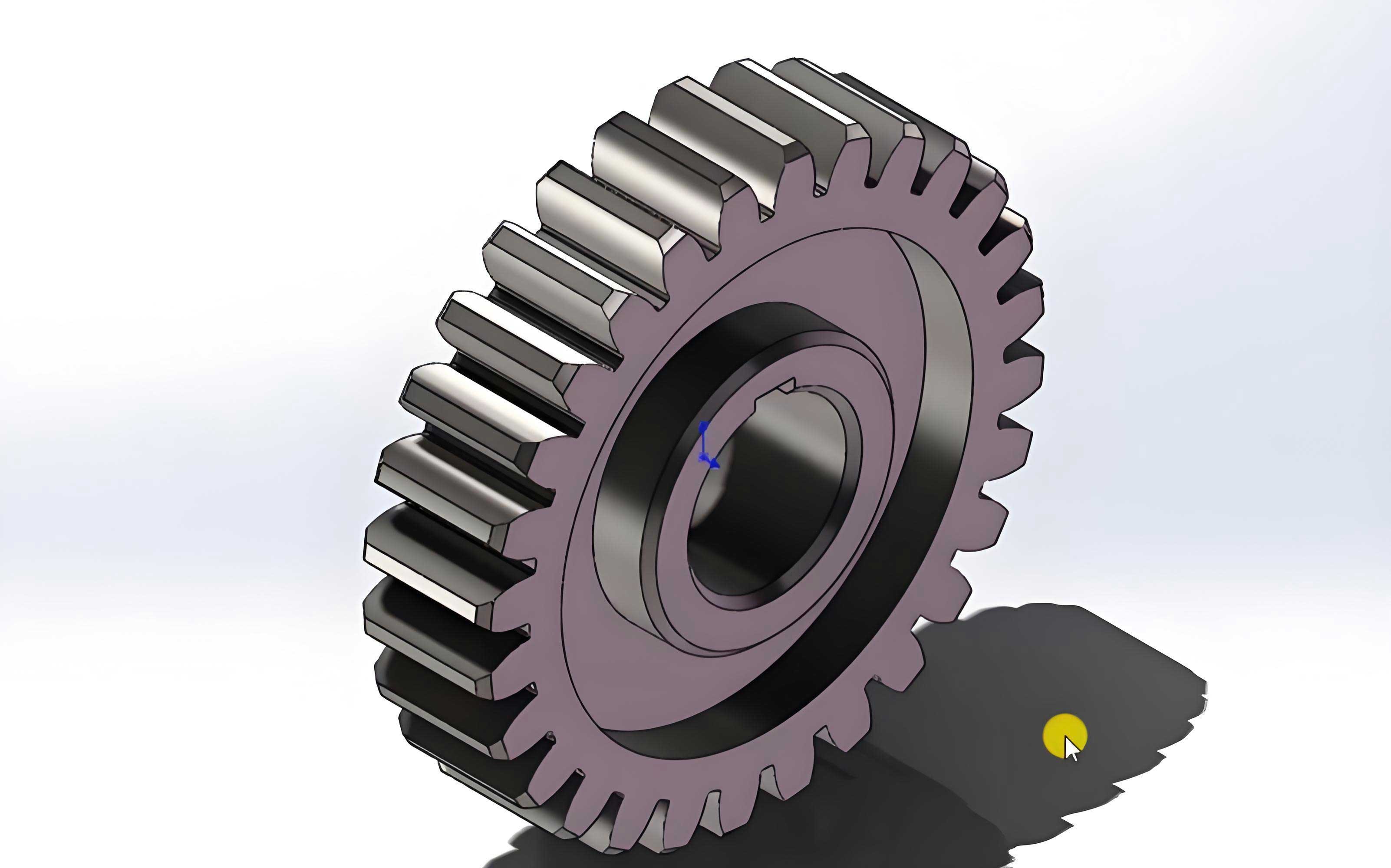
The three-dimensional fluid domain representing the oil inside the gearbox is extracted using Boolean operations. This domain is then discretized using an unstructured mesh, with significant local refinement applied in the critical regions: the gear tooth spaces, the meshing zone, and near all solid boundaries. This strategy ensures high accuracy where velocity and pressure gradients are steep while maintaining computational efficiency. The mesh quality is paramount for dynamic simulations; hence, parameters for subsequent dynamic remeshing are carefully defined.
| Symbol | Parameter | Value | Unit |
|---|---|---|---|
| – | Total Cells | ~1.66 million | – |
| h | Cell Height | 1.5 | mm |
| ah | Height Factor | 0.3 | dimensionless |
| Hideal | Ideal Height | 1.22 | mm |
| He | Pre-defined Cell Height | 0.25 | mm |
The core of the fluid dynamics simulation is governed by the fundamental conservation laws. For an incompressible, transient flow, the Reynolds-Averaged Navier-Stokes (RANS) equations are solved. The continuity and momentum equations are expressed as:
Continuity Equation (Mass Conservation):
$$\frac{\partial (\rho u_i)}{\partial x_i} = 0$$
Momentum Equation (RANS):
$$\frac{\partial}{\partial t}[\rho(u_i)] + \frac{\partial}{\partial x_j}[\rho(u_i)(u_j)] = -\frac{\partial p}{\partial x_i} + \frac{\partial}{\partial x_j}\left[\mu\left(\frac{\partial u_i}{\partial x_j} + \frac{\partial u_j}{\partial x_i}\right)\right] – \frac{\partial}{\partial x_j}(\tau_{ij})$$
Here, $\rho$ is the fluid density, $u_i$ are the velocity components, $p$ is the pressure, $\mu$ is the dynamic viscosity, and $\tau_{ij}$ is the Reynolds stress tensor. The complex, turbulent nature of the oil flow in an agitated gearbox is modeled using the RNG $k$-$\varepsilon$ turbulence model. This model is particularly well-suited for flows with high strain rates and strong streamline curvature, which are characteristic of the flow around rotating spur gears. The transport equations for turbulent kinetic energy $k$ and its dissipation rate $\varepsilon$ are:
$$\frac{\partial (\rho k)}{\partial t} + \frac{\partial (\rho k u_i)}{\partial x_i} = \frac{\partial}{\partial x_j}\left[\alpha_k \mu_{\text{eff}} \frac{\partial k}{\partial x_j}\right] + G_k + P_\varepsilon$$
$$\frac{\partial (\rho \varepsilon)}{\partial t} + \frac{\partial (\rho \varepsilon u_i)}{\partial x_i} = \frac{\partial}{\partial x_j}\left[\alpha_\varepsilon \mu_{\text{eff}} \frac{\partial \varepsilon}{\partial x_j}\right] + C_{1\varepsilon}^* \frac{\varepsilon}{k} G_k + P_\varepsilon$$
Where $\mu_{\text{eff}}$ is the effective viscosity, and $G_k$, $P_\varepsilon$, $\alpha_k$, $\alpha_\varepsilon$, $C_{1\varepsilon}^*$ are model constants and terms.
To track the violent splashing and the evolving free surface between oil and air, the Volume of Fluid (VOF) multiphase model is employed. A single set of momentum equations is shared by the fluids, and the volume fraction of each fluid in every computational cell is tracked. The equation for the $q^{th}$ fluid’s volume fraction $\alpha_q$ is:
$$\frac{\partial \alpha_q}{\partial t} + v_i \frac{\partial \alpha_q}{\partial x_i} = 0$$
The properties in the transport equations are determined by the volume-fraction-averaged value. For instance, a cell with $\alpha_{\text{oil}}=1$ is full of oil, $\alpha_{\text{oil}}=0$ is full of air, and $0 < \alpha_{\text{oil}} < 1$ contains an interface. The properties of the two phases used in this study are listed below.
| Phase | Density (kg/m³) | Dynamic Viscosity (kg/(m·s)) |
|---|---|---|
| Oil (C50) | 965 | 0.0965 |
| Oil (C100) | 960 | 0.0480 |
| Air | 1.225 | 1.7894 × 10⁻⁵ |
The movement of the spur gears is handled using a dynamic mesh technique. A combination of spring-based smoothing and local remeshing is applied. The spring-based smoothing treats edges between nodes as interconnected springs; the displacement of a node is calculated based on the forces from all connected springs. When cell quality deteriorates below a threshold due to large boundary deformation (like in the gear meshing zone), the affected cells are agglomerated and remeshed. This ensures mesh integrity throughout the simulation. The gear motion is prescribed via a User-Defined Function (UDF), maintaining a fixed speed ratio of 5:1 between the driving (G1) and driven (G2) spur gears.
The pressure-velocity coupling is achieved using the SIMPLE (Semi-Implicit Method for Pressure-Linked Equations) algorithm. The discretization schemes for density, momentum, and volume fraction are second-order upwind to enhance accuracy. Convergence is monitored through scaled residuals, with a criterion of 10⁻⁴ for continuity and momentum equations. A critical output is the resistance torque on each gear, which is the direct source of churning power loss. The torque vector $\mathbf{M}_O$ on a gear about its center $O$ is computed by integrating the pressure and viscous forces over its wetted surface area:
$$\mathbf{M}_O = \sum (\mathbf{r}_{Oa} \times \mathbf{F}_p) + \sum (\mathbf{r}_{Oa} \times \mathbf{F}_v)$$
where $\mathbf{r}_{Oa}$ is the position vector from the gear center to a face area element, and $\mathbf{F}_p$ and $\mathbf{F}_v$ are the pressure and viscous force vectors on that element, respectively. The total churning power loss $P_{\text{churn}}$ for the spur gear pair is then:
$$P_{\text{churn}} = \frac{M_{O1} N_1}{9.55} + \frac{M_{O2} N_2}{9.55}$$
where $M_{O1}$ and $M_{O2}$ are the resistance torques (in N·m) on G1 and G2, and $N_1$ and $N_2$ are their rotational speeds (in rpm).
The transient simulation reveals profound differences in the oil flow field depending on the rotational direction of the driving spur gear. For identical speeds, when gear G1 rotates counter-clockwise (the typical “pumping” direction where teeth emerge from the meshing zone moving upward out of the sump), oil is effectively drawn into the meshing zone. Early in the rotation, at t=0.0025s, lubricant rapidly fills the inlet region of the meshing spur gears. In contrast, when G1 rotates clockwise, the inertia of the oil in the tooth spaces dominates, causing it to be flung tangentially away from the gear in a parabolic trajectory, resulting in significantly less oil being transported into the meshing region. This establishes a fundamental dichotomy: counter-clockwise rotation promotes oil pumping at the mesh, while clockwise rotation promotes oil throwing from the gear periphery.
This phenomenon is directly linked to the time-varying volume of the inter-tooth spaces entering the meshing zone. As a pair of spur gear teeth come into mesh, they form a transient cavity. For counter-clockwise rotation, this cavity, initially filled with oil from the sump, decreases in volume, pressurizing the trapped fluid. Some oil may be forced out through side clearances or experience cavitation, but a significant pumping action occurs. For clockwise rotation, the same cavity volume reduction happens, but the initial oil fill is much poorer due to the throwing action, leading to a weaker pump effect and potentially more air entrainment.
The pressure field at specific monitoring points near the meshing zone of the spur gears provides quantitative evidence. Point A is located in the upper meshing region, and Point B in the lower region. The pressure history over one full revolution of the driven gear under different speeds and both rotational directions for G1 is analyzed.
For counter-clockwise rotation of G1, Point A consistently shows negative pressure (suction), while Point B shows positive pressure. The absolute values of these pressures increase with the rotational speed of the spur gears. At 4000 rpm, |P_A| is approximately 12,500 Pa and P_B is about 4,700 Pa. For clockwise rotation, the pattern is inverted: Point A shows positive pressure and Point B shows negative pressure, with smaller absolute magnitudes at comparable speeds (e.g., ~2,600 Pa and -3,500 Pa at 4000 rpm). The pressure contour plots confirm that these point values reflect zone-wide conditions: the entire upper meshing region is under suction for counter-clockwise rotation and under pressure for clockwise rotation, and vice-versa for the lower region. This reversal and magnitude difference highlight that the change in rotational direction has a more dramatic impact on the meshing zone pressure field of the spur gears than a comparable change in rotational speed.
The direct consequence of these flow and pressure differences is reflected in the calculated resistance torque and churning power loss. Simulations were conducted for various combinations of speed (1000-4000 rpm for G1), direction, and oil viscosity (C50 and C100). The computed resistance torques for the driving spur gear (M_O1) under select conditions are tabulated below.
| G1 Speed (rpm) | G1 Direction | Oil Grade | Avg. M_O1 (N·m) |
|---|---|---|---|
| 2000 | Counter-Clockwise | C100 | 0.185 |
| 2000 | Clockwise | C100 | 0.142 |
| 3000 | Counter-Clockwise | C100 | 0.261 |
| 3000 | Clockwise | C100 | 0.201 |
| 3000 | Counter-Clockwise | C50 | 0.291 |
Applying the power loss formula, the churning losses are calculated and compared. The key findings are synthesized in the following analysis:
| Comparison Factor | Effect on Flow Field & Power Loss | Dominant Mechanism |
|---|---|---|
| Rotational Direction (Counter-Clockwise vs. Clockwise) | Major Impact. CCW rotation yields higher mesh pumping, lower peripheral throwing, higher |pressure| at mesh, and higher churning loss. CW rotation yields the opposite. | Pumping loss dominates over throwing loss for the tested spur gears. CCW rotation maximizes pumping action. |
| Rotational Speed (Increasing) | Expected Increase. Raises fluid inertia and shear, increasing resistance torque and power loss monotonically. | Increased velocity gradients and kinetic energy of splashing oil. |
| Oil Viscosity (C50 vs. C100) | Moderate Impact. Higher viscosity (C50) increases shear forces, leading to higher torque and loss compared to lower viscosity (C100) at the same speed. | Viscous shear stress on wetted surfaces of the spur gears. |
| Direction vs. Viscosity | For medium speeds, changing direction has a larger effect on power loss than changing between C50 and C100 viscosity. | The geometric “pumping vs. throwing” mechanism is more influential than a moderate change in fluid property. |
The comprehensive numerical analysis of spur gears operating in an oil-immersed environment leads to several definitive conclusions regarding oil churning dynamics and power loss. Firstly, the rotational direction of the driving spur gear is a critical, yet often overlooked, design parameter. It fundamentally alters the oil flow mechanism: counter-clockwise rotation (teeth exiting the mesh upward) establishes a strong pumping action at the meshing zone, while clockwise rotation promotes vigorous throwing from the gear periphery. Secondly, this directional difference creates distinct pressure fields in the meshing zone—characterized by opposing patterns of positive and negative pressure—whose magnitudes are more sensitive to a change in direction than to a comparable change in rotational speed. Thirdly, for the studied configuration, the power loss associated with pumping oil through the constricting mesh of the spur gears is greater than the loss associated with throwing oil from the gear’s external diameter. Consequently, under medium-to-low speed conditions typical of many industrial gearboxes, a change in the rotational direction of the spur gears exerts a greater influence on the total churning power loss than changes in rotational speed or moderate changes in lubricant viscosity. These insights provide a solid theoretical foundation for energy-saving strategies in gear transmission design, suggesting that optimizing gearbox layout and rotation direction could be as important as selecting optimal speeds and lubricants for minimizing parasitic fluid drag losses.