
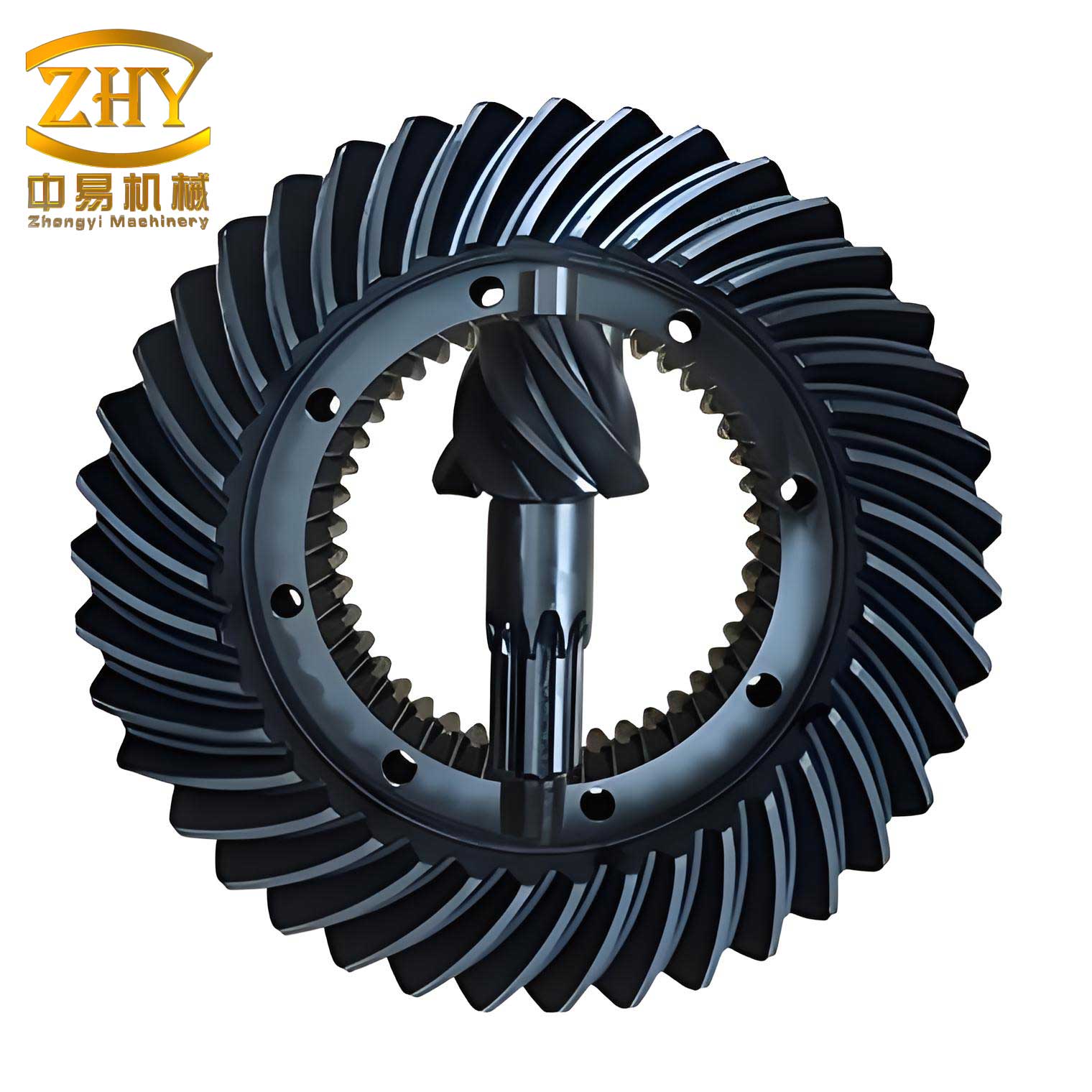
In the realm of automotive and agricultural machinery, the helical bevel gear stands as a critical component within differential systems, transmitting torque between non-parallel shafts while enduring significant cyclic loads and impact forces. Traditionally, these helical bevel gears have been manufactured from low-carbon alloy steels through forging and extensive machining—a process chain that is not only energy-intensive but also costly. My research focuses on exploring an alternative: the production of helical bevel gear blanks using Austempered Ductile Iron (ADI), a material renowned for its exceptional combination of high strength, toughness, and wear resistance. Specifically, I have investigated the application of squeeze casting, a hybrid solidification process combining elements of casting and forging, to fabricate these helical bevel gear preforms. This study aims to overcome the inherent limitations of conventional sand casting for nodular iron, such as shrinkage porosity, gas entrapment, and microstructural inconsistency, which have historically restricted the use of ADI in high-integrity components like helical bevel gears.
The fundamental challenge with producing high-quality nodular iron castings, especially for complex shapes like a helical bevel gear, lies in its wide solidification range, leading to a pasty mode of solidification. This promotes the formation of internal defects. Squeeze casting, characterized by the application of pressure during solidification, can alter this solidification behavior from pasty to a more directional, skin-forming mode. The pressure aids in feeding the liquid shrinkage, suppresses gas pore formation, and refines the microstructure. My objective was to develop a squeeze casting process capable of producing as-cast ferritic ductile iron helical bevel gear blanks with a sound, defect-free structure and a controlled microstructure that would serve as an ideal precursor for the subsequent austempering heat treatment to achieve final ADI properties.
The design of an optimal microstructure is paramount for the performance of any ADI component, and the helical bevel gear is no exception. The target as-cast microstructure for the gear blank prior to austempering should predominantly consist of ferrite to ensure good machinability and a uniform response to heat treatment. The ideal as-cast microstructure I aimed for can be quantitatively described:
- Matrix: Ferrite content > 85%, Pearlite content < 10%. Free carbides and phosphide eutectics are detrimental and must be minimized to below 2% and 1%, respectively.
- Graphite: Nodularity rating better than Type III (per ASTM A247), with a nodule count exceeding 100 nodules/mm². Graphite should be spheroidal or tightly clustered, avoiding degenerate forms.
The relationship between microstructure and mechanical properties can be conceptually framed. For instance, the yield strength of the ferritic matrix $\sigma_y$ can be related to the grain size via the Hall-Petch equation: $$\sigma_y = \sigma_0 + k_y d^{-1/2}$$ where $d$ is the ferrite grain size, and $\sigma_0$ and $k_y$ are material constants. A refined graphite structure indirectly contributes to finer ferrite grains by providing more nucleation sites, thereby enhancing strength and toughness—a critical factor for a helical bevel gear subjected to complex stress states.
The chemical composition is the first lever to control the desired microstructure. After extensive literature review and preliminary trials, I established the target composition range presented in Table 1. Carbon equivalent (CE) is crucial for ensuring graphitization and avoiding chilling in the metal mold. Silicon is a potent graphitizer but must be balanced to prevent embrittlement. Low levels of manganese, sulfur, and phosphorus are essential for high toughness.
| Element | Target Range | Rationale |
|---|---|---|
| Carbon (C) | 3.6 – 3.8 | High carbon equivalent promotes ferrite, ensures fluidity. |
| Silicon (Si) | 2.4 – 2.7 | Promotes ferritization; excess raises ductile-to-brittle transition temperature. |
| Manganese (Mn) | < 0.20 | Minimize pearlite stabilization and segregation. |
| Phosphorus (P) | < 0.03 | Minimize phosphide eutectic formation for toughness. |
| Sulfur (S) | < 0.025 | Low base sulfur is essential for effective nodulization. |
| Magnesium (Mg) | 0.03 – 0.06 | Residual for nodulizing; excess causes carbide formation. |
| Rare Earth (RE) | 0.02 – 0.04 | Controls trace element effects, aids nodulizing. |
| Carbon Equivalent (CE=C+Si/3) | 4.3 – 4.6 | Optimized for ferritic solidification under squeeze casting conditions. |
The melting and treatment process was designed to achieve a high-temperature, low-sulfur base iron. I employed a cupola furnace operation, though the principles apply to induction melting. Key steps included:
- Charge Materials: Selection of low-manganese pig iron, clean steel scrap, and own returns.
- Desulfurization: In-cupola addition of calcium carbide (~3%) and limestone to reduce sulfur by 40-50%.
- Nodulization: Using a covered-pocket method with Fe-Si-Mg-RE alloy (1.5% addition). The reaction was controlled to last about 60 seconds to improve magnesium recovery and reduce fuming.
- Inoculation: A triple inoculation strategy was critical to counteract the chilling tendency of the metal die and generate a high nodule count. This involved:
- Primary: 0.7% FeSi75 as cover during nodulization.
- Secondary: 0.4% FeSi75 plus 0.2% Bismuth-based inoculant during transfer.
- Tertiary: 0.2% fine FeSi powder (3-5 mm) added during pouring.
The efficiency of inoculation in increasing nodule count $N$ can be modeled as a function of undercooling $\Delta T$ and inoculant potency: $$N \propto \exp\left(-\frac{A}{\Delta T^2}\right) \cdot f(I)$$ where $A$ is a constant and $f(I)$ represents the inoculant effectiveness function. Effective inoculation was paramount for the helical bevel gear to achieve a fully ferritic matrix without free carbides.
The heart of this investigation was the development and optimization of the squeeze casting process parameters for the helical bevel gear blank. The experimental setup involved a vertical hydraulic press and a machined steel die set conforming to the gear blank geometry. The key process variables and their optimized ranges, determined through iterative trials, are summarized in Table 2. The underlying physics of each parameter is crucial. For example, the applied pressure $P$ must be sufficient to compensate for volumetric shrinkage $\beta$ and overcome the resistance of the partially solidified shell. A simple mechanical equilibrium at the liquid-solid interface can be considered: $$P_{applied} \ge \sigma_{yield}(T) + \frac{2\gamma}{r} + \rho g h$$ where $\sigma_{yield}(T)$ is the temperature-dependent yield strength of the solid shell, $\gamma$ is the solid-liquid interfacial energy, $r$ is the pore radius, and the last terms account for metallostatic pressure. For the helical bevel gear, a lower pressure was sufficient due to the rapid shell formation.
| Process Parameter | Optimized Range | Functional Role & Justification |
|---|---|---|
| Die Preheating Temperature ($T_{die}$) | 200 – 300 °C | Prevents thermal shock to die, reduces chilling severity to avoid white iron on gear surface, controls solidification rate. |
| Pouring Temperature ($T_{pour}$) | 1320 – 1380 °C | Ensures sufficient superheat for complete filling of the intricate helical bevel gear cavity before pressurization. |
| Squeeze Start Temperature ($T_{sq}$) | ~ Liquidus + 20°C (~1150°C) | Initiate pressure when a thin solid skin has formed to prevent metal splash but while significant feeding is still required. |
| Specific Pressure ($P$) | 20 – 50 MPa (Low Pressure) | Primarily acts as an efficient feeding mechanism for liquid contraction; sufficient to consolidate the mush zone in the helical bevel gear. |
| Pressure Application Speed ($v_{p}$) | Moderate (~10-20 mm/s) | Prevents turbulent entrapment of gas or oxide films during the closing of the die cavity around the helical bevel gear shape. |
| Pressure Dwell Time ($t_{dwell}$) | 5 – 10 seconds | Ensures complete solidification under pressure; time estimated via simplified heat transfer: $t_{dwell} \approx \frac{V \rho L}{A h (T_{pour}-T_{die})}$, where V is volume, L latent heat, A area, h heat transfer coefficient. |
| Ejection Temperature ($T_{ej}$) | 850 – 1000 °C | Allows ejection while gear blank has enough strength, utilizes residual heat for controlled slow cooling to prevent carbides and stress. |
A critical enabling technology for squeeze casting ferritic ductile iron in a metal die is the die coating system. The coating must provide thermal insulation to moderate the high cooling rate and prevent chilling. I developed a two-layer, water-based coating:
- Base Layer (~0.3 mm): A refractory insulating layer with high adhesion and thermal shock resistance. Its effectiveness in reducing heat flux $q$ can be approximated by: $$q = \frac{T_{melt} – T_{die}}{R_{coat} + R_{die}}$$ where $R_{coat}$ is the thermal resistance of the coating, significantly higher than that of the metal die $R_{die}$.
- Top Layer (~0.1 mm): A parting agent for easy ejection and surface finish.
This coating was essential for successfully producing a chill-free helical bevel gear blank.
The experimental campaign involved multiple casting runs with systematic variation of parameters. The key outcomes for selected runs are consolidated in Table 3. The as-cast mechanical properties are a direct reflection of the microstructure achieved. For instance, the ultimate tensile strength $\sigma_u$ and elongation $\delta$ correlate with the ferrite fraction $F_f$ and nodule count $N$: $$\sigma_u \approx \sigma_{ferrite} \cdot F_f + \sigma_{pearlite} \cdot (1-F_f) – k_{\sigma} \cdot \frac{1}{\sqrt{N}}$$ $$\delta \approx \delta_{max} \cdot F_f \cdot \left(1 – \exp(-C \cdot N)\right)$$ where $k_{\sigma}$ and $C$ are constants, and the terms involving $N$ capture the strengthening and ductility enhancement from graphite refinement. The best results (e.g., Run 5) showed a predominantly ferritic matrix with high nodularity, directly translating to good tensile strength and excellent elongation—a promising starting point for a helical bevel gear.
| Run ID | Key Process Variation | As-Cast Microstructure | As-Cast Mechanical Properties | Remarks |
|---|---|---|---|---|
| 1 | Standard parameters, slow cooling after ejection. | ~80% Ferrite, 20% Pearlite, Graphite Type I-II, Nodule Count: ~150/mm² | $\sigma_b$: 506 MPa, $\delta$: 8%, HB: 268 | Acceptable base structure for a helical bevel gear. |
| 2 | Insufficient inoculation, sand bedding after ejection. | 85% Ferrite, 15% Carbides (Fe₃C), Graphite Type II-III | Brittle, not tested | Highlights risk of carbides without proper inoculation/coating. |
| 3 | Higher die preheat (250°C), optimized coating. | 85% Ferrite, 15% Pearlite, Graphite Type I-II, Nodule Count: ~180/mm² | $\sigma_b$: 483 MPa, $\delta$: 13%, HB: 240 | Improved ductility, crucial for gear toughness. |
| 4 | Further optimized inoculation timing. | 85% Ferrite, 15% Pearlite, Graphite Type I, Nodule Count: ~200/mm² | $\sigma_b$: 467 MPa, $\delta$: 11%, HB: 238 | Excellent nodularity achieved for the helical bevel gear. |
| 5 | Highest die preheat (300°C), precise squeeze timing. | ~95% Ferrite, 5% Pearlite, Graphite Type I, Nodule Count: ~220/mm² | $\sigma_b$: 460 MPa, $\delta$: 14%, HB: 230 | Optimum as-cast structure with high ferrite and refined graphite. |
The helical bevel gear blanks produced under the optimal conditions (e.g., Run 5) were then subjected to the austempering heat treatment to transform the ferritic-pearlitic matrix into the desired ausferritic structure of ADI. The standard cycle involved:
- Austenitizing at $920 \pm 10\,^\circ\mathrm{C}$ for sufficient time to achieve carbon saturation.
- Rapid quenching to an isothermal holding bath at $350 \pm 5\,^\circ\mathrm{C}$.
- Holding for a time $t$ to allow the reaction: $$\gamma_{austenite} \rightarrow \alpha_{ferrite} + \gamma_{high-carbon}$$ This results in a microstructure of acicular ferrite and stable, high-carbon austenite.
The final mechanical properties of the ADI helical bevel gear material exceeded $\sigma_b \geq 1000\, \mathrm{MPa}$, $\delta > 5\%$, and impact energy $a_k > 80\, \mathrm{J}$, with a hardness range of 30-38 HRC. These properties are fully competitive with those of forged low-alloy steel gears, validating the potential of this route.
The success of the squeeze casting process for this helical bevel gear can be analyzed through the lens of solidification theory. The applied pressure $P$ increases the effective melting point $T_m$ of the iron according to the Clausius-Clapeyron relation: $$\frac{dT_m}{dP} = \frac{T_m (V_l – V_s)}{\Delta H_f}$$ where $V_l$ and $V_s$ are specific volumes of liquid and solid, and $\Delta H_f$ is latent heat. This slight increase in $T_m$ reduces the undercooling required for nucleation, potentially increasing nodule count. More importantly, pressure reduces the size of critical nuclei $r^*$ for pore formation: $$r^* = \frac{2\gamma_{sl}}{P + \Delta P_{met} – P_g}$$ where $\gamma_{sl}$ is solid-liquid interfacial energy, $\Delta P_{met}$ is metallostatic pressure, and $P_g$ is gas pressure. By making $r^*$ very large or negative, pressure effectively eliminates microporosity, a common failure initiator in gears. For the helical bevel gear geometry, the pressure ensures soundness in the root and tooth flank regions, which are high-stress areas.
Furthermore, the economics of producing a helical bevel gear via this route are compelling. Compared to steel forging, the squeeze casting of ductile iron offers near-net-shape capability, drastically reducing machining allowance and scrap. The material utilization efficiency $\eta_m$ can be expressed as: $$\eta_m = \frac{m_{gear\,blank}}{m_{total\,charge}} \times 100\%$$ In our process, $\eta_m$ approached 85-90%, significantly higher than the 50-60% typical for machining from forged stock. The elimination of sand handling and core-making also reduces environmental footprint. The ability to use lower-cost charge materials (pig iron, scrap) compared to alloy steel billets further enhances cost-effectiveness for mass production of helical bevel gears.
In conclusion, my experimental investigation robustly demonstrates the technical feasibility and practical advantages of using squeeze casting to manufacture ADI helical bevel gear blanks. The process successfully overcomes the drawbacks of traditional sand casting for nodular iron, delivering sound, dense castings with a controlled as-cast ferritic microstructure characterized by high nodularity and fine graphite dispersion. This microstructure serves as a perfect precursor for austempering, yielding final ADI properties that meet or exceed the requirements for this demanding application. The optimized parameters—encompassing composition, melting treatment, die design, coating, and precise control of temperature, pressure, and timing—form a coherent process window. The helical bevel gear produced via this route promises not only performance parity with traditional steel gears but also significant benefits in terms of production cost, material efficiency, and manufacturing simplicity. This study lays a solid foundation for the industrial adoption of squeeze-cast ADI for power transmission components, particularly helical bevel gears, and opens avenues for further research into die life optimization, process automation, and the extension of this technique to other complex, high-integrity iron castings.