
In mechanical transmission systems, helical gears are widely used due to their smooth operation, high load capacity, and reduced noise compared to spur gears. However, during the meshing process, helical gears experience sudden load changes during tooth pair alternation, which can lead to surface fatigue pitting, impact, and reduced lifespan. To address these issues, I conducted a comprehensive study on the static contact analysis and profile modification of profile modified helical gears. This research aims to optimize gear design by reducing stress concentrations and improving contact performance through modification techniques.
The analysis begins with the establishment of a three-dimensional solid model using Pro/ENGINEER (Pro/E), followed by validation of gear meshing accuracy based on contact ratio formulas. I then employ ANSYS Workbench for static finite element analysis to obtain stress distributions during meshing-in and meshing-out processes. Finally, arc profile modification is applied, and the results before and after modification are compared. The findings indicate that with reasonable contact strength, a minimal modification amount can achieve the desired effect, providing a basis for transient dynamic analysis of helical gears.
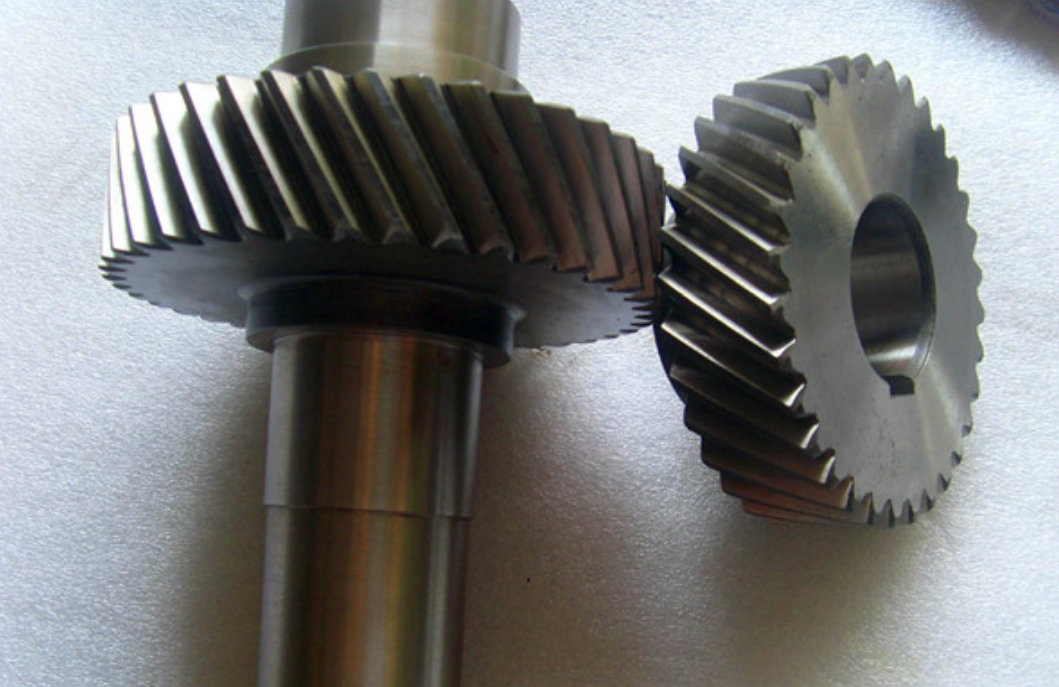
The helical gear’s meshing behavior is characterized by gradual tooth engagement along the helix, which results in multiple tooth pairs being in contact simultaneously. This increases the total contact ratio, but it also introduces complex load-sharing dynamics. During meshing transitions, such as when a tooth pair engages or disengages, abrupt load shifts occur, leading to stress peaks that can cause damage. Therefore, understanding the static contact stress distribution is crucial for designing reliable helical gear systems.
Theoretical Background: Contact Mechanics of Helical Gears
The contact between helical gear teeth can be analyzed using Hertzian contact theory, which simplifies the problem to the contact of two elastic cylinders. For helical gears, the contact line is inclined, and the stress distribution varies along the tooth face. The fundamental equations governing this contact are derived from Hertz theory, assuming linear elasticity, no friction, and small deformations.
The half-width of the contact band at any meshing position is given by:
$$a = \sqrt{\frac{2 F_{bn}}{\pi L} \cdot \frac{\frac{1 – \nu_1^2}{E_1} + \frac{1 – \nu_2^2}{E_2}}{\frac{1}{R_1} \pm \frac{1}{R_2}}}$$
where \(F_{bn}\) is the normal load on the base circle (in N), \(\nu_1\) and \(\nu_2\) are Poisson’s ratios of the two gears (typically 0.27 for hardened steel), \(E_1\) and \(E_2\) are elastic moduli (2.07 × 10⁵ MPa for steel), \(L\) is the total contact line length (in mm), and \(R_1\) and \(R_2\) are the equivalent radii of curvature at the contact point (in mm). The sign ± depends on whether the gears are external (+) or internal (−) meshing.
The maximum contact stress at the center of the contact line is:
$$\sigma_H = \sqrt{\frac{F_{bn}}{\pi L} \cdot \frac{\frac{1}{R_1} \pm \frac{1}{R_2}}{\frac{1 – \nu_1^2}{E_1} + \frac{1 – \nu_2^2}{E_2}}}$$
For helical gears, this can be expressed in terms of gear parameters as:
$$\sigma_H = Z_E Z_H Z_\beta Z_\epsilon \sqrt{\frac{F_{tc}}{B d_1} \cdot \frac{u \pm 1}{u}}$$
where \(Z_E\) is the elasticity coefficient, \(Z_H\) is the zone factor, \(Z_\beta\) is the helix angle factor, \(Z_\epsilon\) is the contact ratio factor, \(F_{tc}\) is the tangential load, \(B\) is the face width, \(d_1\) is the pitch diameter of the pinion, and \(u\) is the gear ratio. When \(Z_\epsilon \geq 1\), it is often approximated as \(1/\sqrt{\epsilon_\alpha}\), where \(\epsilon_\alpha\) is the transverse contact ratio.
The total contact ratio for helical gears is the sum of the transverse contact ratio \(\epsilon_\alpha\) and the axial contact ratio \(\epsilon_\beta\). For profile modified helical gears, the transverse contact ratio is calculated as:
$$\epsilon_\alpha = \frac{1}{2\pi} \left[ Z_1 (\tan \alpha_{at1} – \tan \alpha_t’) + Z_2 (\tan \alpha_{at2} – \tan \alpha_t’) \right]$$
where \(Z_1\) and \(Z_2\) are the tooth numbers, \(\alpha_{at1}\) and \(\alpha_{at2}\) are the transverse pressure angles at the tooth tips, and \(\alpha_t’\) is the operating transverse pressure angle. The axial contact ratio is:
$$\epsilon_\beta = \frac{B \tan \beta}{\pi m_t}$$
where \(\beta\) is the helix angle, and \(m_t\) is the transverse module. The total contact ratio \(\epsilon_\gamma = \epsilon_\alpha + \epsilon_\beta\). In my study, the theoretical total contact ratio was 2.99, with \(\epsilon_\alpha = 1.67\) and \(\epsilon_\beta = 1.33\), ensuring three tooth pairs in contact simultaneously, which was verified via the Pro/E model.
Modeling and Finite Element Analysis Setup
I developed a detailed 3D model of the helical gear pair using Pro/E. The gears were profile modified to adjust the tooth profile for better load distribution. To simplify the finite element analysis without sacrificing accuracy, the gear bodies were reduced to essential regions: the rim and hub. The simplification criteria were based on prior studies showing that when the non-profile boundary width is set to \(9m_n\) (where \(m_n\) is the normal module) and the radial distance from the lowest point of the root fillet is \(1.8m_n\), the stress and displacement errors are within 3%. Thus, I created a model with four tooth pairs in mesh to match the contact ratio requirements.
The model was imported into ANSYS Workbench as an x_t file. The mesh was generated using a swept method, with refined segmentation along the tooth profile edges to ensure element sizes less than one-tenth of the Hertzian half-width. This meticulous meshing is critical for capturing accurate contact stresses. The gear material was hardened steel with an elastic modulus of 207 GPa, Poisson’s ratio of 0.27, and allowable contact stress of 1120 MPa and bending stress of 460 MPa.
Boundary conditions were applied to simulate real meshing: a torque of \(7.27 \times 10^5\) kN·mm was applied to the driven gear, and a reaction torque of \(1.612 \times 10^5\) kN·mm was applied to the driving gear shaft. The driven gear’s inner ring was fixed, while rotational degrees of freedom were allowed. Friction and lubrication effects were neglected, consistent with Hertzian assumptions.
Static Contact Analysis Results
The static analysis revealed the stress distribution during meshing transitions. For the unmodified helical gear, the maximum contact stress occurred at the tooth tip during engagement and disengagement. Specifically, during meshing-in, the driven gear exhibited a peak contact stress of 931.87 MPa and a root bending stress of 141.54 MPa. During meshing-out, these values were 950.5 MPa and 125.35 MPa, respectively. The stress contours showed inclined contact lines with varying lengths, confirming the helical gear’s meshing pattern. Stress concentrations were observed at the tooth tips, highlighting the need for modification to mitigate load突变.
To quantify these results, I compared the finite element stresses with Hertz theory calculations. The agreement was within acceptable limits, validating the model. The table below summarizes the stress values for key meshing phases:
| Meshing Phase | Max Contact Stress (MPa) | Max Bending Stress (MPa) |
|---|---|---|
| Meshing-in | 931.87 | 141.54 |
| Meshing-out | 950.5 | 125.35 |
These stresses are below the allowable limits but indicate room for improvement through profile modification, especially to reduce the peaks during load transitions.
Profile Modification Strategy and Implementation
Profile modification, or tip relief, is a common technique to enhance gear performance by removing material from the tooth tip to avoid edge contact and reduce stress concentrations. For helical gears, I adopted an arc-based modification method, focusing on the driven gear’s tooth tips where maximum stresses occurred. The modification involves three parameters: the modification curve, maximum modification amount \(\Delta_{\text{max}}\), and modification length \(H_{\text{max}}\).
Based on Walker’s modification theory, the maximum modification amount is determined by:
$$\Delta_{\text{max}} = \delta \pm \Delta_{bf}$$
where \(\delta\) is the base pitch difference due to elastic deformation during tooth pair alternation, and \(\Delta_{bf}\) is the base pitch deviation from manufacturing. In practice, \(\Delta_{\text{max}}\) is often chosen empirically. For this study, I selected two modification schemes: short modification with \(H_{\text{max}} = 0.5m_n\) and long modification with \(H_{\text{max}} = m_n\), both with \(\Delta_{\text{max}} = 0.06\) mm. The parameters are summarized in the table below.
| Modification Type | Max Modification Amount \(\Delta_{\text{max}}\) (mm) | Modification Height \(H_{\text{max}}\) (mm) |
|---|---|---|
| Short Modification | 0.06 | 8 (0.5\(m_n\)) |
| Long Modification | 0.06 | 16 (\(m_n\)) |
The arc modification was applied to the tooth profile using Pro/E, and the modified model was re-analyzed in ANSYS Workbench. The goal was to assess how modification affects stress distribution during meshing transitions, particularly when tooth pairs engage or disengage under load.
Effects of Profile Modification on Stress Distribution
After applying profile modification, the static contact analysis was repeated for both short and long modification cases. The results showed significant reductions in contact stresses. For short modification, during tooth pair alternation, the maximum contact stress on the driven gear dropped to 267.95 MPa, a decrease of 71.2% compared to the unmodified gear. The root bending stress was 127.88 MPa, a 10% reduction. For long modification, the maximum contact stress was 316.1 MPa, a 66% decrease, but the root bending stress increased to 154.16 MPa, an 8.18% rise relative to the unmodified case.
The stress contours indicated smoother load transitions and reduced stress concentrations at the tooth tips. The table below compares the stress values before and after modification.
| Condition | Max Contact Stress (MPa) | Change vs. Unmodified | Max Bending Stress (MPa) | Change vs. Unmodified |
|---|---|---|---|---|
| Unmodified | 950.5 | — | 141.54 | — |
| Short Modification | 267.95 | -71.2% | 127.88 | -10% |
| Long Modification | 316.1 | -66% | 154.16 | +8.18% |
These results demonstrate that short modification is more effective overall, as it reduces both contact and bending stresses. Long modification, while lowering contact stress, inadvertently increases bending stress, possibly due to altered load distribution along the tooth flank. This highlights the importance of optimizing modification parameters for helical gears.
Discussion on Helical Gear Performance and Optimization
The analysis underscores the critical role of profile modification in enhancing helical gear performance. By reducing stress concentrations during meshing transitions, modification mitigates the risk of fatigue pitting and shock, thereby extending gear life. The helical gear’s inherent advantages, such as high contact ratio and smooth operation, are further amplified with proper modification.
Key factors influencing modification effectiveness include the helix angle, load conditions, and material properties. For instance, a higher helix angle increases axial contact ratio, which may require tailored modification to manage load sharing. Additionally, the modification curve—whether arc, linear, or parabolic—can impact stress distribution. In this study, arc modification proved suitable, but further optimization using advanced algorithms could yield even better results.
Moreover, the finite element model’s accuracy depends on mesh refinement and boundary conditions. I ensured mesh elements were sufficiently small to capture Hertzian contact details, and boundary conditions mirrored real-world constraints. Future work could incorporate dynamic effects, such as inertia and damping, to study transient behavior under varying loads.
The contact ratio validation via Pro/E confirmed that the model maintained three-tooth contact, which is essential for load distribution in helical gears. The theoretical and numerical重合度 values aligned, ensuring model reliability. This validation step is crucial for any gear analysis, as it affects stress calculations and modification design.
Conclusion and Future Perspectives
In this study, I conducted a static analysis of profile modified helical gears, focusing on stress distribution during meshing transitions and the impact of arc profile modification. The findings reveal that even a small modification amount can significantly reduce contact stresses, with short modification outperforming long modification in terms of overall stress reduction. The helical gear’s design benefits from modification, as it alleviates load突变 effects and improves contact integrity.
The methodology—combining Pro/E modeling, contact ratio validation, ANSYS Workbench analysis, and modification techniques—provides a robust framework for helical gear optimization. The results offer practical insights for engineers seeking to enhance gear durability and efficiency. Future research should explore dynamic simulations, thermal effects, and advanced modification profiles to further optimize helical gear systems for high-performance applications.
Overall, this work contributes to the understanding of helical gear mechanics and underscores the value of profile modification in achieving reliable and efficient gear transmissions. By leveraging finite element analysis and modification strategies, we can design helical gears that meet stringent performance criteria while minimizing failure risks.