
As a common transmission component in mechanical systems, the design and manufacturing quality of gears directly affect the overall performance of machinery. Accurately calculating and analyzing the stress distribution on gears is crucial for gear optimization. In this study, I focus on the static analysis of an involute straight spur gear using the finite element software ABAQUS. The work aims to provide theoretical support for improving transmission performance, reducing vibration and noise, and optimizing meshing characteristics of straight spur gear pairs. By establishing a simplified five-tooth model and comparing the results with classical Hertz contact theory, I investigate the influence of friction coefficient and radial extension distance of the root circle on contact and bending stresses. The findings will contribute to better design practices for straight spur gear systems.
1. Model Establishment and Simplification
1.1 Gear Parameters
The gear model parameters used in this study are based on typical data from the literature. A straight spur gear pair with external meshing is considered. The detailed geometric and material properties are listed in Table 1.
| Parameter | Value |
|---|---|
| Elastic Modulus (GPa) | 206 |
| Poisson’s Ratio | 0.3 |
| Module (mm) | 2 |
| Number of Teeth (Pinion Z1) | 25 |
| Number of Teeth (Gear Z2) | 83 |
| Face Width (mm) | 17 |
| Pressure Angle (deg) | 20 |
| Driving Torque (N·mm) | 95000 |
| Meshing Type | External |
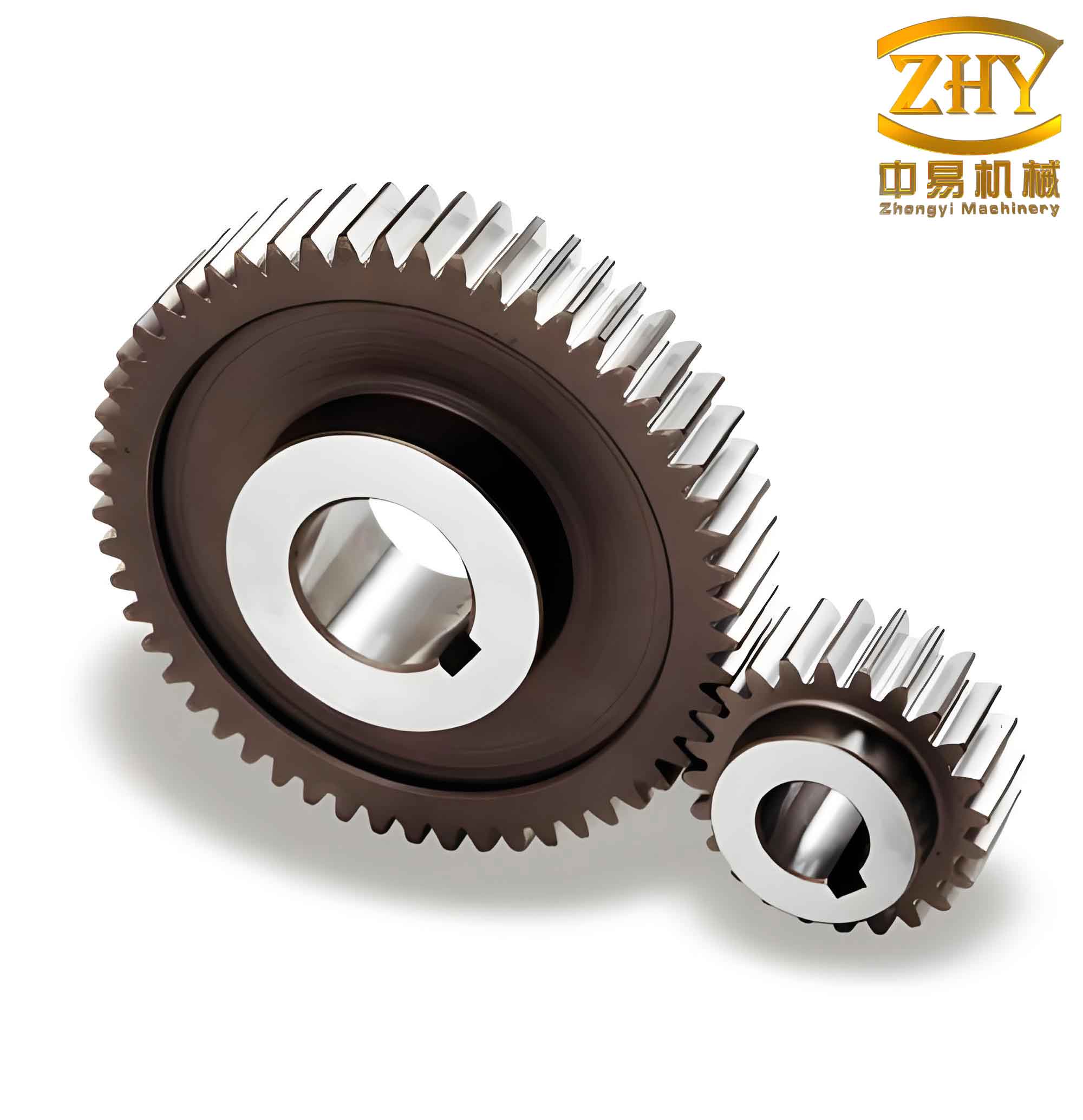
According to the literature on finite element stress analysis, the circumferential influence zone of gear contact is approximately three tooth spaces, while the radial influence zone is about 2–3 times the module (m). Therefore, I adopt a simplified five-tooth model for the straight spur gear. The model extends radially inward from the root circle by 2.5m to ensure accurate stress distribution near the tooth root. The simplified meshing model is shown schematically in the figure below (image of a five-tooth straight spur gear model).
1.2 Classical Hertz Contact Stress Calculation
In traditional gear design, the maximum contact stress is evaluated using the Hertz contact theory, which considers various correction factors. The classical formula for contact stress in a straight spur gear is given by:
$$
\sigma_H = Z_H \cdot Z_E \cdot Z_\varepsilon \cdot \sqrt{\frac{K F_t}{b d_1} \cdot \frac{\mu+1}{\mu}}
$$
where:
- \(Z_H\) is the zone factor (2.5)
- \(Z_E\) is the elastic coefficient (189.8 MPa¹/²)
- \(Z_\varepsilon\) is the contact ratio factor (0.872)
- \(K\) is the load factor (1.2)
- \(b\) is the face width (17 mm)
- \(d_1\) is the pitch circle diameter of pinion (50 mm)
- \(F_t\) is the tangential force (3800 N)
- \(\mu\) is the gear ratio (3.32)
Substituting the values from Table 2 (calculated according to design standards), I obtain the classical contact stress:
| Parameter | Symbol | Value |
|---|---|---|
| Load factor | K | 1.2 |
| Zone factor | Z_H | 2.5 |
| Elastic coefficient (MPa¹/²) | Z_E | 189.8 |
| Contact ratio factor | Z_\varepsilon | 0.872 |
| Face width (mm) | b | 17 |
| Pinion pitch diameter (mm) | d_1 | 50 |
| Gear ratio | μ | 3.32 |
| Tangential force (N) | F_t | 3800 |
After calculation, the classical contact stress is:
$$
\sigma_H = 1029 \ \text{MPa}
$$
This value serves as a benchmark for comparing with the finite element results.
2. Finite Element Analysis Using ABAQUS
2.1 Model Setup and Solution
I perform a quasi-static analysis using ABAQUS/Standard. The five-tooth straight spur gear model is meshed with quadratic hexahedral elements (C3D20R). Contact is defined between the tooth flanks with a finite sliding formulation. The boundary conditions include fixing the large gear (Z2) at its bore and applying a torque of 95000 N·mm to the pinion shaft. The analysis yields the contact stress distribution shown in the stress contour plot (not referenced numerically here). The maximum contact stress from FEA is approximately 1209 MPa, located near the root of the tooth, close to the involute start point. This value is about 17% higher than the classical Hertz result, indicating the influence of the simplified geometry and boundary conditions.
2.2 Effect of Friction Coefficient on Contact Stress
Friction plays a significant role in the contact behavior of straight spur gear teeth. Due to elastic deformation, the initial line contact becomes a finite area contact, and friction affects the tangential traction. I investigate five different friction coefficients: 0, 0.05, 0.07, 0.10, and 0.15. The results are summarized in Table 3 and Figure 3 (shown below as a table of values).
| Friction Coefficient | Contact Stress (MPa) |
|---|---|
| 0 | 1040 |
| 0.05 | 1048 |
| 0.07 | 1050 |
| 0.10 | 1050 |
| 0.15 | 1055 |
The trend shows that as the friction coefficient increases, the contact stress at the initial engagement point rises more rapidly, and the overall maximum contact stress increases slowly. For the straight spur gear, a friction coefficient of 0.1 is commonly used in practice, and the corresponding stress is 1050 MPa, which is still close to the classical value. However, the stress distribution becomes more uneven with higher friction, potentially leading to increased wear and pitting.
2.3 Effect of Radial Inward Extension Distance on Bending Stress
The distance from the root circle inward (denoted as \(\delta_0\)) significantly influences the bending stress at the tooth root. I select five values: 1m, 1.5m, 2m, 2.5m, and 3m (where m is the module). The pinion tooth root bending stress is extracted at a point near the tooth root fillet. Results are presented in Table 4 and Figure 4 (as a table).
| Radial Extension Distance (multiples of m) | Root Bending Stress (MPa) |
|---|---|
| 1m | 353 |
| 1.5m | 402 |
| 2m | 430 |
| 2.5m | 458 |
| 3m | 462 |
The bending stress increases with \(\delta_0\) but the rate of increase diminishes. For distances beyond 2.5m, the stress stabilizes around 460 MPa. This observation aligns with the recommendation in mechanical design handbooks that a radial extension of 2–3m is sufficient for accurate stress evaluation. Therefore, for the straight spur gear model, using a 2.5m extension provides a good balance between computational cost and accuracy.
3. Discussion and Conclusions
Through this finite element study of a straight spur gear, several important conclusions can be drawn:
- The classical Hertz contact stress (1029 MPa) underestimates the actual contact stress predicted by FEA (1209 MPa) for the given straight spur gear model. This difference arises from the simplified assumptions in Hertz theory and the influence of the tooth shape and boundary constraints.
- Friction coefficient has a limited but noticeable effect on the maximum contact stress of the straight spur gear. Higher friction increases the stress slightly and leads to a more severe stress gradient near the contact zone. For practical design, a friction coefficient of 0.1 is recommended.
- The radial inward extension distance \(\delta_0\) significantly affects the tooth root bending stress. A value of 2.5m to 3m yields consistent results, which matches the guidelines in gear design literature. Using a smaller extension (e.g., 1m) underestimates the bending stress by about 24%, which could lead to unsafe designs.
- The five-tooth simplified model is effective for static stress analysis of straight spur gear meshing, providing a good balance between computational efficiency and accuracy.
In summary, this study provides valuable insights into the stress behavior of an involute straight spur gear under static loading. The results can serve as a reference for optimizing the design of straight spur gear transmissions, reducing vibration and noise, and improving meshing characteristics. Future work could extend the analysis to dynamic loading and include the effects of gear tooth modifications.
All simulations were performed using ABAQUS 2020. The material is assumed to be isotropic and linear elastic, which is appropriate for steel gears. The findings confirm that careful selection of model parameters, such as friction coefficient and root extension, is essential for reliable finite element analysis of straight spur gear systems.