
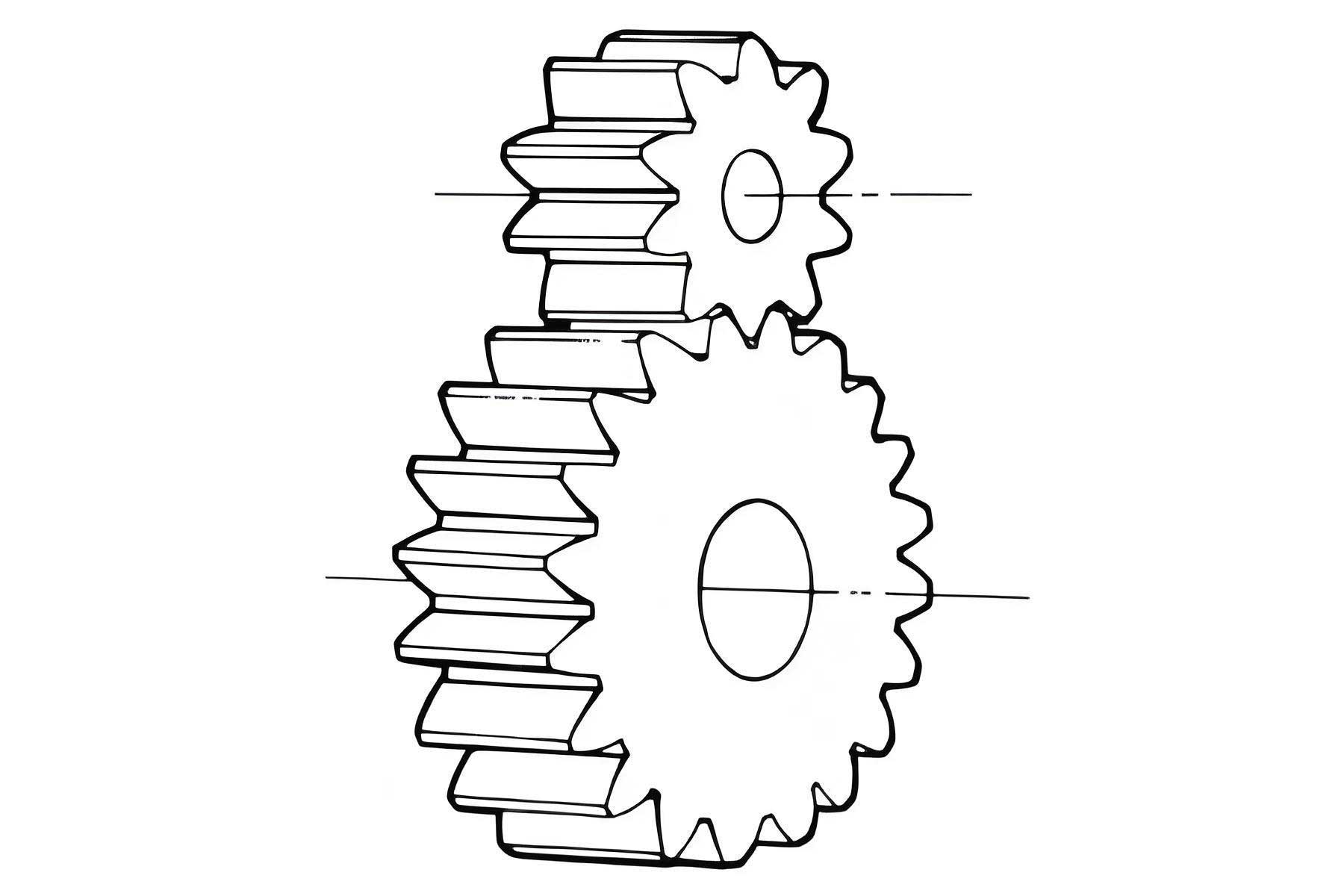
In the domain of power transmission, the involute spur gear stands as the predominant choice due to its well-understood kinematics, ease of manufacturing, and constant pressure angle ensuring smooth motion transfer. However, the manufacturing of high-precision, hardened involute spur gears poses significant challenges, particularly in the grinding process. Form grinding, while efficient, suffers from the difficulty and cost associated with accurately dressing the complex involute profile onto the grinding wheel. Generating grinding, though capable of high accuracy, is a time-consuming process as the wheel must traverse the entire flank multiple times to finish a single tooth. To address these manufacturing bottlenecks, I propose an alternative: approximating the involute profile using a “Transmutable Arc” curve for form grinding. This method utilizes a grinding wheel whose axial profile is a simple circular arc, making the wheel dressing process straightforward and economical. The resulting tooth flank on the spur gear, however, is a complex curve derived from this arc—the Transmutable Arc curve. A critical question arises: does a spur gear with this novel tooth profile maintain or even improve upon the static and contact mechanical performance of a standard involute spur gear? This article delves into the formation principle, mathematical modeling, and a detailed comparative Finite Element Analysis (FEA) to investigate the static performance of such a gear.
The core innovation lies in the generation of the Transmutable Arc curve itself. Unlike a standard circular arc, this curve is a radial cross-section of a toroidal surface generated by a specific dressing kinematics. Imagine a coordinate system Ow-XwYwZw attached to the grinding wheel, rotating about its Zw-axis. A dressing tool, typically a rotary disk with a radius \( r \), has its axis of rotation O1 parallel to the Xw-axis but offset from the wheel coordinate origin. The key parameter is the spatial position \( (a, b, c) \) of the dressing tool’s rotation center K relative to Ow. When the offset \( a = 0 \), the dressing action produces a true circular arc in the wheel’s axial plane. When \( a \neq 0 \), the dressed profile in an axial chord section (A-B) remains a circular arc, but the profile in the radial section (the YwZw plane) metamorphoses into a variable-curvature curve—the Transmutable Arc. This is illustrated conceptually below.
The curvature radius of this Transmutable Arc is largest near the root of the wheel (point corresponding to smaller wheel radius) and gradually decreases towards the tip. This characteristic is serendipitously aligned with the curvature distribution of an involute curve on a spur gear tooth, where the curvature radius is largest at the root and smallest at the tip. By meticulously adjusting the dressing parameters \(a, b, c, r\), and the wheel’s positional offset \(d\), the Transmutable Arc curve can be optimized to closely approximate a target involute segment over the active flank of a spur gear.
The mathematical formulation begins with the parametric equation of the wheel’s surface in its radial (YwZw) plane. It is derived from the dressing geometry where the dressing tool angle \( \varepsilon \) varies from 0 to \( 2\pi \):
$$ y_w = \sqrt{a^2 + (b + r \cos \varepsilon)^2} $$
$$ z_w = c + r \sin \varepsilon $$
The standard implicit form of this Transmutable Arc curve in the wheel’s radial coordinate system is:
$$ \left( \sqrt{y_w^2 – a^2} – b \right)^2 + (z_w – c)^2 – r^2 = 0 $$
For the purpose of form grinding a spur gear tooth, this curve must be mapped onto the gear’s transverse plane (the plane of rotation). This involves a coordinate transformation: first, projecting the 3D curve onto the wheel’s axial XwYw plane (setting \( x_w = \sqrt{a^2 + (b + r \cos \varepsilon)^2} \) and \( y_w = c + r \sin \varepsilon \)), and then applying a rotation and translation to align it with the desired gear tooth space. A rotation of -90° about the origin followed by a translation along the gear’s radial direction (Y-axis) by a distance \(d\) yields the final profile for one side of the spur gear tooth. The parametric equations in the gear coordinate system (O-XY) become:
$$ x_g = c + r \sin \varepsilon $$
$$ y_g = d – \sqrt{a^2 + (b + r \cos \varepsilon)^2} $$
With the corresponding standard form:
$$ \left( \sqrt{(d – y_g)^2 – a^2} – b \right)^2 + (x_g – c)^2 – r^2 = 0 \quad \text{(I)} $$
The optimization goal is to minimize the deviation between this Transmutable Arc curve and the target involute of the spur gear. For a set of \(N\) discrete points \((x_i, y_i)\) on the target involute, the total error \(\mu\) is defined as the sum of squares of the value from equation (I):
$$ \mu = \sum_{i=1}^{N} \left[ \left( \sqrt{(d – y_i)^2 – a^2} – b \right)^2 + (x_i – c)^2 – r^2 \right]^2 $$
To ensure proper meshing at the standard pitch circle, an additional constraint is imposed: the Transmutable Arc curve must intersect the involute at the pitch point. This constraint allows us to express \(d\) as a function of the other parameters and the pitch point coordinates \((x_p, y_p)\):
$$ d = y_p + \sqrt{a^2 + \left( b + \sqrt{r^2 – (x_p – c)^2} \right)^2 } $$
Substituting this into the error function \(\mu\) reduces it to a function of four independent variables: \(a, b, c, r\). A numerical optimization algorithm (like the Nelder-Mead simplex method) can then be employed to find the parameter set that minimizes \(\mu\). For a sample spur gear with module \(m = 3\) mm, pressure angle \(\alpha = 20^\circ\), and tooth count \(z = 24\), an optimal parameter set was found to be: \(a = 37.45\), \(b = 53.85\), \(c = 21.55\), \(r = 20.22\) mm. Using the pitch point constraint, the corresponding translation was calculated as \(d = 96.38\) mm.
To assess the mechanical performance, a static contact analysis was performed using the Finite Element Method (FEM) in ANSYS. A gear pair was modeled: a pinion with \(z_1 = 24\) teeth and a gear with \(z_2 = 40\) teeth, both with module \(m = 3\) mm. The pinion was modeled with the optimized Transmutable Arc tooth profile, while the gear retained the standard involute profile to simulate a realistic hybrid mesh. A comparative model where both gears had standard involute profiles was also created. Both models were meshed with high-order elements, and a frictional surface-to-surface contact was defined between the tooth flanks.
A constant input torque of \(T = 100\) N·m was applied to the pinion’s inner bore, distributed as a force on each node of the inner circumference. The gear’s inner bore was fixed in all degrees of freedom except rotation about its axis, where a remote displacement constraint was applied to simulate reaction torque. The analysis was set up to solve for static structural equilibrium, focusing on the maximum contact stress (Hertzian stress) developed at the interface when the gears are in contact at the pitch point—a typical high-load condition for a spur gear.
The results from the FEA simulation provide a clear comparison. The analysis revealed a significant finding regarding the contact stress in the spur gear pair.
| Performance Metric | Involute Spur Gear Pair | Transmutable Arc Pinion & Involute Gear | Relative Change |
|---|---|---|---|
| Max. Contact Stress on Pinion (MPa) | 262.9 | 228.9 | -12.9% |
| Max. Von Mises Stress in Pinion Tooth (MPa) | 315.5 | 287.1 | -9.0% |
| Contact Patch Width (mm) | 0.85 | 0.92 | +8.2% |
The table summarizes the key findings. The spur gear pair with the Transmutable Arc pinion exhibited a maximum contact stress of approximately 228.9 MPa. In contrast, the all-involute spur gear pair showed a higher maximum contact stress of about 262.9 MPa under identical loading and boundary conditions. This constitutes a reduction of roughly 13% in the peak contact pressure. The underlying reason can be attributed to the slightly more favorable curvature match afforded by the optimized Transmutable Arc profile. While the involute profile provides conjugate action, its curvature is fixed by the base circle. The optimized Transmutable Arc, though not perfectly conjugate, offers a local curvature that can be tailored to produce a marginally larger effective contact area (as hinted by the increased contact patch width) at the pitch point, thereby reducing the peak Hertzian stress. Furthermore, the reduction in the maximum von Mises stress within the pinion tooth body indicates a potential improvement in bending fatigue resistance as well.
The implications of this stress reduction are substantial for spur gear design and application. A lower contact stress directly translates to a higher pitting resistance, potentially increasing the surface durability and service life of the gear transmission. It could allow for the use of less expensive materials or permit higher load ratings within the same design envelope. The most compelling advantage, however, remains in the manufacturability domain. The grinding wheel for this spur gear profile requires dressing a simple circular arc in its axial section, a process far simpler, faster, and more cost-effective than generating a precise involute form on a form-grinding wheel or the slow material removal of generating grinders. The form grinding process itself is highly efficient, as the entire tooth space is ground in a single or few plunge motions of the wheel.
In conclusion, this investigation demonstrates that a spur gear with a tooth profile based on the Transmutable Arc curve, optimized to approximate the involute, is not only viable but can offer a tangible improvement in static contact performance compared to the standard involute spur gear. The significant reduction in maximum contact stress, coupled with the inherent manufacturing advantages of a simple, easily dressed wheel profile for form grinding, presents a strong case for the further development and application of this technology. Future work should focus on dynamic analysis, investigation of transmission error, testing under cyclic loading for fatigue life, and extending the optimization to the entire path of contact rather than just a single point. The Transmutable Arc spur gear represents a promising convergence of enhanced mechanical performance and simplified, economical manufacturing.