
In modern mechanical transmission systems, bevel gears play a critical role due to their ability to transmit power between intersecting shafts. Among various types, spiral bevel gears are particularly favored for high-speed and heavy-duty applications because of their larger contact area and smoother operation compared to straight or helical bevel gears. However, the complex nature of tooth surface contact in these bevel gears often leads to nonlinear behaviors such as stress concentration, wear, and fatigue, which can compromise reliability. To address this, we conducted a comprehensive static and dynamic numerical simulation study on the tooth surface contact of spiral bevel gears used in a reduction mechanism. This research aims to elucidate the contact characteristics, stress distributions, and dynamic responses under varying operational conditions, providing insights for optimizing the design and enhancing the fatigue life of bevel gears.
The importance of bevel gears in industries like automotive, aerospace, and petroleum cannot be overstated. Spiral bevel gears, in particular, exhibit superior performance due to their curved teeth, which allow for gradual engagement and disengagement. This results in reduced noise and vibration, making them ideal for high-speed scenarios. Nevertheless, the tooth surface contact in these bevel gears is influenced by factors such as elastic deformation, thermal effects, and dynamic loads, leading to challenges like pitting, scuffing, and premature failure. Previous studies have focused on static contact analyses or simplified models, but a holistic approach combining static and dynamic simulations is essential to capture the full spectrum of behavior in bevel gears. Our work builds on this by employing advanced numerical methods to analyze both static and dynamic contact stresses, considering real-world operational parameters.
To begin, we established the fundamental parameters and three-dimensional model of the spiral bevel gear pair. The gears were designed for a reduction mechanism with a 90-degree shaft angle, which is common in many industrial applications involving bevel gears. Key parameters include the normal pressure angle, spiral angle, and module, which directly affect the contact pattern and stress distribution. Using MATLAB, we generated the tooth surface based on tooth trace and profile line analyses, followed by secondary development in 3D modeling software to create an accurate geometric representation. The material properties were selected to reflect high-strength alloy steel typically used in bevel gears, with details summarized in Table 1. This table outlines the structural parameters essential for simulating the behavior of bevel gears under load.
| Parameter | Value (Pinion) | Value (Gear) |
|---|---|---|
| Shaft Angle | 90° | |
| Normal Pressure Angle | 20° | |
| Spiral Angle at Mid-Width | 35° | |
| Number of Teeth | 14 | 59 |
| Module | 5 mm | |
| Face Width | 50 mm | |
| Material | 20Cr2Ni4 Steel | |
| Elastic Modulus | 206.75 GPa | |
| Poisson’s Ratio | 0.3 | |
| Density | 7.85 × 10³ kg/m³ | |
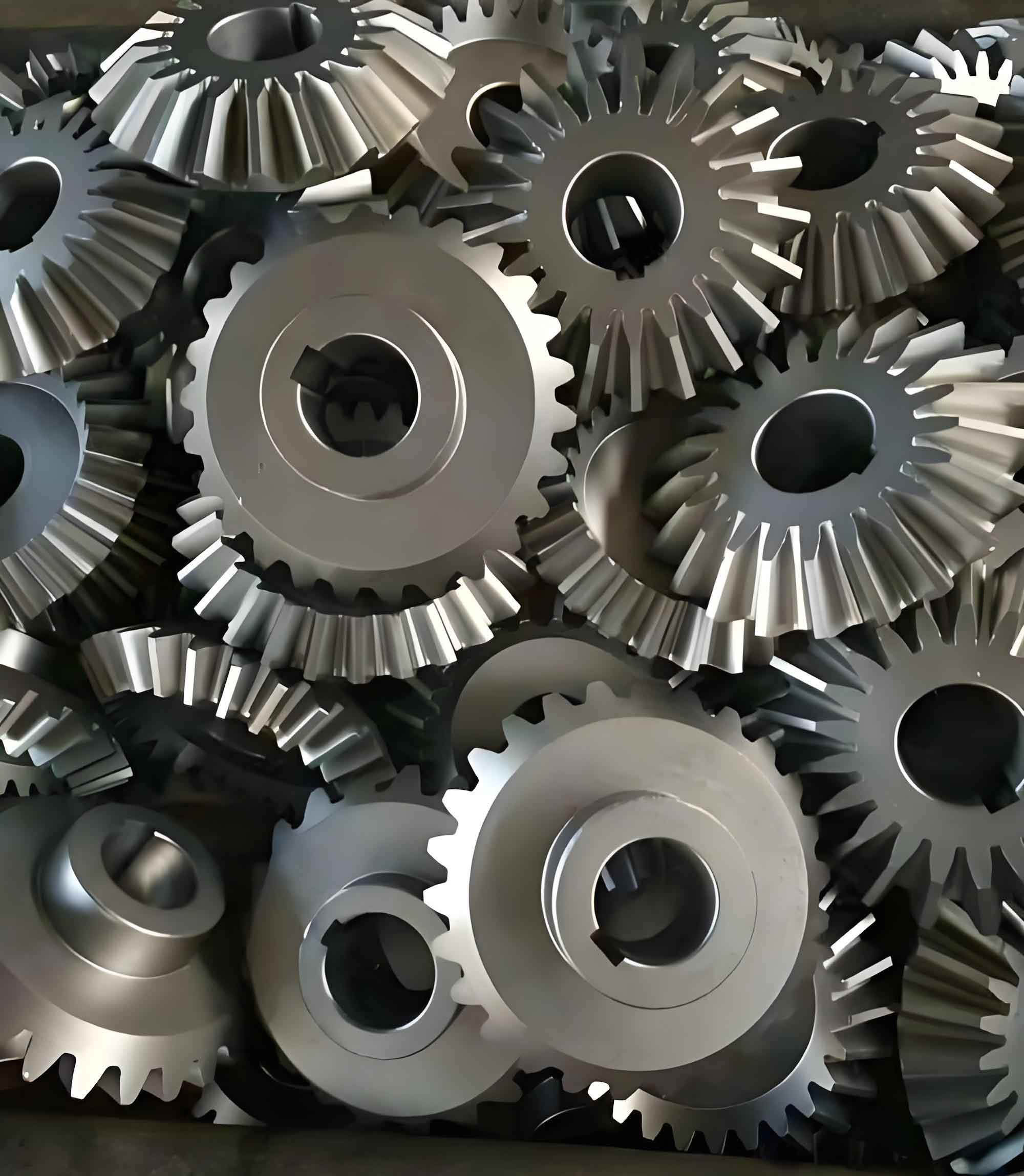
The three-dimensional model of the spiral bevel gear pair is crucial for accurate simulation. As shown in the figure below, the geometry captures the intricate tooth profiles and alignment, which are typical in bevel gears. This model was imported into finite element analysis software, where we performed mesh generation and contact definition to facilitate the numerical studies. The precision of this model ensures that the simulations reflect real-world conditions, allowing us to analyze the static and dynamic contact behavior of bevel gears effectively.
For the static contact analysis, we focused on determining the stress and strain distributions under steady-state conditions. The material properties, including an elastic modulus of 206.75 GPa and a Poisson’s ratio of 0.3, were applied to both gears. Mesh sensitivity analysis was conducted to ensure result accuracy; we varied the mesh size from 0.5 mm to finer scales and observed that stress values stabilized beyond 0.5 mm, with errors below 5%. Thus, a mesh size of 0.5 mm was adopted for the contact regions, using hexahedron-dominant elements for better precision. The contact pairs were defined with the pinion tooth surface as the contact surface and the gear tooth surface as the target surface, employing the augmented Lagrangian method for nonlinear contact resolution. This approach is well-suited for bevel gears, as it accounts for friction and separation effects.
The static analysis revealed the contact stress distribution across multiple teeth during engagement. We examined three distinct rotational positions (a, b, c) corresponding to different stages of the meshing cycle. In position a, the leading tooth enters engagement, showing increasing contact stress, while in position c, the trailing tooth exits, with stress decreasing. The contact patterns exhibited linear distributions along the tooth surfaces, indicating that multiple teeth share the load simultaneously—a key advantage of spiral bevel gears. However, edge contact at the tooth tips was observed, suggesting potential areas for optimization. The maximum contact stress values at these positions are summarized in Table 2, highlighting the stress variations that can impact the durability of bevel gears.
| Meshing Position | Tooth Involved | Maximum Contact Stress (MPa) |
|---|---|---|
| a (Entry) | Tooth 1 | 450 |
| b (Mid) | Tooth 2 | 520 |
| c (Exit) | Tooth 3 | 380 |
The contact stress distribution can be described using the Hertzian contact theory, which provides a foundational model for bevel gears. The maximum contact pressure \( p_{\text{max}} \) for two curved surfaces in contact is given by:
$$ p_{\text{max}} = \frac{3F}{2\pi a b} $$
where \( F \) is the normal load, and \( a \) and \( b \) are the semi-axes of the contact ellipse. For spiral bevel gears, this simplifies to account for the gear geometry and load distribution. The equivalent stress \( \sigma_{\text{eq}} \) can be calculated using the von Mises criterion:
$$ \sigma_{\text{eq}} = \sqrt{\frac{(\sigma_1 – \sigma_2)^2 + (\sigma_2 – \sigma_3)^2 + (\sigma_3 – \sigma_1)^2}{2}} $$
where \( \sigma_1, \sigma_2, \sigma_3 \) are the principal stresses. In our simulations, these formulas were integrated to validate the finite element results, ensuring that the stress levels in bevel gears remain within safe limits under static loads.
Transitioning to dynamic contact analysis, we modeled the gear pair under operational conditions to capture transient effects such as impact loads and varying stiffness. A dynamic model was built by applying an angular velocity boundary condition to the pinion and defining a revolute joint between the gears. The contact definition was converted from static to dynamic, allowing for time-dependent analysis of the meshing process. This is critical for bevel gears, as they often operate under fluctuating speeds and loads, leading to dynamic excitations that static analyses cannot fully capture.
The dynamic simulation covered a full meshing cycle, including single-tooth and double-tooth engagement phases. As the gears rotate, the contact stress varies periodically due to changes in the number of teeth in contact. For instance, in single-tooth engagement, the stress peaks as one tooth bears the entire load, whereas in double-tooth engagement, the load is shared, reducing the stress by approximately 40%. This cyclic behavior is illustrated in Figure 6 of the original text, where stress values oscillate between high and low levels. The equivalent stress contours at different stages (a-f) show how the stress distributes across the tooth surfaces, with maximum stresses occurring during entry and exit phases. This dynamic response underscores the importance of considering operational conditions in the design of bevel gears to prevent fatigue failures.
To quantify the effect of rotational speed on dynamic contact stress, we simulated various speed conditions and recorded the maximum stress during meshing. The results, plotted in Figure 7, indicate that contact stress increases exponentially with speed. At low speeds, the stress is relatively low and stable, but as speed rises, the dynamic effects amplify, leading to higher stress magnitudes and wider stress ranges. This relationship can be expressed mathematically as:
$$ \sigma_{\text{dynamic}} = k \cdot \omega^n $$
where \( \sigma_{\text{dynamic}} \) is the dynamic contact stress, \( \omega \) is the angular velocity, \( k \) is a constant dependent on gear geometry and load, and \( n \) is an exponent typically greater than 1 for bevel gears. Our analysis found that \( n \approx 1.5 \) for the tested gear pair, emphasizing the need for speed considerations in high-performance applications of bevel gears.
Further, we investigated the influence of load variations on dynamic behavior. By applying different torque levels, we observed that increased load leads to higher contact stresses, but the dynamic amplification is more pronounced at higher speeds. This interplay between load and speed is crucial for predicting the fatigue life of bevel gears. The contact fatigue life \( N_f \) can be estimated using the Basquin equation:
$$ N_f = C \cdot \sigma^{-m} $$
where \( C \) and \( m \) are material constants, and \( \sigma \) is the stress amplitude. For bevel gears, this must be adjusted to account for the multiaxial stress state and surface conditions. Our simulations showed that optimizing the tooth profile, such as by incorporating tip relief or grinding the tooth edges, can reduce stress concentrations and extend the life of bevel gears.
In addition to stress analysis, we examined the contact pattern evolution during dynamic meshing. The contact spots shift along the tooth surface as the gears rotate, influenced by factors like misalignment and thermal expansion. For spiral bevel gears, this results in a characteristic elliptical contact area that moves from the toe to the heel of the tooth. The size and shape of this area are critical for ensuring even load distribution and minimizing wear. Using numerical tools, we quantified the contact ratio, which is the ratio of the arc of action to the circular pitch, and found it to be greater than 1.5 for our gear pair, confirming the advantages of spiral bevel gears in terms of smooth power transmission.
The dynamic simulations also highlighted the role of damping and inertia effects. In high-speed operations, bevel gears experience vibrational modes that can lead to resonance if not properly addressed. We computed the natural frequencies and mode shapes of the gear pair to identify potential resonance conditions. The first natural frequency was found to be around 2 kHz, which is above the typical meshing frequency for the applied speeds, reducing the risk of severe vibrations. However, at very high speeds, the dynamic loads can excite higher modes, necessitating structural optimizations such as adding ribs or using composite materials for bevel gears in extreme environments.
To summarize the dynamic findings, we compiled the stress data under different operational scenarios in Table 3. This table compares the maximum dynamic contact stresses at various speeds and loads, providing a reference for designers working with bevel gears. The data clearly shows that both speed and load must be controlled to maintain stress levels within safe limits.
| Speed (RPM) | Load Torque (Nm) | Maximum Dynamic Stress (MPa) |
|---|---|---|
| 1000 | 500 | 480 |
| 2000 | 500 | 620 |
| 3000 | 500 | 850 |
| 1000 | 1000 | 600 |
| 2000 | 1000 | 780 |
| 3000 | 1000 | 1100 |
In conclusion, our static and dynamic numerical simulations provide a deep insight into the tooth surface contact behavior of spiral bevel gears. The static analysis demonstrated that multiple teeth engage simultaneously, distributing the load linearly and reducing stress peaks, but edge contacts require attention through design modifications like grinding. The dynamic analysis revealed that contact stress varies cyclically with meshing phases, and it increases exponentially with speed, highlighting the need for dynamic considerations in high-speed applications of bevel gears. By integrating these findings, we propose that future work should focus on multi-physics simulations incorporating thermal and lubricant effects to further enhance the reliability and lifespan of bevel gears. This research lays a scientific foundation for optimizing the design and operation of bevel gears in various industrial contexts.
The implications of this study extend to practical applications, such as in the petroleum industry where bevel gears are used in pumping systems, or in automotive differentials where durability is paramount. By applying the methodologies developed here, engineers can predict and mitigate failure modes in bevel gears, leading to more efficient and reliable machinery. Overall, the combination of static and dynamic analyses offers a comprehensive approach to understanding and improving the performance of bevel gears, ensuring they meet the demands of modern engineering challenges.