
In the realm of precision mechanical transmission systems, the planetary roller screw assembly stands out as a critical component for converting rotational motion into linear motion with high efficiency, large thrust capacity, and long service life. This mechanism is extensively utilized in aerospace, precision machine tools, medical devices, and other fields demanding reliable linear actuation. The core of the planetary roller screw assembly involves rollers that feature a central threaded section and straight gear teeth at both ends. These straight teeth engage with internal ring gears fixed at the ends of the nut, ensuring proper distribution of rollers around the screw and maintaining parallelism between roller and screw axes. However, the roller teeth are irregular structures resulting from helical sweep cuts, which can lead to stress concentrations, potential fracture under heavy loads or impact, and subsequent misalignment or debris ingress into the threaded sections. Therefore, a detailed static contact analysis of the internal meshing between roller teeth and ring gear is essential to ensure the reliability and durability of the planetary roller screw assembly. This study focuses on employing finite element methods to model and analyze this internal meshing pair, considering variations in contact line lengths across different roller teeth, to evaluate contact stress distributions and identify critical factors influencing performance.
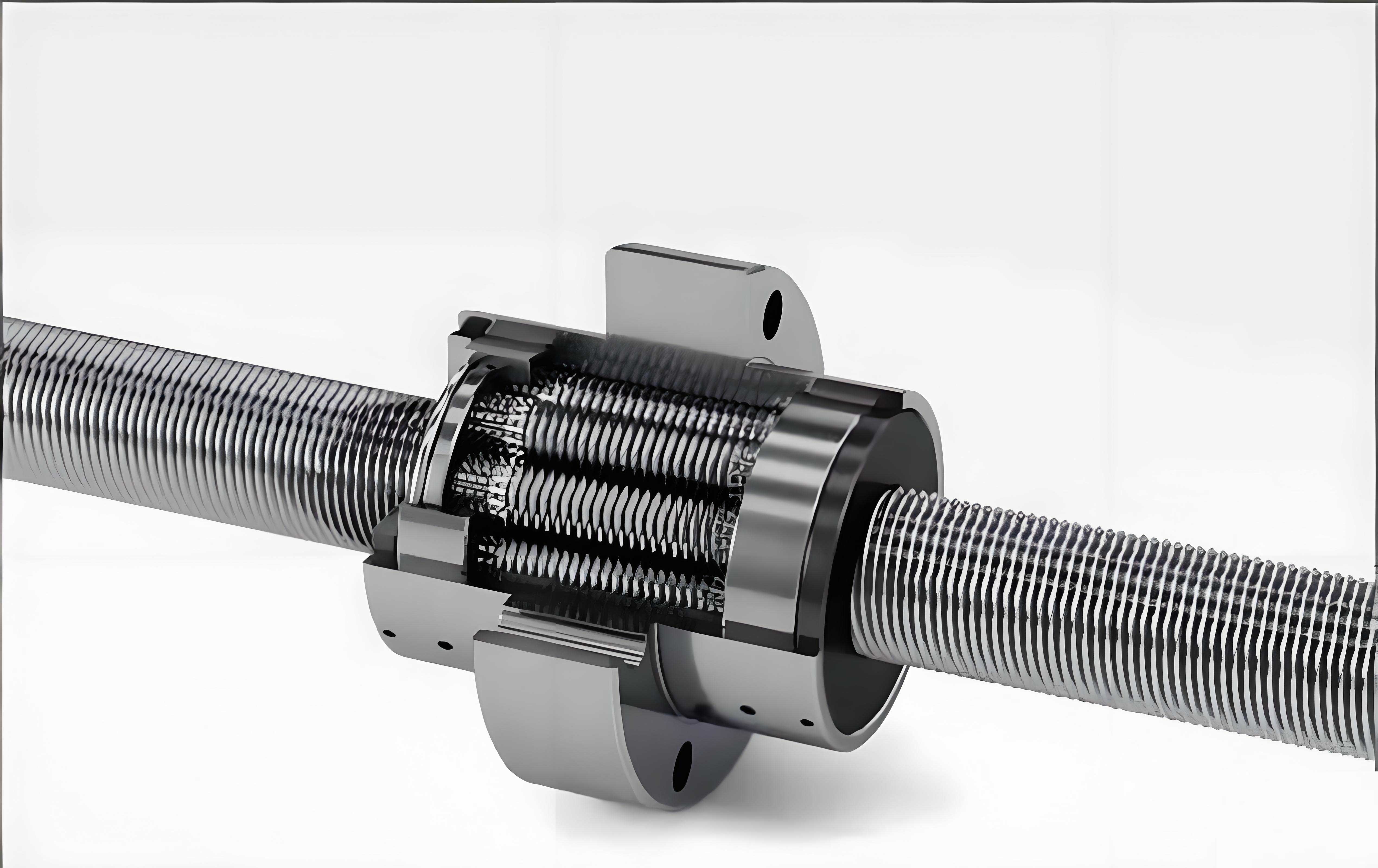
The planetary roller screw assembly operates on a principle where multiple rollers are arranged circumferentially between a central screw and a surrounding nut. As the screw rotates, the rollers both rotate about their own axes and revolve around the screw axis, driving the nut linearly. The engagement of roller teeth with the internal ring gear is crucial for synchronizing roller movements and preventing skewing. Given the complex geometry of roller teeth—shaped by helical cuts to accommodate the threaded sections—their meshing behavior with the ring gear deviates from standard gear interactions. This irregularity necessitates a thorough investigation into contact stresses to prevent failures that could compromise the entire planetary roller screw assembly. In this analysis, we develop a three-dimensional finite element model to simulate the static contact conditions, accounting for the unique tooth profiles and varying contact line lengths. The goal is to quantify maximum contact stresses under single-tooth meshing conditions, which represent the most critical scenario due to the gear pair’s contact ratio. By examining each roller tooth individually, we aim to provide insights that can guide design optimizations, such as tooth profiling or removal of stress-prone small teeth, thereby enhancing the robustness of the planetary roller screw assembly.
To model the internal meshing in the planetary roller screw assembly, we first define the geometric and material parameters. The gear pair consists of an external roller gear (with 20 teeth) and an internal ring gear (with 100 teeth), both having a module of 0.25 mm, pressure angle of 20 degrees, and face width of 5 mm. The roller teeth are further characterized by helical cut parameters, leading to three distinct tooth segments per roller tooth labeled as L1, L2, and L3, each with varying contact line lengths. The total contact line length for each roller tooth is the sum of these segments, which influences load distribution and stress concentrations. Table 1 summarizes the key parameters of the internal meshing gear pair, while Table 2 details the thread profile parameters that affect the roller tooth geometry due to the helical sweep. These parameters are derived from a commercial planetary roller screw assembly model, ensuring relevance to real-world applications.
| Parameter | Symbol | Roller Gear (External) | Ring Gear (Internal) |
|---|---|---|---|
| Module | m | 0.25 mm | 0.25 mm |
| Number of Teeth | z | 20 | 100 |
| Pitch Diameter | d | 5 mm | 25 mm |
| Addendum Coefficient | ha* | 0.8 | 0.8 |
| Dedendum Coefficient | c* | 0.3 | 0.3 |
| Pressure Angle | α | 20° | 20° |
| Addendum | ha | 0.2 mm | 0.2 mm |
| Dedendum | hf | 0.275 mm | 0.275 mm |
| Tip Diameter | da | 5.4 mm | 24.6 mm |
| Root Diameter | df | 4.45 mm | 25.55 mm |
| Face Width | b | 5 mm | 5 mm |
The thread profile parameters, as listed in Table 2, define the helical cut that shapes the roller teeth. These include a pitch of 2 mm, thread angle of 90 degrees, arc radius of 3.536 mm for the thread section, and trapezoidal thread dimensions. The interaction of these parameters with the gear geometry results in the irregular tooth segments, which are critical for accurate finite element modeling in the planetary roller screw assembly.
| Parameter | Value |
|---|---|
| Pitch | 2 mm |
| Thread Angle | 90° |
| Arc Radius of Thread Section | 3.536 mm |
| Upper Base of Trapezoidal Thread | 0.525 mm |
| Lower Base of Trapezoidal Thread | 1.475 mm |
| Height of Trapezoidal Thread | 0.475 mm |
For the finite element analysis, we utilize ANSYS Workbench software to create a three-dimensional contact model. Given the symmetry of the planetary roller screw assembly and to reduce computational cost, we simplify the model to a sector corresponding to one roller engaged with the internal ring gear, assuming equal load sharing among multiple rollers. The meshing is refined around the contacting teeth to ensure accuracy, as shown in Figure 2 of the reference, but here we describe it textually: the mesh density is increased at the engagement zones, resulting in a model with 1,358,082 elements and 260,704 nodes. The material properties are consistent across all components, with an elastic modulus of 210 GPa, Poisson’s ratio of 0.3, and density of 7,900 kg/m³, typical of high-strength steel used in planetary roller screw assembly applications.
The boundary conditions are set to replicate the operational state of the planetary roller screw assembly. Contact pairs are defined between the roller teeth and ring gear teeth using a surface-to-surface contact formulation with a friction coefficient of 0.01, contact stiffness factor of 1.0, and maximum allowable penetration of 0.1 via the Lagrange multiplier method. Displacement constraints are applied: the outer surface of the ring gear is fully fixed, its side faces have symmetric constraints, and the inner bore of the roller is constrained in radial and axial directions, allowing only rotational freedom about its axis. Force boundary conditions are applied to simulate the torque transmitted through the roller. In a cylindrical coordinate system aligned with the roller axis, a circumferential force is applied to all nodes on the roller’s inner bore, calculated as:
$$F_y = \frac{2 M_r}{N \times d_r}$$
where \(M_r\) is the torque on the roller, \(N\) is the number of nodes on the inner bore, and \(d_r\) is the diameter of the roller bore. This force induces meshing contact between the roller teeth and ring gear. The contact ratio of the gear pair is 1.4727, indicating that single-tooth meshing occurs during part of the engagement cycle, which is the most critical condition for stress analysis. Therefore, we analyze each of the 20 roller teeth individually under single-tooth contact conditions to assess their performance in the planetary roller screw assembly.
The contact line lengths for each roller tooth vary due to the helical cut, as summarized in Table 3. Each roller tooth is divided into three segments (L1, L2, L3), and the total contact line length \(L\) is the sum of these segments. This variation significantly affects load distribution and stress concentrations. For instance, roller teeth with shorter total contact lengths tend to experience higher contact stresses, which is a key focus in analyzing the planetary roller screw assembly.
| Roller Tooth ID | L1 (mm) | L2 (mm) | L3 (mm) | Total L (mm) |
|---|---|---|---|---|
| 1 | 0.61739 | 0.79289 | 0.79289 | 2.20317 |
| 2 | 0.71791 | 0.79234 | 0.79234 | 2.30259 |
| 3 | 0.79289 | 0.79289 | 0.79289 | 2.37867 |
| 4 | 0.79234 | 0.79234 | 0.79234 | 2.37702 |
| 5 | 0.79289 | 0.79289 | 0.77550 | 2.36128 |
| 6 | 0.79234 | 0.79234 | 0.67443 | 2.25911 |
| 7 | 0.79289 | 0.79289 | 0.57550 | 2.16128 |
| 8 | 0.79234 | 0.79234 | 0.47443 | 2.05911 |
| 9 | 0.79289 | 0.79289 | 0.37550 | 1.96128 |
| 10 | 0.79234 | 0.79234 | 0.27443 | 1.85911 |
| 11 | 0.79289 | 0.79289 | 0.17550 | 1.76128 |
| 12 | 0.79234 | 0.79234 | 0.07443 | 1.65911 |
| 13 | 0.79289 | 0.79289 | 0 | 1.58578 |
| 14 | 0.79234 | 0.79234 | 0 | 1.58468 |
| 15 | 0 | 0.79289 | 0.79289 | 1.58578 |
| 16 | 0.11791 | 0.79234 | 0.79234 | 1.70259 |
| 17 | 0.21739 | 0.79289 | 0.79289 | 1.80317 |
| 18 | 0.31791 | 0.79234 | 0.79234 | 1.90259 |
| 19 | 0.41739 | 0.79289 | 0.79289 | 2.00317 |
| 20 | 0.51791 | 0.79234 | 0.79234 | 2.10259 |
Using the finite element model, we perform static contact analyses for each roller tooth under single-tooth meshing conditions. The results for maximum contact stress are presented in Table 4. These values reveal significant variations across different roller teeth, highlighting the impact of contact line length and tooth segment geometry in the planetary roller screw assembly. For example, roller tooth 16 exhibits the highest maximum contact stress of 704.85 MPa, while roller tooth 3 shows a lower value of 372.71 MPa. This disparity correlates with the total contact line lengths: shorter lengths generally lead to higher stresses due to reduced load-bearing area. Additionally, the presence of small tooth segments (e.g., L1 or L3 with minimal lengths) can cause stress concentrations, as seen in teeth where the maximum stress occurs on these small segments.
| Roller Tooth ID | Maximum Contact Stress (MPa) | Roller Tooth ID | Maximum Contact Stress (MPa) |
|---|---|---|---|
| 1 | 413.45 | 11 | 654.79 |
| 2 | 404.64 | 12 | 696.62 |
| 3 | 372.71 | 13 | 661.91 |
| 4 | 375.33 | 14 | 661.47 |
| 5 | 377.10 | 15 | 664.66 |
| 6 | 411.50 | 16 | 704.85 |
| 7 | 412.79 | 17 | 650.13 |
| 8 | 425.07 | 18 | 546.78 |
| 9 | 516.78 | 19 | 435.63 |
| 10 | 518.60 | 20 | 415.41 |
To interpret these results, we consider the relationship between contact stress and gear parameters. The Hertzian contact stress theory provides a foundational framework for understanding contact mechanics in gear pairs. For two cylindrical bodies in contact, the maximum contact pressure \(p_{\text{max}}\) can be estimated as:
$$p_{\text{max}} = \sqrt{\frac{F E^*}{\pi R^* L}}$$
where \(F\) is the normal load, \(E^*\) is the equivalent elastic modulus, \(R^*\) is the equivalent radius of curvature, and \(L\) is the contact length. In the context of the planetary roller screw assembly, this formula underscores why roller teeth with shorter contact lengths \(L\) experience higher stresses for a given load. Our finite element results align with this principle, as seen in Table 4 where stresses increase for teeth with \(L\) below 2 mm. For instance, roller teeth 13, 14, and 15 have similar contact lengths around 1.585 mm and exhibit comparable maximum stresses near 660 MPa. In contrast, roller tooth 16, with a slightly longer \(L\) of 1.70259 mm but a very short L1 segment of 0.11791 mm, shows a stress peak of 704.85 MPa, indicating that stress concentrations on small segments can exacerbate beyond what total length alone predicts.
The irregular geometry of roller teeth, caused by helical cuts, introduces small tooth segments that act as stress risers. These segments, often with contact lines less than 0.5 mm, are prone to high localized stresses. In operational conditions of the planetary roller screw assembly, such stresses can lead to micro-pitting, fatigue cracks, or even fracture, especially under dynamic or impact loads. Fractured tooth fragments could enter the threaded regions, causing wear, noise, and eventual failure of the entire mechanism. Therefore, identifying and mitigating these critical areas is vital for enhancing the reliability of the planetary roller screw assembly. One proposed solution is tooth profiling or selective removal of small segments that contribute disproportionately to stress. For example, if the small segment L1 in roller tooth 16 is removed or blended, the contact stress may redistribute to longer segments, reducing the peak value and improving overall durability.
Beyond contact stress, the load distribution across multiple roller teeth in the planetary roller screw assembly is influenced by manufacturing tolerances, alignment errors, and elastic deformations. The finite element model assumes perfect geometry and equal load sharing, but in reality, variations can cause uneven loading, further emphasizing the need for robust design. To account for this, we can extend the analysis to include probabilistic methods or sensitivity studies. For instance, a Monte Carlo simulation could assess the impact of geometric deviations on contact stresses, providing a more comprehensive reliability assessment for the planetary roller screw assembly. Additionally, thermal effects from friction in high-speed applications may alter material properties and contact conditions, warranting coupled thermo-mechanical analyses in future work.
The stiffness of the planetary roller screw assembly is another critical factor tied to contact behavior. Axial stiffness affects positioning accuracy and dynamic response, and it depends on the compliance of contacting surfaces. From our static analysis, we can derive insights into stiffness contributions from the roller teeth meshing. The axial deformation \(\delta\) under load \(F_a\) can be related to contact stiffness \(k_c\) as:
$$\delta = \frac{F_a}{k_c}$$
where \(k_c\) is influenced by the contact stress distribution and material properties. By integrating our contact stress results, we can estimate the stiffness of the internal meshing pair and its effect on overall system performance. This is particularly important for applications requiring precise motion control, such as in aerospace actuators or medical robots where the planetary roller screw assembly is employed.
In practice, the design of the planetary roller screw assembly must balance multiple factors: torque capacity, speed, life expectancy, and size constraints. Our analysis highlights that optimizing roller tooth geometry can enhance performance without increasing size or weight. For example, adjusting the helical cut parameters to minimize small tooth segments or applying root fillets to reduce stress concentrations could significantly improve fatigue life. Furthermore, material selection plays a role; using case-hardened steels or coatings can increase surface hardness and resistance to pitting, common failure modes in heavily loaded gears. These considerations are integral to advancing the planetary roller screw assembly for next-generation applications.
To generalize our findings, we propose a design guideline for the internal meshing in planetary roller screw assembly: ensure that the total contact line length for each roller tooth exceeds a threshold value, say 2 mm for the given parameters, to maintain contact stresses below a safe limit, e.g., 500 MPa for typical steel alloys. Additionally, avoid tooth segments with contact lengths less than 0.3 mm, as they tend to be critical stress points. This can be achieved through modified machining processes or post-production treatments like shot peening to induce compressive residual stresses. Implementing such guidelines during the manufacturing phase of the planetary roller screw assembly can reduce the risk of field failures and extend service intervals.
Our study also underscores the importance of advanced simulation techniques in designing complex mechanical systems like the planetary roller screw assembly. While analytical methods like Hertz theory provide quick estimates, finite element analysis captures geometric nuances and nonlinearities, offering more accurate stress predictions. However, computational cost increases with model complexity, so simplifications like sector symmetry are valuable. Future work could involve dynamic contact analysis to simulate transient loads or multibody dynamics to model the full assembly under operational conditions. Such analyses would provide deeper insights into vibration, noise, and wear patterns in the planetary roller screw assembly.
In conclusion, the static contact analysis of internal meshing in the planetary roller screw assembly reveals that contact stress distributions are highly sensitive to roller tooth geometry, particularly the contact line lengths and presence of small tooth segments. Our finite element results show that maximum contact stresses increase as total contact line length decreases, with small segments often acting as stress concentrators. For the analyzed planetary roller screw assembly, roller teeth with total contact lengths below 2 mm, especially those with segments under 0.3 mm, exhibit stresses exceeding 600 MPa, which may compromise long-term durability. To mitigate this, design modifications such as tooth profiling or removal of critical small segments are recommended. These insights contribute to the optimization of the planetary roller screw assembly, ensuring reliable performance in demanding applications. Future research should explore dynamic effects, thermal coupling, and probabilistic designs to further enhance the robustness of this essential mechanical transmission system.
The planetary roller screw assembly continues to evolve with advancements in materials and manufacturing, and our work provides a foundational approach for evaluating its internal meshing characteristics. By prioritizing contact stress management, engineers can develop more reliable and efficient planetary roller screw assembly designs, meeting the growing demands of high-precision industries. As we push the boundaries of technology, such detailed analyses will remain crucial in unlocking the full potential of the planetary roller screw assembly in innovative applications.