
The pursuit of compact, lightweight, and highly reliable power transmission solutions is paramount in advanced engineering fields such as aerospace and marine propulsion. Among these, the coaxial dual-output cylindrical gear split-combined-torsion transmission system represents a sophisticated architecture designed to meet these demanding requirements. Its configuration allows for the distribution of input power from one or more prime movers across multiple parallel branches before recombining the flow to drive two concentric output shafts. While this design principle inherently suggests symmetry, practical factors invariably lead to unequal load distribution among the power paths. This imbalance can precipitate premature wear, elevated vibration, noise, and ultimately, a reduction in the system’s operational lifespan and reliability.
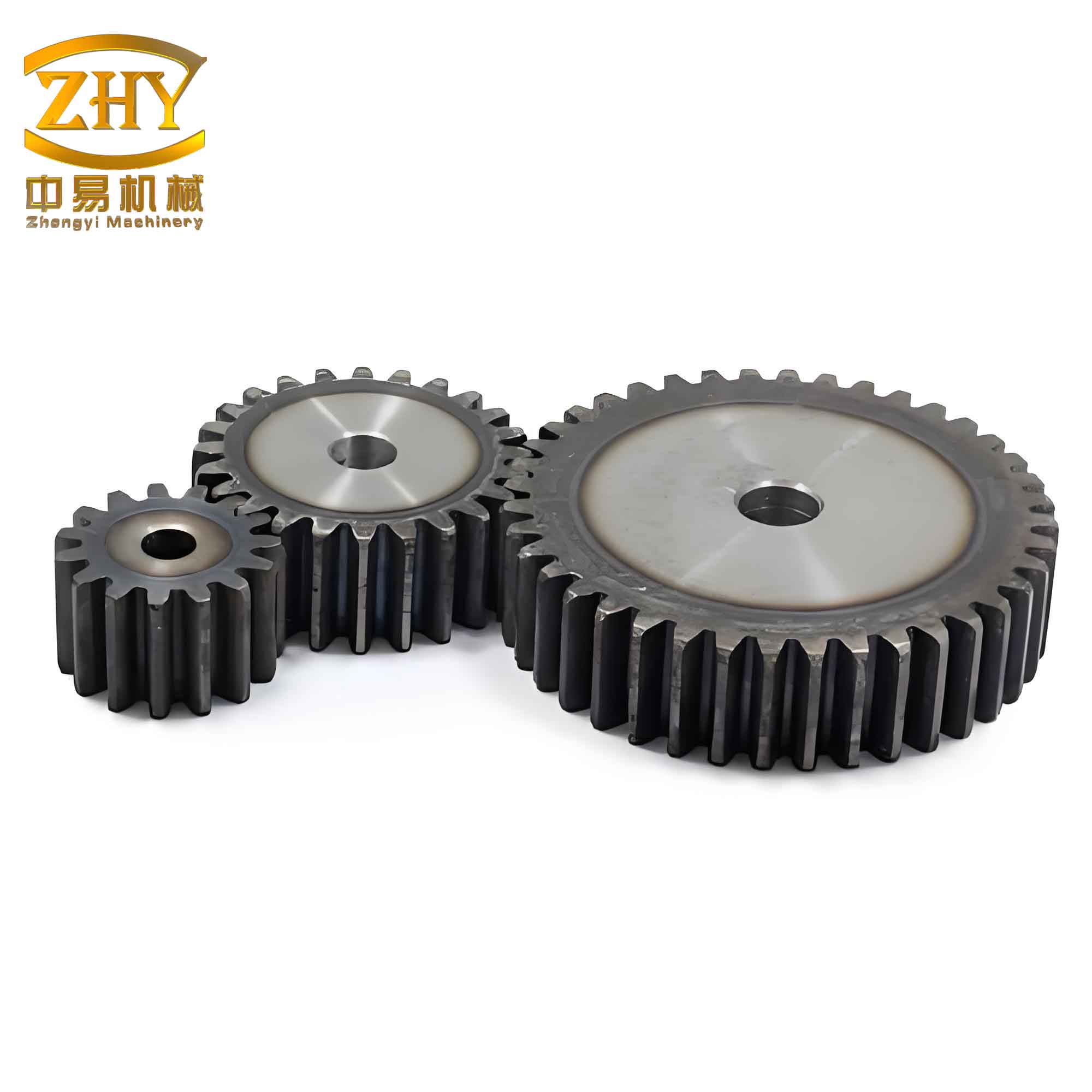
Understanding and mitigating this uneven load sharing is therefore a critical design challenge. While dynamic analysis captures transient effects, a rigorous static analysis forms the foundational understanding of the system’s load distribution behavior under steady-state torque, isolating the effects of geometric configuration, stiffness variations, and inherent errors. This article delves into a detailed static investigation of a two-engine input, coaxial dual-output system, with a particular focus on a often-overlooked yet critical parameter: the meshing phase difference between parallel cylindrical gear pairs.
System Architecture and Operational Principle
The subject transmission system is engineered for applications like rigid coaxial rotor helicopters. It features two independent engine inputs. Each input drive is first redirected via bevel gears (not the primary focus here) and then channeled into two distinct output circuits: one for the inner output shaft and one for the outer output shaft. Thus, for each engine, power is “split” at an initial stage.
Within each output circuit (inner and outer), the power from both engines is further managed by a split-combined-torsion stage comprised exclusively of cylindrical gears. This stage is the core of our analysis. It consists of a “split-torque” level and a “combined-torque” level. At the split-torque level, input cylindrical gears mesh with two separate, parallel cylindrical gear pairs, effectively dividing the incoming torque from each engine’s circuit into two branches. These branches are connected via a quill shaft (or simply, a torsional shaft). Finally, at the combined-torque level, the cylindrical gears from all four branches (2 engines × 2 branches per output circuit) mesh with a single large cylindrical output gear connected to the respective inner or outer shaft, thereby recombining the torque.
Despite the apparent symmetry in this cylindrical gear layout, minute differences in manufacturing tolerances, assembly alignment, and most importantly for this study, the relative timing of gear tooth engagement (phase difference) between parallel branches, disrupt perfect load equality. The following table summarizes the key geometric parameters of the cylindrical gears in the analyzed system.
| Parameter | Split-Torque Stage | Combined-Torque Stage | General |
|---|---|---|---|
| Module (mm) | 2.4 | 3.7 | – |
| Pinion Teeth | 36 | 31 | – |
| Gear Teeth | 100 | 159 | – |
| Face Width (mm) | 25 | 35 | – |
| Pressure Angle (°) | – | – | 20 |
| Young’s Modulus (MPa) | – | – | 2.1×10⁵ |
| Poisson’s Ratio | – | – | 0.3 |
Static Equilibrium Modeling
To analyze the static load sharing, a lumped-parameter model is developed. Each component (shaft, bearing, gear mesh) is represented by its stiffness. The model considers: 1) Torsional deformation of the quill shafts connecting the split and combined level cylindrical gears in each branch. 2) Bending deformations of all shafts. 3) Translational compliance of bearings and their supports. 4) Mesh deformations of the cylindrical gear pairs. 5) Comprehensive errors (manufacturing and assembly) at each cylindrical gear. 6) The time-varying meshing stiffness of the cylindrical gear pairs.
The fundamental equations governing the system are derived from force equilibrium, torque balance, and deformation compatibility conditions. For any branch within an output circuit, the relationship between the torque carried by the quill shaft and the gear mesh forces is central.
Torque and Force Equilibrium: For a given branch, the input torque to the split-level cylindrical pinion is balanced by the sum of mesh forces from its two mating gears. Similarly, the torque on the combined-level output cylindrical gear is the sum of contributions from all four input branches.
Let \( T_{kif} \), \( T_{kip} \), \( T_{kijs} \), \( T_{kijh} \), and \( T_{kB} \) denote the torques on the input shaft, split-level pinion, split-level gear, combined-level pinion, and combined-level output gear, respectively. The indices are: \( k \) for output circuit (U=Inner, D=Outer), \( i \) for engine input side (L=Left, R=Right), and \( j \) for branch number (1, 2). The equilibrium equations are:
$$
\begin{aligned}
T_{kif} – T_{kip} &= 0 \\
T_{ki1s} + T_{ki2s} – i_1 T_{kip} &= 0 \\
T_{kijs} – T_{kijh} &= 0 \\
T_{kB} – i_2 \sum_k \sum_i \sum_j T_{kijh} &= 0
\end{aligned}
$$
where \( i_1 \) and \( i_2 \) are the gear ratios of the split and combined stages. The mesh forces \( F_{kijn}^{ps} \) (between pinion \( Z_{kip} \) and gear \( Z_{kijs} \)) and \( F_{kijn}^{Bh} \) (between pinion \( Z_{kijh} \) and gear \( Z_{kB} \)) relate to torques via their base circle radii \( r_b \):
$$
\begin{aligned}
T_{kip} – (F_{ki1n}^{ps} + F_{ki2n}^{ps}) r_{bp} &= 0 \\
T_{kijs} – F_{kijn}^{ps} r_{bs} &= 0 \\
T_{kijh} – F_{kijn}^{Bh} r_{bh} &= 0 \\
T_{kB} – r_{bB} \sum_k \sum_i \sum_j F_{kijn}^{Bh} &= 0
\end{aligned}
$$
Deformation Compatibility: This is the cornerstone of load sharing analysis. The total angular displacement at the input cylindrical pinion of a branch arises from the sum of several elastic deflections and geometric errors: 1) Torsional wind-up of the quill shaft. 2) Mesh deflections at both cylindrical gear pairs. 3) Relative displacements of gear centers due to shaft/bearing bending. 4) Effective displacement due to gear composite errors. 5) Displacement due to designed backlash.
The relative angular displacement \( \phi_{kij}^p \) for branch \( j \) of a given input side \( i \) and circuit \( k \), referenced to its input pinion, can be expressed as:
$$
\phi_{kij}^p = i_1 (\phi_{kij}^1 + \phi_{kij}^2 + \phi_{kij}^3) + \phi_{kij}^4 + \phi_{kij}^5 + \phi_{kij}^6
$$
where:
\( \phi_{kij}^1, \phi_{kij}^2 \): Angular deflections from mesh compliance of the split and combined cylindrical gear pairs.
\( \phi_{kij}^3 \): Torsional deflection of the quill shaft.
\( \phi_{kij}^4 \): Angular displacement equivalent to circumferential backlash.
\( \phi_{kij}^5, \phi_{kij}^6 \): Angular displacements caused by relative center movements of the split and combined cylindrical gear pairs, respectively.
For perfect load sharing between the two branches (j=1 and j=2) of the same input, their total angular displacements at the common input pinion must be equal, yielding the compatibility equation:
$$
\phi_{ki1}^p – \phi_{ki2}^p = 0
$$
Solving this system of equilibrium and compatibility equations, typically using numerical methods, yields the torque \( T_{kij}^{sh} \) carried by each quill shaft, which is the direct indicator of load sharing.
Time-Varying Meshing Stiffness and Phase Difference Mechanism
A crucial factor disrupting load sharing is the time-varying meshing stiffness \( k(t) \) of the cylindrical gear pairs. As gear teeth rotate, the number of tooth pairs in contact and the contact position on the tooth profile change, causing periodic fluctuation in the mesh stiffness. For a healthy spur cylindrical gear pair, the stiffness varies between a maximum (two-tooth contact) and a minimum (one-tooth contact).
The stiffness can be accurately calculated using the potential energy method, modeling the tooth as a non-uniform cantilever beam. The total mesh stiffness \( k \) for a pair at any meshing position considering Hertzian contact, bending, shear, axial compressive, and fillet foundation deflection is given by:
$$
k = \sum_{i=1}^{2} \left[ 1 / \left( \frac{1}{k_{h,i}} + \frac{1}{k_{b1,i}} + \frac{1}{k_{s1,i}} + \frac{1}{k_{f1,i}} + \frac{1}{k_{a1,i}} + \frac{1}{k_{b2,i}} + \frac{1}{k_{s2,i}} + \frac{1}{k_{f2,i}} + \frac{1}{k_{a2,i}} \right) \right]
$$
where subscripts \( h, b, s, f, a \) denote Hertzian, bending, shear, fillet foundation, and axial stiffnesses, respectively, and indices 1,2 refer to the pinion and gear, and \( i \) refers to the contacting tooth pair (i=1,2).
Meshing Phase Difference: In an ideal, perfectly synchronized split-path system, the parallel cylindrical gear pairs would engage and disengage teeth at identical moments. However, in reality, due to assembly adjustments, intentional backlash setting, or manufacturing deviations, one branch’s gear pair may lead or lag the other in its meshing cycle. This angular offset is the meshing phase difference.
Consider two parallel cylindrical gear pairs, ‘a’ and ‘b’, sharing a common input cylindrical pinion. If pair ‘a’ is taken as reference, the meshing phase difference \( \gamma_{ba}(t_1) \) of pair ‘b’ relative to ‘a’ at time \( t_1 \) is defined as:
$$
\gamma_{ba}(t_1) = \frac{t_2 – t_1}{T_b}
$$
where \( t_2 \) is the time pair ‘b’ reaches an equivalent meshing point (e.g., start of single-tooth contact), and \( T_b \) is its meshing period. This phase difference means that at any given instant, the two parallel cylindrical gear pairs possess different instantaneous mesh stiffness values, \( k_a(t) \) and \( k_b(t + \Delta t) \). This stiffness mismatch directly influences the load-dependent mesh deflection (\( \phi^1, \phi^2 \)) in the compatibility equation, forcing a redistribution of torque between the branches to satisfy displacement equality.
The following table outlines the primary system conditions and error assumptions for the static analysis.
| Analysis Parameter | Condition / Value |
|---|---|
| Input Torque Condition | Equal torque from each input shaft (balanced engine power) |
| Primary Load Sharing Metric | Quill Shaft Torque \( T_{kij}^{sh} \) |
| Load Sharing Coefficient (LSC) | \( \Omega_{kij} = 2T_{kij}^{sh} / (T_{ki1}^{sh} + T_{ki2}^{sh}) \) for branch j |
| System LSC | \( \Omega_{ki} = \max(\Omega_{ki1}, \Omega_{ki2}) \) for input side i |
| LSC Fluctuation Metric | \( \Delta \Omega = \Omega_{\max} – \Omega_{\min} \) over one mesh cycle |
| Phase Difference Convention | Phase of Branch 2 minus Phase of Branch 1. Positive: Branch 2 leads. |
| Baseline Errors | Nominal manufacturing/assembly errors included. |
Impact of Phase Difference on Static Load Sharing
The analysis systematically investigates the influence of introducing controlled phase differences at both the split-torque and combined-torque cylindrical gear stages, separately for the inner (U) and outer (D) output circuit branches. The phase difference is varied over a full meshing period, and the resulting Load Sharing Coefficient (LSC) and its fluctuation are computed.
General Observations
1. The presence of any non-zero meshing phase差 between parallel cylindrical gear branches invariably deteriorates the static load sharing performance compared to the ideal in-phase condition (\( \gamma = 0 \)). Even at \( \gamma = 0 \), minor LSC fluctuations exist due to other system errors, but these are significantly amplified by the phase difference.
2. For both the inner and outer output circuits, the influence of the phase difference at the combined-torque cylindrical gear stage is markedly more severe on the LSC and its fluctuation than the phase difference at the split-torque cylindrical gear stage. This is because the combined stage is the final recombination point for four torque paths, making its compliance directly and simultaneously felt by all branches, thereby magnifying the effect of any timing mismatch.
3. The LSC versus phase angle curve shows pronounced peaks or “mutations” at specific phase differences. This occurs when the stiffness waveforms of the two branches are offset such that their instantaneous stiffness values differ greatly at the system’s operating point, creating a strong incentive for torque redistribution.
Inner Output Shaft Circuit (U) Analysis
The layout symmetry of the inner and outer circuits is different, leading to distinct sensitivity patterns. For the inner output shaft circuit:
– Split-Torque Stage: The impact of phase difference in the right input’s (i=R) branches is generally greater than in the left input’s (i=L) branches.
– Combined-Torque Stage: The right input’s phase difference consistently causes larger LSC fluctuations than the left input’s, regardless of the sign (lead/lag) of the phase difference. Furthermore, negative phase differences (Branch 2 lags) cause worse fluctuations for the left input, while positive differences (Branch 2 leads) cause worse fluctuations for the right input.
Outer Output Shaft Circuit (D) Analysis
For the outer output shaft circuit, the sensitivity is somewhat inverted compared to the inner circuit:
– Split-Torque Stage: The right input’s phase差 consistently causes larger LSC fluctuations than the left input’s.
– Combined-Torque Stage: Here, the left input’s (i=L) phase difference has a greater influence than the right input’s. Negative phase differences cause worse fluctuations for the left input, while positive differences cause worse fluctuations for the right input.
Comparative Summary and Design Insight
The following table synthesizes the key findings regarding the sensitivity of LSC fluctuation (\( \Delta \Omega \)) to phase difference in different parts of the coaxial dual-output cylindrical gear system.
| Transmission Stage & Circuit | Phase Difference Sign | Most Sensitive Input Side | Relative Severity of Impact |
|---|---|---|---|
| Split Stage, Inner Circuit (U) | Negative (Branch 2 Lags) | Left Input (L) | Higher |
| Positive (Branch 2 Leads) | Right Input (R) | Highest | |
| Split Stage, Outer Circuit (D) | Negative | Right Input (R) | High |
| Positive | Right Input (R) | High | |
| Combined Stage, Inner Circuit (U) | Negative | Right Input (R) | Very High |
| Positive | Right Input (R) | Very High | |
| Combined Stage, Outer Circuit (D) | Negative | Left Input (L) | Very High |
| Positive | Right Input (R) | Very High |
The core reason for these behaviors lies in the instantaneous stiffness mismatch. When two parallel cylindrical gear pairs are out of phase, their individual mesh stiffness curves \( k_a(t) \) and \( k_b(t) \) are shifted. The torque in each branch is inversely related to the combined compliance of its path. At instances where \( k_a(t) >> k_b(t) \), branch ‘a’ presents a much stiffer path, attracting a disproportionate share of the load to satisfy the deformation compatibility condition. The magnitude of this effect is directly tied to the amplitude of the stiffness difference, which is maximized at certain phase offsets.
A critical design insight emerges: if a phase difference cannot be entirely eliminated (due to tolerances), its detrimental effect on load sharing in this coaxial dual-output cylindrical gear system can be mitigated by strategically aiming for specific phase conditions. Specifically, better overall system load sharing is promoted if, during assembly or adjustment, one ensures:
1. For the inner output circuit’s combined stage, the phase difference for the right input branches is kept negative (Branch 2 lags).
2. For the outer output circuit’s combined stage, the phase difference for the left input branches is kept positive (Branch 2 leads).
These conditions align with the lower fluctuation amplitudes observed in the analysis for those specific configurations.
Conclusion
The static load sharing performance of a coaxial dual-output cylindrical gear split-combined-torsion transmission is highly sensitive to the meshing phase difference between parallel cylindrical gear pairs. Through detailed static modeling incorporating time-varying mesh stiffness, the following principal conclusions are drawn:
1. Phase Difference is a Primary Detrimental Factor: Any non-zero meshing phase差 between branches disrupts load sharing, causing significant fluctuations in the Load Sharing Coefficient. System均载性能 degrades as the magnitude of the phase difference increases from zero.
2. Criticality of the Combined-Torque Stage: The phase difference at the final combined-torque cylindrical gear stage has a substantially greater impact on load sharing imbalance than the phase difference at the initial split-torque stage. This highlights the combined stage as the most critical control point for均载 in this architecture.
3. Asymmetric System Sensitivity: Due to differing geometric layouts, the inner and outer output shaft circuits exhibit distinct sensitivity patterns. The right input branches of the inner circuit and the left input branches of the outer circuit are generally more susceptible to phase difference-induced load sharing fluctuations at their respective combined stages.
4. Design Guideline for Phase Management: When perfect phase synchronization is unattainable, targeted phase adjustment can minimize negative effects. Aiming for a negative phase差 (Branch 2 lagging) in the inner circuit’s right-input combined stage, and a positive phase差 (Branch 2 leading) in the outer circuit’s left-input combined stage, can lead to improved overall static load sharing for the coaxial dual-output cylindrical gear transmission system.
This analysis provides a foundational understanding and practical guidelines for the design and precision assembly of high-performance, multi-path cylindrical gear transmissions, where optimizing load sharing is essential for achieving the promised benefits of compactness, lightness, and supreme reliability.