
Abstract
This study investigates the steady-state temperature field and thermal deformation field of helical gears in electric drive systems. By integrating meshing principles, heat transfer, and tribological theories, a parametric thermal analysis model is established using the APDL language. The model evaluates the impact of different gear configurations (full-tooth, single-tooth, three-tooth, and five-tooth models) on computational accuracy. Results indicate that the steady-state temperature field exhibits gradient variations, with the highest temperatures at the meshing surface and the lowest at the hub. Thermal deformation accumulates along the gear profile, peaking near the tooth ends. While single-tooth models suffice for temperature field analysis with minimal error, full-tooth models are essential for accurate thermal deformation predictions.
1. Introduction
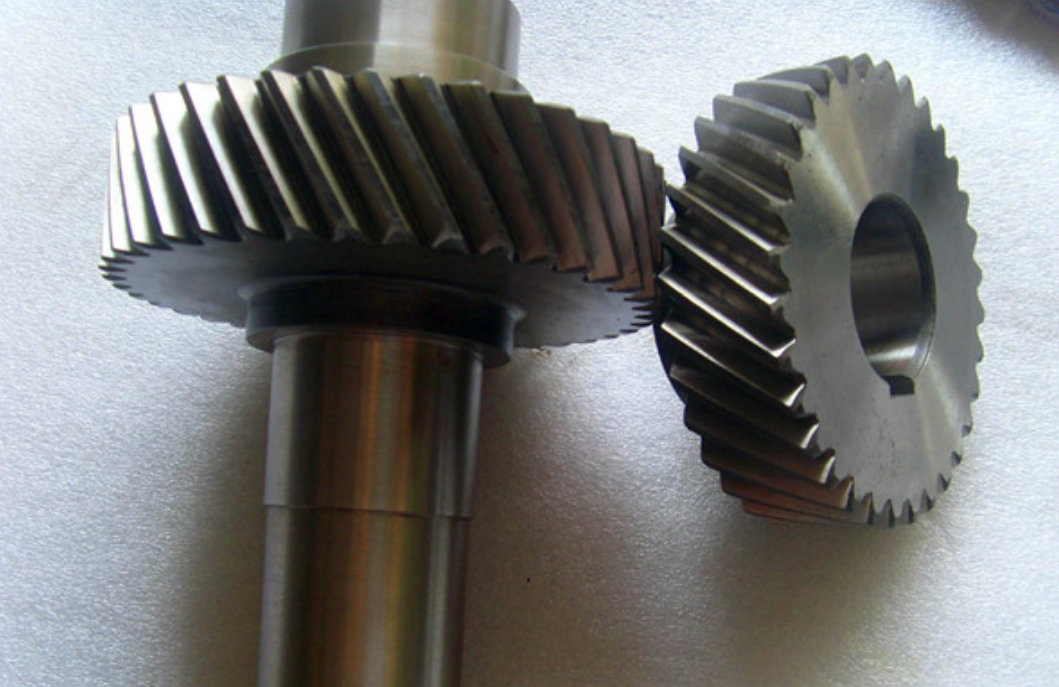
Helical gears are widely adopted in electric drive systems due to their superior load-bearing capacity and smooth transmission. However, under high-speed and heavy-load conditions, frictional heat generation at the meshing interface leads to thermal deformation and potential failure modes such as scuffing. Understanding the temperature and deformation distributions is critical for optimizing gear design and operational reliability.
This research addresses the following challenges:
- Quantifying frictional heat flux and convective heat transfer coefficients.
- Modeling the thermal and structural coupling effects using finite element analysis (FEA).
- Evaluating the accuracy of simplified gear models for computational efficiency.
The study leverages APDL-based parametric modeling to systematically analyze these factors, providing insights into thermal management and deformation mitigation strategies.
2. Theoretical Framework
2.1 Governing Equations
The steady-state heat conduction equation for helical gears is derived from Fourier’s law and energy conservation:λ(∂2t∂x2+∂2t∂y2+∂2t∂z2)=0λ(∂x2∂2t+∂y2∂2t+∂z2∂2t)=0
where λλ is thermal conductivity and tt denotes temperature.
Boundary conditions are categorized as follows:
- Meshing Surfaces: Combined Neumann and Robin conditions:
−λ∂t∂n=h1(tc−ts)−qf−λ∂n∂t=h1(tc−ts)−qf
- Non-Meshing Surfaces: Robin condition:
−λ∂t∂n=h2(tc−ts)−λ∂n∂t=h2(tc−ts)
Here, h1h1 and h2h2 are convective heat transfer coefficients, tctc and tsts are gear and lubricant temperatures, and qfqf is the average frictional heat flux.
2.2 Frictional Heat Flux
The average frictional heat flux qfqf is calculated as:qf=πkffpmax2σ0∣v1−v2∣2T1qf=2T1πkffpmax2σ0∣v1−v2∣
where:
- kfkf: Heat partition coefficient (0.950.95)
- ff: Friction coefficient
- pmaxpmax: Maximum Hertzian contact pressure
- σ0σ0: Contact semi-bandwidth
- v1,v2v1,v2: Tangential velocities of driving/driven gears
2.3 Convective Heat Transfer Coefficients
- Tooth Tip:
hd=0.664⋅Pr0.333⋅(ωv0)0.5hd=0.664⋅Pr0.333⋅(v0ω)0.5
- Tooth Flank and Root:
hd=0.228⋅Re0.731⋅Pr0.333⋅λeLdhd=0.228⋅Re0.731⋅Pr0.333⋅Ldλe
- End Faces:
hd={0.308⋅Pr0.33⋅(ωv0)0.5,Laminar flow0.019⋅Pr0.33⋅(ωv0)0.8,Turbulent flowhd=⎩⎨⎧0.308⋅Pr0.33⋅(v0ω)0.5,0.019⋅Pr0.33⋅(v0ω)0.8,Laminar flowTurbulent flow
Here, Re=ωrm2v0Re=v0ωrm2 and Pr=ρcpv0λPr=λρcpv0.
3. Finite Element Modeling
3.1 Gear and Lubricant Parameters
Key parameters for the helical gear and lubricant are summarized below:
| Gear Parameter | Value |
|---|---|
| Number of teeth (zz) | 23 |
| Module (mm) | 3 mm |
| Pressure angle (αα) | 20° |
| Helix angle (ββ) | 8° |
| Elastic modulus (EE) | 206 GPa |
| Thermal expansion coefficient | 1.13×10⁻⁵ K−11.13×10⁻⁵K−1 |
| Lubricant Parameter | Value |
|---|---|
| Density (ρρ) | 870 kg/m³ |
| Viscosity (νν) | 320 cSt (40°C) |
| Thermal conductivity (λλ) | 2.0 W/m·K |
3.2 Model Configurations
Parametric models were developed in ANSYS APDL:
- Full-Tooth Model: 23 teeth with complete hub.
- Partial-Tooth Models: Single, three, and five teeth with/without hubs.
4. Results and Discussion
4.1 Steady-State Temperature Field
The temperature distribution in helical gears exhibits distinct characteristics:
- Gradient Variation: Highest temperature (92.45∘C92.45∘C) at the meshing surface; lowest at the hub.
- Asymmetry: Non-uniform distribution along the tooth width due to helical contact dynamics.
- “M”-Shaped Profile: Temperature peaks near the tooth root (meshing-in zone) and tooth tip (meshing-out zone).
Comparison of Partial vs. Full-Tooth Models:
| Model | Max Temp (°C) | Relative Error (%) |
|---|---|---|
| Full-Tooth | 92.45 | – |
| Single-Tooth | 92.47 | 0.02 |
| Three-Tooth | 92.66 | 0.23 |
| Five-Tooth | 92.72 | 0.29 |
| Single-tooth models achieve high accuracy (<0.1%<0.1% error), validating their use for temperature field analysis. |
4.2 Thermal Deformation Field
Thermal deformation accumulates axially, with maximum displacement near the tooth ends:
- Full-Tooth Model: Peak deformation 2.64×10⁻⁴ m2.64×10−4m at tooth tips.
- Partial Models: Significant errors due to constrained boundary effects:
| Model | Deformation (×10−5 m×10−5m) | Error (%) |
|---|---|---|
| Full-Tooth | 1.39 | – |
| Single-Tooth | 1.61 | 16.28 |
| Three-Tooth | 1.51 | 8.79 |
| Five-Tooth | 1.54 | 11.10 |
4.3 Influence of Hub Inclusion
Models with partial teeth but full hubs exhibit reduced accuracy:
- Temperature: ΔT=8−11∘CΔT=8−11∘C lower than full-tooth models.
- Deformation: Up to 17.3%17.3% error in displacement.
5. Conclusions
- The steady-state temperature field of helical gears is governed by frictional heat flux and asymmetric convective cooling.
- Thermal deformation peaks at the tooth ends due to cumulative thermal expansion.
- Single-tooth models suffice for temperature analysis (<0.1%<0.1% error) but fail for deformation studies (>10%>10% error).
- Full-tooth models remain essential for accurate thermal-structural coupling analysis.
This work provides a framework for optimizing helical gear design under thermal loads, balancing computational efficiency and precision.