
In modern manufacturing, the machining of eccentric components such as eccentric shafts and sleeves is a common yet challenging task. These parts are essential in various mechanical systems, including engines, pumps, and transmission mechanisms, where precise eccentricity is required for optimal performance. Traditional methods for machining eccentric workpieces often involve dedicated fixtures or adjustable setups with limitations in flexibility and precision. For instance, some fixtures use dual-cylinder positioning for fixed eccentricity, while others employ dual eccentric wheels with shims for adjustment. However, these approaches are either restricted to specific eccentric distances or require custom-made shims for different workpiece dimensions, making them unsuitable for small-batch production with diverse specifications. To address these issues, I have developed a novel stepless-adjustable eccentric fixture that utilizes screw gears for continuous and precise eccentricity control. This fixture offers enhanced versatility and ease of adjustment, catering to the demands of modern multi-variant, small-lot manufacturing.
The core innovation of this fixture lies in its integration of screw gears, which enable smooth and infinite variability in eccentric positioning. Screw gears, commonly referred to as worm and worm gear systems, are known for their high reduction ratios, self-locking capabilities, and compact design. By leveraging these characteristics, the fixture allows for fine-tuning of eccentricity without the need for interchangeable parts, thus streamlining the machining process. In this article, I will delve into the working principles, design calculations, and practical applications of this fixture, emphasizing the role of screw gears in achieving superior performance. Through mathematical modeling, tabular summaries, and detailed explanations, I aim to provide a comprehensive guide for engineers and machinists seeking to implement this technology in their workshops.
The working principle of the stepless-adjustable eccentric fixture revolves around a dual eccentric wheel mechanism driven by screw gears. As illustrated in the accompanying image, the fixture consists of two eccentric wheels that serve as positioning elements. These wheels are rigidly attached to shafts connected to worm gears, which are in turn mounted on a fixture body via hinge pins. The hinge pins define pivot points (denoted as O1 and O2) around which the eccentric wheels can rotate. The screw gears, comprising a worm shaft and worm wheels, provide the driving force for adjustment. When the worm shaft is rotated, it engages with the worm wheels, causing them to turn and thereby rotating the eccentric wheels. This rotation alters the contact points between the eccentric wheels and the workpiece, effectively changing the workpiece’s position relative to a reference plane and thus modifying the eccentric distance.
To understand this mechanism better, consider the extreme positions of the fixture. In the lower limit position, the workpiece center aligns with the machine tool’s rotational axis, resulting in zero eccentricity. This configuration is achieved when the eccentric wheels are oriented such that their nearest points to the rotational axis contact the workpiece. Conversely, in the upper limit position, the workpiece is displaced maximally, yielding the highest eccentricity. The continuous rotation of the screw gears allows for seamless transition between these limits, enabling stepless adjustment of eccentricity across a wide range. The use of screw gears ensures precise control due to their high gear ratio, which translates small input rotations into fine output movements. Moreover, the self-locking nature of screw gears prevents unintended shifts during machining, enhancing stability and safety.
The mathematical foundation of this fixture is crucial for its design and application. Let me define the key parameters involved: the radius of each eccentric wheel is \( R \), the distance from the eccentric wheel’s geometric center to its hinge point (i.e., the eccentricity of the wheel itself) is \( R_h \), the radius of the cylindrical workpiece is \( r \), and the distance between the two hinge points is \( W \). A reference plane OA is established arbitrarily; its choice does not affect the analysis but simplifies calculations. When the workpiece is in the lower limit position, its center is at a distance \( M \) from the reference plane. At this point, the line through the hinge point and the eccentric wheel’s center makes an angle \( \alpha_0 \) with the reference plane. From geometric considerations, we can derive:
$$ M = (R – R_h + r) \sin \alpha_0 $$
This equation arises because the workpiece contacts the eccentric wheel at the point closest to the rotational axis, forming a right triangle with the hinge point. The screw gear system has a defined transmission ratio \( i \), meaning that for every rotation of the worm shaft by an angle \( \theta \), the worm wheel (and thus the eccentric wheel) rotates by an angle \( \alpha = \theta / i \). By rotating the worm shaft, we adjust \( \alpha \), which in turn changes the distance \( H \) from the workpiece center to the reference plane. The eccentric distance \( e \) is then given by \( e = H – M \).
To compute \( H \), we analyze the geometry after rotating the eccentric wheel by an angle \( \alpha \) from its initial position. The coordinates of key points can be expressed relative to the hinge point O1. Let the hinge point O1 be at the origin for simplicity. The center of the eccentric wheel, C, moves along a circle of radius \( R_h \) centered at O1. After rotation, the coordinates of C are:
$$ C_x = R_h \cos(\alpha + \alpha_0) $$
$$ C_y = R_h \sin(\alpha + \alpha_0) $$
The workpiece contacts the eccentric wheel at a point where the distance between their centers equals the sum of their radii. The center of the workpiece, G, must satisfy that its distance to C is \( R + r \). Additionally, due to symmetry, the workpiece center lies on the vertical line midway between the two hinge points, given that the fixture is symmetric. The distance from O1 to the vertical centerline is \( W/2 \). Therefore, the horizontal distance from C to the workpiece center is \( C_x + W/2 \), and the vertical distance is \( C_y – H \), where \( H \) is the vertical coordinate of the workpiece center (since the reference plane OA is horizontal). Applying the distance formula:
$$ (C_x + W/2)^2 + (C_y – H)^2 = (R + r)^2 $$
Substituting the expressions for \( C_x \) and \( C_y \):
$$ \left( R_h \cos(\alpha + \alpha_0) + \frac{W}{2} \right)^2 + \left( R_h \sin(\alpha + \alpha_0) – H \right)^2 = (R + r)^2 $$
Solving for \( H \), we obtain:
$$ H = R_h \sin(\alpha + \alpha_0) + \sqrt{ (R + r)^2 – \left( R_h \cos(\alpha + \alpha_0) + \frac{W}{2} \right)^2 } $$
Thus, the eccentric distance \( e \) is:
$$ e = H – M = R_h \sin(\alpha + \alpha_0) + \sqrt{ (R + r)^2 – \left( R_h \cos(\alpha + \alpha_0) + \frac{W}{2} \right)^2 } – (R – R_h + r) \sin \alpha_0 $$
This formula demonstrates that \( e \) is a function of the rotation angle \( \alpha \), which is controlled via the screw gears. By adjusting \( \alpha \) through the worm shaft, we can achieve any desired eccentricity within the fixture’s range. The transmission ratio \( i \) of the screw gears allows for fine control: a high ratio means that small input rotations yield minute changes in \( \alpha \), enabling precise eccentricity settings. This highlights the advantage of using screw gears in this application, as they provide both high precision and self-locking stability.
To further elucidate the design, let me summarize the key parameters and their effects in a table:
| Parameter | Symbol | Description | Typical Range | Influence on Eccentricity |
|---|---|---|---|---|
| Eccentric wheel radius | \( R \) | Radius of the eccentric wheel | 20–100 mm | Larger \( R \) increases maximum eccentricity but may reduce adjustment range. |
| Eccentric wheel offset | \( R_h \) | Distance from wheel center to hinge point | 5–30 mm | Directly affects eccentricity range; larger \( R_h \) allows greater \( e \). |
| Workpiece radius | \( r \) | Radius of the cylindrical workpiece | 10–50 mm | Smaller \( r \) increases eccentricity for same \( \alpha \); fixture adapts to different sizes. |
| Hinge point distance | \( W \) | Distance between two hinge points | 50–200 mm | Affects geometric constraints; larger \( W \) accommodates larger workpieces. |
| Initial angle | \( \alpha_0 \) | Angle at lower limit position | 0–90° | Sets baseline for calculation; choice optimizes fixture dimensions. |
| Screw gear ratio | \( i \) | Transmission ratio of worm to worm wheel | 10–100 | Higher \( i \) enables finer adjustment and better self-locking. |
| Rotation angle | \( \alpha \) | Angle of eccentric wheel rotation | 0–360° | Primary control variable; stepless variation allows continuous \( e \). |
The table above underscores the interplay between parameters and how screw gears facilitate control. For practical implementation, I recommend selecting \( R_h \) and \( W \) based on the expected workpiece dimensions and desired eccentricity range. The screw gear ratio \( i \) should be chosen to balance adjustment sensitivity with mechanical strength; a ratio of 30–50 is often suitable for general machining tasks. Additionally, the fixture can be enhanced with a locking mechanism on the worm shaft to prevent backlash and ensure positional accuracy during cutting operations.
One of the standout features of this fixture is its adaptability to workpieces of varying diameters. From the formula for \( e \), we see that for a fixed \( \alpha \), changing \( r \) alters the eccentricity. However, by simultaneously adjusting \( \alpha \) via the screw gears, we can compensate for diameter variations and achieve the same eccentric distance. This is particularly useful in job-shop environments where multiple parts with different sizes but similar eccentricities need to be machined. To illustrate, consider two workpieces with radii \( r_1 = 15 \, \text{mm} \) and \( r_2 = 20 \, \text{mm} \), both requiring an eccentricity of \( e = 5 \, \text{mm} \). Using the fixture, we can compute the required \( \alpha \) for each case. Assume \( R = 40 \, \text{mm} \), \( R_h = 10 \, \text{mm} \), \( W = 100 \, \text{mm} \), and \( \alpha_0 = 30^\circ \). For \( r_1 \), we solve the equation:
$$ 5 = 10 \sin(\alpha + 30^\circ) + \sqrt{ (40 + 15)^2 – \left( 10 \cos(\alpha + 30^\circ) + 50 \right)^2 } – (40 – 10 + 15) \sin 30^\circ $$
Simplifying with \( \sin 30^\circ = 0.5 \):
$$ 5 = 10 \sin(\alpha + 30^\circ) + \sqrt{ 3025 – \left( 10 \cos(\alpha + 30^\circ) + 50 \right)^2 } – 22.5 $$
Thus, \( 27.5 = 10 \sin(\alpha + 30^\circ) + \sqrt{ 3025 – \left( 10 \cos(\alpha + 30^\circ) + 50 \right)^2 } \). This transcendental equation can be solved numerically, yielding \( \alpha \approx 45^\circ \). Similarly, for \( r_2 \), we find \( \alpha \approx 50^\circ \). By rotating the worm shaft to these angles, the same eccentricity is achieved. This demonstrates the fixture’s versatility, enabled by the screw gears’ precise angular control.
Beyond basic positioning, the fixture’s performance can be analyzed in terms of positioning error and stiffness. The use of screw gears minimizes error due to their low backlash and high precision. However, factors like manufacturing tolerances and wear can affect accuracy. The primary source of error is the clearance in the screw gear mesh, which can be mitigated by using high-quality gears and preloading mechanisms. The eccentricity error \( \Delta e \) can be estimated from the angular error \( \Delta \alpha \) in the worm wheel rotation. Differentiating the formula for \( e \) with respect to \( \alpha \):
$$ \frac{de}{d\alpha} = R_h \cos(\alpha + \alpha_0) – \frac{ \left( R_h \cos(\alpha + \alpha_0) + \frac{W}{2} \right) R_h \sin(\alpha + \alpha_0) }{ \sqrt{ (R + r)^2 – \left( R_h \cos(\alpha + \alpha_0) + \frac{W}{2} \right)^2 } } $$
Then, \( \Delta e \approx \frac{de}{d\alpha} \Delta \alpha \). For typical values, if \( \Delta \alpha = 0.1^\circ \) (a small error due to gear backlash), and using the previous parameters with \( \alpha = 45^\circ \), we compute \( \frac{de}{d\alpha} \approx 0.5 \, \text{mm/rad} \), so \( \Delta e \approx 0.001 \, \text{mm} \), which is negligible for most applications. This showcases the robustness of the screw gear design.
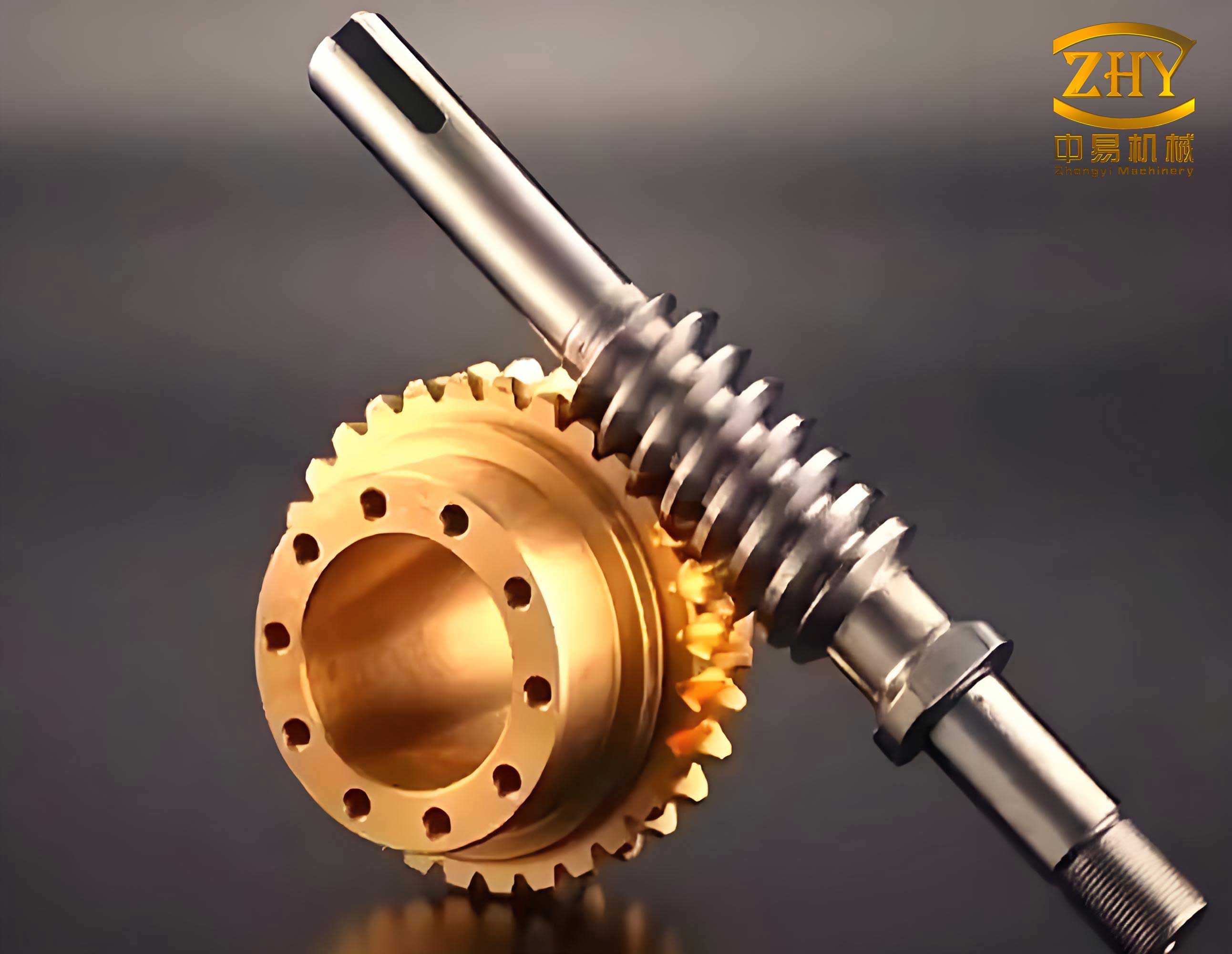
To further emphasize the role of screw gears, let me discuss their selection criteria. Screw gears, or worm gears, consist of a worm (a screw-like shaft) and a worm wheel (a gear with helical teeth). They are characterized by their axis configuration (typically perpendicular) and high reduction ratios. Key advantages include compactness, smooth operation, and the ability to transmit motion between non-parallel shafts. In this fixture, the screw gears serve as both motion reducers and locking devices. When selecting screw gears, consider the following factors:
- Transmission Ratio: Higher ratios provide finer adjustment but may reduce efficiency. A ratio of 30:1 to 50:1 is ideal for this application.
- Material: The worm should be made of hardened steel for wear resistance, while the worm wheel can be bronze or cast iron to reduce friction.
- Module and Pressure Angle: Standard modules (e.g., 2 mm) with a pressure angle of 20° ensure good meshing and load capacity.
- Self-Locking: Ensure the lead angle of the worm is small enough (typically less than 5°) to prevent back-driving, which secures the fixture during machining.
These considerations ensure that the screw gears perform reliably under varying loads and speeds. In practice, the fixture can be mounted on lathes or milling machines for turning or grinding operations. For instance, when machining an eccentric shaft, the workpiece is clamped between centers or in a chuck, and the fixture is attached to the tool post. As the screw gears are adjusted, the workpiece’s eccentric axis aligns with the machine’s spindle, allowing for accurate cutting.
Another aspect worth exploring is the fixture’s economic impact. By enabling stepless adjustment, it reduces the need for multiple dedicated fixtures, saving costs in tooling and storage. Moreover, its quick setup time increases productivity in small-batch production. To quantify this, consider a workshop that machines 10 different eccentric parts per month, each requiring a unique fixture. With this adjustable fixture, only one unit is needed, potentially reducing fixture investment by 90%. Additionally, the screw gears’ durability minimizes maintenance downtime, further enhancing cost-effectiveness.
For broader applicability, the fixture can be modified for different machine tools. For example, on a grinding machine, the fixture can hold eccentric sleeves for internal grinding. The screw gears allow for precise centering of the sleeve’s bore relative to the grinding wheel. Similarly, in a drilling operation, the fixture can position eccentric holes on a flange. The adaptability stems from the fundamental principle of using screw gears to control dual eccentric wheels, which can be scaled or reconfigured as needed.
In terms of design optimization, we can derive the maximum and minimum eccentricities. From the formula for \( e \), the maximum occurs when the square root term is maximized, which happens when \( \cos(\alpha + \alpha_0) = -1 \), provided the argument remains real. Thus:
$$ e_{\text{max}} = R_h \sin(\alpha_{\text{max}} + \alpha_0) + \sqrt{ (R + r)^2 – \left( -R_h + \frac{W}{2} \right)^2 } – (R – R_h + r) \sin \alpha_0 $$
Similarly, the minimum eccentricity (which can be negative, indicating offset in the opposite direction) occurs when \( \cos(\alpha + \alpha_0) = 1 \):
$$ e_{\text{min}} = R_h \sin(\alpha_{\text{min}} + \alpha_0) + \sqrt{ (R + r)^2 – \left( R_h + \frac{W}{2} \right)^2 } – (R – R_h + r) \sin \alpha_0 $$
These limits define the fixture’s range. To ensure versatility, design parameters should be chosen so that \( e_{\text{max}} \) and \( e_{\text{min}} \) cover common eccentricities in industry, typically from 0 to 20 mm. A parametric study can be conducted using the following table, which shows how \( e_{\text{max}} \) varies with \( R_h \) and \( W \) for fixed \( R = 50 \, \text{mm} \), \( r = 20 \, \text{mm} \), and \( \alpha_0 = 45^\circ \):
| \( R_h \) (mm) | \( W \) (mm) | \( e_{\text{max}} \) (mm) | Comments |
|---|---|---|---|
| 10 | 100 | 12.3 | Suitable for small eccentricities. |
| 15 | 100 | 18.5 | Increased range due to larger \( R_h \). |
| 10 | 120 | 10.8 | Larger \( W \) reduces range slightly. |
| 20 | 80 | 25.1 | Optimal for large eccentricities. |
This table aids in selecting parameters based on required specifications. The screw gears’ role is critical in harnessing this range, as they enable smooth traversal between extremes. Furthermore, the fixture can be equipped with digital readouts or encoders on the worm shaft to monitor the rotation angle \( \alpha \), facilitating automated control. Integrating with CNC systems, the screw gears can be driven by stepper motors, allowing for programmable eccentricity adjustments—a step towards Industry 4.0.
From a mechanical analysis perspective, the forces acting on the fixture during machining must be considered. The cutting forces exert pressure on the workpiece, which is transmitted to the eccentric wheels and then to the screw gears. The screw gears must withstand these loads without deflecting or slipping. The torque on the worm shaft can be calculated from the cutting force. Suppose the cutting force \( F_c \) acts radially on the workpiece with a lever arm equal to the eccentricity \( e \). The resulting torque on the workpiece is \( T = F_c \cdot e \). This torque is resisted by the friction between the workpiece and eccentric wheels. Assuming two-point contact, the normal force \( N \) on each eccentric wheel relates to \( F_c \) by equilibrium. For simplicity, if the contact is symmetric, \( N = F_c / (2 \sin \beta) \), where \( \beta \) is the contact angle. The torque required to hold the eccentric wheels in place via the screw gears is then \( T_{\text{worm}} = N \cdot R_h \cdot \mu \), with \( \mu \) as the friction coefficient. However, due to the self-locking of screw gears, the holding torque is minimal, and the primary design concern is strength against wear.
To ensure longevity, the screw gears should be lubricated regularly, and the eccentric wheels made of hardened steel to resist deformation. Finite element analysis (FEA) can be used to simulate stress distributions under load. For instance, a static analysis with a cutting force of 500 N applied at \( e = 10 \, \text{mm} \) might show maximum von Mises stress of 200 MPa in the eccentric wheels, well below the yield strength of tool steel (1000 MPa). The screw gears, with their robust design, would experience even lower stress, affirming the fixture’s durability.
In educational contexts, this fixture serves as an excellent demonstration of mechanical principles, combining kinematics, dynamics, and gear theory. Students can learn about the advantages of screw gears in precision positioning and how geometric parameters influence machine design. Workshops can use it to train machinists in advanced fixture setup, fostering skills in adaptive manufacturing.
Looking ahead, the fixture can be integrated with smart sensors for real-time monitoring. For example, strain gauges on the eccentric wheels can measure cutting forces, while encoders on the screw gears provide feedback for closed-loop control. This aligns with trends in digital manufacturing and the Internet of Things (IoT). The inherent precision of screw gears makes such integrations feasible, paving the way for next-generation intelligent fixtures.
In conclusion, the stepless-adjustable eccentric fixture based on screw gears represents a significant advancement in machining technology. Its ability to provide continuous eccentricity adjustment through screw gears offers unparalleled flexibility, making it suitable for diverse workpiece dimensions and eccentricities. The mathematical formulation derived here allows for precise control, while the mechanical design ensures stability and accuracy. By leveraging the unique properties of screw gears—such as high reduction ratios, self-locking, and smooth operation—this fixture addresses the limitations of traditional methods and enhances productivity in small-batch production. I encourage manufacturers to adopt this technology to stay competitive in an era of increasing customization and rapid prototyping. With proper maintenance and optimization, the fixture can deliver long-term value, reducing costs and improving machining quality across various industries.