
In modern mechanical transmission systems, the straight bevel gear plays a critical role due to its ability to transmit power and motion between intersecting axes. As a fundamental component in industries such as aerospace, the straight bevel gear demands high precision and reliability. Traditional manufacturing methods, including planing and form milling, often result in poor accuracy and low efficiency, typically achieving only GB 11365-1989 grade 8-9 (equivalent to AGMA 2009 grade B9). These methods produce straight bevel gears with linear tooth profiles, leading to full-length contact along the tooth face under ideal conditions. However, in practice, factors like machining errors, heat treatment deformation, assembly misalignments, and load-induced deflections cause contact patterns to shift, resulting in localized stress concentrations at the tooth ends or edges. This can lead to premature failure and inconsistent performance across production batches. To address these challenges, advanced CNC milling techniques have been developed, enabling high-precision machining with tooth flank modifications, such as crowning, to optimize contact patterns and ensure consistency. This article explores the CNC milling process for straight bevel gears, focusing on a six-axis, five-linkage machining center, and outlines a comprehensive development and manufacturing workflow to achieve precision up to GB 11365-1989 grade 5 (equivalent to AGMA 2009 grade B5).
The CNC milling of straight bevel gears involves a sophisticated process that leverages multi-axis control to generate tooth profiles with enhanced geometry. Key to this approach is the ability to introduce a controlled crowning along the tooth length, which mitigates the drawbacks of full-face contact by localizing the contact area to a specified region. This not only improves load distribution but also compensates for operational variances. Additionally, the implementation of master control gears and inspection control gears ensures that manufacturing states are recorded and replicated, facilitating consistent quality across batches. Through detailed process steps, mathematical modeling, and rigorous testing, this method elevates the performance and interchangeability of straight bevel gears, making it suitable for high-stakes applications like aviation. Below, I will delve into the machining methodology, tooth flank modifications, and the standardized development流程 that underpins this technology.
CNC Milling Process for Straight Bevel Gears
The core of high-precision straight bevel gear manufacturing lies in the use of advanced CNC milling machines, such as the Phoenix II 275HC, which features six axes (X, Y, Z, A, B, C) and five-linkage control. This setup allows for complex kinematic movements that simulate the generation of spherical involute tooth profiles. The machining process begins with software-based calculations using tools like Straight Bevel software to determine gear dimensions and cutter parameters based on design drawings. Subsequently, Unical software performs Tooth Contact Analysis (TCA) to predict contact patterns and make first-order corrections, such as spiral angle adjustments, which are encoded into adjustment cards for the milling machine. The actual milling employs an intermittent indexing generation method, where the cutter and workpiece undergo coordinated motions to form the tooth flanks. For instance, the cutter starts above the workpiece, pivots from 0° to 20°, rotates about the C-axis, and oscillates about the B-axis, while the workpiece rotates about the A-axis and translates linearly in the X and Z directions. This generates the left tooth flank; after completing one tooth, the workpiece indexes, and the process repeats for all left flanks before switching to the right flanks with the cutter positioned below the workpiece.
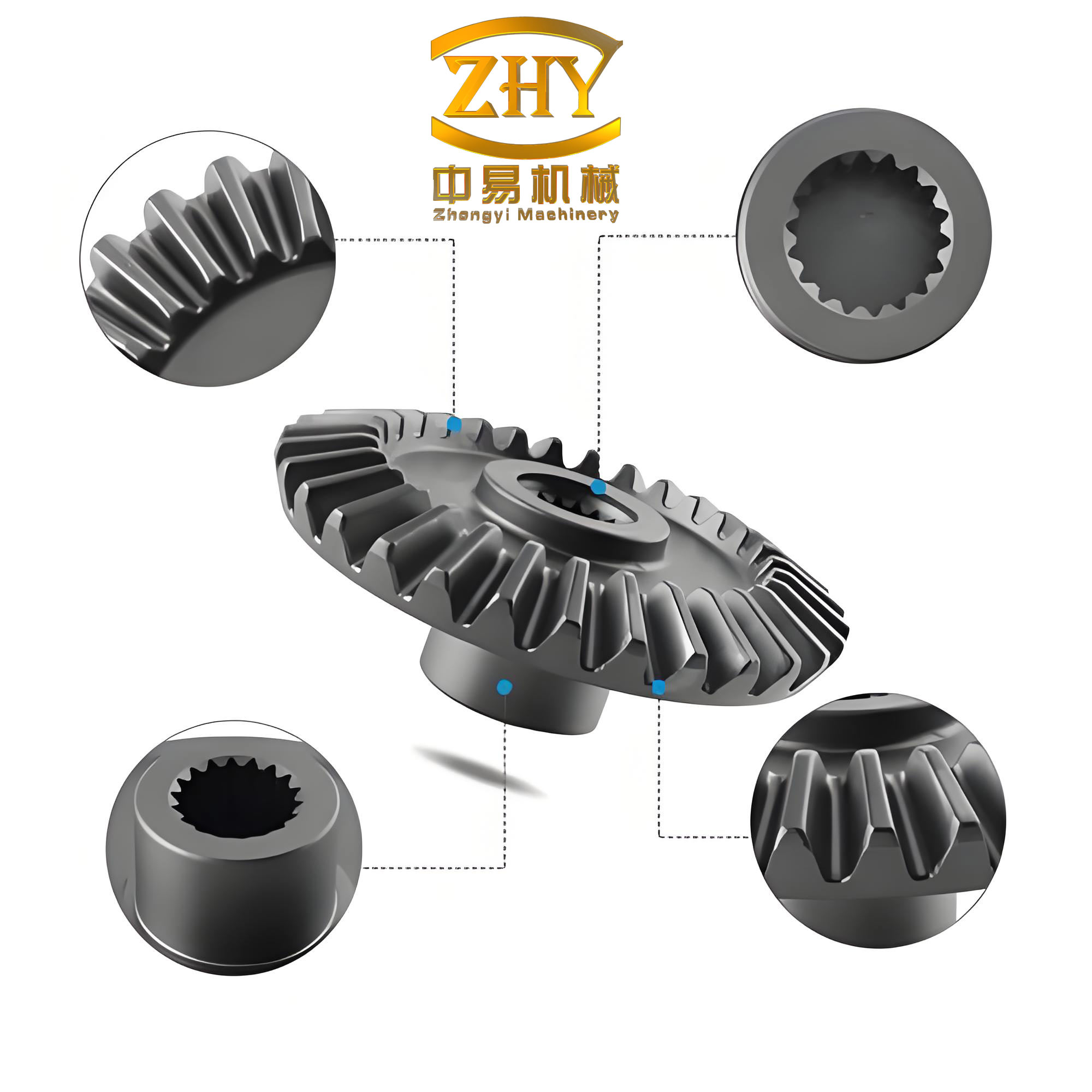
A critical aspect of this process is tooth flank modification, specifically the introduction of crowning along the tooth length. Crowning refers to a slight convex curvature that prevents edge contact under load variations. The magnitude of crowning is influenced by the cutter diameter and dish angle—parameters that can be adjusted to control the contact pattern size. Given that the Phoenix II 275HC typically uses a 9-inch diameter cutter, the dish angle becomes the primary variable for modification. The relationship between crowning (C), cutter diameter (D), and dish angle (α) can be approximated by the formula: $$ C = k \cdot \frac{1}{D} \cdot \sin(\alpha) $$ where k is a machine-specific constant. This crowning ensures that the contact pattern is centralized and elliptical, avoiding extremities that could lead to stress concentrations. Furthermore, TCA-based corrections are applied to shift the contact pattern toward the toe (small end) of the tooth during soft-state machining, accounting for anticipated shifts toward the heel (large end) post-heat treatment and under load. For example, a spiral angle correction Δβ is computed to translate the contact pattern by a desired offset, often 1–2 mm from the toe, using the relation: $$ \Delta \beta = \tan^{-1}\left( \frac{\delta}{L} \right) $$ where δ is the linear offset and L is the face width. This proactive adjustment enhances the gear’s durability and performance in real-world conditions.
The machining workflow involves several iterative steps to achieve precision. Initially, a rough cut is performed on a prototype gear, followed by coordinate measuring machine (CMM) inspection to assess individual geometric parameters like tooth thickness, depth, and flank form. Based on CMM data, feedback adjustments are made using G-AGE software to refine the machining program. This cycle repeats until the gear meets all specifications. Key parameters monitored include midpoint chordal tooth thickness, single pitch deviation, cumulative pitch error, and runout. The midpoint chordal thickness, for instance, is critical for backlash control and is calculated as: $$ s_m = m \cdot \pi \cdot \cos(\gamma) $$ where m is the module and γ is the pitch cone angle. Compared to traditional caliper measurements at the large end, which have an accuracy of about 0.02 mm, CMM-based measurements achieve precision within 0.002 mm, significantly improving consistency. Once the geometric attributes are validated, a pair of gears undergoes rolling tests on a 360T testing machine under light loads to evaluate the contact pattern size, position, and backlash. The ideal contact pattern should be oval or rectangular, centered between the toe and heel, and clear of the tooth edges, with backlash conforming to design tolerances.
Development and Manufacturing Workflow for Straight Bevel Gears
To ensure consistency and interchangeability in straight bevel gear production, a structured development workflow is essential. This workflow revolves around the creation and use of master gears—specifically, master control gears and inspection control gears—which serve as benchmarks for manufacturing quality. The master control gear is the highest-precision reference, used to establish CMM digital inspection programs and validate other gears, while inspection control gears are employed for routine checks in batch production. These gears capture the optimal tooth flank geometry and contact patterns, enabling replication across batches without the need for pairwise matching. The development process is divided into two main phases: the creation of standard gears and the mass production of batch parts, each involving multiple verification stages.
The standard gear manufacturing流程, as outlined in Figure 1, begins with single-tooth cutting on a prototype straight bevel gear. After rough machining, CMM inspection is conducted to measure tooth thickness, depth, and flank form deviations. Based on the results, corrective adjustments are made to the CNC program to refine these parameters. This iterative process continues until the gear meets all geometric requirements, after which full-tooth cutting is performed. The CMM inspection at this stage evaluates flank form, tooth thickness, pitch deviations, and runout, ensuring compliance with design specifications. For flank form assessment, the tooth surface is divided into a grid of 45 points, and deviations from theoretical positions are analyzed to correct pressure angle and spiral angle errors. This grid-based analysis ensures that the actual tooth profile closely matches the ideal spherical involute, which is crucial for predictable contact behavior. The formula for the theoretical tooth surface point coordinates can be expressed in a parametric form based on gear geometry: $$ x = R \cdot \sin(\theta) \cdot \cos(\phi), \quad y = R \cdot \sin(\theta) \cdot \sin(\phi), \quad z = R \cdot \cos(\theta) $$ where R is the pitch cone radius, θ is the cone angle parameter, and ϕ is the rotation angle. By minimizing deviations at these grid points, the machining process achieves a tooth flank that facilitates the desired contact pattern.
Following geometric validation, the gear pair is assembled on a 360T rolling tester for contact pattern analysis under light loads. The contact pattern must be elliptical, positioned away from the toe and heel, and exhibit clear boundaries. Backlash is measured at the large end to verify tooth thickness accuracy. If discrepancies are found, further adjustments are made to the machining parameters. Once approved, the candidate master control gear is selected based on its precision and conformity. Additional gears from the same batch are designated as inspection control gears, provided they meet specific criteria, such as having backlash within tolerance and contact patterns consistent with the master. The conditions for these gears are summarized in Table 1.
| Gear Type | Required Conditions |
|---|---|
| Master Control Gear | Must meet all drawing specifications; be the most accurate pair in the development batch; never used for rolling tests after designation; only one set exists as a reference standard. |
| Inspection Control Gear | Manufactured based on the master control gear; have correct backlash; contact patterns must match the master; flank form must be within 50% of the CMM grid profile tolerance specified in the gear data sheet; typically, two sets are maintained for batch inspections. |
After selecting the master and inspection control gears, the remaining parts undergo heat treatment. One pair is then tested in the actual gearbox under various load conditions—light load (as specified), normal operating load, and maximum load—to assess contact pattern behavior under real-world scenarios. This step is crucial because housing distortions, bearing clearances, and thermal effects can alter contact patterns. The contact area should not extend to the toe, heel, or top land under any load, with a preferred margin of ≤2.5% of tooth height from the edges. If the contact pattern deviates, the design drawings and machining parameters are revised, and the development cycle repeats. This iterative approach ensures that the final straight bevel gears perform reliably in their intended applications. The entire workflow, from initial cutting to gearbox testing, forms a closed-loop system that continuously refines the manufacturing process based on feedback, enhancing quality and consistency.
For batch production, the manufacturing流程 follows a streamlined version of the development phase, as depicted in Figure 2. Here, the master control gear’s digital CMM program is used to inspect all produced gears, ensuring that flank forms remain within tolerance. Inspection control gears are employed for rolling tests to verify contact patterns and backlash, enabling rapid quality assurance without extensive individual testing. This approach not only improves efficiency but also guarantees that every straight bevel gear in a batch matches the approved standard, achieving true interchangeability. The use of standardized workflows and reference gears has proven effective in aerospace applications, where reliability and precision are paramount.
Mathematical Modeling and Analysis in Straight Bevel Gear Manufacturing
The precision of straight bevel gear machining relies heavily on mathematical models that describe tooth geometry, contact mechanics, and machining parameters. One fundamental aspect is the calculation of tooth thickness, which directly influences backlash and meshing quality. The chordal tooth thickness at the midpoint, a key measurement in CMM inspection, can be derived from the gear’s basic parameters. For a straight bevel gear, the midpoint chordal thickness \( s_m \) is given by: $$ s_m = m \cdot \pi \cdot \cos(\gamma_m) $$ where \( m \) is the module, and \( \gamma_m \) is the midpoint pitch cone angle. This formula accounts for the conical shape, ensuring accurate thickness control along the tooth length. Similarly, the theoretical tooth profile follows a spherical involute curve, which can be represented using parametric equations involving the base cone angle and pressure angle. The coordinates of any point on the tooth surface are defined by: $$ x = r_b \cdot (\sin(\psi) – \psi \cdot \cos(\psi)), \quad y = r_b \cdot (\cos(\psi) + \psi \cdot \sin(\psi)) $$ where \( r_b \) is the base cone radius, and \( \psi \) is the generating angle. These equations facilitate the creation of digital models for CMM inspection and TCA.
Contact pattern analysis involves simulating the meshing of gear pairs under load. The TCA software solves systems of equations that describe the contact conditions between tooth flanks. For instance, the separation distance between two engaging teeth can be modeled as: $$ d = \sqrt{(x_1 – x_2)^2 + (y_1 – y_2)^2 + (z_1 – z_2)^2} $$ where \( (x_1, y_1, z_1) \) and \( (x_2, y_2, z_2) \) are points on the pinion and gear tooth surfaces, respectively. By minimizing d under various misalignment scenarios, the software predicts contact patterns and identifies areas requiring correction. In practice, first-order corrections involve adjusting machine settings like spiral angle and cutter position. The spiral angle correction \( \Delta \beta \) to shift the contact pattern along the face width can be estimated using: $$ \Delta \beta = \frac{\Delta s}{R} $$ where \( \Delta s \) is the desired shift in contact pattern position, and R is the pitch cone distance. This linear approximation simplifies the adjustment process during CNC programming.
Furthermore, the crowning magnitude C is optimized based on expected deflections. Using Hertzian contact theory, the contact stress σ between two curved surfaces can be approximated as: $$ \sigma = \sqrt[3]{\frac{F \cdot E^*}{2 \pi \cdot R_c}} $$ where F is the load, E* is the effective elastic modulus, and Rc is the relative radius of curvature. Crowning reduces peak stress by increasing Rc at the tooth ends, thus prolonging gear life. The optimal crowning is determined through iterative testing and finite element analysis, ensuring that the straight bevel gear operates efficiently under dynamic loads. These mathematical tools, integrated into the CNC milling process, enable the production of high-performance gears that meet stringent aerospace standards.
Advantages and Applications of CNC Milled Straight Bevel Gears
The adoption of CNC milling for straight bevel gears offers numerous advantages over traditional methods. Firstly, the achieved precision of GB 11365-1989 grade 5 (AGMA B5) significantly reduces noise, vibration, and wear in gear systems. The introduced crowning and controlled contact patterns enhance load capacity and tolerance to misalignments, making these gears suitable for high-speed and high-torque applications. In aerospace, for example, straight bevel gears are used in actuation systems, transmissions, and rotor drives, where reliability is critical. The consistency afforded by master control gears ensures that parts from different batches are interchangeable, simplifying maintenance and reducing downtime.
Moreover, the CNC process improves production efficiency. While traditional planing might require multiple setups and manual adjustments, the automated CNC milling reduces cycle times and human error. The ability to perform in-process corrections based on CMM data further streamlines quality control. Table 2 compares key attributes of CNC milling versus conventional methods for straight bevel gear manufacturing.
| Aspect | CNC Milling | Traditional Methods (e.g., Planing) |
|---|---|---|
| Accuracy | Up to GB 11365 grade 5 (AGMA B5) | Typically GB 11365 grade 8-9 (AGMA B9) |
| Tooth Flank Form | Crowned with optimized contact patterns | Linear, prone to edge contact |
| Production Efficiency | High, with automated adjustments | Low, due to manual interventions |
| Consistency | Ensured via master control gears | Variable, often requiring pairwise matching |
| Application Suitability | Aerospace, automotive, robotics | General machinery with lower demands |
In conclusion, the CNC milling technology for straight bevel gears represents a significant advancement in gear manufacturing. By integrating multi-axis machining, mathematical modeling, and standardized workflows, it addresses the limitations of earlier techniques. The focus on tooth flank modifications, such as crowning, and the use of reference gears for quality assurance, result in gears that offer superior performance, durability, and interchangeability. As industries continue to demand higher precision and reliability, this approach will play a pivotal role in the evolution of mechanical transmission systems. Future developments may include real-time adaptive machining and AI-based optimization, further enhancing the capabilities of straight bevel gear production.