
In mechanical design, the development of specialized software for three-dimensional modeling, finite element analysis, and simulation of straight bevel gears is crucial due to the complexity of their geometry and mechanical calculations. Existing general-purpose CAD tools lack dedicated functionalities for straight bevel gears, necessitating tailored solutions. This article explores a parametric modeling approach for straight bevel gears using OpenGL, focusing on mathematical foundations, simulation, and practical implementation. The software integrates geometric design, dynamic simulation, and mechanical analysis, significantly reducing design cycles for straight bevel gear applications. By leveraging spherical involute equations, the model ensures accuracy, which is vital for subsequent finite element analysis and CNC code generation.
The mathematical modeling of straight bevel gears begins with the spherical involute, which defines the tooth profile. Unlike cylindrical gears, straight bevel gears have teeth that are tapered and formed on a conical surface, making their geometry more complex. The spherical involute is derived from the rolling motion of a great circle on a base cone. Consider a right-handed coordinate system (O, X, Y, Z) centered at the apex of the base cone. The parametric equations for the spherical involute are as follows:
$$ x_1 = R_b (\sin \delta_b \cos \phi \cos \psi + \sin \phi \sin \psi) $$
$$ y_1 = R_b (\sin \delta_b \sin \phi \cos \psi – \cos \phi \sin \psi) $$
$$ z_1 = R_b \cos \delta_b (1 – \cos \psi) $$
Here, \( R_b \) represents the base cone distance at the large end, \( \delta_b \) is the base cone angle, \( \phi \) is the generating angle on the small circle, and \( \psi \) is the generating angle on the great circle, with \( \psi = \phi \sin \delta_b \). The sign of \( \phi \) determines the direction of the spherical involute: positive for counterclockwise and negative for clockwise. This distinction is essential for constructing the complete tooth surface of a straight bevel gear.
The tooth surface of a straight bevel gear is composed of a series of spherical involutes generated between the large-end and small-end base cone distances. By varying the spherical radius \( R_{bi} \) within this range, we obtain a family of curves that form the tooth flank. The generalized tooth surface equation in the coordinate system (O, X, Y, Z) is:
$$ x = R_{bi} (\sin \delta_b \cos \phi \cos \psi + \sin \phi \sin \psi) $$
$$ y = R_{bi} (\sin \delta_b \sin \phi \cos \psi – \cos \phi \sin \psi) $$
$$ z = R_{bi} \cos \delta_b (1 – \cos \psi) + H (R_b – R_{bi}) / R_b $$
where \( H = R_b \cos \delta_b \) is the height of the base cone. To position these involutes correctly on the gear blank, rotational transformations are applied. For instance, rotating a spherical involute by an angle \( \theta \) around the Z-axis uses the transformation matrix:
$$ \begin{bmatrix} X^* & Y^* & Z^* & 1 \end{bmatrix} = \begin{bmatrix} X & Y & Z & 1 \end{bmatrix} \begin{bmatrix} \cos \theta & \sin \theta & 0 & 0 \\ -\sin \theta & \cos \theta & 0 & 0 \\ 0 & 0 & 1 & 0 \\ 0 & 0 & 0 & 1 \end{bmatrix} $$
This matrix allows us to generate involutes at specific angular positions, which is critical for defining the tooth spacing and profile of the straight bevel gear.
Key design parameters for standard straight bevel gears with a shaft angle of 90 degrees are summarized in the table below. These parameters are inputs to the software and drive the parametric modeling process.
| Parameter | Symbol | Description |
|---|---|---|
| Pitch Angle | δ | Angle of the pitch cone |
| Base Cone Angle | δ_b | Angle of the base cone |
| Dedendum Angle | γ | Angle from pitch cone to root cone |
| Pressure Angle | α | Input via interface |
| Generating Angle (Small Circle) | φ | Angle on the base cone’s small circle |
| Generating Angle (Great Circle) | ψ | Angle on the great circle, ψ = φ sin δ_b |
| Addendum Cone Angle | δ_a | Angle of the addendum cone |
| Root Cone Angle | δ_f | Angle of the root cone |
| Circular Pitch | p | Distance between teeth along pitch circle |
| Module | m | Ratio of pitch diameter to teeth number |
| Working Depth | n | Standard value for tooth engagement |
| Large-End Base Cone Distance | R_b | Input via interface |
| Small-End Base Cone Distance | r_{bj} | Input via interface |
| Large-End Pitch Radius | r | Radius at large end of pitch cone |
| Large-End Root Radius | r_f | Radius at large end of root cone |
| Large-End Tip Radius | r_a | Radius at large end of addendum cone |
| Large-End Base Radius | r_b | Base radius at large end |
| Number of Teeth (Gear 1) | z_1 | Input via interface |
| Number of Teeth (Gear 2) | z_2 | Input via interface |
| Gear Ratio | i | Transmission ratio, i = z_2 / z_1 |
| Face Width | B | B ≤ R_b / 3 (rounded to integer) |
| Clearance | c | Standard value for backlash |
To determine the rotation angle for positioning spherical involutes on a straight bevel gear, consider the geometry at the pitch circle. The rotation angle \( 2\beta \) between clockwise spherical involutes is derived from the pitch circle parameters. The relationships are:
$$ r = \frac{r_b \cos \psi_d}{\cos \alpha} $$
$$ \phi_d = \frac{\psi_d}{\sin \delta_b} $$
$$ \beta = \omega_d + \frac{S}{d} $$
where \( \psi_d \), \( \phi_d \), and \( \omega_d \) correspond to the pitch circle, and \( S \) is the tooth thickness at the pitch circle. This rotation ensures accurate tooth spacing and profile alignment for the straight bevel gear.
The length of the spherical involute is determined by its intersections with the tip and root circles. For the large end, the starting point on the root circle satisfies \( X^2 + Y^2 = r_f^2 \). Solving this with the spherical involute equation gives the initial generating angle \( \phi \):
$$ \phi = \frac{\arcsin \left( \sqrt{ \left( \frac{r_f}{R_b} \right)^2 – \sin^2 \delta_b } / (1 – \sin^2 \delta_b) \right) }{\sin \delta_b} $$
Similarly, replacing \( r_f \) with \( r_a \) yields the terminal generating angle. The same method applies to the small end using \( r_{bj} \) instead of \( R_b \). By setting a step size (e.g., \( \Delta a = 0.1 \)), we generate multiple spherical involutes between the ends, ensuring a smooth tooth surface for the straight bevel gear.
In OpenGL, the three-dimensional modeling of a straight bevel gear involves several steps. First, input parameters are used to compute derived geometric values. Then, for each conical distance \( R_{bi} \) between the large and small ends, spherical involutes are generated with positive and negative \( \phi \) values to form the clockwise and counterclockwise tooth surfaces. Using OpenGL functions like glBegin(GL_QUADS), the tooth top, small-end face, and large-end face are constructed. Finally, the single tooth is replicated around the axis with glRotatef(360.0/z, 0.0, 0.0, 1.0) to complete the straight bevel gear model.
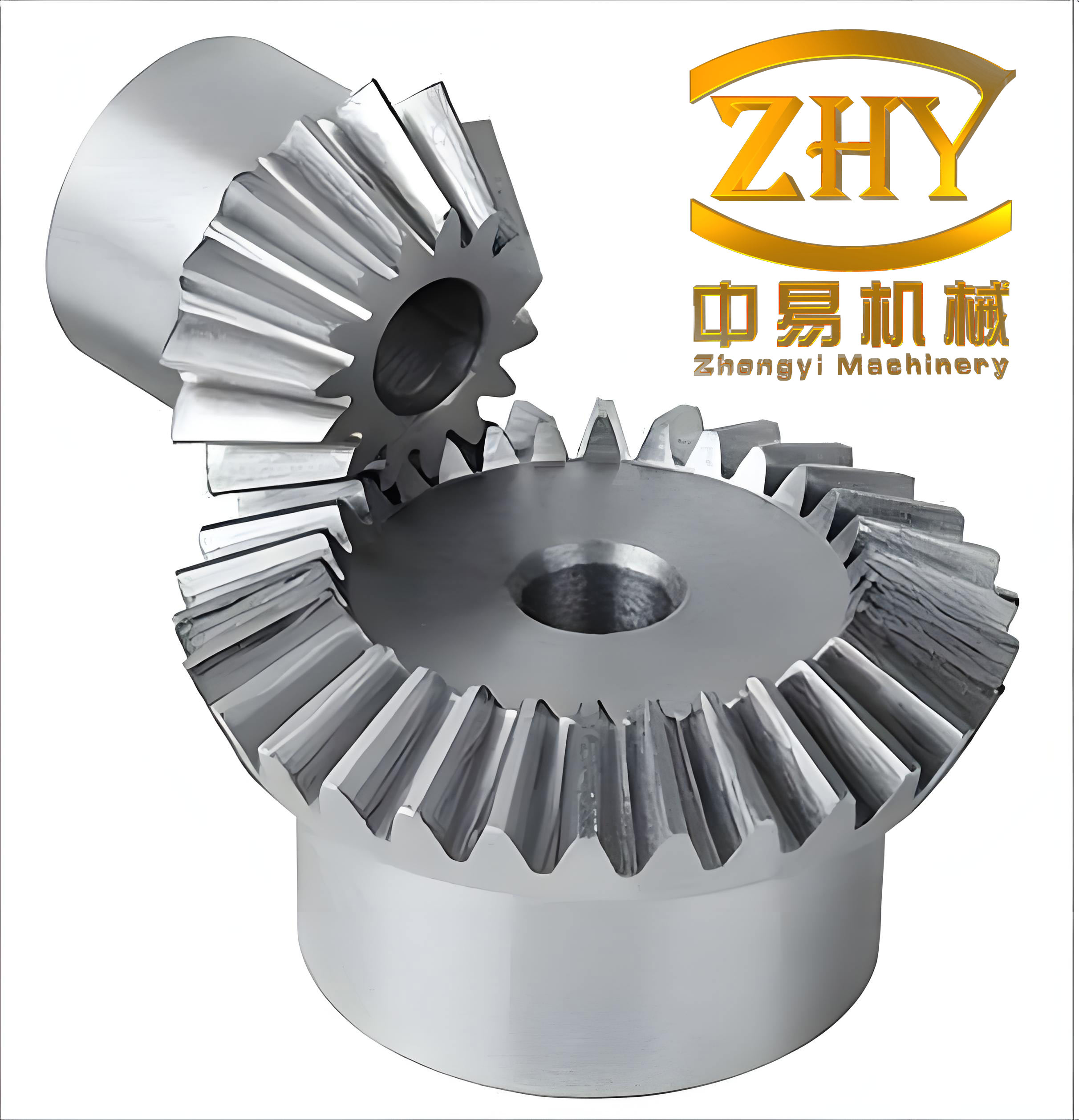
Dynamic simulation of straight bevel gear pairs is achieved in OpenGL using double-buffering techniques. The gears are assembled with a 90-degree shaft angle by rotating and translating them so their base cone apexes coincide and pitch cones are tangent. The glRotatef() and Invalidate() functions animate the meshing, verifying the model’s correctness and checking for interference. This simulation is vital for validating the straight bevel gear design in real-world applications.
Finite element analysis (FEA) integration allows for stress and deformation evaluation under load. The accurate spherical involute-based model provides a precise mesh for FEA, improving reliability. For instance, contact stresses between teeth can be analyzed using the Hertz theory, where the contact pressure \( p \) for a straight bevel gear is given by:
$$ p = \sqrt{ \frac{F E^*}{\pi R^*} } $$
Here, \( F \) is the normal load, \( E^* \) is the equivalent modulus, and \( R^* \) is the equivalent radius of curvature. This analysis helps optimize the straight bevel gear for durability and performance.
Parametric design facilitates customization. For example, the module \( m \) and pressure angle \( \alpha \) can be adjusted to meet specific torque requirements. The bending stress \( \sigma_b \) in a straight bevel gear tooth can be estimated using the Lewis equation:
$$ \sigma_b = \frac{F_t}{b m Y} $$
where \( F_t \) is the tangential force, \( b \) is the face width, and \( Y \) is the Lewis form factor. Tables of form factors for different tooth numbers and pressure angles aid in rapid design iterations for straight bevel gears.
In conclusion, the parametric modeling of straight bevel gears using spherical involutes and OpenGL enables efficient design and simulation. This approach ensures accuracy from geometric modeling to mechanical analysis, supporting industries that rely on straight bevel gear transmissions. Future work could extend this to spiral bevel gears or integrate machine learning for optimized tooth profiles.