
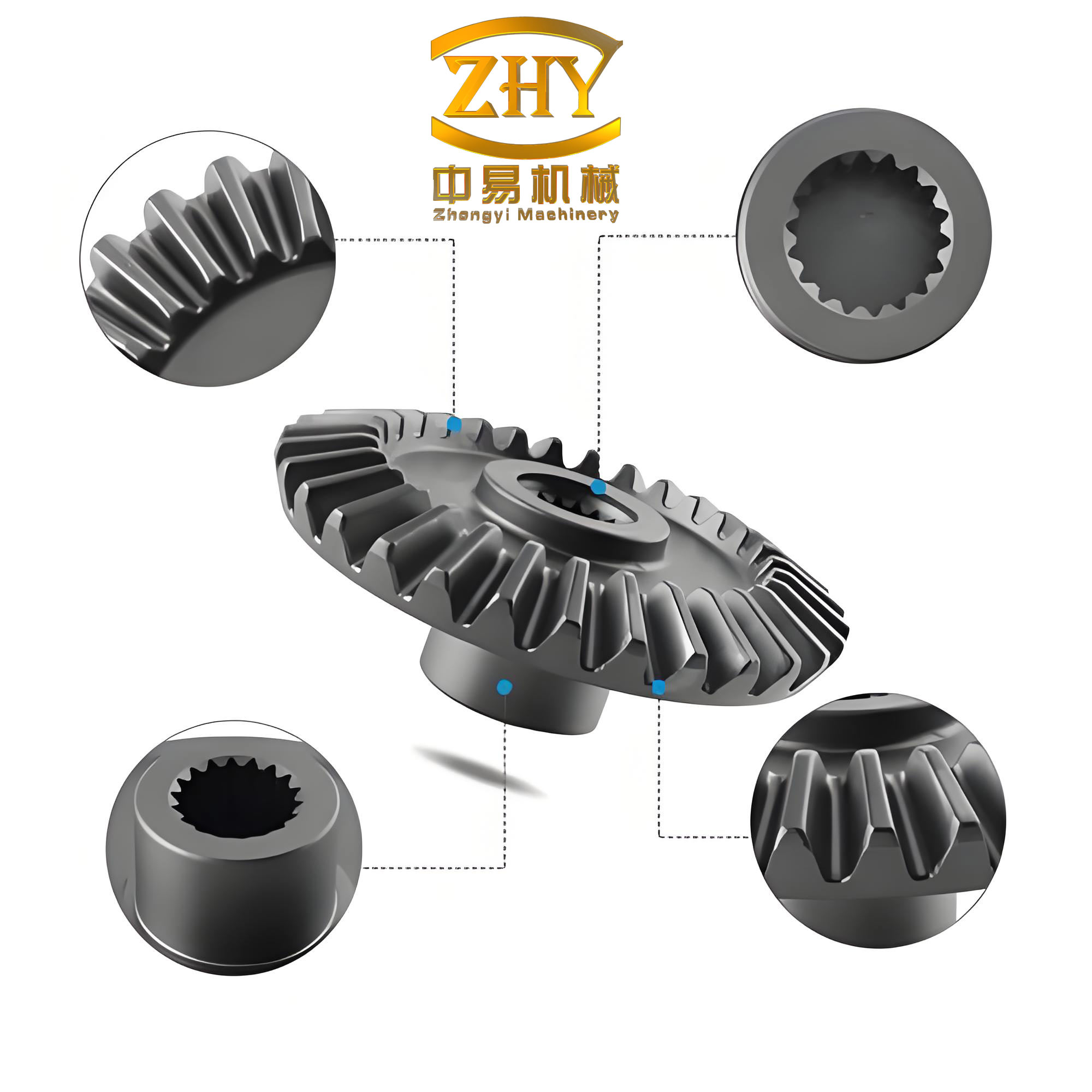
In mechanical engineering, straight bevel gears play a critical role in transmitting motion and power between intersecting shafts, commonly found in automotive differentials, industrial machinery, and aerospace systems. As manufacturing informatization advances, the need for accurate mathematical models of gear products has become paramount, serving as the foundation for analyzing meshing performance, optimizing design, and ensuring efficient production. For straight bevel gears, the theoretical tooth profile is a spherical involute, which poses significant challenges in design and manufacturing due to the non-developable nature of the sphere. Consequently, practical applications often approximate the actual tooth profile as a planar involute on the back cone tangent plane at the large end. This approach aligns modeling with design and manufacturing processes, ensuring consistency and simplifying complexities. In this article, I explore the back cone tangent plane method for modeling straight bevel gears, deriving parametric equations, implementing them in CAD systems, and analyzing modeling accuracy to meet industrial requirements.
The back cone tangent plane method simplifies the modeling of straight bevel gears by projecting the tooth profile onto a plane tangent to the back cone, effectively converting the complex spherical geometry into a manageable planar representation. This method leverages the concept of an equivalent spur gear, which has parameters derived from the actual straight bevel gear. The equivalent number of teeth and equivalent pitch radius are fundamental to this transformation, as they allow for the application of standard involute gear theory. The equations governing this relationship are:
$$ z_v = \frac{z}{\cos \delta} $$
$$ r_v = \frac{r}{\cos \delta} $$
where \( z \) is the number of teeth of the straight bevel gear, \( \delta \) is the pitch cone angle, \( r \) is the pitch radius at the large end, \( z_v \) is the equivalent number of teeth, and \( r_v \) is the equivalent pitch radius. This equivalence facilitates the use of planar involute curves, which are easier to generate and manipulate in CAD environments. The back cone tangent plane serves as a reference for constructing the tooth profile, ensuring that the modeled straight bevel gear closely approximates the theoretical behavior while remaining practical for manufacturing processes like gear cutting or forging.
To establish the tooth profile on the back cone tangent plane, the planar involute curve must be defined and transformed into the appropriate coordinate system. The standard parametric equation of a planar involute in a Cartesian coordinate system (Oxyz) is given by:
$$ x = r_b (\cos \phi + \phi \sin \phi) $$
$$ y = r_b (\sin \phi – \phi \cos \phi) $$
$$ z = 0 $$
where \( r_b \) is the base radius of the equivalent gear, calculated as \( r_b = r_v \cos \alpha \), with \( \alpha \) being the pressure angle, and \( \phi \) is the roll angle, which varies along the involute curve. This equation describes the path of a point on a string unwinding from a base circle, forming the fundamental shape of gear teeth. However, for straight bevel gears, this involute must be oriented symmetrically with respect to the gear’s axial plane and mapped onto the back cone tangent plane. This requires a series of coordinate transformations to align the profile correctly.
The first transformation involves rotating the involute profile about the Z-axis to achieve symmetry relative to the ZX plane. The rotation angle \( \beta \) is determined based on the tooth geometry of the equivalent spur gear. Specifically, one-quarter of the tooth pitch angle \( \gamma \) is calculated as:
$$ \gamma = \frac{90^\circ}{z_v} $$
Additionally, the involute roll angle \( \theta \) at the pitch point is given by the involute function:
$$ \theta = \tan \alpha – \alpha $$
Thus, the rotation angle \( \beta \) is:
$$ \beta = – (\gamma + \theta) $$
This rotation ensures that the involute profile is symmetric about the X-axis in the initial coordinate system. The transformation matrix for rotation about the Z-axis is:
$$ T_{11} = \begin{bmatrix} \cos \beta & \sin \beta & 0 & 0 \\ -\sin \beta & \cos \beta & 0 & 0 \\ 0 & 0 & 1 & 0 \\ 0 & 0 & 0 & 1 \end{bmatrix} $$
Applying this matrix to the standard involute equations yields the symmetric involute profile coordinates \( (x’, y’, z’) \):
$$ x’ = r_b (\cos \phi + \phi \sin \phi) \cos \beta – r_b (\sin \phi – \phi \cos \phi) \sin \beta $$
$$ y’ = r_b (\cos \phi + \phi \sin \phi) \sin \beta + r_b (\sin \phi – \phi \cos \phi) \cos \beta $$
$$ z’ = 0 $$
This step aligns the involute curve properly for subsequent mapping onto the back cone tangent plane, which is essential for accurate straight bevel gear modeling.
Next, the symmetric involute profile is transformed onto the back cone tangent plane by rotating it about the Y-axis by an angle \( -\delta \), where \( \delta \) is the pitch cone angle of the straight bevel gear. This rotation maps the profile from the XY plane to the plane tangent to the back cone at the large end. The transformation matrix for rotation about the Y-axis is:
$$ T_{12} = \begin{bmatrix} \cos \delta & 0 & \sin \delta & 0 \\ 0 & 1 & 0 & 0 \\ -\sin \delta & 0 & \cos \delta & 0 \\ 0 & 0 & 0 & 1 \end{bmatrix} $$
The resulting parametric equations for the involute on the large end back cone tangent plane are:
$$ x_1 = \left[ r_b (\cos \phi + \phi \sin \phi) \cos \beta – r_b (\sin \phi – \phi \cos \phi) \sin \beta \right] \cos \delta $$
$$ y_1 = r_b (\cos \phi + \phi \sin \phi) \sin \beta + r_b (\sin \phi – \phi \cos \phi) \cos \beta $$
$$ z_1 = \left[ r_b (\cos \phi + \phi \sin \phi) \cos \beta – r_b (\sin \phi – \phi \cos \phi) \sin \beta \right] \sin \delta $$
These equations define the tooth profile at the large end of the straight bevel gear in a unified coordinate system, facilitating CAD modeling. Similarly, for the small end, an additional translation along the Z-axis is required to account for the face width \( b \) of the gear. The translation matrix is:
$$ T_{23} = \begin{bmatrix} 1 & 0 & 0 & 0 \\ 0 & 1 & 0 & 0 \\ 0 & 0 & 1 & 0 \\ 0 & 0 & \frac{b}{\cos \delta} & 1 \end{bmatrix} $$
Combining this with the previous transformations, the parametric equations for the small end back cone tangent plane involute are:
$$ x_2 = \left[ r_b (\cos \phi + \phi \sin \phi) \cos \beta – r_b (\sin \phi – \phi \cos \phi) \sin \beta \right] \cos \delta $$
$$ y_2 = r_b (\cos \phi + \phi \sin \phi) \sin \beta + r_b (\sin \phi – \phi \cos \phi) \cos \beta $$
$$ z_2 = \left[ r_b (\cos \phi + \phi \sin \phi) \cos \beta – r_b (\sin \phi – \phi \cos \phi) \sin \beta \right] \sin \delta + \frac{b}{\cos \delta} $$
These equations enable the generation of tooth profiles at both ends of the straight bevel gear, ensuring a complete and accurate model. The roll angle \( \phi \) is typically parameterized as \( \phi = \pi t \) for \( 0 \leq t \leq 1 \), allowing for controlled sampling of points along the involute curve.
To implement this modeling approach in a CAD system like CATIA, a design parameter table is essential for defining the straight bevel gear’s key dimensions and properties. This table, often created in Excel and imported into CATIA, includes parameters such as module, number of teeth, pressure angle, and face width, along with derived values like equivalent radii and angles. The table below summarizes a typical parameter set for a straight bevel gear, which serves as the input for parametric modeling:
| Parameter | Value | Formula | Description |
|---|---|---|---|
| m1 | 3 mm | Large end module | |
| z | 30 | Number of teeth | |
| alpha | 20 deg | Pressure angle | |
| hax | 1 | Addendum coefficient | |
| hfx | 1.2 | Dedendum coefficient | |
| b | 20 mm | Face width | |
| delta | 56.3017 deg | Pitch cone angle | |
| R | 0 mm | m1 * z / sin(delta) / 2 | Cone distance |
| zv | 0.00000 | z / cos(delta) | Equivalent number of teeth |
| r1 | 0 mm | m1 * zv / 2 | Large end equivalent pitch radius |
| rb1 | 0 mm | r1 * cos(alpha) | Large end equivalent base radius |
| rf1 | 0 mm | r1 – hfx * m1 | Large end equivalent root radius |
| ra1 | 0 mm | r1 + hax * m1 | Large end equivalent tip radius |
| m2 | 0 mm | (R – b) * m1 / R | Small end module |
| r2 | 0 mm | m2 * zv / 2 | Small end equivalent pitch radius |
| rb2 | 0 mm | r2 * cos(alpha) | Small end equivalent base radius |
| rf2 | 0 mm | r2 – hfx * m2 | Small end equivalent root radius |
| ra2 | 0 mm | r2 + hax * m2 | Small end equivalent tip radius |
| beta | 0 deg | Rotation angle |
In CAD software, parameters calculated by formulas are initialized to zero with appropriate units, and the system automatically computes their values based on the defined relationships. This parametric approach allows for easy modification and customization of the straight bevel gear model, adapting to different design requirements. For instance, if the gear requires modification or variation, updating the parameter table automatically regenerates the geometry, streamlining the design process.
Using the derived parametric equations, the tooth profile for the straight bevel gear is constructed by generating points along the involute curve. The roll angle \( \phi \) is varied by setting \( \phi = \pi t \) for \( t \) values ranging from 0 to 1, which covers the necessary segment of the involute for tooth formation. For example, selecting \( t = 0, 0.1, 0.15, 0.2, 0.25 \) provides a set of points that define the involute accurately. These points are then connected using a spline curve in CATIA, forming the continuous involute profile on the back cone tangent plane. The tooth轮廓 is completed by adding the tip circle, root circle, and appropriate fillets at the root to avoid stress concentrations. Finally, the profile is projected onto the back cone surface to create the 3D tooth geometry. This process is repeated for both the large and small ends, resulting in a full tooth model that can be patterned around the gear axis to form the complete straight bevel gear.
The accuracy of the straight bevel gear model is critical for ensuring performance in real-world applications. To evaluate the modeling precision, the tooth thickness at the large end pitch circle is compared between the theoretical value and the modeled geometry. The theoretical tooth thickness \( s \) for a straight bevel gear is calculated as:
$$ s = \frac{\pi m}{2} $$
For a module \( m = 3 \) mm, this gives \( s = 4.7124 \) mm. In the modeled gear, the tooth thickness is measured under different conditions: on the tangent plane without projection, on the tangent plane with projection onto the back cone, and directly on the back cone after projection. The table below summarizes the measurements and errors:
| Measurement Type | Value (mm) | Error (mm) |
|---|---|---|
| Theoretical tooth thickness | 4.7124 | – |
| On tangent plane | 4.7154 | -0.0030 |
| Without projection | 4.7738 | -0.0614 |
| With projection | 4.7105 | 0.0019 |
The results indicate that the modeling error is minimal when the tooth profile is projected onto the back cone surface, with an error of only 0.0019 mm, which is well within acceptable tolerances for design and manufacturing. The larger error observed without projection highlights the importance of properly mapping the profile to the back cone to achieve accuracy. This analysis confirms that the back cone tangent plane method produces straight bevel gear models that are both precise and practical for industrial use.
In conclusion, the back cone tangent plane method offers a robust and efficient approach for modeling straight bevel gears, bridging the gap between theoretical complexity and practical application. By deriving parametric equations for the involute profile on the back cone tangent plane and applying coordinate transformations, this method simplifies the modeling process while maintaining high accuracy. The implementation in CAD systems, supported by parametric tables, enables flexible and reproducible design of straight bevel gears. The accuracy analysis demonstrates that the modeled tooth thickness closely matches theoretical values, ensuring reliability in performance analysis and manufacturing. This method not only facilitates the digital design of straight bevel gears but also aligns with modern manufacturing techniques, promoting consistency across the product lifecycle. As industries continue to embrace digitalization, such modeling approaches will play a pivotal role in advancing gear technology and optimizing mechanical systems.