
In modern manufacturing, the demand for high-precision components like straight bevel gears has driven the adoption of advanced CAD/CAM systems. We developed a specialized CAD/CAM system for straight bevel gear precision forging, leveraging SolidWorks’ API and VB6.0 to streamline design and manufacturing processes. This system integrates parametric modeling, database management, and automated NC code generation, significantly enhancing efficiency and accuracy in producing straight bevel gears. The straight bevel gear, a critical component in power transmission systems, requires precise geometry to ensure optimal performance. Our approach addresses common challenges in gear manufacturing, such as repetitive manual modeling and low precision in traditional methods, by automating key steps from digital modeling to CNC machining.
The CAD/CAM system for straight bevel gear forging consists of interconnected modules that cover the entire workflow, from initial design to final machining. We utilized a modular architecture to maintain independence between components while ensuring seamless data exchange. The core modules include CAD for geometric modeling and CAM for toolpath generation. Table 1 summarizes the system’s workflow stages, highlighting how each module contributes to the straight bevel gear production process.
| Stage | Module | Description | Output |
|---|---|---|---|
| 1 | CAD – Gear Modeling | Parametric design of straight bevel gear using SolidWorks API | 3D solid model |
| 2 | CAD – Assembly | Integration of gear components into an assembly | Assembly model |
| 3 | CAD – Forging Design | Generation of forging-specific geometry based on gear parameters | Forging model |
| 4 | CAD – Die Cavity Modeling | Creation of die cavity from forging model | Die model |
| 5 | CAM – NC Code Generation | Toolpath planning and NC code output using CAMWorks | G-code for CNC machining |
The parametric modeling of straight bevel gears relies on mathematical equations to define gear geometry. For instance, the gear tooth profile can be derived using fundamental gear theory. The pitch diameter $D_p$ for a straight bevel gear is calculated as:
$$D_p = \frac{N}{P_d}$$
where $N$ is the number of teeth and $P_d$ is the diametral pitch. The cone distance $A_0$ is given by:
$$A_0 = \frac{D_p}{2 \sin \gamma}$$
Here, $\gamma$ represents the pitch angle. These formulas enable the system to dynamically generate gear models based on user inputs, ensuring consistency and accuracy in straight bevel gear design. The parametric approach allows for rapid iteration, which is crucial for optimizing straight bevel gear performance in forging applications.
To manage data across modules, we implemented ADO (ActiveX Data Objects) database technology. This facilitates efficient storage and retrieval of design parameters, tool specifications, and machining settings. For example, tool data for CNC machining is stored in a relational database, with tables defining attributes like tool diameter and spindle speed. Table 2 illustrates a sample database structure for machining parameters, which is essential for automating the CAM process for straight bevel gear dies.
| Tool Name | Tool Diameter (mm) | Tool Corner Radius (mm) | Cutting Depth (mm) | Stepover Percentage (%) | Spindle Speed (rpm) | Feed Rate (mm/min) |
|---|---|---|---|---|---|---|
| EM12R6 | 12 | 3 | 0.5 | 75 | 3500 | 600 |
| EM6R2 | 6 | 2 | 0.5 | 75 | 3500 | 600 |
| EM3R1 | 3 | 1 | 0.2 | 3500 | 7500 | 250 |
| BM1R0.5 | 1 | 0.5 | 0.1 | 7500 | 7500 | 60 |
The “top-down” modeling methodology is another key aspect of our system. This approach starts with defining major parametric dimensions at the assembly level, then propagates changes to individual components. For a straight bevel gear, this means establishing global parameters like module and pressure angle early in the design process. The gear tooth thickness $t$ can be expressed as:
$$t = \frac{\pi}{2} \cdot m$$
where $m$ is the module. This equation ensures that all derived features, such as the gear blank and forging die, maintain geometric consistency. The top-down method is particularly beneficial for straight bevel gear designs, as it reduces errors and simplifies modifications during the forging die development phase.
In the CAD module, we developed a user-friendly interface using VB6.0, which interacts with SolidWorks via OLE automation. This allows users to input initial gear parameters, such as number of teeth, module, and pressure angle, and automatically generate the straight bevel gear model. The forging design module then computes additional parameters like shrinkage allowances and draft angles to create the forging geometry. For instance, the forging shrinkage factor $S_f$ is applied to the gear dimensions to account for material contraction during cooling:
$$S_f = 1 + \alpha \cdot \Delta T$$
where $\alpha$ is the coefficient of thermal expansion and $\Delta T$ is the temperature change. This ensures that the forged straight bevel gear meets dimensional tolerances after processing.
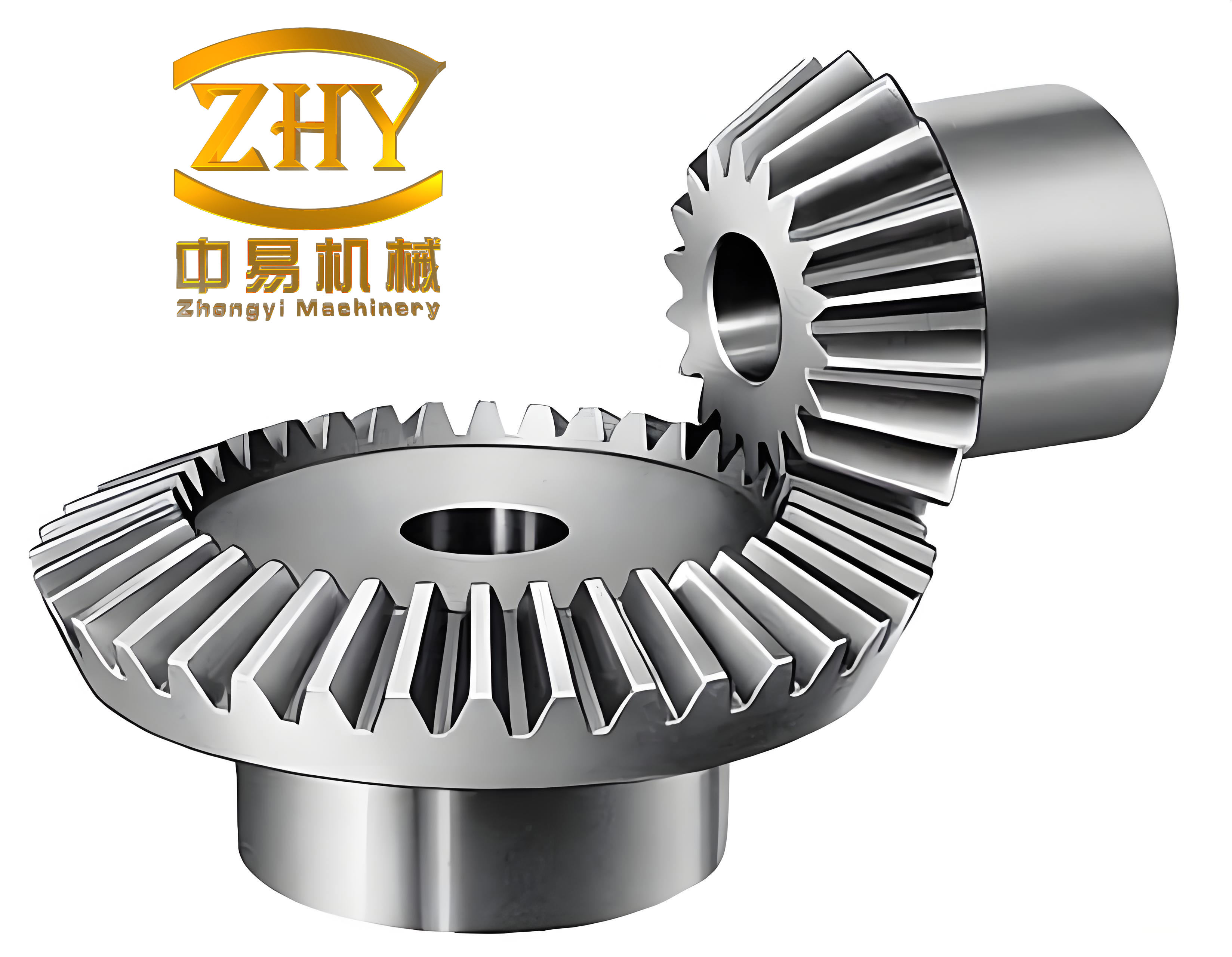
The die cavity modeling module utilizes Boolean operations in SolidWorks to subtract the gear forging model from a die block, creating the precise cavity required for forging. This process is automated through API calls, reducing manual effort and minimizing errors. The straight bevel gear die cavity must account for factors like material flow and die wear, which are incorporated into the design using empirical formulas. For example, the die wear allowance $W_a$ can be estimated as:
$$W_a = k \cdot F \cdot t$$
where $k$ is a wear coefficient, $F$ is the forging force, and $t$ is the production time. This highlights the importance of integrating manufacturing considerations early in the design phase for straight bevel gears.
In the CAM module, we employed CAMWorks for toolpath generation and NC code output. This software leverages automatic feature recognition (AFR) to identify machining regions from the CAD model, such as pockets and contours in the straight bevel gear die. The toolpaths are optimized based on the database parameters from Table 2, ensuring efficient material removal. The total machining time $T_m$ for the die can be approximated by:
$$T_m = \sum_{i=1}^{n} \frac{L_i}{f_i}$$
where $L_i$ is the toolpath length for operation $i$, and $f_i$ is the feed rate. This equation helps in planning production schedules for straight bevel gear dies. The NC code generated includes commands for roughing, semi-finishing, and finishing operations, tailored to the high-speed milling of die steels.
To further enhance the system, we incorporated validation checks using geometric constraints. For instance, the tooth contact pattern of a straight bevel gear is verified through simulation to ensure even load distribution. The contact ratio $C_r$ is calculated as:
$$C_r = \frac{\sqrt{R_a^2 – R_b^2} + \sqrt{R_f^2 – R_b^2} – A \sin \phi}{p_b}$$
where $R_a$ is the addendum radius, $R_b$ is the base radius, $R_f$ is the dedendum radius, $A$ is the center distance, $\phi$ is the pressure angle, and $p_b$ is the base pitch. This ensures that the forged straight bevel gear will operate smoothly in assembly.
The integration of CAD and CAM modules is achieved through a shared parameter database, which stores critical data like gear dimensions and tool offsets. This eliminates manual data re-entry and reduces the risk of errors. For example, the backlash $B$ in a straight bevel gear assembly is controlled by adjusting the die cavity dimensions, and it can be computed as:
$$B = D_p \cdot (\tan \phi_1 – \tan \phi_2)$$
where $\phi_1$ and $\phi_2$ are the operating pressure angles of the mating gears. By automating such calculations, the system ensures that the forged gears meet specified tolerances.
In conclusion, our CAD/CAM system for straight bevel gear precision forging represents a significant advancement in digital manufacturing. By combining parametric modeling, database management, and automated machining, we have streamlined the production of high-quality straight bevel gears. The system’s flexibility allows for easy adaptation to different gear sizes and materials, making it suitable for various industrial applications. Future work will focus on incorporating AI-based optimization for toolpath planning and real-time monitoring during forging. This will further enhance the efficiency and reliability of straight bevel gear manufacturing, solidifying the role of CAD/CAM systems in modern industry.
The development of this system underscores the importance of interdisciplinary approaches in engineering. By leveraging software tools like SolidWorks and VB6.0, we have created a robust platform that bridges design and manufacturing. The straight bevel gear, as a focal point, benefits from precise control over geometry and material properties, leading to improved performance in power transmission systems. As manufacturing evolves, such integrated systems will become increasingly vital for producing complex components like straight bevel gears with high accuracy and efficiency.