
In our automotive manufacturing facility, the production of rear axle differentials for light trucks involves the machining of straight bevel gears, specifically the differential side gears and pinion gears. Historically, after the gear cutting process, particularly planing, we faced a significant challenge: the absence of a dedicated rolling inspection apparatus. This gap meant that operators could not perform immediate checks on the meshing quality of straight bevel gears based on trial cuts. Consequently, adjustments to the machine tool settings and cutting tools lacked a data-driven foundation, leading to suboptimal啮合精度 (meshing accuracy). This issue directly impacted the assembly quality and production schedule of the rear axle, becoming a critical bottleneck. To resolve this, we embarked on designing and fabricating a简易 (simple) yet effective rolling inspection device tailored for straight bevel gears. This apparatus empowers gear planing operators to conduct self-inspections post trial cuts, enabling precise adjustments to the machine and tools, thereby elevating the quality of the planed straight bevel gears. It also serves reliably for sampling inspections of finished straight bevel gears. The following account details our approach, design principles, and operational methodology.
The core function of straight bevel gears in differential systems is to allow wheels to rotate at different speeds while turning, distributing torque effectively. Ensuring their precise meshing is paramount for noise reduction, vibration minimization, and longevity. Our device simulates the actual working conditions of a pair of straight bevel gears—a side gear and a pinion gear—allowing for the assessment of tooth contact pattern and rotational smoothness under light load. The design philosophy centered on simplicity, cost-effectiveness, and ease of use directly on the shop floor, without requiring sophisticated metrology equipment.
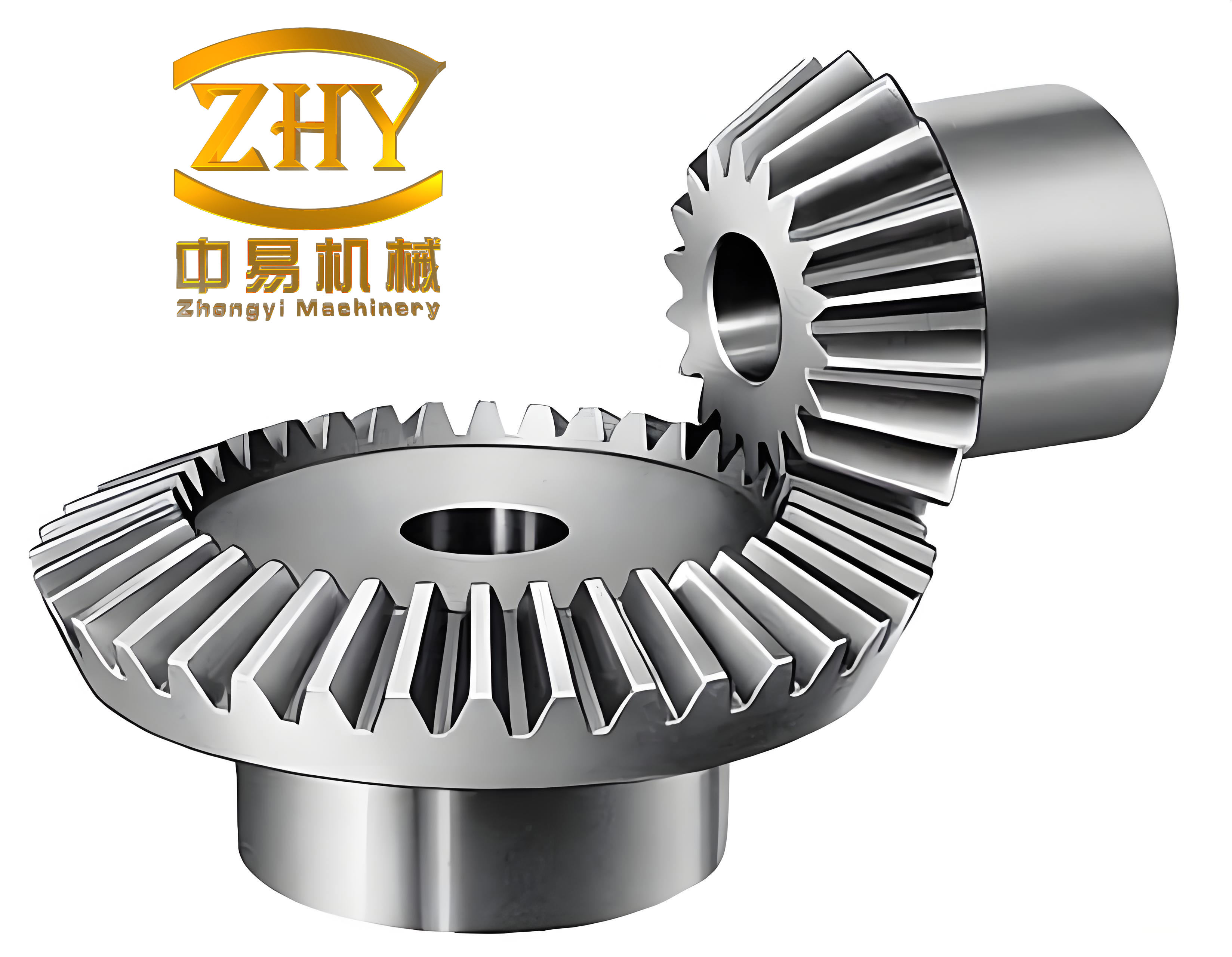
The structural configuration of our straight bevel gear rolling inspection device can be systematically broken down. A base plate serves as the foundation. Key components include interchangeable衬套 (bushings) for mounting the side gear (半轴齿轮) and fixed bushings for the pinion gear (行星齿轮) assembly. The heart of the device lies in its adaptability for both post-planing inspection and final product verification of straight bevel gears. The side gear bushing is designed with two internal bore sizes: one dimension for inspecting the gear immediately after planing, and another for inspecting the finished, fully processed straight bevel gear. Its outer diameter maintains a滑配 (sliding fit) with the base plate, allowing for easy replacement. The critical tolerance for the perpendicularity between the bushing’s top face and its internal bore is maintained within a stringent limit, typically on the order of $$ \delta_{\perp} \leq 0.01 \, \text{mm} $$.
The pinion gear is mounted on a dedicated心轴 (mandrel or arbor). Similarly, two versions of this mandrel exist. For post-planing inspection, the front section of the mandrel, which engages with the pinion gear’s bore, has a diameter denoted as $$ d_{p,\text{planing}} $$, while the rear section, fitting into a fixed bushing, has a diameter $$ d_{f,\text{planing}} $$. For inspecting finished straight bevel gears of the pinion type, both sections share a common diameter $$ d_{\text{finished}} $$. The spatial relationship between the four fixed bushings’ centerlines and the top reference plane of the side gear bushing is precisely controlled at a nominal distance $$ L = 150 \pm 0.02 \, \text{mm} $$. Furthermore, the coaxiality and perpendicularity of these bushings relative to the side gear bushing are held to tight tolerances, generally within $$ \phi 0.02 \, \text{mm} $$ and $$ 0.01 \, \text{mm} $$ respectively. These geometric accuracies are fundamental for replicating true meshing conditions for the straight bevel gears.
A crucial element for setting the correct meshing backlash is a set of微调垫圈 (finely adjustable thickness shims), labeled as component ‘K’ in our documentation. These shims allow the operator to set the啮合间隙 (meshing clearance or backlash) between the pinion and side straight bevel gears to an optimal range, typically between $$ 0.10 \, \text{mm} $$ and $$ 0.15 \, \text{mm} $$. Once the desired backlash is achieved through shim selection, an止动螺钉 (locking screw) is tightened to secure the assembly, preventing any inadvertent shift in clearance during the rolling inspection process. This ensures consistent measurement conditions. The fundamental backlash adjustment can be conceptualized by a simplified relationship accounting for mounting distances and gear geometry. For straight bevel gears, the effective backlash $$ B $$ set by the shim pack of thickness $$ t_s $$ is approximated by:
$$ B \approx k \cdot ( t_{s,\text{nominal}} – t_{s,\text{actual}} ) + B_0 $$
where $$ k $$ is a proportionality factor related to the gear cone angle, and $$ B_0 $$ is an initial constant. Precise setting requires empirical correlation with feeler gauge measurements.
The inspection methodology employs a master-and-article principle. To evaluate the planing quality of a pinion straight bevel gear, it is meshed with a known合格 (qualified) master side gear straight bevel gear. Conversely, a master pinion gear is used to inspect a production side gear. The process begins by applying a thin, uniform layer of Prussian blue or red lead paste (红丹油) onto the tooth flanks of the gear under test. The adjustable shims are then used to set the meshing gap until it feels smooth yet has minimal play, after which the locking screw is secured. The inspector then manually operates the device: the left hand rotates the side gear steadily, while the right hand applies a light, consistent drag or resistance to the pinion gear. This action causes the paste to transfer from the tested gear teeth onto the master gear teeth, revealing the contact pattern.
Analysis of the contact pattern is the primary diagnostic tool. For correctly meshing straight bevel gears, the pattern should be centrally located on the tooth flank, neither too close to the toe (inner end) nor the heel (outer end), and should have an elliptical or oval shape. Deviations indicate errors in machine setup or tool geometry. Common patterns and their interpretations for straight bevel gears are summarized in the table below:
| Contact Pattern Appearance | Likely Cause | Corrective Action for Straight Bevel Gears |
|---|---|---|
| Pattern biased toward toe (small end) | Excessive mounting distance of pinion or insufficient distance of side gear. | Adjust machine setting to effectively increase the cone distance of the tested gear or decrease the other. |
| Pattern biased toward heel (large end) | Insufficient mounting distance of pinion or excessive distance of side gear. | Adjust machine setting to effectively decrease the cone distance of the tested gear or increase the other. |
| Pattern too high (near tip) or too low (near root) | Incorrect pressure angle or blade profile error. | Re-grind or adjust the cutting tool geometry; verify cutter settings. |
| Uneven pattern across face width | Misalignment in the inspection fixture or gear blank runout. | Check fixture alignment (bushing perpendicularity, coaxiality) and gear blank quality. |
| Excessive noise/binding during rotation | Insufficient or excessive backlash, tooth spacing errors. | Re-adjust shim pack thickness; inspect index error on gear generating machine. |
Beyond qualitative pattern assessment, we can derive quantitative metrics. The contact ratio for straight bevel gears, a critical indicator of smooth power transmission, can be estimated from the pattern length. The effective length of contact $$ L_c $$ observed on several teeth can be averaged. For a gear with face width $$ F $$, an empirical quality index $$ Q_c $$ can be defined as:
$$ Q_c = \frac{\overline{L_c}}{F} \times 100\% $$
A well-meshed pair of straight bevel gears typically exhibits $$ Q_c $$ values above 70-80% under light inspection load. Furthermore, the rotational torque variation during manual rotation can be subjectively graded or, with a simple torque gauge, quantitatively measured. A consistent, low torque indicates good tooth alignment and spacing for the straight bevel gears.
The versatility of this device for straight bevel gears is noteworthy. It functions in two primary modes: 1) Process Control Mode: Used immediately after planing a batch’s first-piece straight bevel gear. The operator performs the check, interprets the pattern, and makes necessary offsets to the gear planer’s settings (like cutter head tilt, feed, or work offset) before proceeding with the full batch. This prevents scrap and reduces rework. 2) Quality Assurance Mode: Used by quality inspectors for random sampling of finished straight bevel gears from inventory or post-heat-treatment. It provides a functional check beyond simple dimensional measurement.
The design incorporates several thoughtful details to enhance reliability for inspecting straight bevel gears. The bushings are hardened and ground to resist wear from frequent insertion and removal of gears and mandrels. All locating surfaces are meticulously lapped. The base plate is made from stress-relieved cast iron to ensure dimensional stability. The device is calibrated periodically using a master gear pair whose meshing characteristics have been certified on a high-end analytical rolling tester. This traceability maintains the integrity of our inspection process for straight bevel gears.
From a theoretical standpoint, the device validates the fundamental geometry of straight bevel gears. The Tredgold’s approximation method is often used for the initial design of these gears, where back-cone radii are used to create an equivalent spur gear. The rolling check essentially validates the conjugate action derived from this approximation. The condition for correct conjugation is that the angular velocity ratio remains constant. During our manual rolling, any perceptible variation or “bump” indicates a deviation from this condition. The basic equation for the angular velocity ratio $$ i $$ for a pair of straight bevel gears with numbers of teeth $$ N_1 $$ and $$ N_2 $$ and pitch cone angles $$ \gamma_1 $$ and $$ \gamma_2 $$ is:
$$ i = \frac{\omega_1}{\omega_2} = \frac{N_2}{N_1} = \frac{\sin \gamma_2}{\sin \gamma_1} $$
Our inspection ensures that the manufactured straight bevel gears adhere closely to this kinematic requirement in practice.
We can further elaborate on the mathematical relationship governing the backlash adjustment via shims. Consider the pinion gear’s axial position as the adjustable variable. The change in backlash $$ \Delta B $$ as a function of the pinion’s axial shift $$ \Delta A_p $$ is given by:
$$ \Delta B \approx 2 \Delta A_p \tan \alpha \sin \gamma_p $$
where $$ \alpha $$ is the pressure angle and $$ \gamma_p $$ is the pinion’s pitch cone angle. Since our shim thickness $$ \Delta t_s $$ directly translates to an axial shift of the pinion assembly ($$ \Delta A_p \approx \Delta t_s $$ for our design), the formula provides a theoretical basis for shim selection to achieve the target backlash for the straight bevel gears. For our typical gears with $$ \alpha = 20^\circ $$ and $$ \gamma_p \approx 20^\circ $$, the sensitivity is roughly $$ \Delta B \approx 0.23 \cdot \Delta t_s $$. Therefore, to change backlash by 0.05 mm, a shim change of about 0.22 mm is required. This guides the gradation of our shim set (e.g., 0.05 mm, 0.1 mm, 0.2 mm increments).
The implementation of this straight bevel gear rolling inspection device has yielded substantial benefits. Firstly, it has democratized quality control by putting a powerful diagnostic tool directly in the hands of the machine operator. The feedback loop for correcting straight bevel gear planing errors has shrunk from hours (or days, if waiting for QC) to minutes. Secondly, the scrap rate for straight bevel gears has decreased by an estimated 40% in the planing department, as errors are caught immediately. Thirdly, the consistency of straight bevel gear quality has improved, leading to smoother rear axle assembly, reduced selective fitting, and a measurable drop in warranty claims related to differential noise. The device’s low cost and simplicity have made it replicable across multiple production lines for different sizes of straight bevel gears.
To systematize data collection, we occasionally log inspection results for statistical process control (SPC) of our straight bevel gear production. For a batch of gears, we might record parameters like the average contact pattern length ($$ \overline{L_c} $$), its standard deviation, and the subjectively assessed smoothness grade on a scale of 1-5. These can be plotted on control charts. For instance, the process capability index $$ C_{pk} $$ for the contact pattern length can be calculated if specification limits are defined. Suppose the target pattern length is 80% of face width with tolerances of ±15%. For a sample data set, $$ C_{pk} $$ is given by:
$$ C_{pk} = \min\left( \frac{USL – \mu}{3\sigma}, \frac{\mu – LSL}{3\sigma} \right) $$
where $$ \mu $$ is the sample mean, $$ \sigma $$ is the sample standard deviation, and USL/LSL are the upper/lower specification limits for $$ Q_c $$. Monitoring such indices helps in maintaining the long-term quality of straight bevel gears.
Comparing this simple device to more advanced coordinate measuring machines (CMM) or dedicated computerized gear testers for straight bevel gears is instructive. While those systems provide exhaustive data on tooth profile, lead, and pitch deviations in microns, they are expensive, require skilled operators, and are often offline. Our rolling checker provides an integrated, functional assessment that directly correlates with performance in the assembly. It is a perfect example of appropriate technology: sufficient for the control need, immediate, and economical. It complements, rather than replaces, periodic full-geometry audits on advanced equipment.
In conclusion, the development and deployment of this in-house straight bevel gear rolling inspection device have been instrumental in overcoming a critical production constraint. By enabling real-time functional verification of straight bevel gears after planing, it has fostered a culture of first-piece approval and operator-led quality assurance. The design, grounded in robust mechanical principles and adaptable for both process and product inspection, has proven its worth through improved gear quality, reduced waste, and enhanced assembly efficiency. The key to its success lies in its direct simulation of meshing conditions for straight bevel gears, providing an intuitive yet informative check that bridges the gap between machine setting and final performance. Future enhancements might include integrating a simple digital torque sensor or a fixture for systematic pattern photography and image analysis, but the core concept remains a vital part of our manufacturing toolkit for ensuring the reliability of straight bevel gears in automotive differentials.