
In my extensive experience designing and manufacturing injection molds, particularly for high-precision components like bevel gears, I have come to understand that the longevity and performance of a mold are not merely a function of the selected tool steel. The entire lifecycle, from initial forging to final surface engineering, dictates its ultimate success. The core challenge lies in balancing conflicting properties: achieving supreme surface hardness and wear resistance to withstand abrasive polymers and cyclic stresses, while maintaining sufficient core toughness to resist catastrophic cracking, all without compromising the dimensional accuracy painstakingly machined into the cavity and core. A flawed heat treatment process can introduce a multitude of heat treatment defects that silently compromise mold life, leading to premature failure, increased downtime, and costly rework. This discussion synthesizes my practical approach, focusing on the systematic prevention of such defects through a holistic strategy encompassing material science, thermal processing, and advanced surface engineering.
The selection of the base material is the foundational decision. For precision molds, such as those for polycarbonate bevel gears requiring excellent wear resistance and polishability, I often specify steels like AISI P20 pre-hardened steel for simpler applications, or alloy tool steels like AISI H13 (Cr-Mo-V) and AISI S7 (Si-Cr-Mo) for more demanding ones. While the referenced case used CrWMn, modern practice often favors steels with better hardenability and tempering resistance. The key is to understand the alloying elements and their role, as this directly influences the susceptibility to heat treatment defects. A fundamental relationship governs the hardenability, which is the depth to which a steel will transform to martensite upon quenching:
$$ D_I = f(\sum k_i \cdot [\%Element_i]) $$
Where \( D_I \) is the ideal critical diameter, and \( k_i \) represents the multiplying factor for each alloying element’s concentration. Elements like Chromium (Cr), Molybdenum (Mo), and Vanadium (V) increase hardenability, allowing slower quenches (e.g., oil or high-pressure gas) to achieve full hardness, thereby reducing the risk of distortion and quench cracking—a severe class of heat treatment defects. Conversely, high carbon content increases ultimate hardness but also increases sensitivity to cracking. The following table contrasts common mold steel choices:
| Steel Grade (AISI) | Primary Alloying Elements | Typical Hardness (HRC) after Treatment | Key Advantages | Potential Heat Treatment Defects Risk |
|---|---|---|---|---|
| P20 (Pre-hardened) | Cr, Mo | 28-32 (as-supplied) | Good machinability; No heat treatment required by molder. | Lower wear resistance limits life for abrasive resins. |
| H13 (Hot-work) | Cr, Mo, V | 48-52 | Excellent toughness, good thermal fatigue resistance, good polishability. | Decarburization during austenitizing; Requires precise tempering. |
| S7 (Shock-resisting) | Si, Cr, Mo | 54-58 | High toughness with good wear resistance. | Susceptible to oxidation; Quench cracking if cooling is too severe. |
| D2 (High-Carbon, High-Chromium) | C, Cr, Mo, V | 58-62 | Very high wear resistance and compressive strength. | High risk of quenching cracks; Poor toughness; Grinding checks. |
Once the steel is selected, the heat treatment protocol is paramount. The process sequence—soft annealing after forging, rough machining, stress relieving, final machining, hardening & tempering, and finishing—must be meticulously planned. The hardening phase, where the steel is austenitized and quenched, is the most critical and defect-prone stage. The formation of martensite, the desired hard phase, follows a temperature-dependent transformation kinetics model often described by the Koistinen-Marburger equation for the fraction of martensite (f):
$$ f = 1 – \exp[-\alpha (M_s – T)] $$
Here, \( M_s \) is the martensite start temperature, \( T \) is the temperature below \( M_s \), and \( \alpha \) is a material constant. A low \( M_s \) temperature, common in high-alloy steels, means transformation occurs at lower temperatures, generating higher stresses and increasing the propensity for heat treatment defects like quench cracking. The cooling rate must be optimized: too fast can cause cracks, too slow can result in soft, non-martensitic structures like pearlite or bainite, which are also considered defects for a high-hardness application. Tempering is the essential follow-up, where the brittle, strained martensite is relieved to achieve a balance of hardness and toughness. The tempering response can be modeled using the Hollomon-Jaffe parameter (HJP) for estimating equivalent time-temperature effects:
$$ \text{HJP} = T (C + \log t) $$
Where \( T \) is the absolute temperature, \( t \) is time, and \( C \) is a constant. Insufficient tempering can leave the steel brittle, while overtempering leads to excessive softening—both are undesirable outcomes and clear heat treatment defects.
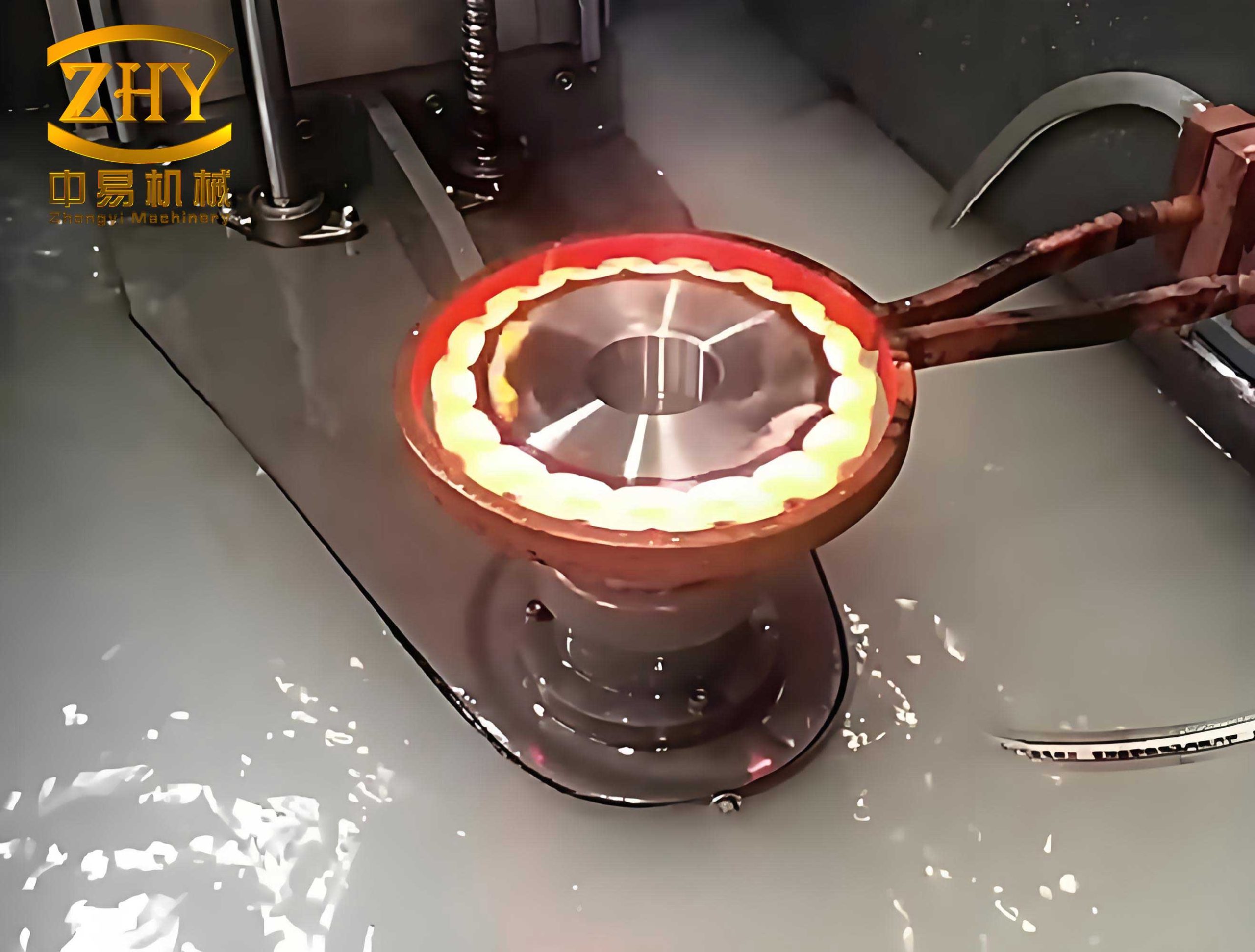
The pursuit of superior surface properties without affecting the bulk core properties leads us to thermochemical diffusion treatments. My evaluation of processes like gas nitriding, boriding (boronizing), and Chemical Vapor Deposition (CVD) or Physical Vapor Deposition (PVD) is based on a defect-minimization framework. Nitriding, performed at relatively low temperatures (500-580°C), introduces nitrogen to form hard nitrides (e.g., Fe4N, Fe2-3N). The depth of the nitrided case follows a parabolic growth law:
$$ d = k \sqrt{t} $$
where \( d \) is case depth, \( t \) is time, and \( k \) is a temperature-dependent rate constant. While nitriding induces minimal distortion, it can lead to a brittle “white layer” of iron nitrides at the surface, a classic heat treatment defect that can spall under impact. Boriding creates even harder FeB and Fe2B phases but operates at very high temperatures (~900°C), posing a high risk of core microstructure degradation (overtempering) and significant distortion. The high brittleness of the boride layer makes it prone to chipping, another catastrophic defect.
Therefore, for the ultimate performance in precision bevel gear molds, my strategy heavily favors advanced thin-film coatings applied via CVD or PVD. These processes, such as depositing Titanium Nitride (TiN), Titanium Aluminum Nitride (TiAlN), or Diamond-Like Carbon (DLC), occur at temperatures compatible with hardened tool steels (often 200-500°C for PVD). The adhesion and performance of these coatings are critically dependent on the substrate’s condition. Any prior heat treatment defects—such as surface decarburization, oxidation, or even improper polishing marks—will be amplified under the coating, leading to poor adhesion and early coating failure. The coating process itself can introduce defects like pinholes, droplets, or residual compressive stress that, if too high, can cause delamination. The selection of coating type is based on the polymer being processed; for example, DLC offers an excellent anti-stick surface for resins like polycarbonate, reducing mold release forces and wear.
I dedicate significant focus to identifying, understanding, and mitigating heat treatment defects. They are the primary cause of unplanned mold failure. A systematic categorization is essential for root cause analysis.
| Category of Defect | Specific Defect | Primary Causes | Consequences for Mold | Preventive/Corrective Measures |
|---|---|---|---|---|
| Quenching-Related | Quench Cracks | Excessive thermal stress during rapid cooling; Design with sharp corners; Improper Ms temperature. | Catastrophic failure; Often irreparable. | Use steels with high hardenability for milder quench; Design fillet radii; Use martempering or austempering. |
| Distortion/Warpage | Non-uniform cooling or heating; Residual stresses from prior machining. | Loss of dimensional accuracy; Poor part fit. | Slow, uniform heating; Stress relieve before hardening; Use fixtures during quenching. | |
| Soft Spots | Vapor blanket during quenching (in oil); Contaminated surface; Low hardenability steel. | Localized wear and erosion; Poor polish. | Use aggressive quenching media or agitation; Ensure clean surface; Select appropriate steel. | |
| Tempering-Related | Temper Embrittlement | Holding in certain temperature range (e.g., 375-575°C for some steels) or slow cooling through it. | Reduced impact toughness; Brittle fracture. | Avoid critical temperature ranges; Quench rapidly after high-temperature tempering. |
| Insufficient Tempering | Too low temperature or too short time. | Retained high brittleness; Risk of in-service cracking. | Follow proper time-temperature charts; Use multiple tempers for high-alloy steels. | |
| Surface Treatment | Spalling/Peeling (Nitriding/Boriding) | Excessively thick or brittle compound layer (white layer); Poor load support from substrate. | Loss of wear protection; Debris damages mold and parts. | Control process parameters to limit compound layer; Ensure substrate has adequate core hardness. |
| Coating Delamination (CVD/PVD) | Poor surface preparation (contamination, roughness); Subsurface defects; Coefficient of Thermal Expansion (CTE) mismatch. | Complete loss of coating benefits; Accelerated localized wear. | Meticulous cleaning and etching prior to coating; Use interlayers (e.g., Cr) to improve adhesion. | |
| General | Oxidation & Decarburization | Exposure to air at high austenitizing temperatures. | Soft surface layer; Reduced fatigue strength; Poor coating adhesion. | Use controlled atmosphere (vacuum, salt bath, packed in cast iron chips) or protective coatings during heat treat. |
The interplay between residual stress and heat treatment defects cannot be overstated. Heat treatment, especially quenching, introduces complex residual stress profiles. A desirable profile has compressive stress at the surface, which inhibits crack initiation. An undesirable profile with tensile stress at the surface acts as a crack promoter. The final grinding and polishing operations must be carefully controlled, as excessive heat or pressure can induce localized tensile stresses and even “grinding burns,” a form of re-tempering that creates a soft spot, which is a severe heat treatment defect introduced post-hardening.
Looking forward, the integration of computational tools is revolutionizing how I approach heat treatment. Finite Element Analysis (FEA) software can simulate temperature distributions, phase transformations, and stress evolution during heating and cooling cycles, allowing for virtual prototyping of the heat treatment process to predict and prevent distortion and cracking. Predictive models based on machine learning algorithms, trained on vast datasets of material compositions, process parameters, and defect outcomes, are emerging as powerful tools to optimize protocols and minimize the occurrence of heat treatment defects. The future lies in digitally connected process chains where the design geometry, material certificate, heat treatment simulation, and machining data are all linked, creating a holistic “digital twin” of the mold that guides its manufacturing to ensure maximum performance and longevity from the very first shot.