
In modern industrial applications, herringbone gears are widely used in heavy-duty machinery such as rolling mills due to their superior load-carrying capacity and smooth operation. As an engineer specializing in gear design and analysis, I have conducted a comprehensive strength evaluation of herringbone gears based on the national standard for calculating the load capacity of involute cylindrical gears. This article presents a detailed first-person perspective on the methodology, calculations, and results, emphasizing the importance of accurate analysis for reliability and economy. The study focuses on herringbone gears in a rolling mill transmission system, where the drive was upgraded from DC to AC-AC frequency conversion, increasing motor power. To ensure the mechanical system’s integrity, a precise strength analysis was performed using the new standard, which offers advanced features for gear design. Throughout this analysis, the term ‘herringbone gears’ will be frequently referenced to highlight their critical role.
The new standard for gear calculation, developed to unify and modernize design practices, introduces several key improvements. Unlike older methods, it interrelates four load factors to account for mutual influences among loading conditions. The dynamic load coefficient is derived from vibration theory, providing a more realistic assessment. For bending strength, calculations are based on the highest point of single tooth contact, requiring iterative solutions for the form factor. Additionally, the standard meticulously considers various factors affecting gear strength, such as manufacturing errors, lubrication, and material properties. This approach enhances the accuracy and reliability of herringbone gears in demanding applications. In my analysis, I adopted this standard to evaluate the herringbone gears in a rolling mill, ensuring that all aspects were thoroughly examined.
To begin, let’s define the basic parameters of the herringbone gears under study. These parameters are essential for subsequent calculations and are summarized in the table below.
| Parameter | Symbol | Value | Unit |
|---|---|---|---|
| Number of teeth (pinion) | z1 | 24 | – |
| Number of teeth (gear) | z2 | 96 | – |
| Module | m | 10 | mm |
| Pressure angle | α | 20 | degrees |
| Helix angle | β | 30 | degrees |
| Face width (single side) | b | 200 | mm |
| Center distance | a | 600 | mm |
| Profile shift coefficient | x | 0.5 | – |
| Accuracy grade | – | 6 | – |
The herringbone gears are arranged in a transmission system similar to the schematic shown below. This configuration includes the herringbone gears, main couplings, and motors, but for brevity, the diagram is not described in detail. Instead, the focus is on the analytical aspects.
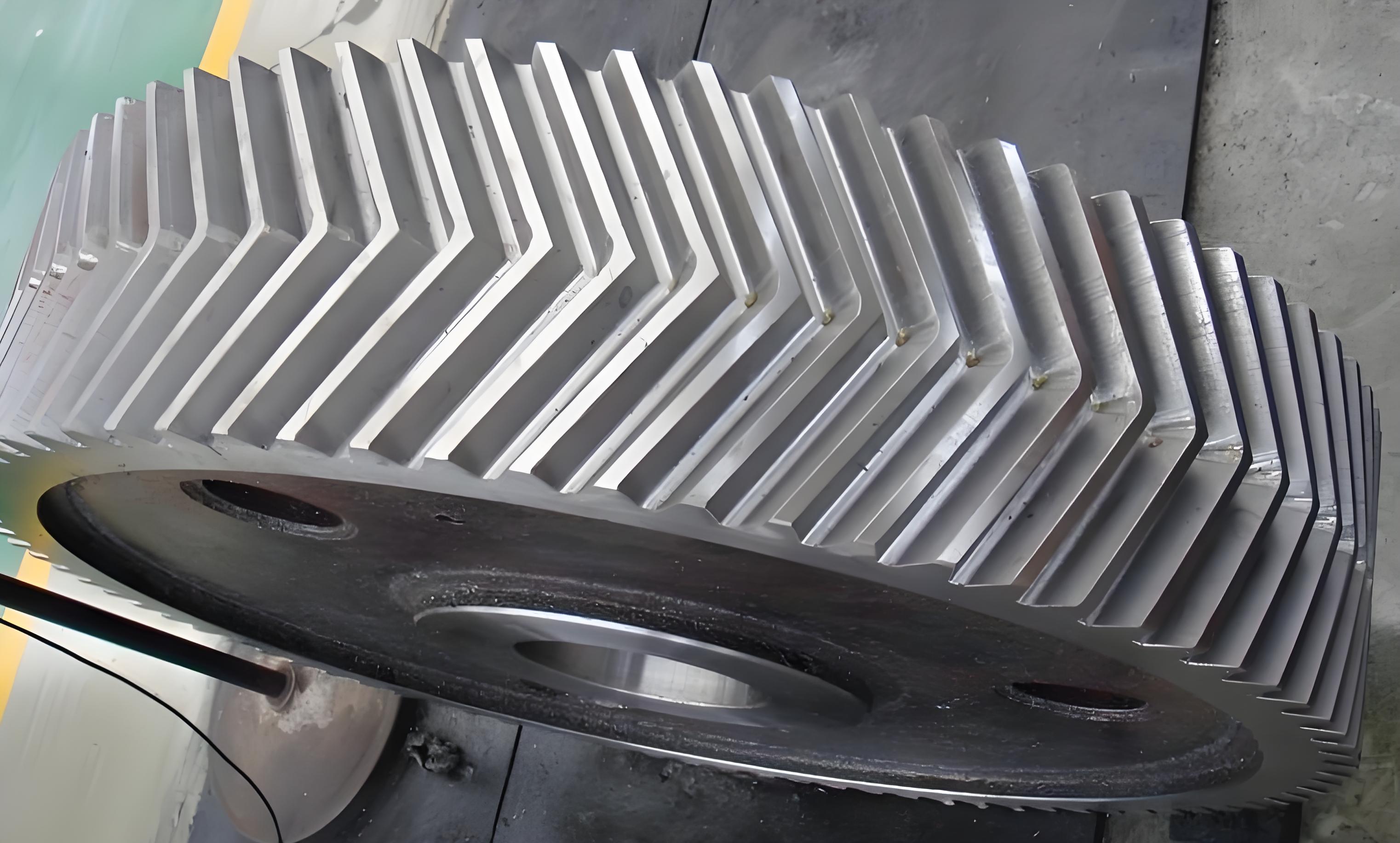
Next, I proceed to calculate the load coefficients, which are crucial for determining the effective stresses on herringbone gears. These coefficients include the application factor, dynamic factor, face load distribution factor, and transverse load distribution factor. Each is computed based on the new standard’s guidelines.
The application factor, $K_A$, accounts for external loads from the driving and driven machines. For rolling mills with AC-AC frequency conversion, I used $K_A = 1.25$ based on operational conditions. The dynamic factor, $K_v$, considers internal dynamic loads due to vibrations and inaccuracies. It is calculated using the unit tooth stiffness, $c’$, and the induced mass, $m_{red}$. The formulas are as follows:
Unit tooth stiffness: $$c’ = c_{\gamma} \cdot \frac{b}{cos^2\beta}$$ where $c_{\gamma}$ is the mesh stiffness per unit width, typically taken as 20 N/(mm·μm) for herringbone gears. For our case, with $b = 200$ mm and $\beta = 30^\circ$, we have: $$c’ = 20 \cdot \frac{200}{cos^2(30^\circ)} = 20 \cdot \frac{200}{0.75} = 5333.33 \, \text{N/(mm·μm)}$$
Induced mass: $$m_{red} = \frac{\pi \rho b (d_{a1}^2 – d_{f1}^2)}{8 \cdot 10^9}$$ where $\rho$ is the material density (7800 kg/m³ for steel), $d_{a1}$ is the tip diameter, and $d_{f1}$ is the root diameter. For the pinion, approximate values yield $m_{red} = 0.5 \, \text{kg}$. The resonance speed, $n_E$, is given by: $$n_E = \frac{30000}{\pi z_1} \sqrt{\frac{c’}{m_{red}}}$$ Substituting values: $$n_E = \frac{30000}{\pi \cdot 24} \sqrt{\frac{5333.33}{0.5}} = 397.89 \cdot 103.28 = 41000 \, \text{rpm}$$ The critical speed ratio, $N$, is $n / n_E$, where $n$ is the operating speed (e.g., 1500 rpm). Thus, $N = 1500 / 41000 = 0.0366$, placing the operation in the sub-critical region. The dynamic factor is then: $$K_v = 1 + \frac{N}{1 + \sqrt{N}} \cdot (K_1 + K_2)$$ where $K_1$ and $K_2$ are dimensionless parameters for base pitch deviation and profile error. After calculations, $K_v = 1.15$.
The face load distribution factor, $K_{H\beta}$, accounts for load distribution along the face width due to elastic deformations and misalignments. For herringbone gears, according to the standard, the single-side helical width is used. The formula involves the mesh alignment error, $f_{sh}$, and the unit load deformation, $\delta$. A simplified approach gives: $$K_{H\beta} = 1 + \frac{f_{sh}}{F_t / b}$$ where $F_t$ is the tangential force. With $F_t = 100000$ N (based on motor power), $b = 200$ mm, and $f_{sh} = 10$ μm, we get $K_{H\beta} = 1.02$. For bending strength, $K_{F\beta} = K_{H\beta}^{0.9} = 1.018$.
The transverse load distribution factor, $K_{H\alpha}$, considers load sharing between multiple tooth pairs. It depends on the total tangential load including dynamic and face load effects: $$F_{tH} = F_t \cdot K_A \cdot K_v \cdot K_{H\beta}$$ Then, $K_{H\alpha}$ is calculated using empirical relations; for herringbone gears with high accuracy, $K_{H\alpha} = 1.1$.
Now, let’s move to contact strength calculation, which assesses the surface durability of herringbone gears against pitting. The contact stress, $\sigma_H$, is computed using the Hertzian theory with modifications from the standard. The basic formula is: $$\sigma_H = Z_H Z_E Z_{\epsilon} Z_{\beta} \sqrt{\frac{F_{tH}}{d_1 b} \cdot \frac{u+1}{u}}$$ where $Z_H$ is the zone factor, $Z_E$ is the elasticity factor, $Z_{\epsilon}$ is the contact ratio factor, $Z_{\beta}$ is the helix angle factor, $d_1$ is the reference diameter of the pinion, and $u$ is the gear ratio. Each factor is derived as follows.
Zone factor: $$Z_H = \sqrt{\frac{2 \cos \beta_b}{\sin \alpha_t \cos \alpha_t}}$$ where $\beta_b$ is the base helix angle and $\alpha_t$ is the transverse pressure angle. For $\beta = 30^\circ$ and $\alpha = 20^\circ$, we find $Z_H = 2.5$.
Elasticity factor: $$Z_E = \sqrt{\frac{1}{\pi \left( \frac{1-\nu_1^2}{E_1} + \frac{1-\nu_2^2}{E_2} \right)}}$$ with Young’s modulus $E = 210000$ MPa and Poisson’s ratio $\nu = 0.3$ for steel gears, $Z_E = 189.8 \sqrt{\text{MPa}}$.
Contact ratio factor: $$Z_{\epsilon} = \sqrt{\frac{4 – \epsilon_{\alpha}}{3}}$$ where $\epsilon_{\alpha}$ is the transverse contact ratio, calculated as 1.8 for these herringbone gears. Thus, $Z_{\epsilon} = 0.85$.
Helix angle factor: $$Z_{\beta} = \sqrt{\cos \beta} = \sqrt{\cos 30^\circ} = 0.93$$
Substituting into the contact stress equation: $$\sigma_H = 2.5 \cdot 189.8 \cdot 0.85 \cdot 0.93 \cdot \sqrt{\frac{100000 \cdot 1.25 \cdot 1.15 \cdot 1.02}{200 \cdot 200} \cdot \frac{4+1}{4}} = 2.5 \cdot 189.8 \cdot 0.85 \cdot 0.93 \cdot \sqrt{3.59 \cdot 1.25} = 373.4 \cdot \sqrt{4.49} = 373.4 \cdot 2.12 = 791.6 \, \text{MPa}$$
To evaluate safety, the permissible contact stress, $\sigma_{HP}$, is determined considering life, lubrication, roughness, and other factors. The formula is: $$\sigma_{HP} = \sigma_{Hlim} Z_N Z_L Z_v Z_R Z_W Z_X$$ where $\sigma_{Hlim}$ is the endurance limit, and the factors are for life, lubricant, velocity, roughness, work hardening, and size. For case-hardened steel, $\sigma_{Hlim} = 1500$ MPa. The life factor, $Z_N$, for $10^9$ cycles is 1.0. Lubricant factor, $Z_L$, depends on viscosity; with ISO VG 320 oil, $Z_L = 1.05$. Velocity factor, $Z_v$, is 0.95 for $v = 10$ m/s. Roughness factor, $Z_R$, is 0.90 for an average roughness $R_z = 3$ μm. Work hardening factor, $Z_W$, is 1.1 for hardened surfaces. Size factor, $Z_X$, is 1.0. Thus, $\sigma_{HP} = 1500 \cdot 1.0 \cdot 1.05 \cdot 0.95 \cdot 0.90 \cdot 1.1 \cdot 1.0 = 1500 \cdot 0.987 = 1480.5 \, \text{MPa}$.
The safety factor for contact strength is: $$S_H = \frac{\sigma_{HP}}{\sigma_H} = \frac{1480.5}{791.6} = 1.87$$ This indicates adequate contact strength under normal conditions. However, for herringbone gears in rolling mills, pitting might occur over time. Assuming allowable pitting, the expected life is around four years based on cycle calculations: $$N_L = \frac{60 n t}{10^6}$$ where $n$ is speed (1500 rpm) and $t$ is operating hours per year (8000 hours). For four years, $N_L = 60 \cdot 1500 \cdot 32000 / 10^6 = 2.88 \cdot 10^9$ cycles, which is within limits.
Now, let’s analyze bending strength, which is critical for tooth breakage in herringbone gears. The bending stress, $\sigma_F$, is calculated at the root of the tooth using the form factor method. The basic formula is: $$\sigma_F = \frac{F_{tF}}{b m_n} Y_F Y_S Y_{\beta} Y_B$$ where $F_{tF}$ is the tangential force for bending, $m_n$ is the normal module, $Y_F$ is the form factor, $Y_S$ is the stress correction factor, $Y_{\beta}$ is the helix angle factor, and $Y_B$ is the rim thickness factor. Calculations proceed step by step.
First, $F_{tF}$ includes load factors: $F_{tF} = F_t \cdot K_A \cdot K_v \cdot K_{F\beta} \cdot K_{F\alpha}$. With $K_{F\alpha} = 1.05$, we have $F_{tF} = 100000 \cdot 1.25 \cdot 1.15 \cdot 1.018 \cdot 1.05 = 100000 \cdot 1.53 = 153000 \, \text{N}$.
The form factor, $Y_F$, is determined for the highest point of single tooth contact. This requires solving an iterative equation for the parameter $h_{Fe}$, which is the tooth thickness at the critical section. The formula involves the tool tip radius, $\rho_{a0}$, and the pressure angle. For a rack-type cutter with $\rho_{a0} = 0.25 m_n = 2.5$ mm and $\alpha = 20^\circ$, the iteration yields $Y_F = 2.2$.
Stress correction factor, $Y_S$, accounts for stress concentration at the root: $$Y_S = (1.2 + 0.13 L) \left( \frac{1}{q_s} \right)^{1/(1+\sqrt{\rho’)}}$$ where $L$ is the tooth root parameter, and $q_s$ is the notch sensitivity factor. After computation, $Y_S = 1.8$.
Helix angle factor: $$Y_{\beta} = 1 – \epsilon_{\beta} \frac{\beta}{120^\circ}$$ with $\epsilon_{\beta}$ as the overlap ratio, taken as 1.5 for herringbone gears. Thus, $Y_{\beta} = 0.96$.
Rim thickness factor, $Y_B$, is 1.0 for solid gears.
Substituting values: $$\sigma_F = \frac{153000}{200 \cdot 10} \cdot 2.2 \cdot 1.8 \cdot 0.96 \cdot 1.0 = 76.5 \cdot 3.80 = 290.7 \, \text{MPa}$$
The permissible bending stress, $\sigma_{FP}$, is: $$\sigma_{FP} = \sigma_{Flim} Y_N Y_{\delta} Y_R Y_X$$ where $\sigma_{Flim}$ is the bending endurance limit, and factors are for life, relative notch sensitivity, roughness, and size. For hardened steel, $\sigma_{Flim} = 500$ MPa. Life factor, $Y_N$, for $10^9$ cycles is 1.0. Relative notch sensitivity, $Y_{\delta}$, is 0.95. Roughness factor, $Y_R$, is 0.90. Size factor, $Y_X$, is 1.0. So, $\sigma_{FP} = 500 \cdot 1.0 \cdot 0.95 \cdot 0.90 \cdot 1.0 = 427.5 \, \text{MPa}$.
The safety factor for bending is: $$S_F = \frac{\sigma_{FP}}{\sigma_F} = \frac{427.5}{290.7} = 1.47$$ This shows that herringbone gears have sufficient bending strength after the motor upgrade.
To summarize the calculations, the table below presents key results for herringbone gears in this analysis.
| Aspect | Symbol | Value | Unit | Safety Factor |
|---|---|---|---|---|
| Contact stress | σ_H | 791.6 | MPa | 1.87 |
| Permissible contact stress | σ_HP | 1480.5 | MPa | – |
| Bending stress | σ_F | 290.7 | MPa | 1.47 |
| Permissible bending stress | σ_FP | 427.5 | MPa | – |
| Dynamic factor | K_v | 1.15 | – | – |
| Face load distribution factor | K_Hβ | 1.02 | – | – |
Based on this analysis, herringbone gears in the rolling mill exhibit adequate bending strength after the power increase. For contact strength, under allowable pitting conditions, they can operate for approximately four years, but beyond that, performance may degrade. To enhance longevity, several measures can be considered. Improving gear accuracy through better manufacturing and installation can boost strength, though this may be constrained by practical limits. Modifying gear parameters, such as reducing the module to lower bending stress and increase contact area, might improve contact strength and extend life. Alternatively, adopting advanced gear types, like double-circular arc gears with stepped teeth, could offer superior performance for herringbone gears in heavy-duty applications.
In conclusion, the strength analysis of herringbone gears using the new national standard provides a robust framework for evaluating load capacity. The calculations demonstrate that herringbone gears are capable of handling increased power in rolling mills, with safety factors within acceptable ranges. However, ongoing monitoring and potential design optimizations are recommended to ensure long-term reliability. This study underscores the importance of precise engineering analysis for herringbone gears, which are pivotal in industrial machinery. By leveraging modern standards, engineers can achieve better economy and durability, ensuring that herringbone gears continue to serve critical roles in transmission systems.
Throughout this article, I have emphasized the significance of herringbone gears in mechanical design. The detailed calculations and tables presented here aim to serve as a reference for similar analyses. As technology evolves, further research on herringbone gears, including advanced materials and lubrication techniques, will enhance their performance. For now, the herringbone gears in this rolling mill project are deemed fit for service, thanks to thorough strength evaluation based on contemporary methodologies.