
This study investigates the strength failure mechanisms and fatigue characteristics of super-reduction ratio hypoid gears through advanced computational modeling and finite element analysis. Hypoid gears with ultra-high reduction ratios are critical components in applications requiring compact designs, such as robotics and precision servo systems. We present a systematic methodology for designing, simulating, and optimizing these specialized gear systems.
1. Geometric Parameter Design
The fundamental geometric relationships for hypoid gears are defined by the following equations:
$$ \tan \delta’_2 = \frac{z_2 \sin \Sigma}{1.2(z_1 + z_2 \cos \Sigma)} $$
$$ r_2 = \frac{1}{2}(d_{e2} – b_2 \sin \delta’_2) $$
$$ \sin \epsilon’_0 = \frac{E \sin \delta’_2}{r_2} $$
Key design parameters for super-reduction ratio hypoid gears are calculated through iterative optimization:
| Parameter | Pinion | Gear |
|---|---|---|
| Number of Teeth | 2 | 60 |
| Module (mm) | 7.806 | 47.80 |
| Pressure Angle (°) | 20 | 20 |
| Spiral Angle (°) | 35 | 78.68 |
| Root Fillet Radius (mm) | 1.9-2.1 | 1.9-2.1 |
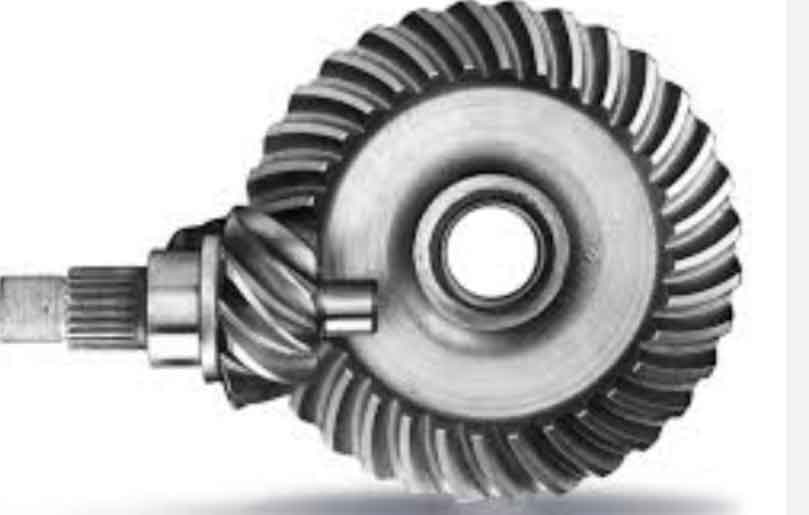
2. Three-Dimensional Modeling
The tooth surface equations for hypoid gears are derived using coordinate transformation matrices:
$$ \mathbf{r}^{(a)}_{01} = \begin{bmatrix}
(-r_{c1} \pm s_1 \sin \alpha_{01}) \sin \theta_1 \\
(-r_{c1} \pm s_1 \sin \alpha_{01}) \cos \theta_1 \\
-s_1 \cos \alpha_{01}
\end{bmatrix} $$
$$ \mathbf{n}^{(a)}_{01} = \begin{bmatrix}
-\cos \alpha_{01} \sin \theta_1 \\
-\cos \alpha_{01} \cos \theta_1 \\
\mp \sin \alpha_{01}
\end{bmatrix} $$
Discrete tooth surface points are generated through MATLAB numerical computation and imported into SolidWorks for surface reconstruction.
3. Finite Element Analysis
The transient stress distribution in hypoid gears under operational loads is analyzed using the following contact mechanics formulation:
$$ \sigma_{eq} = \sqrt{\frac{1}{2}[(\sigma_1 – \sigma_2)^2 + (\sigma_2 – \sigma_3)^2 + (\sigma_3 – \sigma_1)^2]} $$
Fatigue life prediction employs the modified Palmgren-Miner rule:
$$ \sum \frac{n_i}{N_i} = D $$
Critical findings from finite element simulations:
| Condition | Maximum Stress (MPa) | Minimum Fatigue Life (Cycles) |
|---|---|---|
| Base Configuration | 667.59 | 8,721 |
| Increased Torque (550 Nm) | 712.34 | 6,892 |
| Higher Speed (1,200 rpm) | 683.15 | 7,543 |
| Optimized Root Fillet (2.1 mm) | 601.27 | 11,209 |
4. Parametric Sensitivity Analysis
The influence of root fillet radius on stress concentration factors:
$$ K_t = 1 + 2\sqrt{\frac{t}{r}} $$
Where t = tooth thickness and r = fillet radius. The fatigue life improvement with increased fillet radius follows:
$$ N_f \propto \left(\frac{\Delta \sigma}{\sigma_{UTS}}\right)^{-b} $$
Where b = 6.56 for 20CrNi4A alloy steel.
5. Dynamic Load Characteristics
Time-dependent meshing behavior of hypoid gears reveals periodic stress variations:
$$ \tau(t) = \tau_{mean} + \tau_{amp} \sin(2\pi f_m t) $$
Where $f_m$ = meshing frequency. The dynamic magnification factor reaches maximum at resonance condition:
$$ \frac{\omega}{\omega_n} = \sqrt{1 – 2\zeta^2} $$
This comprehensive analysis demonstrates that hypoid gear performance can be significantly enhanced through geometric optimization and proper fillet design. The methodology provides valuable insights for developing high-reliability hypoid gear systems in demanding industrial applications.