
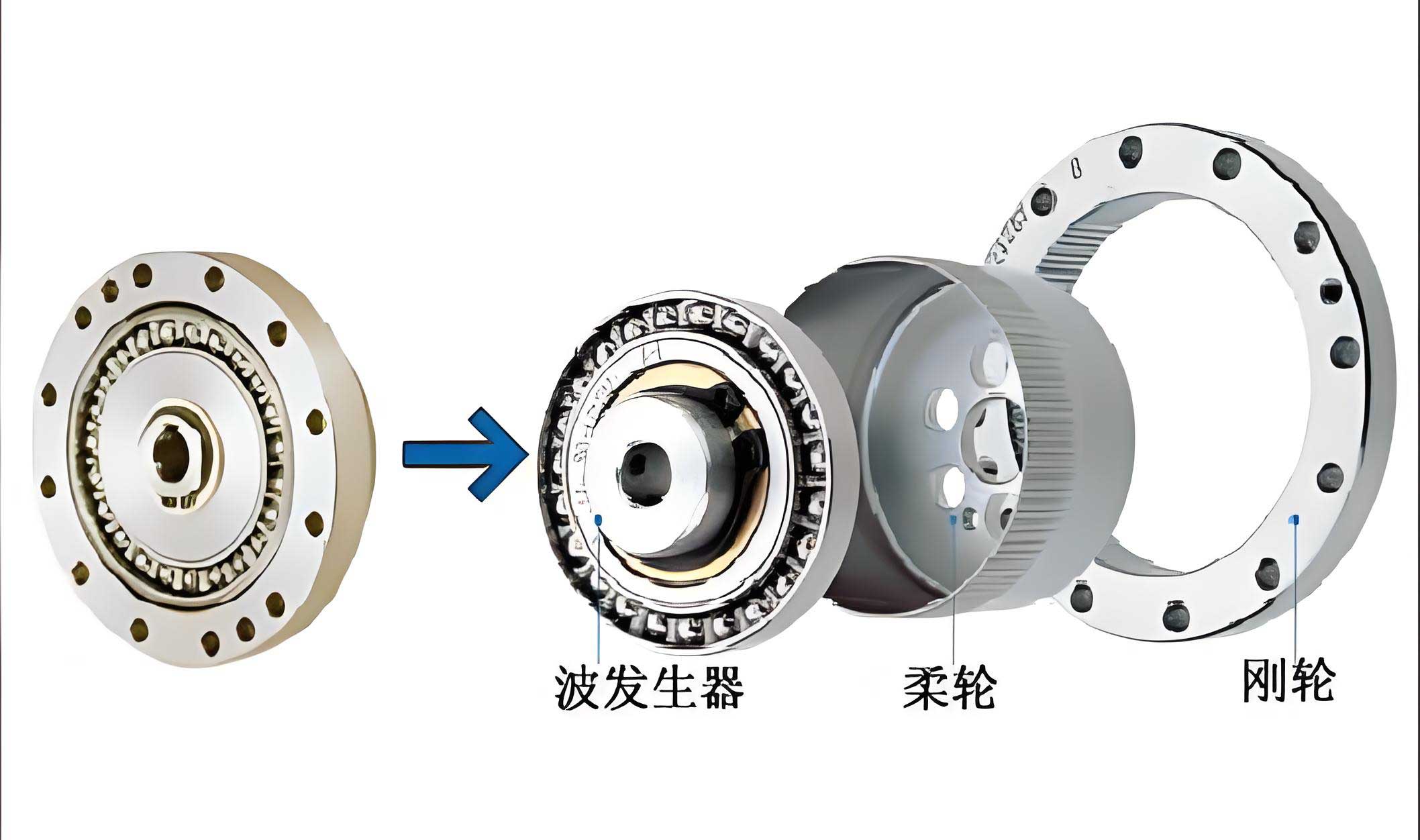
In the field of precision motion transmission, the strain wave gear, also known as harmonic drive, stands out due to its unique operating principle based on the elastic deformation of a flexible component called the flexspline. This mechanism enables high reduction ratios, compact design, and zero-backlash performance, making it indispensable in robotics, aerospace, and industrial automation. The longevity and reliability of a strain wave gear system are predominantly dictated by the fatigue life of the flexspline, which undergoes cyclic elastic deformation during operation. Consequently, a thorough understanding of the stress distribution within the flexspline, especially under assembly conditions, is paramount for optimal design and failure prevention. Traditional analytical methods, often relying on simplified models like the equivalent ring theory, provide valuable insights but may not fully capture the complex stress state induced by the actual tooth geometry and three-dimensional effects. In this work, I aim to bridge this gap by developing a detailed, parameterized three-dimensional solid finite element model of the flexspline that incorporates realistic tooth profile information. The primary objective is to perform a comprehensive stress analysis of the strain wave gear in its assembled, unloaded state, and to critically compare the results with established theoretical and empirical design values.
The core innovation of this study lies in the methodological approach to modeling. Rather than simplifying the flexspline into a smooth, toothless shell—a common practice in prior studies to reduce computational cost—I deliberately retain the intricate details of the tooth geometry. This includes the exact involute tooth profile, variable tooth thickness, and the critical tooth root fillet radius, all of which are known stress concentrators. To achieve this, I employ ANSYS Parametric Design Language (APDL) for script-based, parameterized modeling. This allows for the flexible definition of all key geometric parameters, enabling systematic studies and design optimizations in the future. The model is built for a cup-type strain wave gear configuration. The process begins with the creation of a two-dimensional planar gear ring sector, which is then extruded to form a three-dimensional solid model of the entire flexspline assembly, including its cup body. The wave generator, specifically a four-roller type, is modeled and brought into contact with the inner surface of the flexspline cup. Defining accurate contact conditions between these components is crucial for simulating the assembly state where the wave generator elliptically deforms the flexspline to engage with the rigid circular spline.
The theoretical foundation for stress analysis in strain wave gears often starts with the equivalent ring theory. This theory simplifies the flexspline into a thin circular ring with equivalent stiffness, accounting for the reinforcing effect of the cup body. For a four-roller wave generator with a specific offset angle, the circumferential stress in the flexspline’s neutral layer can be derived analytically. Let \( \phi \) be the angular position measured from the major axis of the deformed flexspline, \( w_0 \) the maximum radial deformation, \( E \) the Young’s modulus, \( h \) the equivalent ring thickness, \( r_m \) the radius of the neutral circle before deformation, and \( \beta \) the offset angle of the roller axes. The circumferential stress \( \sigma(\phi) \) is given by two piecewise functions:
$$ \sigma(\phi) = \frac{w_0 E h}{2 r_m^2} \left[ \frac{4}{\pi} – 2\sin\beta \cos\phi \over \frac{\pi}{2}\cos\beta + \sin\beta – \beta\cos\beta – \frac{4}{\pi} \right], \quad (0 \leq \phi \leq \beta) $$
$$ \sigma(\phi) = \frac{w_0 E h}{2 r_m^2} \left[ \frac{4}{\pi} – 2\cos\beta \sin\phi \over \frac{\pi}{2}\cos\beta + \sin\beta – \beta\cos\beta – \frac{4}{\pi} \right], \quad (\beta \leq \phi \leq \pi/2) $$
In practical design guidelines, further simplifications are made for hand calculations. The flexspline is treated as a smooth cylindrical shell, and the maximum circumferential bending stress is estimated using an empirical formula that incorporates various correction coefficients:
$$ \sigma_{\phi c} = K_{rt} K_M K_d C_{\sigma} \frac{w_0 E s}{r_m^2} $$
Here, \( s \) is the wall thickness at the tooth ring, \( K_{rt} \) is a coefficient accounting for increased stress due to flexspline bending stiffness, \( K_M \) is a factor for load-induced distortion, \( K_d \) is a dynamic load factor, and \( C_{\sigma} \) is a normal stress coefficient. While these theoretical and empirical methods offer quick estimates, they inherently smooth over the local stress variations caused by the discrete teeth and three-dimensional constraints. This motivates the need for a more refined finite element analysis of the strain wave gear.
The first step in my finite element modeling is to define the geometric parameters of the flexspline tooth. For this study, an involute tooth profile with modification is chosen. The relevant parameters are summarized in the table below:
| Parameter | Symbol | Value | Unit |
|---|---|---|---|
| Module | \( m \) | 0.5 | mm |
| Number of Teeth on Flexspline | \( z_1 \) | 200 | – |
| Profile Shift Coefficient | \( x_1 \) | 3.0 | – |
| Pressure Angle | \( \alpha_0 \) | 20 | ° |
| Addendum Coefficient | \( h_a^* \) | 1.0 | – |
| Dedendum Clearance Coefficient | \( c^* \) | 0.35 | – |
Using these parameters, the key dimensions of the involute tooth profile are calculated programmatically within APDL. The formulas governing these dimensions are essential for the parametric model:
| Dimension | Symbol | Calculation Formula |
|---|---|---|
| Pitch Circle Radius | \( r_1 \) | \( r_1 = m z_1 / 2 \) |
| Dedendum Circle Radius | \( r_f \) | \( r_f = 0.5m[z_1 + 2(x_1 – h_a^* – c^*)] \) |
| Addendum Circle Radius | \( r_a \) | \( r_a = 0.5m[z_1 + 2(x_1 + h_a^*)] \) |
| Tooth Thickness on Pitch Circle | \( s_p \) | \( s_p = (\pi/2 + 2x_1 \tan\alpha_0)m \) |
| Space Width on Pitch Circle | \( e_p \) | \( e_p = (\pi/2 – 2x_1 \tan\alpha_0)m \) |
The involute curve itself is defined parametrically. For a gear generated by a rack-type cutter (simulating hobbling or shaping), the coordinates \((x_1, y_1)\) of a point on the involute are given by:
$$ x_1 = r_1[-\sin(u – \theta) + u \cos\alpha_0 \cos(u – \theta + \alpha_0)] $$
$$ y_1 = r_1[\cos(u – \theta) + u \cos\alpha_0 \sin(u – \theta + \alpha_0)] $$
Here, \( u \) is the rolling angle parameter, and \( \theta \) is half of the angular tooth thickness on the pitch circle. Using these equations within APDL, points are generated to construct the involute profile from the base circle to the addendum circle. The tooth root fillet, a critical region for stress concentration, is modeled with a specified radius. A single tooth is constructed by connecting these profiles and then mirrored to create a symmetric, full tooth model. This tooth is then patterned circumferentially to create a sector of the gear ring—initially, a 90-degree sector (one-fourth of the full ring) is modeled to exploit symmetry, reducing computational expense. This forms the “planar gear ring” model, which is essentially a 2D representation of the tooth ring extruded by a unit depth.
For the planar gear ring analysis, the wave generator is modeled as four rigid rollers positioned at an offset angle \( \beta = 25^\circ \). Contact elements are defined between the roller surfaces and the inner cylindrical surface of the flexspline tooth ring model. A frictionless contact condition is assumed for the initial assembly state analysis. The flexspline material is modeled as linear elastic with a Young’s modulus \( E = 210 \) GPa and a Poisson’s ratio of 0.3. The maximum radial deformation \( w_0 \) is set equal to the module, i.e., \( w_0 = m = 0.5 \) mm, representing a standard deformation coefficient of 1. After applying symmetry boundary conditions to the cut edges of the 90-degree sector and constraining the wave generator, a static structural analysis is performed to obtain the stress distribution.
To interpret the results, I define paths through the thickness of the planar gear ring. Three radial layers are considered: the “top layer” at the dedendum circle radius (tooth root), the “middle layer” at the neutral surface of the ring, and the “bottom layer” at the inner surface of the ring. The circumferential stress component (\( S_X \) in the model coordinate system, corresponding to hoop stress) is extracted along these paths over the 90-degree range from the major axis (\( \phi = 0^\circ \)) to the minor axis (\( \phi = 90^\circ \)). The finite element results for the planar model show a fluctuating stress pattern along the circumference, reflecting the discrete influence of the teeth. The mean value of this fluctuating stress, however, follows the trend predicted by the equivalent ring theory. For instance, at the top layer (tooth root), the stress is tensile near the minor axis and compressive near the major axis, as expected from bending theory. A quantitative comparison is shown in the table below for key locations, using the theoretical values from Eq. (1) and design code values from Eq. (2) with typical coefficients (\( K_{rt}=1.67 \), \( K_M=1 \), \( K_d=1 \), \( C_{\sigma}=1.5 \), \( s=0.7 \) mm, \( r_m=50.375 \) mm).
| Model & Location | Max. Circumferential Stress (MPa) | Comparison vs. Theory (Eq.1) | Comparison vs. Design Code (Eq.2) |
|---|---|---|---|
| Theory (Eq.1): Minor Axis | 52.2 | – | – |
| Design Code (Eq.2) | 74.5 | – | – |
| Planar Model – Top Layer, Minor Axis | 106.2 | +103.4% | +42.6% |
| Planar Model – Top Layer, Roller Contact (~\( \phi=\beta \)) | 100.2 | +104.5% (vs. ~49 MPa) | +34.5% |
| Planar Model – Bottom Layer, Minor Axis | -66.0 (Compressive) | +26.4% (vs. |-52.2|) | -11.4% |
The results clearly indicate that the planar finite element model, which includes tooth geometry, predicts significantly higher tensile stresses at the tooth root (top layer) compared to both the smooth-ring theory and the empirical design code. This underscores the stress-concentrating effect of the tooth geometry, which is not accounted for in the simpler models. The stress in the bottom layer (inner surface) is compressive and shows better agreement with the theory, especially in magnitude relative to the design code value.
While the planar model provides valuable insights into the in-plane stress variations, a real strain wave gear flexspline is a three-dimensional object. To capture effects such as axial stress development and the influence of the cup body, I extend the model to a full 3D solid. The planar tooth ring sector is extruded axially to the specified tooth ring width. The cup body of the flexspline is then modeled and merged with the tooth ring using a shared node technique in APDL to ensure a continuous mesh. The complete 3D solid model includes the cup with a front flange, a cylindrical body, and the tooth ring. The key dimensions for the cup are listed below:
| Parameter | Symbol | Value | Unit |
|---|---|---|---|
| Tooth Ring Width | \( b \) | 8.0 | mm |
| Cup Length | \( L \) | 80.0 | mm |
| Wall Thickness at Tooth Ring | \( s \) | 0.7 | mm |
| Distance from Front to Tooth Ring | \( f \) | 8.0 | mm |
| Inner Diameter at Fixed End | \( d_k \) | 40.0 | mm |
The wave generator is also modeled in 3D. A surface-to-surface contact condition is now defined between the roller surfaces and the inner cylindrical surface of the flexspline cup. The analysis is again performed for the assembly state. To facilitate comparison with the planar model and theory, I define paths not only radially (top, middle, bottom layers) but also axially. Three axial sections are considered: the front section (closer to the open end of the cup), the middle section (at the axial center of the tooth ring), and the back section. The middle section of the 3D model corresponds directly to the plane of the previously analyzed 2D planar gear ring model.
The stress results from the 3D solid model reveal a more complex and generally more severe stress state. The circumferential stress distribution in the middle section still shows a fluctuating pattern, but the magnitudes are substantially higher than those from the planar model, particularly at the tooth root (top layer). This is attributed to the development of axial stresses (\( S_Z \)) due to the bending constraint imposed by the cup body. In the planar model, plane stress or plane strain conditions are assumed, suppressing these 3D effects. In the actual strain wave gear assembly, the cup body restricts free deformation, leading to a biaxial stress state that amplifies the hoop stress at critical locations. The table below compares the peak circumferential stresses from the 3D model’s middle section with previous results.
| Model & Location | Max. Circumferential Stress (MPa) | Comparison vs. Planar Model | Comparison vs. Theory (Eq.1) | Comparison vs. Design Code (Eq.2) |
|---|---|---|---|---|
| 3D Solid – Mid Sect., Top Layer, Minor Axis | 170.3 (Tensile) | +60.4% | +226.2% | +128.6% |
| 3D Solid – Mid Sect., Top Layer, Roller Contact | 120.0 (Tensile) | +19.8% | +144.9% (vs. ~49 MPa) | +61.1% |
| 3D Solid – Mid Sect., Bottom Layer, Minor Axis | -88.0 (Compressive) | +33.3% | +68.6% (vs. |-52.2|) | +18.1% |
The drastic increase in tensile stress at the tooth root is the most significant finding. It suggests that traditional design calculations based on ring theory or empirical codes may be non-conservative for predicting root bending fatigue in strain wave gears. The maximum stress occurs at the top layer (dedendum) of the tooth ring, confirming it as the most critical region for crack initiation. Furthermore, the stress is not uniform along the axial direction. Preliminary observations from the 3D model indicate that the stress magnitude tends to be highest in the middle axial section and may decrease slightly towards the front and back edges of the tooth ring, though a detailed axial stress analysis is a subject for further study.
The parametric nature of the APDL model allows me to easily investigate the influence of key geometric parameters on the stress state of the strain wave gear. For instance, varying the tooth root fillet radius \( \rho_f \) has a direct and pronounced impact on the maximum von Mises stress at the root. The relationship can be explored through a series of simulations. Similarly, the effect of the wall thickness \( s \), the tooth ring width \( b \), and the wave generator offset angle \( \beta \) can be systematically studied to establish design guidelines for optimizing the flexspline’s fatigue resistance. The formulas used in the parametric model make this process efficient. For example, the equivalent ring thickness \( h \) used in theoretical comparisons is often derived from the wall thickness \( s \). A common relation is \( h = 1.67^{1/3} s \), which was used in this study for theoretical calculations. Exploring how the finite element results deviate from this equivalent thickness assumption for different \( s \) values is another valuable avenue.
In conclusion, this study successfully develops and validates a high-fidelity three-dimensional solid finite element modeling methodology for the stress analysis of strain wave gears in the assembly state. The use of APDL for parameterized modeling, incorporating true involute tooth profiles and fillet geometries, represents a significant step towards more accurate simulation of these complex mechanical systems. The key findings are multifaceted. First, even a two-dimensional planar model that includes tooth geometry predicts root stresses substantially higher than those from simplified analytical models, highlighting the indispensable role of finite element analysis in strain wave gear design. Second, and more importantly, the full three-dimensional solid model reveals an even more critical stress state, with tensile hoop stresses at the tooth root being over twice as high as theoretical predictions and significantly exceeding empirical design code values. This is primarily due to the development of axial stresses constrained by the flexspline cup body, an effect completely absent in lower-dimensional models. Therefore, for a reliable fatigue life assessment of a strain wave gear, especially under high-cycle loading conditions, performing a detailed 3D solid finite element analysis that includes accurate tooth geometry and proper contact modeling is strongly recommended. The proposed modeling framework not only provides a tool for accurate stress evaluation but also serves as a foundation for future optimization studies aimed at enhancing the performance and durability of strain wave gear transmissions across various engineering applications.