
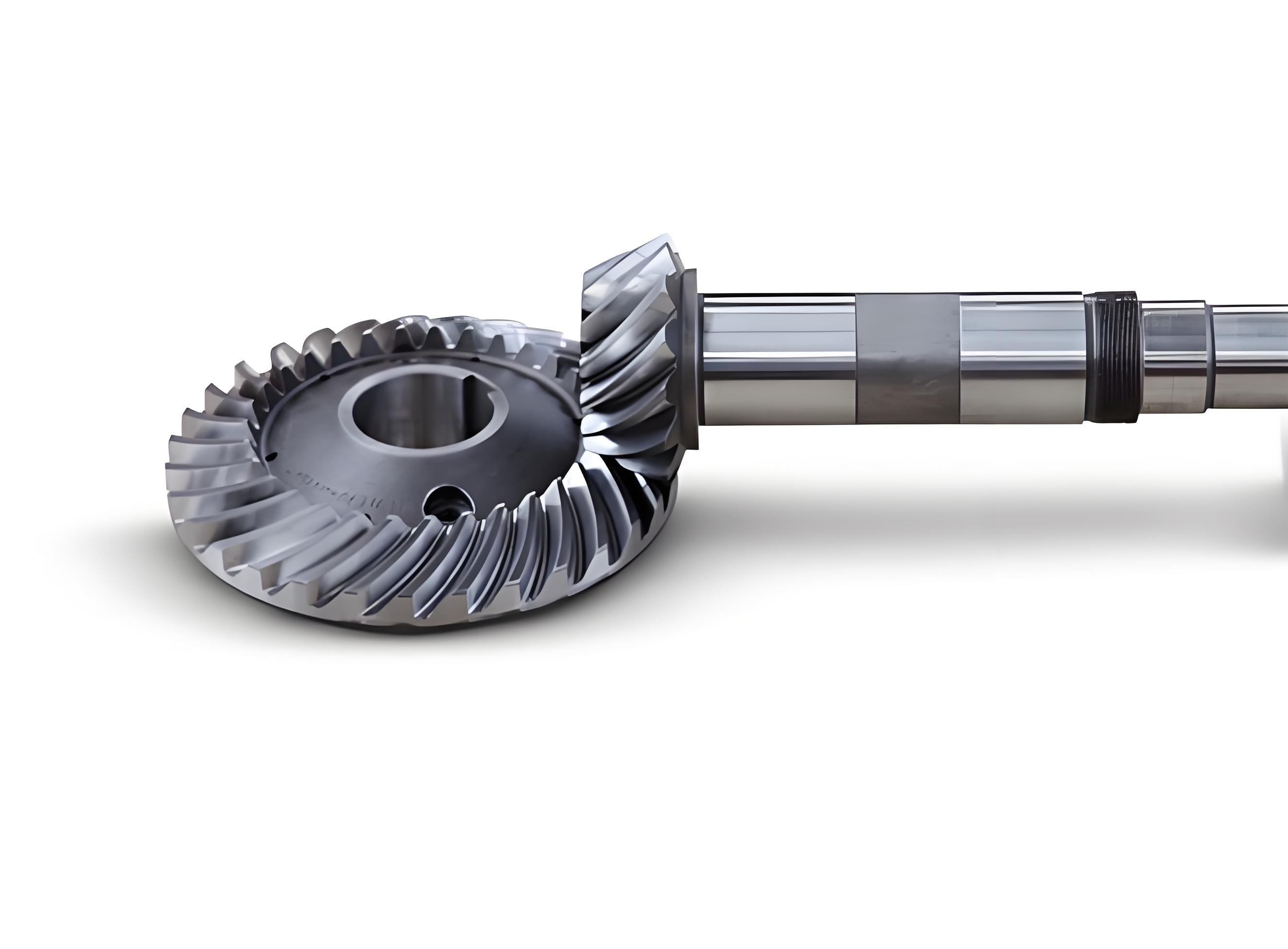
Spiral bevel gears are critical components in mechanical transmission systems, offering advantages such as high load capacity, efficiency, and smooth motion. This study focuses on the parametric design and finite element analysis of logarithmic spiral bevel gears using SolidWorks and C programming. Key parameters, including modulus, tooth count, and pressure angle, are optimized to ensure structural reliability under varying torque conditions.
1. Material Properties and Geometric Design
The logarithmic spiral bevel gears are manufactured from P91 chromium-molybdenum alloy steel, selected for its superior mechanical properties. Table 1 summarizes the material parameters:
| Parameter | Value |
|---|---|
| Elastic Modulus (GPa) | 210 |
| Poisson’s Ratio | 0.28 |
| Yield Strength (MPa) | 620.42 |
| Tensile Strength (MPa) | 723.83 |
| Density (kg/m³) | 7,700 |
The geometric parameters of the spiral bevel gears are derived using a parametric modeling approach. Key equations include:
Pitch diameter: $$d = \\frac{m \\cdot z}{\\cos\\delta}$$
Tooth height: $$h = m \\cdot (2h_a^* + c^*)$$
where \(m\) = module, \(z\) = tooth count, and \(\delta\) = pitch angle.
| Parameter | Pinion | Gear |
|---|---|---|
| Tooth Count (z) | 18 | 36 |
| Module (mm) | 2.5 | |
| Helix Angle (°) | 35 | |
| Face Width (mm) | 12.7 | |
2. Contact Stress Analysis
The contact stress for spiral bevel gears is calculated using:
$$\\sigma_H = Z_E \\sqrt{\\frac{K_A K_V K_{H\\beta} \\cdot T}{b \\cdot d_1^2 \\cdot I}}$$
where \(Z_E\) = elasticity coefficient, \(T\) = torque, and \(I\) = geometry factor. Safety factor validation:
$$S_H = \\frac{\\sigma_{H\\text{ lim}} \\cdot Z_{NT}}{K_\\theta \\cdot \\sigma_H} \\geq 1.25$$
| Torque (N·m) | Max Stress (MPa) | Safety Factor |
|---|---|---|
| 50 | 469.6 | 1.32 |
| 60.5 | 620.4 | 1.00 |
| 100 | 1,227 | 0.51 |
3. Finite Element Analysis
Nonlinear FEA using SolidWorks Simulation reveals stress distribution under operational loads. Critical findings include:
$$ \\varepsilon_{\\text{max}} = 0.2075\\,\\text{mm} \\quad (\\text{at } 200\\,\\text{N·m}) $$
Deformation increases nonlinearly with torque, as shown in Figure 1. The spiral bevel gear’s root and contact regions exhibit highest stress concentrations.
| Torque (N·m) | Displacement (mm) | Critical Zone |
|---|---|---|
| 50 | 0.2075 | Tooth root |
| 100 | 0.1815 | Contact area |
| 200 | 0.1384 | Flank surface |
4. Optimal Torque Range
The logarithmic spiral bevel gear demonstrates safe operation below 60.5 N·m, where contact stress (620.4 MPa) matches the material yield limit. Beyond this threshold, plastic deformation occurs:
$$\\tau_{\\text{critical}} = \\frac{\\sigma_y}{\\sqrt{3}} = 358.2\\,\\text{MPa}$$
Torque vs. stress correlation follows:
$$\\sigma_{\\text{max}} = 9.37 \\cdot T^{0.91} \\quad (R^2 = 0.998)$$
5. Conclusion
Parametric modeling and FEA validate the structural integrity of logarithmic spiral bevel gears under 60.5 N·m torque. The methodology provides a reliable framework for optimizing spiral bevel gear designs in high-load applications, ensuring compliance with ISO 23509 standards.