
In military off-road vehicles, traversing complex terrains demands exceptional mobility and traction. Conventional open differentials, while allowing wheels to rotate at different speeds during turns, suffer from a critical flaw: they distribute torque equally to both wheels, regardless of ground adhesion. This often leads to wheel spin on low-traction surfaces, severely hampering vehicle passability. Limited-slip differentials (LSDs) address this by biasing torque toward the wheel with higher grip, thus enhancing off-road performance. However, in extreme off-road scenarios, such as when one wheel completely loses traction, even a high bias-ratio LSD may fail to provide sufficient torque to the grounded wheel, leaving the vehicle stranded. To overcome this limitation, we propose an advanced differential design that integrates a spiral gear based limited-slip mechanism with an automatic lock-up function. This hybrid system ensures optimal torque distribution during normal conditions and full mechanical lock-up in极限 situations, thereby maximizing the越野 capabilities of military vehicles. This article delves into the geometric principles, structural design, and functional analysis of this innovative spiral gear differential.
The core of the limited-slip functionality lies in the use of parallel-axis spiral gears (often referred to as helical gears) with large helix angles. These spiral gears generate significant internal friction and axial forces during operation, which resist relative motion between the side gears and the differential case, thereby limiting slip. The lock-up mechanism is an add-on system that automatically engages when a wheel spins excessively, locking the differential entirely to direct all available torque to the wheel with traction. The design builds upon existing托森-type differential concepts but incorporates a novel centrifugal-actuated locking assembly. Our focus here is on the detailed modeling of the spiral gear components and the lock-up机构, followed by assembly and functional simulation.
Let us begin with the mathematical foundation for modeling the spiral gear teeth. A spiral gear tooth surface is a helical surface generated by sweeping a profile along a helix. Two primary methods exist for defining this surface: one involves the helical motion of a transverse (端面) profile, and the other uses an axial profile. For数字化 modeling convenience, we adopt the first approach. Consider a fixed coordinate system \( S_1(O_1-x_1, y_1, z_1) \) and a moving coordinate system \( S_a(O_a-x_a, y_a, z_a) \) that undergoes a screw motion relative to \( S_1 \). This motion is characterized by a rotation angle \( \psi \) and a concurrent axial displacement \( p\psi \), where \( p \) is the screw parameter—the pitch of the helix. The relationship is given by:
$$ p = \frac{H}{2\pi} $$
where \( H \) is the axial displacement corresponding to one full revolution (\( \psi = 2\pi \)).
Assume a planar curve \( L \), representing the gear tooth transverse profile, is defined in \( S_a \) by the parametric equations:
$$ \mathbf{r}_a = \begin{bmatrix} x_a(\theta) \\ y_a(\theta) \\ 0 \\ 1 \end{bmatrix} $$
where \( \theta \) is an independent parameter. The helical surface generated in \( S_1 \) is obtained via coordinate transformation:
$$ \mathbf{r}_1 = \mathbf{M}_{1a} \cdot \mathbf{r}_a $$
where \( \mathbf{M}_{1a} \) is the homogeneous transformation matrix for the screw motion:
$$ \mathbf{M}_{1a} = \begin{bmatrix} \cos\psi & -\sin\psi & 0 & 0 \\ \sin\psi & \cos\psi & 0 & 0 \\ 0 & 0 & 1 & p\psi \\ 0 & 0 & 0 & 1 \end{bmatrix} $$
From this, we derive the explicit equations for the螺旋面 in \( S_1 \):
$$ x_1 = x_a(\theta) \cos\psi – y_a(\theta) \sin\psi $$
$$ y_1 = x_a(\theta) \sin\psi + y_a(\theta) \cos\psi $$
$$ z_1 = p\psi $$
For an involute spiral gear, the transverse profile is an involute curve. In \( S_a \), the involute of a base circle with radius \( r_b \) can be expressed as:
$$ x_a(\theta) = r_b (\cos\theta + \theta \sin\theta) $$
$$ y_a(\theta) = r_b (\sin\theta – \theta \cos\theta) $$
where \( \theta \) is the involute roll angle. Substituting into the螺旋面 equations yields the parametric surface of an involute spiral gear:
$$ x_1 = r_b [\cos(\theta+\psi) + \theta \sin(\theta+\psi)] $$
$$ y_1 = r_b [\sin(\theta+\psi) – \theta \cos(\theta+\psi)] $$
$$ z_1 = p\psi $$
This formulation is crucial for accurate geometric modeling and subsequent stress analysis of the spiral gear teeth.
Key parameters defining a parallel-axis spiral gear include the transverse module \( m_t \), number of teeth \( Z \), transverse pressure angle \( \alpha_t \), and helix angle \( \beta \). The relationship between the helix angle on the pitch cylinder \( \beta \) and that on the base cylinder \( \beta_b \) is derived from the geometry of the unfolded pitch cylinder:
$$ \tan\beta_b = \tan\beta \cos\alpha_t $$
The pitch diameter \( d \) is given by \( d = m_t Z \). The lead of the helix \( P_Z \) (axial distance for one complete revolution) is:
$$ P_Z = \frac{\pi d}{\tan\beta} $$
For our design, we selected a large helix angle to maximize axial thrust and friction. The primary parameters for the spiral gears in the differential are summarized in Table 1.
| Parameter | Symbol | Value | Unit |
|---|---|---|---|
| Helix Angle | \(\beta\) | 45° | degree |
| Transverse Pressure Angle | \(\alpha_t\) | 20° | degree |
| Transverse Module | \(m_t\) | 3.75 | mm |
| Number of Teeth (Side Gear) | \(Z_s\) | 6 | – |
| Number of Teeth (Planet Gear) | \(Z_p\) | 6 | – |
| Pitch Diameter | \(d\) | 22.5 | mm |
| Base Circle Radius | \(r_b\) | 10.5716 | mm |
| Lead of Helix | \(P_Z\) | 70.6858 | mm |
| Axial Width | \(b\) | 20 | mm |
Using these parameters, the spiral gear teeth were modeled parametrically in SolidWorks. The process involved defining the involute curve in a sketch, creating a helix with the specified lead, and performing a sweep operation to generate a single tooth. The complete gear was formed via circular pattern. Both left-hand and right-hand helix versions were created for the planet gears to mesh properly with the side gears. The resultant three-dimensional model showcases the intricate geometry of these螺旋 gears, which are central to the differential’s operation.
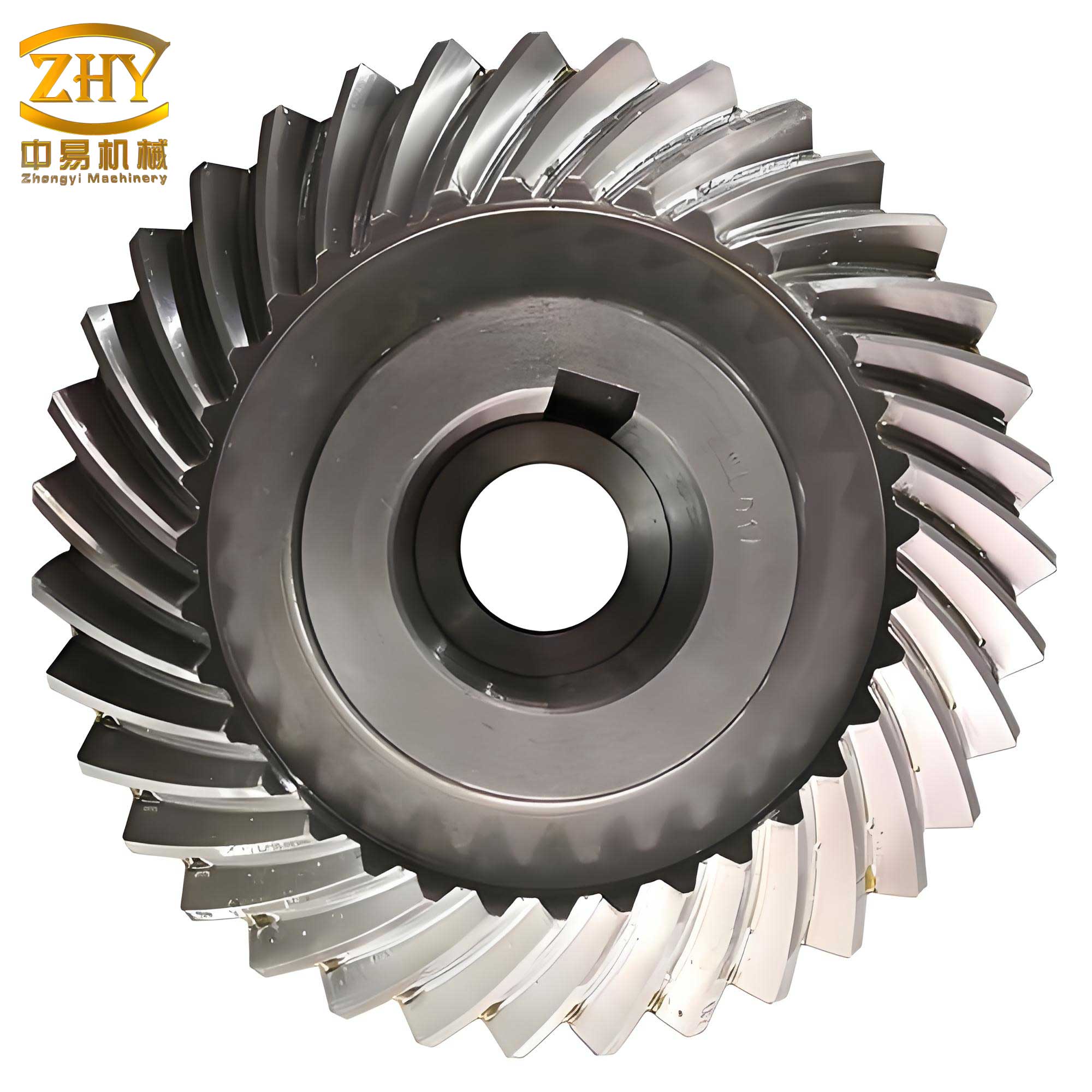
The spiral gear pair’s meshing condition for parallel axes requires matching helix angles but opposite hand directions. The contact ratio is enhanced compared to spur gears due to the gradual engagement of the螺旋 teeth. The normal force \( F_n \) acting on a spiral gear tooth can be resolved into tangential \( F_t \), radial \( F_r \), and axial \( F_a \) components:
$$ F_t = \frac{2T}{d} $$
$$ F_r = F_t \frac{\tan\alpha_n}{\cos\beta} $$
$$ F_a = F_t \tan\beta $$
where \( T \) is the transmitted torque, and \( \alpha_n \) is the normal pressure angle, related to the transverse pressure angle by \( \tan\alpha_n = \tan\alpha_t \cos\beta \). The substantial axial force \( F_a \) is a key contributor to the limited-slip action, as it pushes the gears against thrust washers or housing surfaces, generating friction torque.
The limited-slip mechanism employs a gear-type differential with three left-hand spiral planet gears and three right-hand spiral planet gears interposed between two side gears. The spiral gear design induces several friction-producing effects: 1) Sliding friction between the meshing螺旋 gear teeth due to their large helix angle. 2) Friction between the planet gears and their pinion shafts caused by the separating force from the high pressure angle. 3) Friction at the end faces of the gears due to the axial thrust. The total friction torque \( T_f \) can be approximated as a function of the input torque \( T_{in} \) and a bias ratio \( B \):
$$ T_f = \mu \sum F_n r_m $$
where \( \mu \) is the coefficient of friction, and \( r_m \) is an effective radius. A simplified model for the torque bias ratio (TBR) — the ratio of torque delivered to the high-traction wheel versus the low-traction wheel — is given by:
$$ \text{TBR} \approx \frac{1 + \eta}{1 – \eta} $$
with \( \eta = T_f / T_{in} \). For our spiral gear set, the theoretical static bias ratio can exceed 3.5, providing significant限滑 capability.
While the spiral gear assembly effectively manages moderate traction differences, an automatic lock-up mechanism is essential for极端 conditions. The lock-up system is designed to engage when a wheel speed discrepancy exceeds a critical threshold, indicating complete loss of traction on one side. It consists of a cam disk gear, a flywheel mechanism, a friction clutch pack, and a centrifugal release block. The kinematic design of the cam profiles is vital for smooth engagement and disengagement.
The cam disk gear and the flywheel pinion form a spur gear pair with a large reduction ratio to amplify rotational speed. Their design parameters are constrained by the available space within the differential housing. The gear pair must fit within a center distance of approximately 50 mm. Using standard gear design equations:
$$ a = \frac{m(z_1 + z_2)}{2} $$
$$ d_1 = m z_1, \quad d_2 = m z_2 $$
where \( a \) is the center distance, \( m \) is the module, \( z_1 \) and \( d_1 \) are the tooth number and pitch diameter of the cam disk gear, and \( z_2 \) and \( d_2 \) correspond to the flywheel pinion. Selected values are listed in Table 2.
| Component | Module \( m \) (mm) | Number of Teeth \( z \) | Pitch Diameter \( d \) (mm) |
|---|---|---|---|
| Cam Disk Gear | 0.8 | 117 | 93.6 |
| Flywheel Pinion | 0.8 | 9 | 7.2 |
Center Distance \( a = 50.4 \text{ mm} \).
The cam surfaces on the side gear shaft and the cam disk gear are conjugate helical cams. Their profile ensures that relative rotation translates into axial displacement. The axial displacement \( \Delta z \) per relative rotation angle \( \phi \) is determined by the cam lead \( L_c \):
$$ \Delta z = \frac{L_c \phi}{2\pi} $$
For a rapid lock-up response, a steep cam lead (e.g., \( L_c = 5 \text{ mm} \)) is chosen. When the cam disk gear is restrained from rotating, the relative motion forces the cam disk axially against the friction plates, engaging the lock.
The flywheel mechanism operates on centrifugal principle. The flyweight’s centrifugal force \( F_c \) at a rotational speed \( \omega \) is:
$$ F_c = m_f r_f \omega^2 $$
where \( m_f \) is the flyweight mass and \( r_f \) is its effective radius. This force is balanced by a spring preload \( F_s \). Engagement occurs when \( F_c > F_s \), which corresponds to a threshold differential speed \( \omega_{th} \).
The complete differential assembly integrates the螺旋 gear limited-slip unit and the lock-up module. Key components, as illustrated in the exploded view, include: 1) Differential case, 2) Right side spiral gear, 3) Left side spiral gear, 4) Right-hand spiral planet gear set (3 pieces), 5) Left-hand spiral planet gear set (3 pieces), 6) Spacer ring, 7) Side gear cam, 8) Cam disk gear, 9) Friction plate pack, 10) Upper housing cover, 11) Lower housing cover, 12) Flywheel mechanism with pinion, 13) Centrifugal release block.
The operational modes are as follows:
1. Straight-Line Travel: The differential case rotates as a unit. The spider gears (planets) have no relative motion with respect to the case, and both side gears rotate at the same speed as the case. Torque is equally distributed.
2. Differential Action (Turning or Uneven Terrain): When a speed difference is required, the planet螺旋 gears rotate on their axes, allowing the side gears to turn at different speeds. The spiral gear interaction provides a slight resistance, offering a base level of限滑.
3. Limited-Slip Mode: If one wheel begins to lose traction and spin faster, the relative motion between the side gears and the case increases. This activates the spiral gear friction mechanisms described earlier. The axial forces \( F_a \) from the spiral gears press the gear assembly against the housing covers and spacer, generating substantial internal friction. This friction torque resists the speed difference, thereby biasing more torque to the slower, high-traction wheel. The torque transfer can be modeled dynamically using a moment balance on the differential case and side gears:
$$ T_{in} = T_L + T_R + T_f $$
$$ \omega_{case} = \frac{\omega_L + \omega_R}{2} $$
where \( T_L, T_R \) are the torques at left and right outputs, and \( T_f \) is the total friction torque within the spiral gear assembly, which is a function of the speed difference \( \Delta \omega = \omega_L – \omega_R \). A common empirical model is \( T_f = c \cdot \Delta \omega \), where \( c \) is a damping coefficient inherent to the spiral gear design.
4. Automatic Lock-Up Mode: In an extreme scenario where one wheel (e.g., left) loses all traction and spins freely, the speed difference \( \Delta \omega \) becomes very large. The high-speed rotation of the slipping side gear is transmitted via its spline to the side gear cam. This cam drives the cam disk gear through their helical interface. The cam disk gear, meshing with the small flywheel pinion, causes the flywheel mechanism to spin at an extremely high speed. Centrifugal force throws the flyweights outward, causing them to engage with the centrifugal release block, which is fixed to the differential case. This suddenly stops the rotation of the flywheel mechanism and, consequently, the cam disk gear. With the cam disk gear locked, the continuing rotation of the side gear cam relative to it forces the cam disk axially upward (via the helical cam action) against the stack of friction plates. The friction plates are splined to the housing. The reaction force clamps the entire assembly, effectively locking the side gear cam and its attached side gear to the differential case. This results in a fully locked differential: both axles turn at the same speed as the case, directing all available engine torque to the wheel with traction. The lock-up condition can be expressed as a constraint:
$$ \omega_L = \omega_R = \omega_{case} $$
The engagement force \( F_{engage} \) generated by the cam is:
$$ F_{engage} = \frac{2\pi T_{cam}}{L_c} $$
where \( T_{cam} \) is the torque transmitted through the cam pair at the moment of lock-up initiation.
5. Automatic Unlock Mode: Once the vehicle regains traction and moves forward, the overall vehicle speed increases. When the rotational speed of the differential case exceeds a certain value, the centrifugal release block itself (which is spring-loaded) experiences sufficient centrifugal force to overcome its spring preload. It pivots outward, disengaging from the flyweights. This frees the flywheel mechanism, allowing the cam disk gear to rotate back under the action of return springs (or reverse cam motion), disengaging the friction clutch. The differential reverts to its spiral gear limited-slip operation. The unlock threshold speed \( \Omega_{unlock} \) is set higher than normal operating speeds to prevent unwanted cycling.
To validate the packaging and compatibility, the assembled differential was virtually installed into the rear axle housing of a Mengshi military vehicle model. Interference checks performed in SolidWorks confirmed clearances with surrounding components like the axle shafts, bearing seats, and housing bolts. The design required minimal modification to the existing axle architecture, highlighting its adaptability. The integration of the spiral gear set and the lock-up module was achieved without significantly increasing the overall envelope dimensions. The spiral gear differential’s compactness is one of its advantages, as the螺旋 gears provide high torque bias without requiring additional bulky clutch packs like in some other LSD types.
The performance of the螺旋 gear limited-slip differential with lock-up can be summarized through key metrics compared to conventional designs. Table 3 provides a qualitative comparison.
| Feature | Open Differential | Conventional Clutch-type LSD | Spiral Gear LSD (Proposed, without lock-up) | Proposed Spiral Gear LSD with Lock-Up |
|---|---|---|---|---|
| Torque Bias Capability | 1:1 | Up to 3:1 typically | 3.5:1 to 4:1 (theoretical) | ∞:1 (when locked) |
| Response to Wheel Slip | None | Progressive | Progressive, speed-sensitive | Progressive then full lock |
| Durability & Maintenance | High | Medium (clutch wear) | High (gear-based, robust) | High (lock-up is transient) |
| Complexity & Cost | Low | Medium | Medium | Medium-High |
| Suitability for Extreme Off-Road | Poor | Good | Very Good | Excellent |
The mathematical modeling of the system’s dynamics can be extended further. For instance, the equation of motion for a spinning side gear during lock-up engagement can be written as:
$$ I \frac{d\omega}{dt} = T_{in} – T_{friction}(\omega) – T_{lock}(\delta) $$
where \( I \) is the moment of inertia, \( T_{friction} \) is the spiral gear friction torque (a function of speed), and \( T_{lock} \) is the locking torque from the engaged clutch, which depends on the axial displacement \( \delta \) of the cam disk. This displacement is governed by the cam kinematics:
$$ \delta = \int (\omega_{cam} – \omega_{disk}) \frac{L_c}{2\pi} dt $$
These equations form a system that can be simulated to analyze lock-up timing and shock loads.
In conclusion, the integration of a high-friction spiral gear mechanism with an automatic centrifugal lock-up system presents a robust solution for enhancing the off-road performance of military vehicles. The螺旋 gear assembly provides a reliable, wear-resistant means of achieving substantial torque bias during typical slip conditions. The lock-up mechanism acts as a fail-safe for极限 scenarios, ensuring maximum torque transfer when needed. This design leverages the geometric advantages of spiral gears—their inherent axial thrust and smooth engagement—to create a differential that is both intelligent and durable. Future work will involve detailed finite element analysis of the spiral gear teeth under load, dynamic simulation of the full lock-up sequence, and prototype testing to quantify the exact bias ratios and lock-up thresholds. Furthermore, parametric optimization of the spiral gear geometry (helix angle, pressure angle, tooth profile) could yield even higher performance. The proposed spiral gear differential with lock-up function holds significant promise for not only military vehicles but also for severe-duty commercial and recreational off-road applications where ultimate traction is paramount. The repeated emphasis on螺旋 gear technology throughout this design underscores its critical role in achieving the desired balance of smooth differential action, progressive limited-slip, and positive locking capability.