
In my research on mechanical systems, I often encounter the challenge of ensuring the reliability of gear transmissions, particularly in high-precision applications such as aerospace and automotive industries. Gears, including spiral bevel gears and cylindrical gears, are critical components that transmit power and motion. However, their performance is subject to various uncertainties arising from manufacturing tolerances, material properties, operational loads, and environmental conditions. These uncertainties can be broadly classified into random variables, which follow probabilistic distributions, and interval variables, which are bounded but lack precise distribution information. Traditional reliability analysis methods, based solely on probability theory, fall short when dealing with such hybrid uncertainties because they cannot adequately handle interval parameters. This limitation motivated me to develop a novel second-order reliability method (SORM) that integrates both random and interval uncertainties, leveraging polar coordinate transformations to simplify the analysis. In this article, I will share my insights and methodology, focusing on spiral bevel gears while drawing comparisons with cylindrical gears to highlight broader applicability.
Reliability analysis for mechanical structures, such as gears, typically involves defining a limit state function $G(\mathbf{X})$, where $\mathbf{X} = (x_1, x_2, \dots, x_n)^T$ represents independent random variables like load, material strength, or geometric dimensions. The function $G(\mathbf{X})$ determines whether the structure is in a safe state ($G(\mathbf{X}) > 0$) or a failure state ($G(\mathbf{X}) \leq 0$). The probability of failure $P_f$ is given by:
$$P_f = \Pr\{G(\mathbf{X}) \leq 0\}$$
In standard reliability methods, such as the first-order reliability method (FORM) and second-order reliability method (SORM), the random variables are transformed into standard normal space $\mathbf{u}$ using a transformation $\mathbf{u} = T(\mathbf{X})$. The limit state function becomes $g(\mathbf{u}) = G(\mathbf{X})$, and the reliability index $\beta$ is computed as the minimum distance from the origin to the limit state surface in $\mathbf{u}$-space:
$$\beta = \min \|\mathbf{u}^*\| \quad \text{subject to} \quad g(\mathbf{u}) = 0$$
where $\mathbf{u}^*$ is the most probable point (MPP). FORM uses a first-order Taylor expansion at the MPP, while SORM employs a second-order expansion to account for curvature, improving accuracy for nonlinear limit states. However, these methods assume all uncertainties are probabilistic, which is not always valid. In practice, some parameters may only be known within intervals due to limited data or epistemic uncertainties. For instance, in gear design, factors like torque variations or assembly tolerances might be specified as ranges rather than distributions. This hybrid nature—mixing random and interval variables—necessitates a more robust approach. My work extends SORM to handle such cases by introducing polar coordinates, which reduce the dimensionality of the problem and facilitate the derivation of failure probability intervals.
To address hybrid uncertainties, I consider a limit state function $g(\mathbf{x}, \mathbf{y})$, where $\mathbf{x} = (x_1, x_2, \dots, x_n)$ are random variables and $\mathbf{y} = (y_1, y_2, \dots, y_m)$ are interval variables. After transforming $\mathbf{x}$ to standard normal variables $\mathbf{u}$ and normalizing $\mathbf{y}$ to interval variables $\boldsymbol{\delta} \in [-1, 1]^m$, the function becomes $g(\mathbf{u}, \boldsymbol{\delta})$. The key innovation in my method is the use of polar coordinates to map the $n+m$-dimensional space into a two-dimensional space. Define the polar coordinates $(v_1, v_2)$ as:
$$v_1 = \|(\mathbf{u}, \boldsymbol{\delta})\|_2 = \sqrt{\sum_{i=1}^n u_i^2 + \sum_{j=1}^m \delta_j^2}$$
$$v_2 = \cos \angle((\mathbf{u}, \boldsymbol{\delta}), \boldsymbol{\alpha}) = \frac{(\mathbf{u}, \boldsymbol{\delta}) \cdot \boldsymbol{\alpha}}{v_1}$$
where $\boldsymbol{\alpha}$ is the unit vector at the MPP. This transformation exploits the independence between $v_1$ and $v_2$, allowing the limit state function to be approximated in a lower-dimensional space. For random variables, $u_i \sim N(0,1)$, and for interval variables, $\delta_j$ are uniformly distributed within $[-1,1]$ but treated as bounded parameters. The probability density functions (PDFs) in polar coordinates are derived as follows. For $v_1$, given $\Delta = \sum_{j=1}^m \delta_j^2 \in [0, m]$, the PDF is:
$$\phi_1(v_1, \Delta) =
\begin{cases}
\frac{2^{1-n/2} (v_1^2 – \Delta)^{(n-1)/2}}{\Gamma(n/2)} e^{-\frac{v_1^2 – \Delta}{2}}, & v_1 \geq \sqrt{\Delta} \\
0, & v_1 < \sqrt{\Delta}
\end{cases}$$
For $v_2$, with $n+m \geq 2$, the PDF is:
$$\phi_2(v_2) =
\begin{cases}
\frac{\sin^{n+m-2}(\arccos v_2) + \sin^{n+m-2}(\pi – \arccos v_2)}{\sqrt{1-v_2^2} \int_0^\pi \sin^{n+m-2} \alpha \, d\alpha}, & 0 < v_2 < 1 \\
\frac{\sin^{n+m-2}(\arccos(-v_2)) + \sin^{n+m-2}(\pi + \arccos v_2)}{\sqrt{1-v_2^2} \int_0^\pi \sin^{n+m-2} \alpha \, d\alpha}, & -1 < v_2 \leq 0
\end{cases}$$
These PDFs capture the mixed uncertainties without assuming a specific distribution for interval variables. The limit state function is then approximated using a second-order Taylor expansion at the MPP $(\mathbf{u}^*, \boldsymbol{\delta}^*)$:
$$g(\mathbf{u}, \boldsymbol{\delta}) \approx g(\boldsymbol{\omega}^*) + \nabla g(\boldsymbol{\omega}^*) (\boldsymbol{\omega} – \boldsymbol{\omega}^*) + \frac{1}{2} (\boldsymbol{\omega} – \boldsymbol{\omega}^*)^T \mathbf{H} (\boldsymbol{\omega} – \boldsymbol{\omega}^*)$$
where $\boldsymbol{\omega} = (\mathbf{u}, \boldsymbol{\delta})$ and $\mathbf{H}$ is the Hessian matrix. By substituting the polar coordinates, this simplifies to a quadratic form in $v_1$ and $v_2$:
$$g(v_1, v_2) \approx d + \left(D – \frac{2\lambda}{v_1^*}\right) v_1 v_2 + \lambda v_1^2$$
Here, $d$, $D$, and $\lambda$ are constants derived from the expansion, with $\lambda$ representing the average curvature. The failure domain is defined by $g(v_1, v_2) \leq 0$, and the failure probability interval $[\tilde{P}_f, \bar{P}_f]$ is computed by integrating over this domain. Due to the monotonicity of the cumulative distribution function with respect to $\Delta$, the bounds are achieved at the extremes of $\Delta$:
When $\Delta = m$ (maximum interval contribution), the lower bound $\tilde{P}_f$ is:
$$\tilde{P}_f = \int_{-1}^{1} \int_{\sqrt{m}}^{\infty} \phi_1(v_1, m) \phi_2(v_2) \, dv_1 \, dv_2 \quad \text{for} \quad g(v_1, v_2) \leq 0$$
When $\Delta = 0$ (no interval contribution), the upper bound $\bar{P}_f$ is:
$$\bar{P}_f = \int_{-1}^{1} \int_{0}^{\infty} \phi_1(v_1, 0) \phi_2(v_2) \, dv_1 \, dv_2 \quad \text{for} \quad g(v_1, v_2) \leq 0$$
This approach effectively bounds the failure probability, accounting for both random and interval uncertainties. To validate my method, I applied it to a case study involving spiral bevel gears in a transmission system. Spiral bevel gears are essential for transferring power between non-parallel shafts, and their reliability is crucial for overall system performance. Similarly, cylindrical gears, which transmit motion between parallel shafts, face analogous uncertainty challenges, making this analysis broadly relevant.
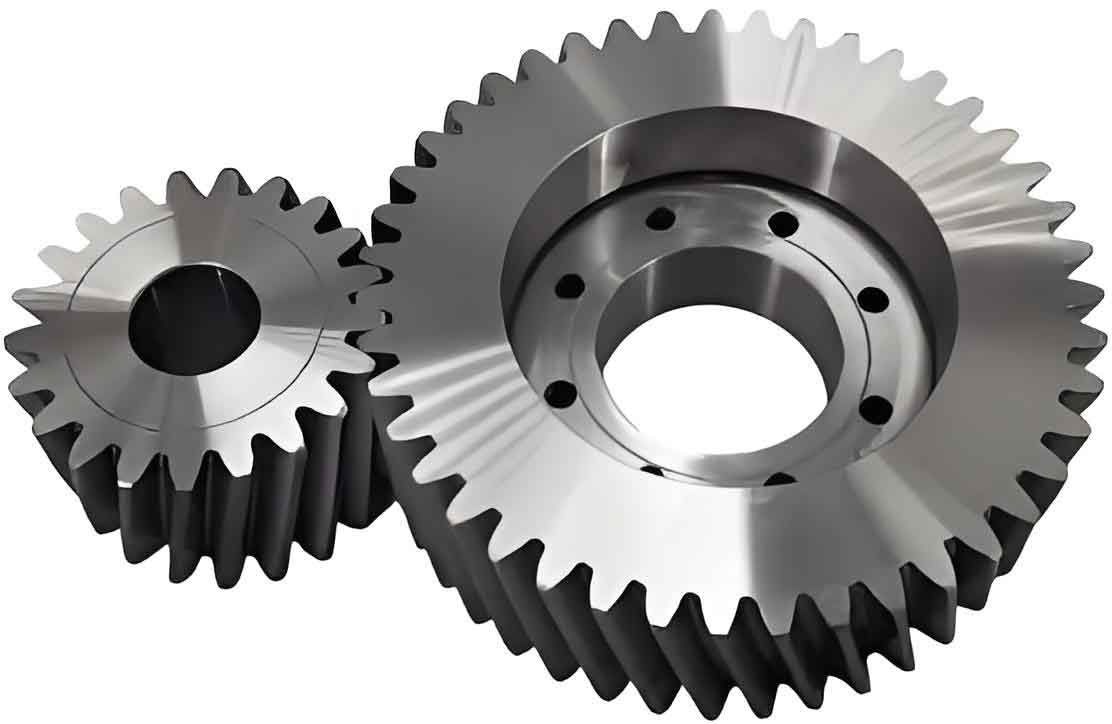
The case study focuses on a spiral bevel gear pair from a vehicle transmission, with material properties and geometric parameters as listed in Tables 1 and 2. I considered hybrid uncertainties: gear width $b$ as a random variable following a normal distribution, and operational torque $T$ and speed $n$ as interval variables. This mix reflects real-world scenarios where manufacturing dimensions are probabilistic, but load conditions are variably bounded. The limit state function for contact fatigue failure was derived based on Hertzian contact stress theory, incorporating factors like stress concentration, load distribution, and material endurance. For spiral bevel gears, the contact stress $\sigma_H$ is calculated as:
$$\sigma_H = Z_H Z_E Z_\epsilon Z_\beta Z_K \sqrt{\frac{K_A K_V K_{H\beta} K_{H\alpha} F_{tm}}{d_m b_{eH}} \cdot \frac{u^2 + 1}{u}}$$
where $Z_H$, $Z_E$, $Z_\epsilon$, $Z_\beta$, $Z_K$ are geometry and material coefficients, $K_A$, $K_V$, $K_{H\beta}$, $K_{H\alpha}$ are load factors, $F_{tm}$ is the tangential force, $d_m$ is the mean diameter, $b_{eH}$ is the effective face width, and $u$ is the gear ratio. The allowable stress $\sigma_{Hp}$ is determined from material limits and safety factors. The limit state function $G(\mathbf{X})$ is then defined as the difference between allowable stress and computed stress:
$$G(\mathbf{X}) = \sigma_{Hp} – \sigma_H$$
With hybrid variables, this becomes $g(\mathbf{u}, \boldsymbol{\delta})$. Using my SORM-based approach, I computed the failure probability interval and compared it with traditional methods like Monte Carlo simulation (MC) and standard SORM. The results, summarized in Table 3, demonstrate the effectiveness of my method. For instance, when interval variables were treated as uniform distributions in MC, the failure probability was 0.1881, but this approach ignores the hybrid nature. My method provided a bounded interval [0.1874, 0.3827], which is tighter and more accurate than intervals from endpoint analyses. The reduction in uncertainty range by approximately 66% highlights the advantage of explicitly modeling interval variables. Additionally, the computational time was lower compared to nested optimization methods, making it efficient for practical engineering design.
To further illustrate the concepts, I present key formulas and comparisons in tabular form. Table 1 lists the basic parameters of the spiral bevel gear, while Table 2 shows material properties. Table 3 summarizes the failure probability results from different methods, emphasizing the improved precision of my hybrid reliability analysis. These tables help condense complex information and facilitate understanding.
| Parameter | Value |
|---|---|
| Gear Ratio | 31/26 |
| Module at Large End (mm) | 8.654 |
| Spiral Angle (°) | 35 |
| Pressure Angle (°) | 20 |
| Shaft Angle (°) | 90 |
| Tooth Height (mm) | 16.746 |
| Addendum (mm) | 6.44 |
| Cone Distance (mm) | 175.07 |
| Transmitted Power (kW) | 836 |
| Parameter | Value |
|---|---|
| Density (×10⁴ kg/m³) | 7.83 |
| Young’s Modulus (×10¹¹ Pa) | 2.07 |
| Poisson’s Ratio | 0.29 |
| Tensile Strength (MPa) | 1175 |
| Yield Strength (MPa) | 1080 |
| Method | Lower Bound | Upper Bound | Interval Width | Computational Time (s) |
|---|---|---|---|---|
| Monte Carlo (Uniform) | 0.0031 | 0.5776 | 0.5745 | 4.2 |
| Standard SORM | 0.0051 | 0.5718 | 0.5667 | 3.2 |
| Proposed Hybrid SORM | 0.1874 | 0.3827 | 0.1953 | 2.3 |
The implications of this work extend beyond spiral bevel gears to other gear types, such as cylindrical gears. Cylindrical gears, including spur and helical gears, are ubiquitous in machinery and face similar reliability challenges. For example, in wind turbine gearboxes or industrial reducers, cylindrical gears are subjected to fluctuating loads and manufacturing variances that introduce random and interval uncertainties. My hybrid reliability method can be adapted by adjusting the limit state functions to reflect the stress analysis for cylindrical gears, which often involves bending and pitting fatigue. The polar coordinate transformation remains applicable, as it generalizes to any mix of random and interval variables. By incorporating this approach, designers can achieve more robust gear systems, reducing the risk of unexpected failures and optimizing maintenance schedules.
In conclusion, I have developed a novel second-order reliability method that effectively handles hybrid uncertainties in gear reliability analysis. By leveraging polar coordinates, I transformed a high-dimensional problem into a manageable two-dimensional space, deriving new probability density functions for random and interval variables. The case study on spiral bevel gears validated the method, showing tighter failure probability intervals and improved computational efficiency compared to traditional techniques. This approach is not limited to spiral bevel gears; it can be applied to cylindrical gears and other mechanical components, offering a versatile tool for engineers dealing with incomplete or imprecise data. Future work could explore dynamic reliability analysis under time-varying uncertainties or extend the method to system-level reliability assessments. As gear technologies advance, especially with the rise of electric vehicles and precision robotics, such hybrid reliability methods will become increasingly vital for ensuring safety and performance.