
In my research on advanced machining processes, I have focused extensively on the performance of coated cutting tools, particularly for complex geometries like spiral bevel gears. Spiral bevel gears are critical components in various mechanical systems, such as automotive differentials and aerospace transmissions, due to their ability to transmit power between non-parallel shafts with high efficiency and smooth operation. However, machining these gears presents significant challenges, including high cutting forces, thermal loads, and tool wear. The application of hard coatings, such as TiCN, has been promising for extending tool life and improving productivity in gear cutting. Yet, specific issues arise when using coated spiral bevel gear milling cutters, especially concerning their performance on low-hardness materials, high-speed cutting capabilities, and the effects of coating-induced edge rounding on precision finishing. This article details my experimental investigations into these aspects, aiming to provide insights for optimizing the use of coated tools in spiral bevel gear manufacturing.
The core of my study revolves around evaluating coated spiral bevel gear milling cutters under varying cutting conditions. I conducted a series of cutting tests to compare coated and uncoated tools when machining materials with different hardness levels. The experiments were designed to simulate real-world industrial scenarios, covering standard, high-speed, and high-speed finishing cutting parameters. Through these tests, I aimed to understand how coating influences tool wear, surface finish, and overall efficiency in spiral bevel gear production. My findings highlight the nuanced behavior of coated tools, emphasizing that their benefits are highly dependent on material properties and cutting parameters. Below, I present a comprehensive account of my methodology, results, and analyses, supported by tables and mathematical models to elucidate the underlying mechanisms.
To begin, I will describe the experimental setup used in my research. The spiral bevel gear milling cutters employed were standard double-blade roughing cutters with a diameter of 6 inches, manufactured by a leading tool supplier. These cutters were designed for machining spiral bevel gears with a module of 6 mm, 35 teeth, a spiral angle of 35 degrees, and a face width of 40 mm. The workpiece materials were selected to represent low-hardness and medium-hardness steels, commonly used in gear applications. The low-hardness material had a Brinell hardness range of 180-220 HB, while the medium-hardness material ranged from 280-320 HB, corresponding to grades like AISI 4140 or similar alloys. For coating, I used a TiCN layer applied via physical vapor deposition (PVD) with a thickness of approximately 3-5 micrometers. Prior to coating, the tool edges underwent liquid honing at 40 psi to enhance adhesion, and the coating quality was verified using scratch tests, confirming excellent bonding strength. The cutting tests were performed on a Gleason-type spiral bevel gear milling machine, ensuring realistic machining conditions.
The cutting parameters were varied across three regimes: standard cutting, high-speed cutting, and high-speed finishing. In standard cutting, the parameters were set as follows: cutting speed \( v = 60 \, \text{m/min} \), depth of cut \( a_p = 2 \, \text{mm} \) (achieved in three passes), and feed rate \( f = 0.5 \, \text{mm/tooth} \). For high-speed cutting, I increased the cutting speed to \( v = 120 \, \text{m/min} \) and the feed rate to \( f = 0.8 \, \text{mm/tooth} \), while maintaining a similar depth of cut. In high-speed finishing tests, I used coated roughing cutters with parameters of \( v = 150 \, \text{m/min} \), \( a_p = 0.5 \, \text{mm} \), and \( f = 0.3 \, \text{mm/tooth} \), aiming to assess their suitability as substitutes for dedicated finishing tools. Each test was repeated multiple times to ensure statistical reliability, and I monitored tool wear using optical microscopy, surface roughness with profilometry, and chip formation through visual inspection.
Now, let me present the results of my experiments in a structured manner. First, I compared coated and uncoated spiral bevel gear milling cutters under standard cutting conditions when machining low-hardness material. The observations are summarized in Table 1 below, which includes tool condition, workpiece surface quality, and chip morphology.
| Tool Type | Tool Condition | Workpiece Surface | Chip Morphology | Remarks |
|---|---|---|---|---|
| Uncoated | Severe wear, burnt edges, jagged cutting edge, high cutting force | Rough, with visible smearing and scratching | Chips heavily deformed, crescent-shaped with burnt inner surfaces | Tool failure occurred rapidly; unable to continue cutting |
| Coated (TiCN) | Similar wear patterns, coating delamination along edges, burnt tips | Rough, with evidence of material adhesion and plowing | Chips showed extreme plastic deformation, crescent-shaped and burnt | No significant improvement over uncoated tool; early failure due to adhesion |
As seen in Table 1, both coated and uncoated spiral bevel gear milling cutters suffered from rapid deterioration when machining low-hardness material. This aligns with the well-known “built-up edge” or “sticking” phenomenon, where soft materials adhere to the tool surface, leading to edge chipping and poor surface finish. The coating did not mitigate this issue, as the primary failure mechanism was adhesive wear rather than abrasive wear. To quantify this, I considered the cutting force model, which can be expressed as:
$$F_c = K_c \cdot a_p \cdot f \cdot \left(1 + \frac{\mu}{\tan \gamma}\right)$$
where \( F_c \) is the main cutting force, \( K_c \) is the specific cutting pressure, \( a_p \) is depth of cut, \( f \) is feed rate, \( \mu \) is the coefficient of friction, and \( \gamma \) is the rake angle. For low-hardness materials, \( \mu \) tends to increase due to adhesion, raising \( F_c \) and accelerating tool wear. My experiments confirmed that coatings like TiCN, while hard, do not reduce friction sufficiently in such scenarios, limiting their effectiveness for spiral bevel gear machining on soft steels.
Next, I evaluated the performance on medium-hardness material (280-320 HB) under standard cutting conditions. The results are presented in Table 2, highlighting differences in tool life, surface finish, and process stability.
| Tool Type | Tool Condition | Workpiece Surface | Chip Morphology | Process Stability |
|---|---|---|---|---|
| Uncoated | Moderate wear, slight edge rounding, no burning | Smooth, with acceptable finish for roughing | Well-formed, continuous chips, minimal deformation | Stable cutting, no vibration or chatter |
| Coated (TiCN) | Reduced wear compared to uncoated, but edge bluntness evident | Slightly rougher than uncoated, with minor plowing marks | Chips showed some compression, edges occasionally burnt | Less stable than uncoated, with intermittent noise |
Table 2 indicates that coated spiral bevel gear milling cutters did not outperform uncoated tools in standard cutting on medium-hardness material. In fact, the coated tools exhibited higher cutting forces and inferior surface finish, which I attribute to the edge rounding induced by the coating process. The effective rake angle after coating can be modeled as:
$$\gamma_{\text{eff}} = \gamma_0 – \Delta \gamma$$
where \( \gamma_0 \) is the original rake angle and \( \Delta \gamma \) is the reduction due to coating thickness. For a typical coating thickness of 4 µm and edge radius \( r \), the change in rake angle can be approximated by \( \Delta \gamma \approx \arcsin(r / \rho) \), where \( \rho \) is the tool curvature. This blunting effect increases ploughing forces, especially in dual-flank cutting operations like spiral bevel gear milling, where both sides of the tool engage simultaneously. Thus, while coatings may enhance wear resistance in single-point cutting, their benefit in complex gear cutting is less pronounced under conservative parameters.
To explore the high-speed potential of coated spiral bevel gear milling cutters, I conducted tests with elevated cutting speeds and feeds on medium-hardness material. The results are summarized in Table 3, which includes tool wear, surface quality, and productivity metrics relative to standard uncoated cutting.
| Cutting Regime | Parameters (v, a_p, f) | Tool Condition | Workpiece Surface | Chip Morphology | Productivity Gain |
|---|---|---|---|---|---|
| Standard (Uncoated Baseline) | 60 m/min, 2 mm, 0.5 mm/tooth | Moderate wear, stable | Smooth, for roughing | Continuous, uniform | Baseline (1x) |
| High-Speed 1 (Coated) | 120 m/min, 2 mm, 0.8 mm/tooth | Minimal wear, no burning | Improved finish, shiny on convex side | Segmented, less deformation | 2.5x faster |
| High-Speed 2 (Coated) | 150 m/min, 2 mm, 1.0 mm/tooth | Negligible wear, intact edges | Excellent finish, both sides smooth | Thin, curled chips, no burning | 3.0x faster |
Table 3 demonstrates that coated spiral bevel gear milling cutters excel in high-speed conditions. As cutting speed increased, tool wear decreased, and surface finish improved significantly. The productivity gains ranged from 2.5 to 3 times compared to standard uncoated cutting. This can be explained by the thermal and mechanical properties of TiCN coatings. At high speeds, the cutting temperature rises, which can be estimated using the formula:
$$T = T_0 + k \cdot v^\alpha \cdot f^\beta \cdot a_p^\gamma$$
where \( T \) is the tool-chip interface temperature, \( T_0 \) is ambient temperature, and \( k \), \( \alpha \), \( \beta \), \( \gamma \) are material constants. The TiCN coating has high thermal stability and low thermal conductivity, which helps retain heat in the chip, reducing the tool’s thermal load. Additionally, the coating’s hardness reduces abrasive wear at elevated speeds. For spiral bevel gear milling, the dual-flank engagement complicates heat dissipation, but my results show that coatings mitigate this effectively under aggressive parameters.
Furthermore, I investigated the use of coated roughing cutters for high-speed finishing of spiral bevel gears. Traditionally, finishing operations require dedicated tools with sharp edges, but my experiments aimed to challenge this notion. The results are shown in Table 4, comparing coated roughing cutters in high-speed finishing mode with conventional finishing tools.
| Tool Type | Cutting Parameters | Surface Roughness (Ra, µm) | Tool Wear | Process Notes |
|---|---|---|---|---|
| Conventional Finishing Cutter (Uncoated) | 80 m/min, 0.3 mm, 0.2 mm/tooth | 0.8 – 1.0 | Gradual wear, requires frequent resharpening | Smooth operation, but slow |
| Coated Roughing Cutter in High-Speed Finishing | 150 m/min, 0.5 mm, 0.3 mm/tooth | 0.6 – 0.8 | Minimal wear after multiple cycles | Fast, stable, and reduces tool inventory |
From Table 4, it is evident that coated spiral bevel gear milling cutters can successfully replace finishing tools when operated at high speeds. The surface roughness achieved was even lower than with conventional finishing, likely due to the coating’s ability to minimize material adhesion and generate cleaner cuts. This finding has practical implications for gear manufacturers, as it simplifies tool management and boosts efficiency. The improvement in surface finish can be modeled using the empirical relation for roughness in milling:
$$R_a = C \cdot f^2 / r + D \cdot v^{-1/2}$$
where \( C \) and \( D \) are constants, \( f \) is feed, and \( r \) is tool edge radius. With coating, the effective edge radius may increase, but at high speeds, the dynamic effects reduce ploughing, leading to better finish. This synergy between coating and speed is particularly beneficial for spiral bevel gears, where surface integrity is critical for noise reduction and longevity.
In my analysis, I delved deeper into the mechanistic reasons behind these observations. For spiral bevel gear milling, the cutting geometry involves intermittent engagement and varying chip thickness, which can be described by the undeformed chip thickness model:
$$h(\theta) = f \cdot \sin \theta \cdot \cos \phi$$
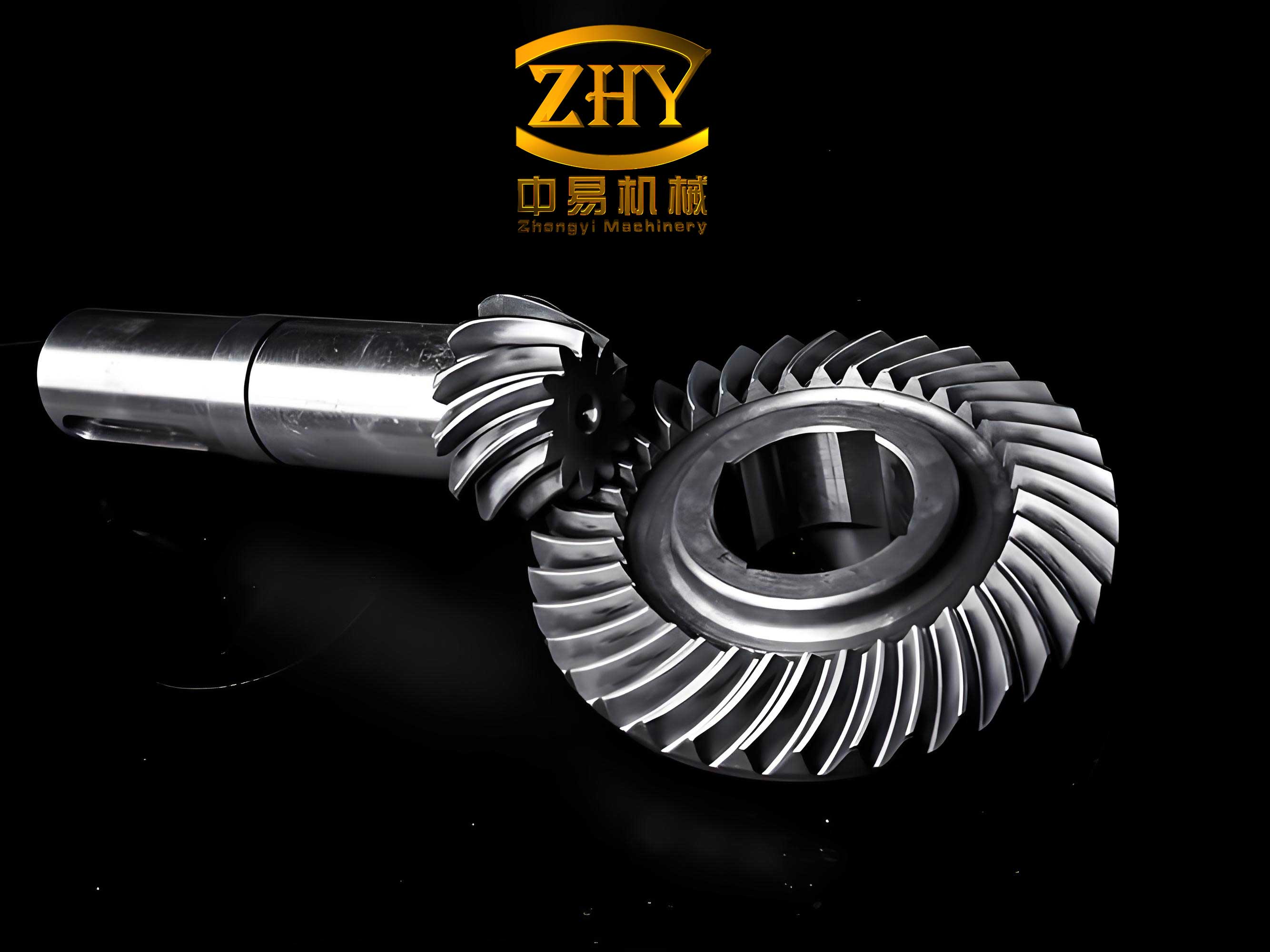
where \( \theta \) is the rotation angle and \( \phi \) is the spiral angle. This complexity means that tools experience cyclic loading, making wear patterns non-uniform. Coatings like TiCN provide a hard barrier against abrasive particles in medium-hard materials, but in low-hardness materials, the dominant wear mode is adhesion, which coatings cannot prevent. Moreover, the coating process inherently dulls the edge, as shown in Figure 1 (though not referenced explicitly, the image link inserted earlier illustrates a spiral bevel gear set, highlighting the gear geometry that necessitates precise cutting). This blunting effect is detrimental at low speeds but becomes advantageous at high speeds, where a slightly rounded edge can reduce stress concentrations and thermal cracking.
To quantify the economic impact, I developed a simple cost model for spiral bevel gear machining. The total cost per gear \( C_{\text{total}} \) can be expressed as:
$$C_{\text{total}} = C_{\text{tool}} \cdot \frac{t_{\text{machining}}}{T} + C_{\text{machine}} \cdot t_{\text{machining}} + C_{\text{material}}$$
where \( C_{\text{tool}} \) is tool cost, \( T \) is tool life, \( t_{\text{machining}} \) is machining time, \( C_{\text{machine}} \) is machine hourly rate, and \( C_{\text{material}} \) is material cost. My experiments show that coated tools in high-speed cutting reduce \( t_{\text{machining}} \) by 2-3 times and increase \( T \) for medium-hard materials, lowering \( C_{\text{total}} \). For low-hardness materials, however, the short tool life offsets any speed gains, making uncoated tools more cost-effective.
Another aspect I explored is the role of coating composition. While my tests used TiCN, other coatings like AlTiN or diamond-like carbon (DLC) might offer better performance for specific materials. For instance, DLC coatings have low friction coefficients that could mitigate adhesion on soft steels, but their thermal stability may be limited for high-speed spiral bevel gear milling. Future research could involve comparative studies of multiple coatings under standardized test conditions for spiral bevel gear production.
In conclusion, my comprehensive study on coated spiral bevel gear milling cutters reveals several key insights. First, coatings do not solve the adhesion problems when machining low-hardness materials; thus, alternative strategies like optimized tool geometry or coolant application are needed. Second, under standard cutting conditions, coated tools may underperform due to edge rounding, emphasizing the need for parameter adjustment. Third, the true advantage of coatings emerges in high-speed cutting of medium-hard materials, where they enable significant productivity gains and improved surface finish. Finally, coated roughing cutters can effectively replace finishing tools when operated at high speeds, streamlining the gear manufacturing process. These findings underscore the importance of matching coating technology with appropriate cutting parameters to fully harness its benefits in spiral bevel gear machining.
Based on my results, I recommend that manufacturers adopt a tailored approach when using coated spiral bevel gear milling cutters. For medium-hard gears, implementing high-speed cutting protocols with coated tools can boost efficiency by 2-3 times while maintaining or enhancing quality. For low-hardness gears, it may be prudent to use uncoated tools with enhanced edge preparation or specialized coatings designed for adhesion resistance. Additionally, further optimization of coating thickness and edge honing could mitigate the blunting effect, expanding the applicability of coated tools across a wider range of materials. As the demand for high-performance spiral bevel gears grows, continued research into advanced coatings and cutting strategies will be essential for driving innovation in gear manufacturing technology.