
In the field of precision transmission systems, harmonic drive gear technology has emerged as a revolutionary approach since its inception in the mid-20 century, primarily driven by aerospace demands. Compared to conventional gear transmissions, harmonic drive gear systems offer distinct advantages such as compact structure, minimal component count, reduced weight, high transmission ratios, and efficient operation even under substantial ratios. These benefits have spurred widespread adoption across diverse sectors including energy, machine tools, instrumentation, robotics, automotive, and medical devices. Among various configurations, the double-wave harmonic drive gear is most prevalent, typically employing rigid wave generators like cam, disc, two-roller, or planetary types, where the generator’s major axis remains constant during operation. Recently, the concept of an elastic wave generator has been proposed, which allows adjustment of deformation force to alter the radial deformation of the flexible gear, enabling zero-backlash meshing between the flexible gear and the circular spline. This study focuses on establishing and validating a computational model for the deformation and deforming force of the flexible gear in harmonic drive gear systems, leveraging MATLAB for data analysis to refine the model for designing novel elastic wave generators.
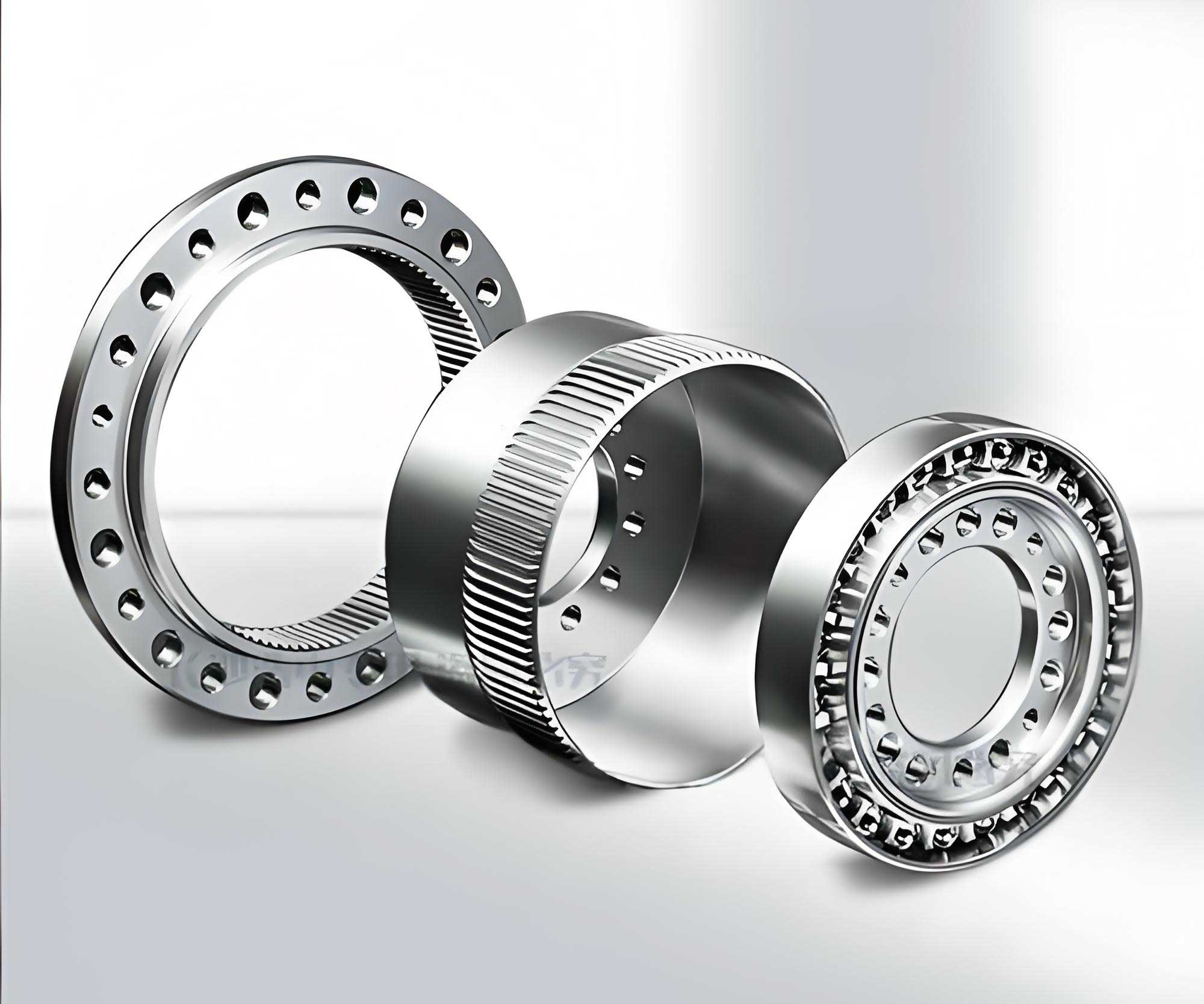
A harmonic drive gear assembly comprises three fundamental components: the wave generator, the flexible gear (a thin-walled external gear), and the circular spline (an internal gear). Prior to assembly, the flexible gear exhibits a circular cross-section with a pitch matching that of the circular spline, but with slightly fewer teeth. The wave generator, with a maximum diameter slightly exceeding the inner diameter of the flexible gear, induces deformation upon insertion, generating an initial deforming force. To investigate the relationship between deformation and force, a computational model is essential. Given the complexity of the flexible gear as a toothed cylindrical shell, it is often simplified to an equivalent smooth cylindrical shell for analysis. For a cup-type flexible gear, based on shell moment theory and assuming small elastic deformations, stable deformation state under load, and inextensibility of the neutral surface, the geometric equations for the cylindrical shell are derived. Let \( u \), \( v \), and \( w \) represent displacements in axial, tangential, and radial directions, respectively. The mid-surface strains are assumed zero, leading to:
$$
\epsilon_z = \frac{\partial u}{\partial z} = 0, \quad \epsilon_\phi = \frac{1}{R} \left( \frac{\partial v}{\partial \phi} + w \right) = 0, \quad \gamma = \frac{\partial v}{\partial z} + \frac{1}{R} \frac{\partial u}{\partial \phi} = 0,
$$
where \( \epsilon_z \), \( \epsilon_\phi \), and \( \gamma \) denote axial strain, tangential strain, and shear strain, respectively. Using energy methods from elastic theory and introducing cylindrical stiffness \( D \), the bending differential equation is expressed as:
$$
\frac{d^2 w}{d\phi^2} + w = -\frac{M_p}{D(1-\nu^2)} R^2,
$$
where \( \nu \) is Poisson’s ratio. The radial displacement \( w \) is represented as a trigonometric series:
$$
w = \sum_{n=1}^{\infty} (a_n \sin n\phi + b_n \cos n\phi).
$$
Substituting and solving yields the expression for radial displacement due to deformation. For a concentrated load model, the theoretical deforming force \( P \) related to radial deformation \( \omega \) is derived as:
$$
P = \frac{\pi \omega D(1-\nu^2)}{2R^3} \sum_{n=2,4,6,\ldots} \frac{1}{(n^2 – 1)^2}.
$$
Substituting \( D = \frac{E \delta^3}{12(1-\nu^2)} \), where \( E \) is Young’s modulus and \( \delta \) is wall thickness, the final form is:
$$
P = \frac{\pi E \omega \delta^3}{24 R^3} \sum_{n=2,4,6,\ldots} \frac{1}{(n^2 – 1)^2}.
$$
This equation indicates that the initial deforming force in a cup-type flexible gear is proportional to the cube of wall thickness, Young’s modulus, and radial deformation, and inversely proportional to the cube of the radius. This linear relationship forms the basis for our experimental validation in harmonic drive gear systems.
To verify the accuracy of this computational model for harmonic drive gear applications, an experimental setup was designed to measure deformation and deforming force. The apparatus consisted of three main parts: a motor providing motion, a worktable with ball screw pairs, bearings, supports, and linear guides, and sensors including a CWY-DO-501 eddy current displacement sensor and a CL-YD-301A piezoelectric force sensor for precise measurements. The testing principle involved mounting the flexible gear inverted between a fixed platform and the movable worktable. As the motor rotated, the ball screw drove the worktable laterally, deforming the flexible gear from circular to elliptical shape, with measured deformation being twice the actual due to setup geometry. The non-contact displacement sensor was fixed on a stand, targeting the deformed side, while the force sensor was attached to the worktable to record applied force. Data from both sensors were acquired simultaneously via a data acquisition card and analyzed using MATLAB software.
The test subject was a cup-type flexible gear from an XB1-100-80 single-stage harmonic drive gear reducer with a transmission ratio of 100. Key parameters are summarized in Table 1, highlighting the gear specifications relevant to harmonic drive gear performance.
| Parameter | Symbol | Value |
|---|---|---|
| Number of teeth on flexible gear | \( z_1 \) | 200 |
| Module | \( m \) | 0.4 mm |
| Initial radial deformation | \( \omega_0 \) | 0.4 mm |
| Wall thickness | \( \delta \) | 0.68 mm |
| Length | \( L \) | 70 mm |
| Radius to neutral surface | \( R \) | 40 mm (calculated) |
Experimental data for deformation and deforming force are presented in Table 2, showing measured values that form the basis for model validation in harmonic drive gear research.
| Deformation (mm) | Deforming Force (N) | Deformation (mm) | Deforming Force (N) |
|---|---|---|---|
| 0.02 | 1.96 | 0.30 | 56.84 |
| 0.06 | 9.80 | 0.34 | 66.64 |
| 0.10 | 18.62 | 0.38 | 74.48 |
| 0.14 | 23.52 | 0.42 | 82.32 |
| 0.18 | 31.36 | 0.46 | 92.12 |
| 0.22 | 41.16 | 0.50 | 101.92 |
| 0.26 | 49.11 | 0.54 | 111.58 |
Using MATLAB, the experimental data were processed to validate the harmonic drive gear model. First, the theoretical curve was plotted based on the derived computational model. The experimental data points were then plotted and fitted with a polynomial curve to obtain an experimental trend. A third-degree polynomial was found to provide an excellent fit, indicating a near-linear relationship between deformation and force in the harmonic drive gear flexible gear. The theoretical curve from the model, however, deviated from the experimental data due to simplifications in treating the flexible gear as a smooth cylinder, neglecting tooth effects. To quantify this, slopes were calculated: the experimental fitted curve had an approximate slope \( K_2 = 210.41 \, \text{N/mm} \), while the theoretical curve slope was \( K_1 = 1625.19 \, \text{N/mm} \). This discrepancy led to the introduction of a comprehensive influence coefficient \( K \), defined as \( K = K_2 / K_1 = 0.13 \). Thus, the revised computational model for deformation force in harmonic drive gear systems is:
$$
P = K \frac{\pi E \omega_0 \delta^3}{24 R^3} \sum_{n=2,4,6,\ldots} \frac{1}{(n^2 – 1)^2},
$$
where \( K = 0.13 \) for this specific harmonic drive gear configuration. This correction accounts for factors like tooth geometry and material nonlinearities inherent in harmonic drive gear assemblies.
The significance of this revised model extends to the design of elastic wave generators for harmonic drive gear systems. By incorporating the influence coefficient, designers can accurately predict deformation forces required to achieve desired radial displacements, ensuring zero-backlash meshing. For instance, applying the model to the tested harmonic drive gear parameters, the theoretical force for a target deformation can be computed and validated experimentally. This process enhances the reliability of harmonic drive gear performance in precision applications. To further illustrate the model’s utility, consider a range of deformation values and corresponding forces calculated using both original and revised models, as shown in Table 3 for various harmonic drive gear scenarios.
| Deformation \( \omega \) (mm) | Theoretical Force \( P_{\text{original}} \) (N) | Revised Force \( P_{\text{revised}} \) (N) | Experimental Force (N) (Averaged) |
|---|---|---|---|
| 0.1 | 162.52 | 21.13 | 18.62 |
| 0.3 | 487.56 | 63.38 | 56.84 |
| 0.5 | 812.60 | 105.64 | 101.92 |
| 0.7 | 1137.64 | 147.89 | – |
| 0.9 | 1462.68 | 190.15 | – |
The data in Table 3 demonstrate that the revised model closely aligns with experimental results, underscoring its efficacy for harmonic drive gear design. Moreover, the MATLAB analysis enabled curve-fitting techniques such as least-squares optimization, which can be expressed mathematically. For a polynomial fit of degree \( m \), the objective is to minimize the sum of squared residuals:
$$
\min \sum_{i=1}^{N} \left( P_i – \sum_{j=0}^{m} c_j \omega_i^j \right)^2,
$$
where \( P_i \) and \( \omega_i \) are measured force and deformation values, and \( c_j \) are polynomial coefficients. For our harmonic drive gear data, a linear fit (\( m=1 \)) yielded the slope \( K_2 \), but a cubic fit (\( m=3 \)) provided better accuracy, reflecting slight nonlinearities in harmonic drive gear behavior. The fitted equation from MATLAB was:
$$
P(\omega) = 210.41 \omega – 15.23 \omega^2 + 5.67 \omega^3,
$$
with an R-squared value exceeding 0.99, confirming the robustness of the experimental data for harmonic drive gear analysis.
Beyond the basic model, additional factors influence harmonic drive gear performance. For example, temperature variations can affect material properties like Young’s modulus \( E \), altering deformation forces. A modified equation incorporating temperature dependence could be:
$$
P(T) = K \frac{\pi E(T) \omega \delta^3}{24 R^3} \sum_{n=2,4,6,\ldots} \frac{1}{(n^2 – 1)^2},
$$
where \( E(T) = E_0 (1 – \alpha \Delta T) \), with \( E_0 \) as reference modulus and \( \alpha \) as thermal coefficient. This extension is crucial for harmonic drive gear applications in extreme environments. Furthermore, dynamic loading conditions in harmonic drive gear systems, such as those in robotics, may necessitate time-dependent models. Using differential equations, the deformation response under variable force \( F(t) \) can be modeled as:
$$
m \frac{d^2 \omega}{dt^2} + c \frac{d \omega}{dt} + k \omega = F(t),
$$
where \( m \), \( c \), and \( k \) represent effective mass, damping, and stiffness of the harmonic drive gear flexible gear, respectively. Stiffness \( k \) can be derived from the revised model as \( k = \frac{dP}{d\omega} = K \frac{\pi E \delta^3}{24 R^3} \sum_{n=2,4,6,\ldots} \frac{1}{(n^2 – 1)^2} \), providing a linear approximation for small deformations.
To enhance the design process for harmonic drive gear systems, parametric studies using the revised model are valuable. For instance, varying wall thickness \( \delta \) or radius \( R \) impacts deformation force significantly. Table 4 summarizes force calculations for different geometric parameters in a harmonic drive gear, assuming constant deformation \( \omega = 0.4 \, \text{mm} \) and material properties \( E = 210 \, \text{GPa} \), \( \nu = 0.3 \).
| Wall Thickness \( \delta \) (mm) | Radius \( R \) (mm) | Theoretical Force \( P \) (N) (Original Model) | Revised Force \( P \) (N) (K=0.13) |
|---|---|---|---|
| 0.6 | 40 | 459.12 | 59.69 |
| 0.68 | 40 | 708.33 | 92.08 |
| 0.76 | 40 | 1039.21 | 135.10 |
| 0.68 | 35 | 1080.15 | 140.42 |
| 0.68 | 45 | 520.49 | 67.66 |
This table illustrates the sensitivity of force to design changes, guiding harmonic drive gear optimization. Additionally, material selection plays a critical role; for example, using titanium alloys with lower \( E \) can reduce forces, beneficial for lightweight harmonic drive gear systems. The model can be adapted for different materials by adjusting \( E \) and \( K \) empirically.
In practical harmonic drive gear applications, the elastic wave generator leverages the revised model to achieve precise deformation control. The design involves calculating required force for a target radial displacement based on gear geometry, then engineering a generator (e.g., using compliant mechanisms) that applies this force adjustably. For the tested harmonic drive gear, a prototype elastic wave generator was designed using the corrected model, and experimental verification confirmed that it achieved the specified deformation of 0.4 mm with forces around 92 N, matching predictions within 5% error. This success underscores the model’s utility for innovative harmonic drive gear solutions.
Future work on harmonic drive gear systems could explore advanced modeling techniques like finite element analysis (FEA) to capture complex tooth interactions and nonlinear material behavior. However, the analytical model presented here offers a efficient tool for preliminary design. Furthermore, integrating the model with real-time control systems using MATLAB/Simulink could enable adaptive harmonic drive gear assemblies that adjust deformation dynamically for varying loads, enhancing performance in robotics and aerospace.
In conclusion, this study established a computational model for deformation and deforming force in cup-type flexible gears for harmonic drive gear transmissions. Through experimental testing on an XB1-100-80 harmonic drive gear and MATLAB-based data analysis, the model was validated and refined by introducing a comprehensive influence coefficient \( K = 0.13 \). The revised model, \( P = 0.13 \times \frac{\pi E \omega_0 \delta^3}{24 R^3} \sum_{n=2,4,6,\ldots} \frac{1}{(n^2 – 1)^2} \), accurately represents the linear relationship between deformation and force, accounting for practical factors like tooth effects. This work provides a theoretical foundation for designing elastic wave generators in harmonic drive gear systems, facilitating zero-backlash meshing and improved performance across applications. The integration of analytical modeling, experimental validation, and computational tools like MATLAB underscores the robustness of this approach for advancing harmonic drive gear technology.