
In the evolving landscape of high-end equipment applications across sectors such as new energy, aerospace, and national defense, the demand for advanced gearbox structures with enhanced performance has become increasingly pressing. As a core component within gearboxes, multi-feature gear shafts exhibit increasingly diverse and refined串联-shaped structures, enabling compact design philosophies and multifunctional performance. The reliable operation of such gear shafts hinges not only on rational structural design and the协调 of various features but also on stringent manufacturing processes, including surface quality and physical properties. Given certain gaps in materials, machine tools, and cutting tools compared to Western developed nations, precise structural design and parameter optimization are essential to compensate for工艺 shortcomings, facilitating a leap from mid-to-low-end to high-end manufacturing routes. This study, based on a forward engineering design approach, proposes a rapid static-dynamic joint design methodology to investigate the structural characteristics and operational parameter intervals of high-speed multi-feature gear shafts, providing auxiliary design support for developing new shaft structures in engineering applications.
Multi-feature gear shafts typically integrate elements such as involute gears, involute splines, rectangular splines, conical surfaces, threads, and flat faces, each serving specific functions. For instance, in a high-speed wire rod finishing mill application, the gear transmits torque, the conical surface outputs载荷 for hot rolling, involute splines drive labyrinth seal动 rings, and rectangular splines combined with external threads adjust preload forces. The primary parameters of these elements are summarized in Table 1.
| Element | Module (mm) | Number of Teeth | Pressure Angle (°) | Helix Angle (°) | Face Width (mm) |
|---|---|---|---|---|---|
| Involute Gear | 5.0 | 25 | 20 | 15.5 | 80 |
| Involute Spline | 1.5 | 59 | 20 | 0 | 20 |
During operation, two gear shafts drive rollers to共同 squeeze wire rods, generating反向 radial挤压力 on the gear shafts. The shaft system primarily承受 radial forces, bending moments, and torques. Support is provided by a combination of oil film bearings and rolling bearings, with oil film bearings handling radial loads and rolling bearings managing较小的 axial loads. A simplified mechanical analysis model is established,忽略 non-critical geometric features for computational efficiency.
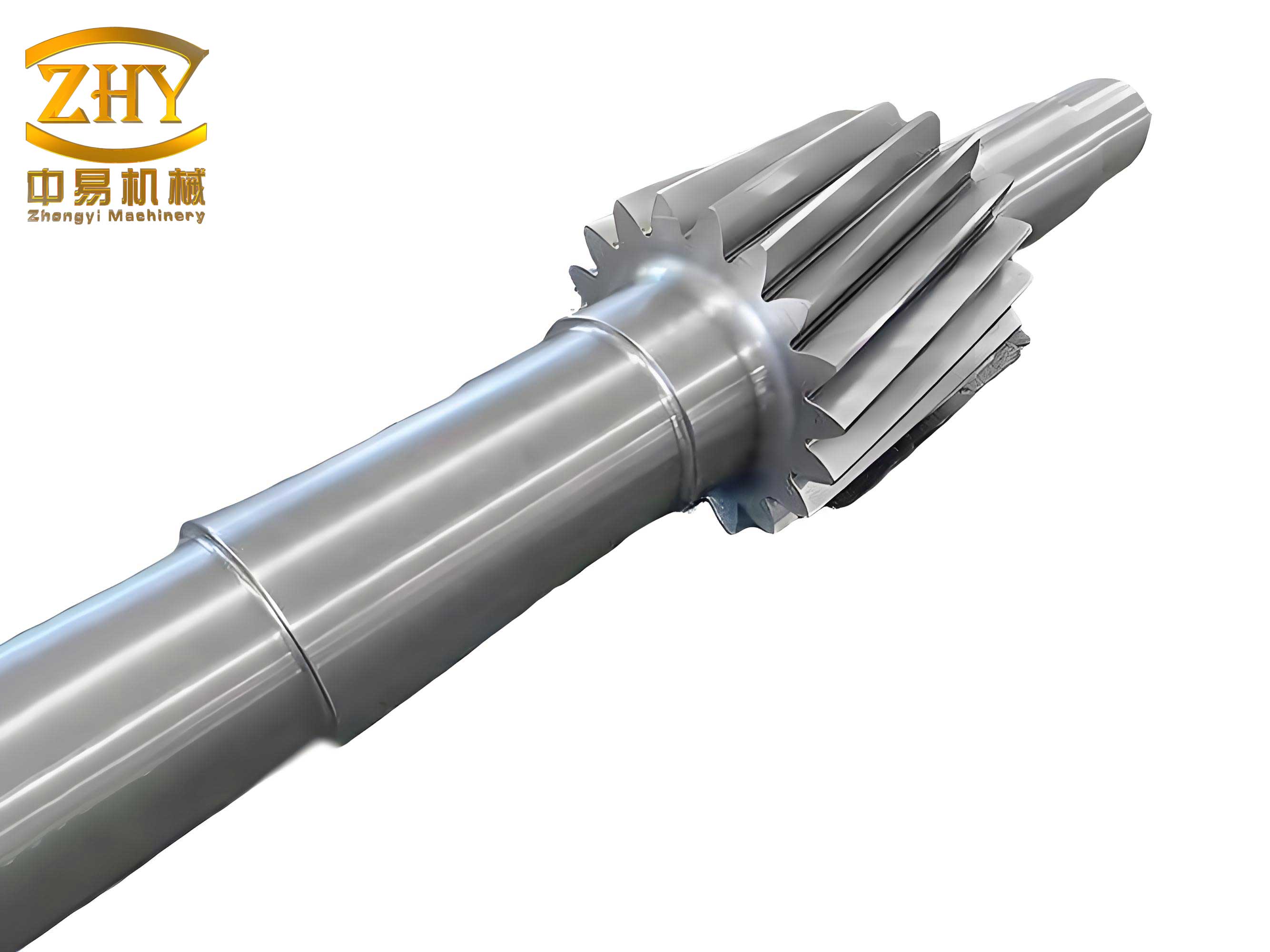
For static strength analysis, the output torque $M$ is calculated using $M = 9,549 \cdot P / n$, where $P$ is power in kW and $n$ is rotational speed in rpm. The radial挤压力 $F_r$ on the conical surface is derived from equilibrium with friction torque. Forces include gear啮合力, conical surface radial force, and gravity, while torques comprise input torque at the gear and output torque at the cone. Using Romax software with parameters $P = 300 \text{ kW}$ and $n = 8,000 \text{ rpm}$, force distributions, displacements, moments, and stresses are computed. The maximum bending moment occurs in the YZ-plane, valued at $1,609 \text{ N·m}$, and the maximum combined stress is $13.6 \text{ MPa}$ at a截面突变 location, identified as the critical section. The safety factor $S_s$ for this critical section is校核 using:
$$ S_s = \frac{S_{s\sigma} S_{s\tau}}{\sqrt{S_{s\sigma}^2 + S_{s\tau}^2}} \geq S_{sp} $$
where $S_{sp}$ is the allowable safety factor for static strength, $S_{s\sigma}$ is the safety factor considering only bending moment, and $S_{s\tau}$ is the safety factor considering only torque. These are calculated as:
$$ S_{s\sigma} = \frac{\sigma_s Z}{M_{\text{max}}}, \quad S_{s\tau} = \frac{\tau_s Z_P}{T_{\text{max}}} $$
Here, $M_{\text{max}}$ and $T_{\text{max}}$ are the maximum bending moment and torque on the critical section, $Z$ and $Z_P$ are the section moduli for bending and torsion, and $\sigma_s$ and $\tau_s$ are the material’s tensile and torsional yield limits. For material 17CrNiMo6 with调质 hardness 260-280 HBS and case-hardened teeth (58-62 HRC), values $\sigma_s = 290 \text{ MPa}$ and $\tau_s = 180 \text{ MPa}$ are adopted, with $S_{sp} = 1.8$. Calculations yield $S_{s\sigma} = 9.1$, $S_{s\tau} = 50.5$, and $S_s = 9.0 > S_{sp}$, indicating ample static strength under these conditions.
To determine the operational parameter interval under static conditions, the relationships between power, speed, and safety factors—including critical section safety factor $S_S$, tooth contact strength safety factor $S_H$, and tooth root bending strength safety factor $S_F$—are analyzed over power ranges of 300-1,500 kW and speed ranges of 5,000-12,000 rpm. The variations are summarized in Table 2 and expressed through empirical formulas derived from simulation data.
| Parameter | Effect on $S_S$ | Effect on $S_H$ | Effect on $S_F$ |
|---|---|---|---|
| Power Increase (constant speed) | Decreases nonlinearly | Decreases gradually | Decreases nonlinearly |
| Speed Increase (constant power) | Increases slightly | Increases moderately | Increases significantly |
Mathematically, these trends can be approximated as:
$$ S_S \approx a_0 + a_1 P^{-1} + a_2 n, \quad S_H \approx b_0 + b_1 \ln(P) + b_2 n^{0.5}, \quad S_F \approx c_0 + c_1 P^{-0.8} + c_2 n^{1.2} $$
where $a_i$, $b_i$, and $c_i$ are coefficients derived from curve fitting. Based on design standards and experience, allowable limits are set as $2.0 \leq S_S \leq 3.0$, $1.3 \leq S_H \leq 2.0$, and $1.6 \leq S_F \leq 3.0$. The intersection of these intervals defines the static operational parameter region, visualized as a power-speed envelope where gear shafts can operate reliably.
For rotor dynamics analysis, a mathematical model incorporating bearing stiffness and damping is established. Natural frequencies are computed using both Romax and DyRoBes software, with results for forward precession shown in Table 3.
| Mode Order | Natural Frequency (Romax, Hz) | Natural Frequency (DyRoBes, Hz) | Deviation (%) |
|---|---|---|---|
| 1 | 374.9 | 374.7 | 0.05 |
| 2 | 471.1 | 478.2 | 1.49 |
| 3 | 722.3 | 732.1 | 1.34 |
| 4 | 1,452.1 | 1,496.9 | 2.99 |
The mode shapes in the XZ-plane exhibit characteristic displacements, with higher modes showing increased nodal points. The Campbell diagram with damping is plotted to identify critical speeds and excitation sources. The first critical speed is $22,494 \text{ rpm}$, and a potential激励 source exists near $11,247 \text{ rpm}$ where twice the rotational frequency intersects the first natural frequency. The system’s equivalent stiffness $k_{\text{eq}}$ is given by:
$$ \frac{1}{k_{\text{eq}}} = \frac{1}{k_{\text{shaft}}} + \frac{1}{k_{\text{bearing}}} $$
where $k_{\text{shaft}} \approx 1.75 \times 10^5 \text{ N/mm}$ and $k_{\text{bearing}} \approx 2.5 \times 10^5 \text{ N/mm}$ for oil film bearings. As bearing stiffness varies, natural frequencies shift, stabilizing at rigid-support values when $k_{\text{bearing}} > 10^6 \text{ N/mm}$.
Unbalance response analysis considers unbalance masses at key locations, such as the gear and shaft end, with balancing grades G2.5 and G1.0 corresponding to maximum unbalances of $0.25 \text{ kg·mm}$ and $0.1 \text{ kg·mm}$, respectively. The displacement amplitude $A$ at node $i$ as a function of speed $\omega$ is modeled as:
$$ A_i(\omega) = \frac{U \cdot \omega^2}{\sqrt{(k_i – m_i \omega^2)^2 + (c_i \omega)^2}} $$
where $U$ is the unbalance, $m_i$ is the modal mass, $k_i$ is the stiffness, and $c_i$ is the damping coefficient. Results indicate that amplitudes increase with speed and unbalance magnitude, particularly beyond $9,600 \text{ rpm}$, where growth becomes陡. The relationship between平衡 grade, speed, and vibration amplitude is summarized in Table 4.
| Balancing Grade | Max Unbalance (kg·mm) | Amplitude at 8,000 rpm (µm) | Critical Speed for Rapid Growth (rpm) |
|---|---|---|---|
| G2.5 | 0.25 | 15.2 | 9,600 |
| G1.0 | 0.10 | 6.8 | 9,600 |
By integrating static and dynamic constraints, the final operational parameter interval is derived. Dynamically, speeds should avoid critical regions near $11,247 \text{ rpm}$ and above $9,600 \text{ rpm}$ to limit vibration. Combining this with the static envelope yields a refined power-speed domain, described by the inequality:
$$ P \leq \alpha \cdot n^{\beta} \quad \text{for} \quad n < 9,600 \text{ rpm} $$
where $\alpha$ and $\beta$ are constants determined from intersection boundaries. This region ensures that multi-feature gear shafts operate with sufficient safety margins and dynamic stability.
In conclusion, this study presents a comprehensive approach to designing high-speed multi-feature gear shafts through static-dynamic joint analysis. The static strength assessment, based on critical section safety factors, confirms structural integrity and defines power-speed limits through the interplay of contact, bending, and截面 safety factors. Dynamics analysis reveals natural frequencies, mode shapes, and unbalance responses, identifying critical speeds and vibration thresholds. The fusion of static and dynamic parameter intervals provides a reliable operational domain, enabling rapid selection and optimization of gear shaft designs. This methodology supports the development of advanced multi-feature gear shafts in engineering applications, contributing to enhanced performance and reliability in high-speed machinery.
The research underscores the importance of considering both static and dynamic behaviors in gear shaft design. Future work could explore the effects of thermal loads, nonlinear bearing characteristics, and manufacturing tolerances on operational intervals. Additionally, experimental validation of the proposed parameter intervals would further solidify the design framework. Overall, this study offers a valuable reference for engineers seeking to innovate in the realm of high-speed gear shafts, ensuring that these critical components meet the demands of modern industrial applications.
Throughout this analysis, gear shafts are emphasized as pivotal elements in transmission systems. Their multi-feature nature necessitates meticulous design to balance strength, dynamics, and functionality. By applying the proposed methods, designers can efficiently navigate the complex parameter spaces associated with gear shafts, leading to more robust and efficient machinery. The integration of computational tools like Romax and DyRoBes facilitates accurate predictions, reducing reliance on trial-and-error approaches. As industries continue to push the boundaries of speed and power, such methodologies will become increasingly vital for advancing gear shaft technology.