
In gear transmission systems, cylindrical gears are fundamental components widely used due to their simplicity and efficiency. However, vibrations and noise induced by time-varying meshing stiffness (TVMS) significantly impact performance and longevity. This study focuses on investigating the effects of tooth profile modification on the meshing dynamic characteristics of cylindrical gears. We establish an analytical model for modified spur gear transmission, incorporating various stiffness components, and numerically simulate the influence of single and compound profile shifts on TVMS and dynamic responses. The goal is to provide insights into optimizing gear design for reduced vibration and enhanced stability, with particular emphasis on cylindrical gears as the core subject.
The durability, smooth operation, low noise, and minimal vibration of modified spur gears make them advantageous in mechanical systems. By optimizing modification coefficients, the performance of cylindrical gears can rival that of helical gears while reducing manufacturing and maintenance costs. Internal excitations, primarily TVMS, are key drivers of gear dynamics. Thus, understanding how tooth profile modifications alter these excitations is crucial for advancing gear technology. This research contributes by: (1) proposing a new analytical model for TVMS in modified cylindrical gears; (2) examining the impact of single profile shifts on TVMS and dynamic traits; and (3) exploring compound modifications for cylindrical gears. Our approach integrates geometric analysis, stiffness modeling, and dynamic simulations to comprehensively assess these effects.
To begin, we delve into the TVMS analytical model, which is central to predicting gear behavior. TVMS serves as a periodic excitation source in gear systems, directly affecting operational performance. Our model is based on the potential energy method, where a gear tooth is simplified as a cantilever beam with variable cross-section. The total potential energy comprises Hertzian contact energy, bending energy, shear energy, axial compression energy, and fillet foundation energy. For cylindrical gears, these components are expressed as:
$$U_h = \frac{F^2}{2k_h}, \quad U_b = \frac{F^2}{2k_b}, \quad U_s = \frac{F^2}{2k_s}, \quad U_a = \frac{F^2}{2k_a}, \quad U_f = \frac{F^2}{2k_f}$$
where \( F \) is the meshing force, and subscripts denote stiffness types. The total potential energy for a single gear pair is:
$$U = \frac{F^2}{2k} = U_h + U_{b1} + U_{s1} + U_{a1} + U_{f1} + U_{b2} + U_{s2} + U_{a2} + U_{f2} = \frac{F^2}{2} \left( \frac{1}{k_h} + \frac{1}{k_{b1}} + \frac{1}{k_{s1}} + \frac{1}{k_{a1}} + \frac{1}{k_{f1}} + \frac{1}{k_{b2}} + \frac{1}{k_{s2}} + \frac{1}{k_{a2}} + \frac{1}{k_{f2}} \right)$$
Thus, the TVMS for a gear pair is given by:
$$k = \begin{cases}
1 / \left( \frac{1}{k_h} + \frac{1}{k_{b1}} + \frac{1}{k_{s1}} + \frac{1}{k_{a1}} + \frac{1}{k_{f1}} + \frac{1}{k_{b2}} + \frac{1}{k_{s2}} + \frac{1}{k_{a2}} + \frac{1}{k_{f2}} \right) & \text{single-tooth-pair} \\
\sum_{i=1}^{2} 1 / \left( \frac{1}{k_{h,i}} + \frac{1}{k_{b1,i}} + \frac{1}{k_{s1,i}} + \frac{1}{k_{a1,i}} + \frac{1}{k_{f1,i}} + \frac{1}{k_{b2,i}} + \frac{1}{k_{s2,i}} + \frac{1}{k_{a2,i}} + \frac{1}{k_{f2,i}} \right) & \text{double-tooth-pair}
\end{cases}$$
This formulation accounts for the cyclic engagement of cylindrical gears, where stiffness varies with rotation angle. For cylindrical gears, tooth geometry is critical, especially under profile modification. We consider two cases based on the relationship between the root circle and base circle. In Case 1, where the root circle is smaller than the base circle, the tooth profile consists of an involute curve from the tip to the base circle and a transition curve thereafter. Geometric parameters, such as height \( h \) and distance \( x \), are derived using:
$$h = R_b [(\phi_1 + \phi_2) \cos \phi_1 – \sin \phi_1]$$
$$h_x = \begin{cases}
R_b \sin \phi_2 + r_f – \sqrt{r_f^2 – (x – d_1)^2}, & 0 \leq x < d_1 \\
R_b[(\phi_2 – \phi) \cos \phi_1 + \sin \phi_1], & d_1 \leq x \leq d
\end{cases}$$
where \( R_b \) is the base radius, \( r_f \) is the fillet radius, and angles \( \phi_1, \phi_2 \) define the involute segment. The stiffness components for bending, shear, and axial compression integrate over these curves:
$$\frac{1}{k_b} = -\int_{\phi_2}^{\phi_3} \frac{3a_x (R_b – R_f \cos \phi_3) \cos \phi_1 – a_x \phi \cos \phi_1 – b_x \cos \phi_1}{2E L \left( R_b \sin \phi_2 + r_f – \sqrt{r_f^2 – (x – d_1)^2} \right)^3} d\phi + \int_{-\phi_1}^{\phi_2} \frac{3\{1 + \cos \phi_1[(\phi_2 – \phi) \sin \phi – \cos \phi]\}^2 (\phi_2 – \phi) \cos \phi}{2E L [\sin \phi_2 + (\phi_2 – \phi) \cos \phi]^3} d\phi$$
$$\frac{1}{k_s} = -\int_{\phi_2}^{\phi_3} \frac{1.2a_x (1 + \nu) \cos^2 \phi_1}{E L \left( R_b \sin \phi_2 + r_f – \sqrt{r_f^2 – (x – d_1)^2} \right)} d\phi + \int_{-\phi_1}^{\phi_2} \frac{1.2 (1 + \nu) (\phi_2 – \phi) \cos \phi \cos^2 \phi_1}{E L [\sin \phi_2 + (\phi_2 – \phi) \cos \phi]} d\phi$$
$$\frac{1}{k_a} = -\int_{\phi_2}^{\phi_3} \frac{a_x \sin^2 \phi_1}{2E L \left( R_b \sin \phi_2 + r_f – \sqrt{r_f^2 – (x – d_1)^2} \right)} d\phi + \int_{-\phi_1}^{\phi_2} \frac{(\phi_2 – \phi) \cos \phi \sin^2 \phi_1}{E L [\sin \phi_2 + (\phi_2 – \phi) \cos \phi]} d\phi$$
Here, \( E \) is Young’s modulus, \( L \) is tooth width, and \( \nu \) is Poisson’s ratio. Hertzian contact stiffness for cylindrical gears is simplified as:
$$k_h = \frac{\pi E L}{4(1 – \nu^2)}$$
Fillet foundation stiffness follows:
$$\frac{1}{k_f} = \frac{\cos^2 \beta}{E L} \left[ L^* \left( \frac{u_f}{S_f} \right)^2 + M^* \left( \frac{u_f}{S_f} \right) + P^* (1 + Q^* \tan^2 \phi_1) \right]$$
with parameters \( \beta, u_f, S_f, L^*, M^*, P^*, Q^* \) referenced from literature. In Case 2, where the root circle exceeds the base circle, the tooth profile is purely involute, simplifying integrals to involute segments only. This adaptability ensures our model applies to various cylindrical gear designs.
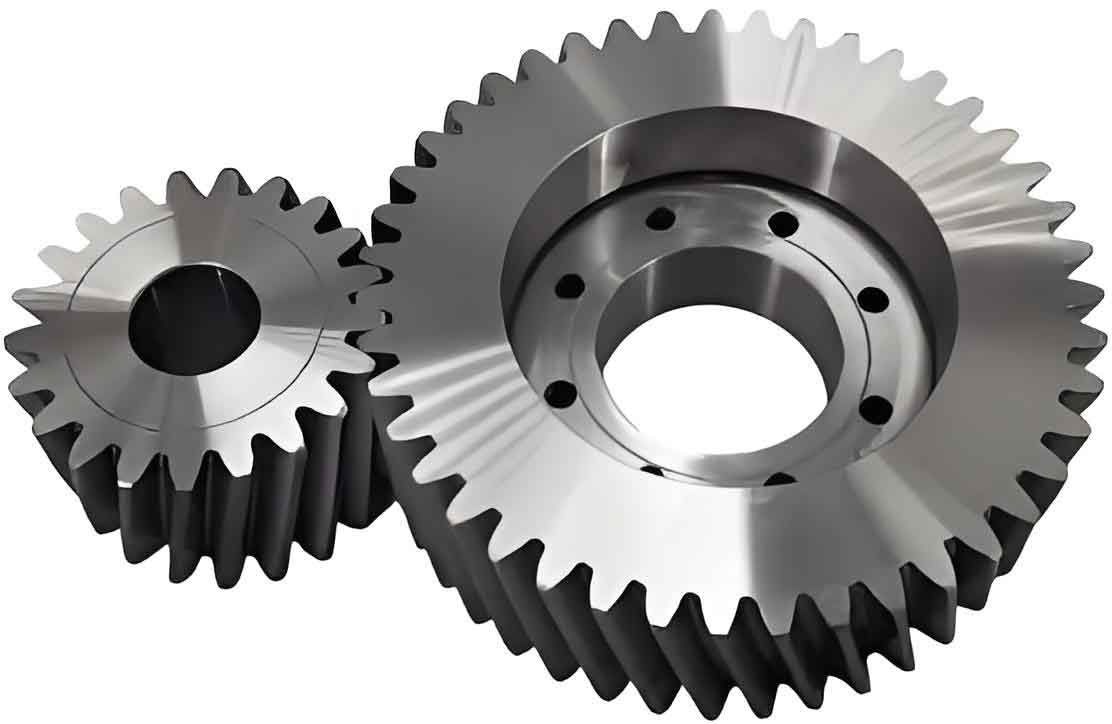
Geometric relationships for modified cylindrical gears are vital, as shift coefficients alter reference circles. For gears with unequal shift coefficients, the pitch circle no longer coincides with the reference circle, changing the pure rolling position. At mesh start, contact occurs at the intersection of the line of action and the gear tip circle. Angles \( \phi_{1,p} \) and \( \phi_{1,g} \) for pinion and gear are:
$$\phi_{1,p} = \phi_{01,p} + \beta_p, \quad \phi_{1,g} = \phi_{01,g} – i_g \beta_g$$
where \( i_g \) is the gear ratio, and initial angles depend on base radii, tip radii, and shift parameters. This geometric adjustment is essential for accurate TVMS computation in modified cylindrical gears.
Our research framework builds on this TVMS model to examine single and compound profile modifications for cylindrical gears. We employ a lumped-mass dynamic model with six degrees of freedom, considering motions along and perpendicular to the line of action. The equations of motion are:
$$m_p \ddot{x}_p + c_b \dot{x}_p + k_b x_p = -F_m$$
$$m_p \ddot{y}_p + c_b \dot{y}_p + k_b y_p = -F_f$$
$$I_p \ddot{\beta}_p = -F_m R_{b,p} – T_p$$
$$m_g \ddot{x}_g + c_b \dot{x}_g + k_b x_g = F_m$$
$$m_g \ddot{y}_g + c_b \dot{y}_g + k_b y_g = F_f$$
$$I_g \ddot{\beta}_g = -F_m R_{b,g} – T_g$$
Here, \( m \) and \( I \) denote mass and inertia, \( c_b \) and \( k_b \) are bearing damping and stiffness, \( T \) is torque, and \( F_m \) and \( F_f \) are meshing and friction forces. The meshing force incorporates TVMS and static transmission error \( e(t) \):
$$F_m = k(t) [x_p – x_g + R_{b,g} \beta_g – e(t)] + c_m [\dot{x}_p – \dot{x}_g + \dot{R}_{b,g} \dot{\beta}_g – \dot{e}(t)]$$
$$F_f = -\mu F_m$$
with \( c_m = 2\zeta \sqrt{\bar{k} m} \), where \( \zeta \) is damping ratio, \( \bar{k} \) is average meshing stiffness, and \( m \) is equivalent mass. Dynamic transmission error (DTE) is computed as \( \text{DTE} = x_p – x_g + R_{b,p} \beta_p + R_{b,g} \beta_g – e(t) \). We analyze vibration using frequency spectra and statistical metrics: root mean square (RMS), square root amplitude (SRA), peak-to-peak value (PPV), and kurtosis value (KV), defined as:
$$X_{\text{rms}} = \sqrt{\frac{1}{N} \sum_{i=1}^N x_i^2}, \quad X_{\text{sra}} = \left( \frac{1}{N} \sum_{i=1}^N \sqrt{|x_i|} \right)^2$$
$$X_{\text{ppv}} = \max(x_i) – \min(x_i), \quad X_{\text{kv}} = \frac{1}{N} \sum_{i=1}^N \left( \frac{x_i – \bar{x}}{\sigma} \right)^4$$
These tools help quantify the impact of modifications on cylindrical gear dynamics.
For case studies, we use parameter values typical of cylindrical gears, as summarized in Table 1. This table includes gear numbers, module, width, pressure angle, and material properties, providing a basis for consistent simulations.
| Parameter | Pinion | Gear |
|---|---|---|
| Number of Teeth | 22 | 133 |
| Module (mm) | 5 | 5 |
| Tooth Width (mm) | 70 | 70 |
| Pressure Angle (°) | 20 | 20 |
| Addendum Coefficient | 1.1 | 1.1 |
| Clearance Coefficient | 0.25 | 0.25 |
| Young’s Modulus (GPa) | 206 | 206 |
| Poisson’s Ratio | 0.3 | 0.3 |
| Density (kg/m³) | 7850 | 7850 |
| Bearing Stiffness (N/m) | 1×10¹⁰ | 1×10¹⁰ |
| Mass (kg) | 3.08 | 147.61 |
| Moment of Inertia (kg·m²) | 6.66×10⁻⁹ | 8.936 |
First, we analyze single profile modification for cylindrical gears. Positive shift coefficients (e.g., 0, 0.1, 0.2, 0.3, 0.4, 0.5) are applied to the pinion. Single tooth stiffness curves show that positive shifts increase tooth thickness but reduce stiffness during meshing, particularly at engagement end. The relative change in stiffness, \( \bar{k}_{p,i} = (k_i – k_0)/k_0 \), reveals steeper curves with larger shifts, indicating heightened sensitivity. TVMS results, plotted against pinion rotation angle, demonstrate that positive shifts decrease overall TVMS and contact ratio for cylindrical gears. Mean and standard deviation of TVMS exhibit nonlinear trends: mean declines slowly with mild shifts but accelerates with larger ones, while standard deviation rises sharply initially then plateaus. Dynamic simulations with damping ratios \( \zeta = 0.07, 0.08, 0.09, 0.1 \) yield DTE statistics. As shown in Table 2, RMS, SRA, and PPV generally increase with shift coefficient, implying aggravated vibration; KV shows negative values for small shifts, suggesting reduced peaks, but turns positive for larger shifts. This confirms that positive modification, while thickening teeth, degrades stiffness and excites cylindrical gear systems.
| Shift Coefficient | RMS (%) | SRA (%) | PPV (%) | KV (%) | Damping Ratio \( \zeta \) |
|---|---|---|---|---|---|
| 0.1 | 5.2 | 4.8 | 3.5 | -1.2 | 0.07 |
| 0.2 | 10.1 | 9.3 | 7.8 | -0.5 | 0.07 |
| 0.3 | 15.3 | 14.1 | 12.4 | 0.8 | 0.07 |
| 0.4 | 20.6 | 19.0 | 17.5 | 2.1 | 0.07 |
| 0.5 | 25.9 | 23.8 | 22.9 | 3.5 | 0.07 |
| 0.1 | 4.9 | 4.5 | 3.2 | -1.0 | 0.08 |
| 0.2 | 9.8 | 9.0 | 7.5 | -0.3 | 0.08 |
| 0.3 | 14.9 | 13.7 | 12.0 | 1.0 | 0.08 |
| 0.4 | 20.1 | 18.5 | 17.1 | 2.3 | 0.08 |
| 0.5 | 25.4 | 23.4 | 22.5 | 3.7 | 0.08 |
| 0.1 | 4.7 | 4.3 | 3.0 | -0.8 | 0.09 |
| 0.2 | 9.5 | 8.7 | 7.2 | -0.1 | 0.09 |
| 0.3 | 14.5 | 13.4 | 11.7 | 1.2 | 0.09 |
| 0.4 | 19.7 | 18.1 | 16.7 | 2.5 | 0.09 |
| 0.5 | 24.9 | 22.9 | 22.1 | 3.9 | 0.09 |
| 0.1 | 4.5 | 4.1 | 2.8 | -0.6 | 0.10 |
| 0.2 | 9.2 | 8.4 | 6.9 | 0.1 | 0.10 |
| 0.3 | 14.1 | 13.0 | 11.4 | 1.4 | 0.10 |
| 0.4 | 19.3 | 17.7 | 16.3 | 2.7 | 0.10 |
| 0.5 | 24.4 | 22.5 | 21.7 | 4.1 | 0.10 |
Negative shift coefficients (e.g., 0, -0.1, -0.2, -0.3, -0.4, -0.5) are examined next for cylindrical gears. Single tooth stiffness decreases with negative shifts, making gears more compliant, but the loss is minimal at engagement start and grows progressively. The rate of change, \( \bar{k}_{p,i} \), shows parabolic curves without crossings, with maximal stiffness loss at meshing midpoint. TVMS curves indicate that negative shifts initially lower stiffness but later exceed standard gear values, enhancing contact ratio. This improves transmission smoothness for cylindrical gears. Mean TVMS increases linearly with shift magnitude, while standard deviation decreases steadily, as summarized in Table 3. DTE statistics reveal that RMS and SRA decline monotonically, suggesting vibration suppression; PPV changes negligibly, and KV improves slowly. Thus, negative modification benefits cylindrical gears by boosting stiffness and stability.
| Shift Coefficient | Mean TVMS (×109 N/m) | Standard Deviation (×108 N/m) |
|---|---|---|
| 0.0 | 1.640 | 2.40 |
| -0.1 | 1.645 | 2.35 |
| -0.2 | 1.650 | 2.30 |
| -0.3 | 1.655 | 2.25 |
| -0.4 | 1.660 | 2.20 |
| -0.5 | 1.665 | 2.15 |
Compound modification involves simultaneous shifts on both gears in cylindrical gears. We analyze S-gears (non-zero total shift) and s0-gears (zero total shift). Six groups are defined: Group 1 (\( p_p=0.4, p_g=0.1 \)), Group 2 (\( p_p=0.2, p_g=0.1 \)), Group 3 (\( p_p=0.1, p_g=-0.6 \)), Group 4 (\( p_p=0.1, p_g=-0.4 \)), Group 5 (\( p_p=0.1, p_g=-0.1 \)), and Group 6 (standard, \( p_p=0, p_g=0 \)). TVMS results show that negative total shifts (Groups 3-4) increase contact ratio and stiffness, whereas positive total shifts (Groups 1-2) reduce them. s0-gears (Group 5) have minor TVMS impact but affect dynamics notably. Mean TVMS is higher for negative shifts, with values dispersing for pinion shifts and converging for gear shifts, as in Table 4. Standard deviation opposes this trend. DTE statistics, across damping ratios, indicate that positive compound shifts elevate metrics (e.g., RSA up to 15%), while negative shifts lower them. KV curves exhibit折线 patterns, implying S-gears steepen time-domain waveforms. s0-gears show deviations from standard due to opposed shift signs, highlighting that even balanced modifications alter cylindrical gear behavior.
| Group | Pinion Shift \( p_p \) | Gear Shift \( p_g \) | Total Shift | Mean TVMS (×109 N/m) | Std Dev TVMS (×108 N/m) |
|---|---|---|---|---|---|
| 1 | 0.4 | 0.1 | 0.5 | 1.50 | 3.0 |
| 2 | 0.2 | 0.1 | 0.3 | 1.55 | 2.8 |
| 3 | 0.1 | -0.6 | -0.5 | 1.65 | 2.0 |
| 4 | 0.1 | -0.4 | -0.3 | 1.63 | 2.2 |
| 5 | 0.1 | -0.1 | 0.0 | 1.60 | 2.5 |
| 6 | 0.0 | 0.0 | 0.0 | 1.58 | 2.6 |
The dynamics of cylindrical gears under modification can be further elucidated through frequency-domain analysis. Spectra of DTE reveal that positive shifts amplify harmonics related to TVMS fluctuations, while negative shifts attenuate them, correlating with stiffness changes. For instance, the fundamental meshing frequency \( f_m = N_p \omega_p / (2\pi) \), where \( \omega_p \) is pinion angular speed, shows heightened sidebands with positive shifts due to increased modulation. This aligns with the statistical trends, underscoring that profile modifications directly influence the vibrational energy distribution in cylindrical gears.
In summary, this study establishes a comprehensive analytical model for TVMS in cylindrical gears with tooth profile modification. We demonstrate that single positive shifts reduce tooth stiffness and TVMS, exacerbating vibration, whereas negative shifts enhance stiffness and promote smoother operation. For compound modifications, S-gears with negative total shifts raise TVMS and dampen vibrations, while s0-gears minimally affect TVMS but alter dynamic responses. These findings emphasize the importance of selecting appropriate shift coefficients to optimize the performance of cylindrical gears in practical applications. Future work could extend this model to helical or bevel gears, incorporate thermal effects, or experimental validation. Nevertheless, the insights provided here offer a solid foundation for designing quieter and more reliable cylindrical gear systems.
To encapsulate, cylindrical gears are pivotal in machinery, and their modification via profile shifts is a key design lever. Our TVMS model, blending Hertzian, bending, shear, axial, and foundation stiffnesses, captures the essential physics. Through numerical simulations, we quantify how shifts modulate stiffness and dynamics, guiding engineers toward optimal configurations. The repeated focus on cylindrical gears throughout this analysis underscores their centrality in transmission technology, and we hope this research aids in advancing their design and application.