
The contact fatigue failure of gears is a critical bottleneck issue in modern industry. As power densities in transmission drives continue to rise, understanding the precise mechanism of failure and developing accurate predictive models are paramount. The key lies in deeply characterizing the correlation between the gradient mechanical properties—such as hardness and residual stress—of the modified surface layer on carburized gears and the complex multiaxial stress-strain response generated during meshing. This paper aims to establish a comprehensive, physics-based risk prediction model for contact fatigue in spur cylindrical gears, leveraging a combined analytical and numerical approach to elucidate the influence of key material and operational parameters on failure initiation.
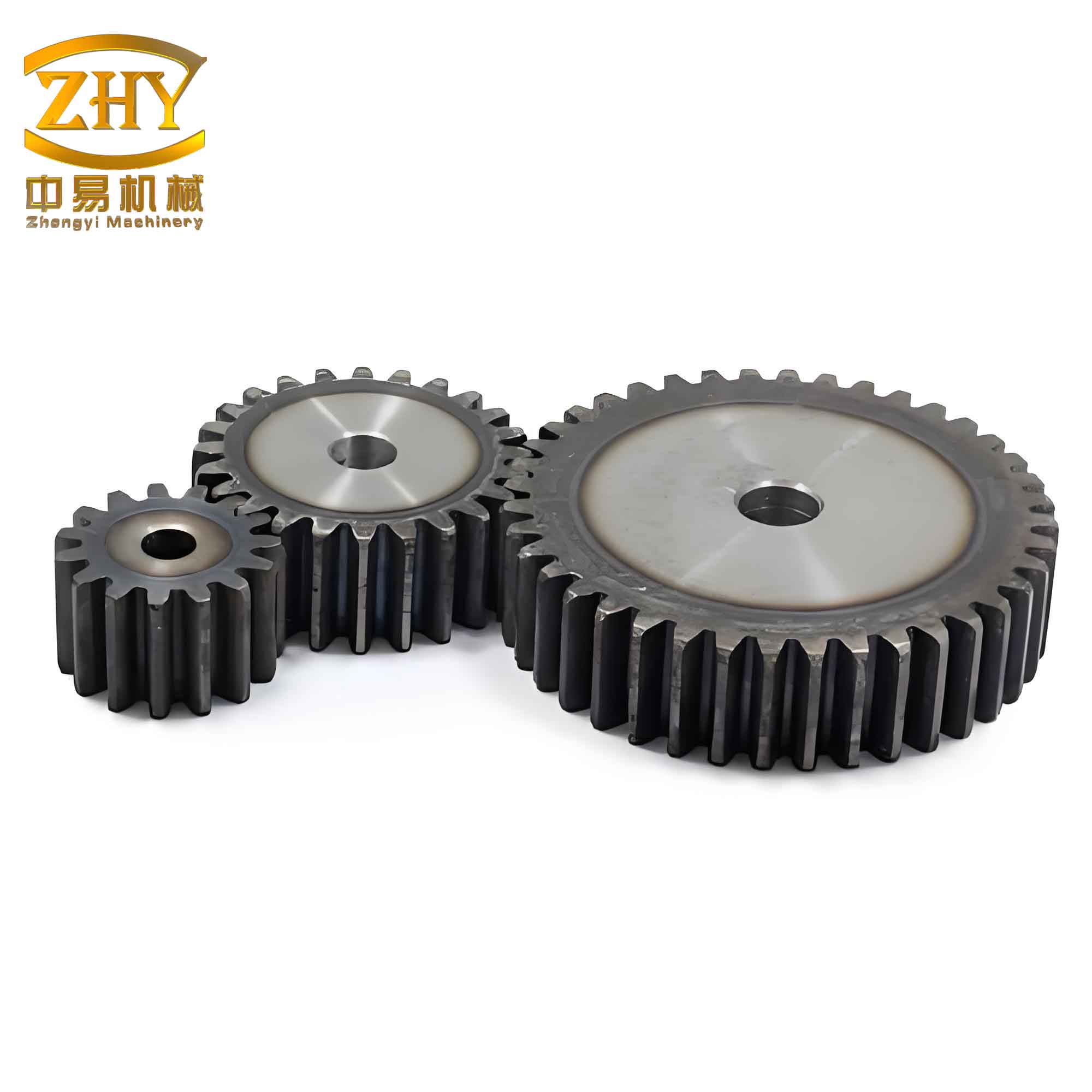
Spur and helical cylindrical gears are the backbone of countless mechanical power transmission systems. Their primary failure modes, such as micro-pitting, pitting, and spalling, directly limit the reliability and lifespan of these systems. Established standards like ISO 6336 and GB/T 3480 provide methods for rating gear load capacity based on calculated contact stress and material strength. However, these methods often treat material properties as homogeneous, not accounting for the significant gradients introduced by surface-hardening processes like carburizing and quenching. To move beyond this limitation and enable high-performance design, a model that explicitly couples the gradient-bearing capacity of the hardened layer with the transient contact mechanics is essential.
1. Mathematical Modeling of Gear Meshing Contact
1.1 Equivalent Contact Model for Cylindrical Gears
For a pair of spur cylindrical gears with a contact ratio ε between 1 and 2, the teeth undergo alternating single and double pair contact along the line of action. At any contact point during this meshing cycle, the local geometry can be treated as an equivalent contact between two cylinders. Using the theory of Hertzian contact for elastic bodies, the principal parameters at a specific mesh point defined by its pressure angle can be derived. The fundamental relationships are summarized below.
The load per unit width \( F \) is given by the transmitted power and geometry:
$$ F = \frac{9550 \cdot P_0}{n \cdot R_{pm} \cdot \cos(\alpha_{pm}) \cdot B} $$
where \( P_0 \) is power (kW), \( n \) is rotational speed (rpm), \( R_{pm} \) is the radius of curvature for the driving gear at the contact point, \( \alpha_{pm} \) is the operating pressure angle at that point, and \( B \) is the face width.
The instantaneous radii of curvature for the pinion \( \rho_{pm} \) and gear \( \rho_{qm} \) are:
$$ \rho_{pm} = \frac{m \cdot z_p \cdot \cos(\alpha)}{2} \cdot \tan(\alpha_{pm}) $$
$$ \rho_{qm} = \frac{m \cdot z_q \cdot \cos(\alpha)}{2} \cdot \tan(\alpha_{qm}) $$
where \( m \) is the module, \( z_p \) and \( z_q \) are the numbers of teeth, and \( \alpha \) is the standard pressure angle.
Finally, the semi-contact width \( b \) for two elastic cylinders in contact is:
$$ b = \sqrt{ \frac{4F}{\pi} \cdot \frac{\rho_{pm} \rho_{qm}}{\rho_{pm} + \rho_{qm}} \cdot \left( \frac{1-\nu_p^2}{E_p} + \frac{1-\nu_q^2}{E_q} \right) } $$
where \( E_p, E_q \) are elastic moduli and \( \nu_p, \nu_q \) are Poisson’s ratios. For identical material, \( E_p = E_q = E \) and \( \nu_p = \nu_q = \nu \).
The typical variation of the radius of curvature along the path of contact for a standard spur gear pair is non-linear, with the minimum value occurring at the start of single pair contact, influencing the location of maximum Hertzian pressure.
1.2 Elastic Half-Plane Contact Stress Solution
The stress state within the subsurface material resulting from surface tractions is modeled using the theory of an elastic half-plane. The surface is subjected to combined normal pressure \( p(t) \) and tangential traction \( q(t) \) distributions over a contact interval from \( x_1 \) to \( x_2 \). The stress components at any subsurface point \( (x, z) \) are given by the following singular integrals:
$$ \sigma_x = -\frac{2z}{\pi} \int_{x_1}^{x_2} \frac{p(t)(x-t)^2}{[(x-t)^2+z^2]^2} dt – \frac{2}{\pi} \int_{x_1}^{x_2} \frac{q(t)(x-t)^3}{[(x-t)^2+z^2]^2} dt $$
$$ \sigma_z = -\frac{2z^3}{\pi} \int_{x_1}^{x_2} \frac{p(t)}{[(x-t)^2+z^2]^2} dt – \frac{2z^2}{\pi} \int_{x_1}^{x_2} \frac{q(t)(x-t)}{[(x-t)^2+z^2]^2} dt $$
$$ \tau_{xz} = -\frac{2z^2}{\pi} \int_{x_1}^{x_2} \frac{p(t)(x-t)}{[(x-t)^2+z^2]^2} dt – \frac{2z}{\pi} \int_{x_1}^{x_2} \frac{q(t)(x-t)^2}{[(x-t)^2+z^2]^2} dt $$
These equations are difficult to solve analytically for arbitrary load distributions. Therefore, a discrete numerical method is employed for efficient and accurate computation.
1.3 Discrete Numerical Method via Rectangular Micro-elements
The load distributions \( p(t) \) and \( q(t) \) are discretized into \( n \) rectangular segments of constant pressure \( p_j \) and traction \( q_j \). For a single rectangular load element of half-width \( s \) centered at a local coordinate origin, the closed-form analytical solutions for the stress components at a field point \( (x_{ij}, z_j) \) due to a normal load \( p_j \) are:
$$ \sigma_x^{p} = -\frac{p_j}{\pi} \left[ \arctan\left(\frac{s-x_{ij}}{z_j}\right) + \arctan\left(\frac{s+x_{ij}}{z_j}\right) – \frac{z_j(s+x_{ij})}{r_1^2} + \frac{z_j(x_{ij}-s)}{r_2^2} \right] $$
$$ \sigma_z^{p} = -\frac{p_j}{\pi} \left[ \arctan\left(\frac{s-x_{ij}}{z_j}\right) + \arctan\left(\frac{s+x_{ij}}{z_j}\right) + \frac{z_j(s+x_{ij})}{r_1^2} – \frac{z_j(x_{ij}-s)}{r_2^2} \right] $$
$$ \tau_{xz}^{p} = -\frac{z_j^2 p_j}{\pi} \left( \frac{1}{r_1^2} – \frac{1}{r_2^2} \right) $$
where \( r_1^2 = (s – x_{ij})^2 + z_j^2 \) and \( r_2^2 = (s + x_{ij})^2 + z_j^2 \).
Similarly, for a tangential load \( q_j \):
$$ \sigma_x^{q} = -\frac{q_j}{\pi} \left( \frac{z_j^2}{r_2^2} – \frac{z_j^2}{r_1^2} + 2 \ln\frac{r_2}{r_1} \right) $$
$$ \sigma_z^{q} = -\frac{z_j^2 q_j}{\pi} \left( \frac{1}{r_1^2} – \frac{1}{r_2^2} \right) $$
$$ \tau_{xz}^{q} = -\frac{q_j}{\pi} \left[ \arctan\left(\frac{s-x_{ij}}{z_j}\right) + \arctan\left(\frac{s+x_{ij}}{z_j}\right) – \frac{z_j(s+x_{ij})}{r_1^2} + \frac{z_j(x_{ij}-s)}{r_2^2} \right] $$
The total stress at any point \( i \) is obtained by superposition of the influences from all \( n \) load segments. This can be expressed efficiently in matrix form using influence coefficients \( T \). For example, the total \( \sigma_x \) stress is:
$$ \sigma_{x_i} = \sum_{j=1}^{n} \left( T_{p,j-i} \cdot p_j + T_{q,j-i} \cdot q_j \right) $$
This method provides a highly efficient and accurate way to compute the complete subsurface stress field for any combination of normal and tangential loading, which is fundamental for fatigue analysis.
2. Characterization of Performance Gradients in Cylindrical Gears
2.1 Hardness Gradient
The carburizing and quenching process creates a hardened case on the surface of cylindrical gears. The carbon concentration gradient results in a corresponding hardness gradient, which is critical for load capacity. The hardness distribution HV(z) from the surface (z=0) to the core can be modeled using a piecewise quadratic function based on key parameters: surface hardness \( HV_{surf} \), core hardness \( HV_{core} \), and the depth of the case-hardened layer (DCHD), typically defined as the depth where hardness falls to 550 HV.
A representative model is:
$$
HV(z) =
\begin{cases}
a_a z^2 + b_a z + c_a, & 0 \leq z < \text{DCHD} \\
a_b z^2 + b_b z + c_b, & \text{DCHD} \leq z < z_{core} \\
HV_{core}, & z_{core} \leq z
\end{cases}
$$
The coefficients \( a, b, c \) are determined to satisfy boundary conditions (surface hardness, core hardness, continuity at DCHD). The tensile strength gradient \( R_m(z) \), a direct input for fatigue strength calculations, is derived from this hardness gradient via a linear empirical relationship established from material data, such as that found in ISO 6336-5.
2.2 Residual Stress Gradient
Carburizing and quenching also induces a characteristic residual stress profile, typically compressive at the surface and transitioning to tensile in the core. This profile significantly affects fatigue crack initiation. A sigmoidal function based on statistical modeling can accurately represent this gradient:
$$ \sigma_{RS}(z) = \sigma_D + \frac{\sigma_z – \sigma_D}{1 + e^{-k(z + \delta)}} $$
where \( \sigma_D \) is the maximum compressive residual stress (negative value), \( \sigma_z \) is the maximum tensile residual stress (positive value), and \( k \) and \( \delta \) are fitting parameters controlling the slope and shift of the transition. This residual stress field is treated as a mean stress component in the subsequent multiaxial fatigue analysis.
2.3 Gradient of Material Fatigue Strength Parameters
The local fatigue strength of the material, essential for a gradient-aware model, is derived from the hardness profile. The fully reversed bending fatigue limit \( \sigma_{-1}(z) \) and torsional fatigue limit \( \tau_{-1}(z) \) can be estimated using empirical relationships tied to hardness or tensile strength. For high-strength steels, common approximations include:
$$ \sigma_{-1} \approx 0.5 \cdot R_m \quad \text{and} \quad \tau_{-1} \approx 0.577 \cdot \sigma_{-1} \approx 0.29 \cdot R_m $$
More refined, material-specific correlations from databases or testing provide higher accuracy. These gradients define the spatially varying material resistance against fatigue damage.
3. Dang Van Multiaxial Fatigue Criterion for Risk Prediction
The Dang Van criterion is a high-cycle fatigue (HCF) model based on a critical plane approach, well-suited for rolling-sliding contact where stresses are multiaxial and non-proportional. It postulates that fatigue crack initiation occurs when a linear combination of the local shear stress amplitude and the hydrostatic stress on a critical material plane exceeds a material-dependent threshold.
For a given material point, the time-varying stress tensor \( \underline{\sigma}(t) \) is computed over a load cycle. On an arbitrary material plane defined by its normal vector, the shear stress vector \( \vec{\tau}(t) \) and the hydrostatic stress \( \sigma_H(t) = \frac{1}{3}\text{tr}(\underline{\sigma}(t)) \) are determined. The criterion searches for the plane experiencing the maximum range of the shear stress \( \Delta \tau_{\text{max}} \). The fatigue risk parameter, often termed the load factor or the Dang Van equivalent stress, is defined as:
$$ \text{RFP}(\alpha, z, t) = \frac{ \Delta \tau_{\text{max}}(\alpha, z, t) + a_{DV} \cdot \sigma_H(z, t) }{ b_{DV} } $$
where \( a_{DV} \) and \( b_{DV} \) are material constants derived from the fatigue limits:
$$ a_{DV} = 3 \left( \frac{\tau_{-1}}{\sigma_{-1}} – \frac{1}{2} \right) \quad \text{and} \quad b_{DV} = \tau_{-1} $$
The critical plane is the one that maximizes the numerator over the cycle. A value of RFP ≥ 1 indicates a high risk of fatigue crack initiation.
To account for the specific conditions in carburized cylindrical gears, the model is enhanced by incorporating the gradient properties:
- Gradient Material Strength: The denominator \( b_{DV} = \tau_{-1}(z) \) becomes a function of depth, reflecting the higher fatigue resistance in the hardened case.
- Residual Stress Inclusion: The residual stress \( \sigma_{RS}(z) \) is added to the hydrostatic stress term as a constant mean stress, influencing the driving force for fatigue. The modified risk parameter becomes:
$$ \text{RFP}'(\alpha, z, t) = \frac{ \Delta \tau_{\text{max}}(\alpha, z, t) + a_{DV}(z) \cdot \left[ \sigma_H(z, t) + \sigma_{RS}(z) \right] }{ \tau_{-1}(z) } $$
This formulation creates a powerful, gradient-aware model for predicting the most critical location (in depth and along contact) and the risk level for contact fatigue initiation in cylindrical gears.
4. Results, Parameter Analysis, and Discussion
The proposed model is applied to a standard spur gear pair made from 18CrNiMo7-6 carburized steel. The primary analysis is focused on the pitch point, a critical location for contact fatigue, though the model can evaluate any point on the path of contact.
| Parameter | Symbol | Value |
|---|---|---|
| Module | m | 6.5 mm |
| Number of Teeth (Pinion/Gear) | z_p / z_q | 24 / 25 |
| Pressure Angle | α | 20° |
| Face Width | B | 30 mm |
| Center Distance | a | 160 mm |
| Young’s Modulus | E | 210 GPa |
| Poisson’s Ratio | ν | 0.3 |
| Nominal Contact Stress | σ_H0 | 1500 MPa |
| Kinetic Friction Coefficient | f | 0.05 |
4.1 Subsurface Stress State and Critical Locations
The discrete numerical method efficiently computes the full multiaxial stress history. Under combined normal and tangential loading, the principal stresses \( \sigma_1, \sigma_2, \sigma_3 \) and the maximum shear stress \( \tau_{max} \) are derived. The results consistently show that the maximum compressive stresses occur at the surface, while the maximum shear stress peaks at a subsurface depth, typically around 0.2-0.4 mm below the surface for the given load and geometry. This subsurface shear stress peak is a primary driver for classical pitting (spalling) failure. The analysis of the Dang Van risk parameter RFP’ reveals even more nuanced information. The location of maximum RFP’ is found not directly at the depth of \( \tau_{max} \), but slightly shifted both in depth and laterally from the contact centerline. This shift is due to the interplay between the shear stress amplitude, the hydrostatic stress (modified by residual stress), and the spatially varying material strength \( \tau_{-1}(z) \).
4.2 Influence of Key Characteristic Parameters
The strength of the developed model is its ability to quantitatively assess the impact of various design and operational parameters on the fatigue risk.
| Parameter Variation | Trend in RFP’_max | Shift in Critical Depth | Physical Interpretation |
|---|---|---|---|
| Increased Friction Coefficient (f) e.g., from 0.05 to 0.2 |
Significant Increase | Moves towards the surface | Poor lubrication increases surface traction, raising shear stresses near the surface. This promotes surface distress and micro-pitting initiation, aligning with empirical observations that micro-pitting is highly sensitive to lubricant film thickness and surface friction. |
| Increased Surface Hardness e.g., from 60 to 62 HRC |
Decrease | Negligible change | A higher surface and near-surface hardness directly increases the material strength parameter \( \tau_{-1}(z) \) in the denominator of the RFP’ equation, thereby lowering the risk factor. This validates the fundamental purpose of carburizing. |
| Increased Compressive Residual Stress Magnitude | Decrease | Slight deepening | Enhanced compressive residual stress makes the local hydrostatic stress \( \sigma_H + \sigma_{RS} \) more negative (more compressive). Since \( a_{DV} \) is positive, this reduces the numerator in the RFP’ equation, providing a beneficial “clamping” effect that suppresses crack initiation, especially in the high-shear subsurface region. |
| Increased Applied Load (Contact Stress) | Sharp Increase (can exceed 1.0) |
Moderate deepening | Higher load increases all stress components proportionally. The risk factor rises super-linearly. When RFP’_max exceeds 1, failure within a finite number of cycles is predicted. This perfectly correlates with the standard S-N curve behavior and gear endurance testing at different load stages. |
| Increased Case Depth (DCHD) | Decrease | Moves slightly deeper | A deeper hardened case extends the high-strength region (\( \tau_{-1}(z) \)) further into the material, providing better support against the subsurface shear stress peak, thus reducing the risk factor in that critical zone. |
4.3 Model Validation and Practical Implications
The predictions from this coupled gradient-Dang Van model show strong qualitative and quantitative agreement with established empirical knowledge and experimental observations in gear contact fatigue:
- Failure Mode Distinction: The model explains why different failure modes prevail under different conditions. Under good lubrication (low \( f \)), the critical RFP’ zone is subsurface, predicting classical pitting/spalling. Under poor lubrication (high \( f \)), the critical zone migrates to the surface, predicting micro-pitting, which is a known surface-originated failure.
- Benefit of Residual Stress: The calculated reduction in RFP’ due to compressive residual stress provides a mechanistic explanation for the well-documented life extension offered by processes like shot peening or optimized heat treatment that enhance surface compressive stresses.
- Load-Life Relationship: The nonlinear increase of RFP’ with applied load inherently contains the power-law relationship between stress and cycles to failure (e.g., the exponent in ISO standard life calculations).
This model, therefore, transcends the standard approach by not just calculating a stress and comparing it to a single fatigue limit, but by computing a “damage potential” map that accounts for gradients, multiaxiality, non-proportional loading, and residual stresses. It serves as a powerful tool for the virtual prototyping and optimization of cylindrical gears, enabling engineers to balance case depth, surface hardness, residual stress profiles, and lubrication requirements against operational loads to achieve target life and reliability.
5. Conclusions
This study has developed and demonstrated a comprehensive physics-based model for predicting contact fatigue risk in carburized and quenched spur cylindrical gears. By integrating a discrete numerical solution for elastic half-plane contact stresses with a gradient-aware formulation of the Dang Van multiaxial fatigue criterion, the model successfully links the key performance gradients (hardness, residual stress, and derived fatigue strength) to the complex subsurface stress state. The main conclusions are:
- Gradient-Aware Modeling is Crucial: Treating material properties as homogeneous leads to an inaccurate assessment of the critical failure location and risk. The proposed model provides a rapid, forward-design calculation method that explicitly accounts for property gradients, offering a more accurate prediction tool for cylindrical gears.
- Quantified Parameter Effects: The model quantitatively demonstrates how specific parameters influence fatigue risk:
- Material Gradients: Increased surface hardness and case depth directly reduce the risk factor by strengthening the material. Enhanced compressive residual stress gradients reduce the risk by improving the subsurface resistance to shear-driven crack initiation, aligning with practical experience from improved heat treatment processes.
- Operational Parameters: Increased friction, simulating lubricant breakdown, shifts the risk zone towards the surface and raises the risk value, explaining the transition from subsurface pitting to surface micro-pitting. Increased applied load dramatically raises the risk factor, accurately reflecting the fundamental load-life relationship observed in gear endurance tests.
- Mechanistic Explanation of Failure Modes: The model offers a clear mechanistic distinction between failure modes. It confirms that well-lubricated cylindrical gears typically fail from subsurface-initiated pitting, while poorly lubricated gears are prone to surface-originated micro-pitting, based on the migration of the critical stress-risk domain.
- General Applicability: While demonstrated on spur cylindrical gears, the core methodology is general. For other gear types like helical or bevel cylindrical gears, equivalent contact geometry and load distribution can be incorporated into the same analytical framework for contact fatigue risk prediction.
This research provides a significant step towards a more fundamental understanding and predictive capability for contact fatigue in high-performance cylindrical gears. It bridges the gap between standardized calculation methods and detailed, computationally expensive finite element analyses, offering engineers a practical yet advanced tool for designing more reliable and durable gear transmissions.