
In modern industrial applications, the contact fatigue failure of spur gears remains a critical bottleneck, particularly in high-power-density transmission systems. The mechanism underlying gear contact fatigue, such as pitting and micro-pitting, is complex and influenced by material properties, loading conditions, and lubrication states. Carburizing and quenching processes enhance the surface properties of spur gears by introducing gradient characteristics in hardness and residual stress, which significantly affect their load-bearing capacity and fatigue life. However, accurately predicting the risk of contact fatigue requires a deep understanding of the interplay between these gradient properties and the multiaxial stress states generated during gear meshing. Existing standards, such as ISO 6336 and GB/T 3480, provide methods for calculating surface durability but often overlook the gradient effects introduced by heat treatment. This study aims to develop a comprehensive predictive model that integrates the gradient承载 characteristics of carburized spur gears with multiaxial stress analysis, using the Dang Van fatigue criterion to assess the risk of contact fatigue. By employing discrete numerical methods and explicit analytical solutions, we evaluate the influence of key parameters, such as friction, surface hardness, and residual stress, on fatigue risk. The results demonstrate that the proposed model effectively captures the transition of risk domains from subsurface to surface under varying conditions, aligning with experimental observations of pitting and micro-pitting mechanisms. This work provides a foundational approach for the design and optimization of high-performance spur gears in demanding applications.
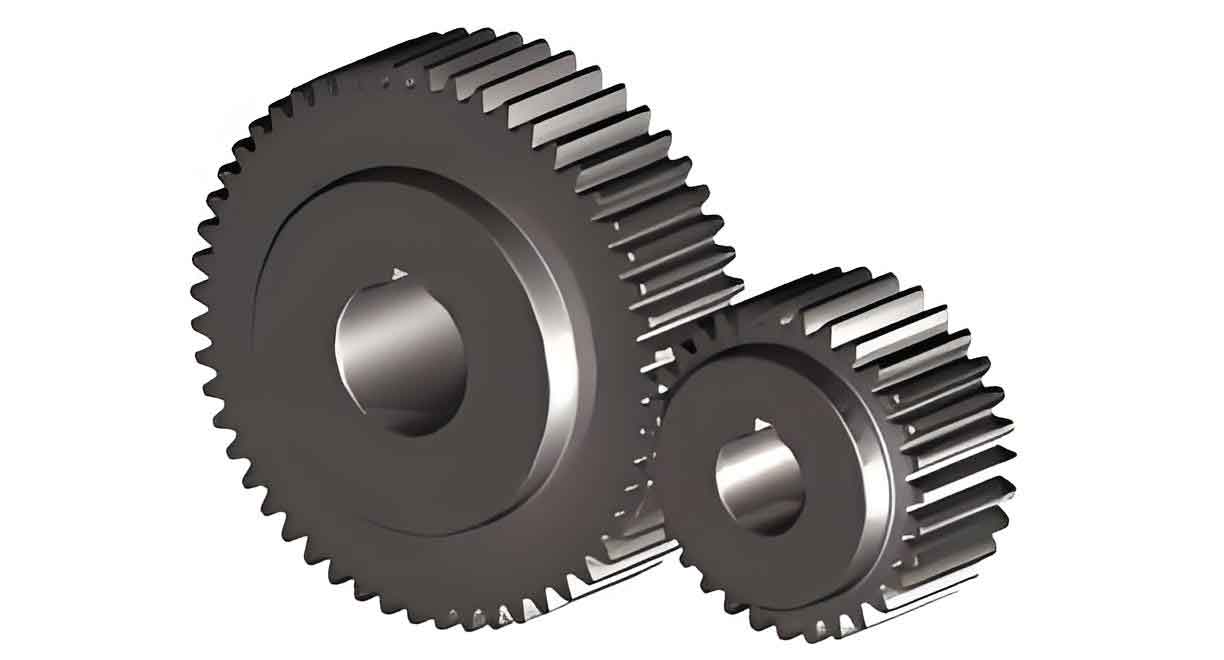
The meshing behavior of spur gears can be represented using an equivalent cylindrical contact model, where the contact between tooth flanks is simplified to the interaction of two cylinders with varying radii of curvature along the path of contact. For a pair of spur gears with a contact ratio between 1 and 2, the meshing process involves alternating single and double tooth contact. The curvature radius at any meshing point can be derived from the involute profile parameters and the Bobillier construction method. According to Hertzian contact theory, the contact semi-width and nominal contact area relate to the meshing angle as follows:
$$ F = 9,549 \frac{P_0}{n R_{pm} \cos \alpha_{pm}} $$
$$ b = \sqrt{\frac{4F}{\pi B} \frac{\rho_{pm} \rho_{qm}}{\rho_{pm} + \rho_{qm}} \left( \frac{1 – \nu_p^2}{E_p} + \frac{1 – \nu_q^2}{E_q} \right)} $$
$$ \rho_{pm} = \frac{m z_p \cos \alpha \tan \alpha_{pm}}{2}, \quad \rho_{qm} = \frac{m z_q \cos \alpha \tan \alpha_{qm}}{2} $$
Here, \( F \) represents the load, \( P_0 \) the power, \( n \) the rotational speed, \( R_{pm} \) the radius at the contact point of the driving gear, \( \alpha_{pm} \) and \( \alpha_{qm} \) the meshing angles for the driving and driven gears, respectively, \( b \) the contact semi-width, \( B \) the face width, \( \rho_{pm} \) and \( \rho_{qm} \) the curvature radii, \( \nu_p \), \( E_p \), \( \nu_q \), \( E_q \) the Poisson’s ratios and elastic moduli, \( m \) the module, \( \alpha \) the pressure angle, and \( z_p \), \( z_q \) the numbers of teeth. For spur gears made of the same material, \( \nu_p = \nu_q \) and \( E_p = E_q \).
To analyze the stress field under contact loads, we consider an elastic half-plane model subjected to normal and tangential tractions. The stress components at any point (x, z) within the material can be expressed as singular integral equations:
$$ \sigma_x = -\frac{2z}{\pi} \int_{x_1}^{x_2} \frac{p(t)(x-t)^2}{[(x-t)^2 + z^2]^2} dt – \frac{2}{\pi} \int_{x_1}^{x_2} \frac{q(t)(x-t)^3}{[(x-t)^2 + z^2]^2} dt $$
$$ \sigma_z = -\frac{2z^3}{\pi} \int_{x_1}^{x_2} \frac{p(t)}{[(x-t)^2 + z^2]^2} dt – \frac{2z^2}{\pi} \int_{x_1}^{x_2} \frac{q(t)(x-t)}{[(x-t)^2 + z^2]^2} dt $$
$$ \tau_{xz} = -\frac{2z^2}{\pi} \int_{x_1}^{x_2} \frac{p(t)(x-t)}{[(x-t)^2 + z^2]^2} dt – \frac{2z}{\pi} \int_{x_1}^{x_2} \frac{q(t)(x-t)^2}{[(x-t)^2 + z^2]^2} dt $$
where \( p(t) \) and \( q(t) \) denote the normal and tangential distributed loads, respectively. Due to the complexity of these integrals, a discrete numerical approach is employed for efficient computation. The contact interface is divided into fine rectangular elements, each carrying uniform loads. For a single rectangular element with load \( p_j \), the stress components can be derived explicitly. For instance, the stress in the x-direction due to normal load is given by:
$$ \sigma_{xp} = -\frac{p}{\pi} \left[ \arctan\left(\frac{s – x}{z}\right) + \arctan\left(\frac{s + x}{z}\right) – \frac{z(s + x)}{r_1^2} + \frac{z(x – s)}{r_2^2} \right] $$
with \( r_1^2 = (s – x)^2 + z^2 \) and \( r_2^2 = (s + x)^2 + z^2 \). Similarly, for tangential load \( q_j \), the stress components are:
$$ \sigma_{xq} = -\frac{q}{\pi} \left( \frac{z^2}{r_2^2} – \frac{z^2}{r_1^2} + 2 \ln \frac{r_2}{r_1} \right) $$
By defining influence functions \( T_{p,j-i} \) and \( T_{q,j-i} \), the total stress at any point i due to n discrete load units can be summed as:
$$ \sigma_{xi} = \sum_{j=1}^{n} \left( T_{p,j-i} p_j + T_{q,j-i} q_j \right) $$
This discrete method allows for accurate stress field computation under complex loading conditions typical in spur gears meshing.
After carburizing and quenching, spur gears exhibit gradient properties in hardness and residual stress. The hardness distribution from the surface to the core can be modeled using a piecewise function based on experimental data. For example, the Vickers hardness HV(z) as a function of depth z is given by:
$$ HV(z) =
\begin{cases}
a_a z^2 + b_a z + c_a, & 0 \leq z < \text{DCHD} \\
a_b z^2 + b_b z + c_b, & \text{DCHD} \leq z < z_{\text{core}} \\
HV_{\text{core}}, & z_{\text{core}} < z
\end{cases} $$
where DCHD is the effective case hardening depth, and \( HV_{\text{core}} \) is the core hardness. This gradient enhances the surface load-bearing capacity while maintaining toughness in the core. Similarly, the residual stress distribution \( \sigma_{RS}(z) \) can be described by a statistical model:
$$ \sigma_{RS}(z) = \sigma_D + \frac{\sigma_z – \sigma_D}{1 + e^{-k(z + \delta)}} $$
where \( \sigma_D \) is the maximum compressive residual stress, \( \sigma_z \) is the maximum tensile residual stress, and k and δ are fitting parameters. These gradient properties are crucial for assessing the fatigue resistance of spur gears.
The material’s tensile strength gradient can be derived from hardness measurements using a linear relationship established in standards. For instance, the ultimate tensile strength \( \sigma_u \) relates to Vickers hardness HV as:
$$ \sigma_u = a \cdot HV + b $$
where a and b are constants determined from empirical data. This conversion allows for the incorporation of strength gradients into fatigue analysis.
To evaluate the risk of contact fatigue, we employ the Dang Van multiaxial fatigue criterion, which accounts for the critical plane where the shear stress amplitude and hydrostatic stress are combined. The fatigue risk parameter (RFP) is defined as:
$$ \text{RFP}(\alpha, t) = \frac{\Delta \tau_{\text{max}}(\alpha, t) + \kappa_D \sigma_H(t)}{\lambda} $$
where \( \Delta \tau_{\text{max}} \) is the maximum shear stress amplitude on a critical plane, \( \sigma_H \) is the hydrostatic stress, and \( \kappa_D \) and \( \lambda \) are material parameters derived from fully reversed bending and torsion limits. For spur gears with residual stresses, the RFP is modified to include the residual stress gradient:
$$ \text{RFP}'(\alpha, z, t) = \frac{\Delta \tau_{\text{max}}(\alpha, z, t) + \kappa_D [\sigma_H(z, t) + \sigma_{RS}(z)]}{\lambda} $$
This formulation enables the assessment of fatigue risk under the influence of gradient properties.
In our analysis, we consider a spur gear pair with parameters as listed in Table 1. The gears undergo a manufacturing process including forging, normalizing, rough machining, quenching, and carburizing. Contact fatigue failures often occur near the pitch circle, so we focus on this region with a contact stress of 1,500 MPa and a friction coefficient of 0.05 to simulate lubricated rolling-sliding contact.
| Parameter | Value |
|---|---|
| Module (mm) | 6.5 |
| Number of teeth (driving/driven) | 24/25 |
| Center distance (mm) | 160 |
| Face width (mm) | 30 |
| Pressure angle (°) | 20 |
| Addendum coefficient | 1.0 |
| Dedendum coefficient | 0.25 |
| Profile shift coefficients (driving/driven) | 0.0735/0.0439 |
| Elastic modulus (GPa) | 210 |
| Poisson’s ratio | 0.3 |
The computed stress fields under normal and tangential loads reveal that normal stresses dominate, with significant compressive stresses near the surface. The principal stresses and maximum shear stress are derived from the stress components. For instance, at the contact center (x=0), the stresses vary with depth, showing peak shear stress in the subsurface region, which aligns with typical crack initiation sites in spur gears.
The hardness gradient significantly influences the fatigue behavior. Figure 13(a) illustrates hardness distributions for different case depths, indicating that steeper gradients occur with shallower hardening depths. The tensile strength, torsion limit, and bending limit strengths follow similar trends, as shown in Figure 14. For a case depth of 2.1 mm, the strength parameters decrease gradually with depth, highlighting the enhanced surface capacity due to carburizing.
Applying the Dang Van criterion, we compute the RFP distribution across the contact region. Without residual stress, the maximum RFP value of 0.83 occurs at a subsurface point (-0.1 mm, 0.4 mm), indicating a risk of pitting. When residual stress is included, the RFP reduces to 0.71 at the same location, demonstrating the beneficial effect of compressive residual stresses in spur gears. The RFP distribution along depth at x=-0.1 mm confirms a uniform reduction in risk, enhancing the gear’s resistance to shear-driven crack initiation.
We further investigate the impact of key parameters on fatigue risk. Increasing the friction coefficient from 0 to 0.2 shifts the high-RFP region towards the surface, as summarized in Table 2. This transition explains why poor lubrication leads to surface micro-pitting, while good lubrication favors subsurface pitting in spur gears.
| Friction Coefficient | Maximum RFP | Risk Location (mm) |
|---|---|---|
| 0.0 | 0.71 | (-0.1, 0.4) |
| 0.1 | 0.78 | (-0.2, 0.3) |
| 0.2 | 0.85 | (-0.3, 0.2) |
Surface hardness increments also affect the RFP. As shown in Table 3, higher surface hardness reduces the RFP without altering its location, emphasizing the role of material strengthening in improving the contact fatigue life of spur gears.
| Surface Hardness (HV) | Maximum RFP |
|---|---|
| 600 | 0.80 |
| 670 | 0.71 |
| 750 | 0.65 |
Additionally, increasing the contact pressure from 1,500 MPa to 1,900 MPa expands the contact semi-width and raises the RFP above 1.0 in subsurface regions, accelerating fatigue failure. This aligns with experimental observations where higher loads lead to shorter fatigue lives in spur gears.
In conclusion, this study develops a predictive model for contact fatigue risk in carburized and quenched spur gears by integrating gradient properties with multiaxial stress analysis. The discrete numerical method efficiently solves the contact stress fields, while the Dang Van criterion, modified for residual stresses, provides a reliable assessment of fatigue risk. Key findings include the migration of risk domains with friction changes, the strengthening effect of hardness gradients, and the beneficial role of residual stresses. The model’s predictions consistent with experimental data on pitting and micro-pitting mechanisms, offering a valuable tool for the design of durable spur gears in high-performance applications. Future work could extend this approach to other gear types, such as helical or bevel gears, by adapting the equivalent contact parameters.