
The pursuit of high-performance power transmission in automotive and heavy machinery industries has placed increasing demands on the quality and precision of gear pairs. Among these, hypoid gears are particularly critical due to their ability to transmit power between non-intersecting, perpendicular axes with high torque density and smooth operation. However, the final quality of these hypoid gears is heavily influenced by post-heat treatment distortions and inherent micro-geometrical errors from the cutting process. Lapping, as a final finishing operation, serves as a pivotal step to correct these deviations, refine the tooth surface, optimize the contact pattern, and ultimately enhance the meshing performance and service life of the gear set. Despite its importance, the underlying kinematics and control theory for the lapping of hypoid gears have not been extensively documented, hindering the advancement from experience-based methods to precise, numerically controlled processes. This study delves into the fundamental principles governing the lapping of hypoid gears, establishes a comprehensive mathematical model correlating machine adjustment parameters with tooth contact kinematics, and validates the model through sophisticated tooth contact analysis and physical rolling tests.
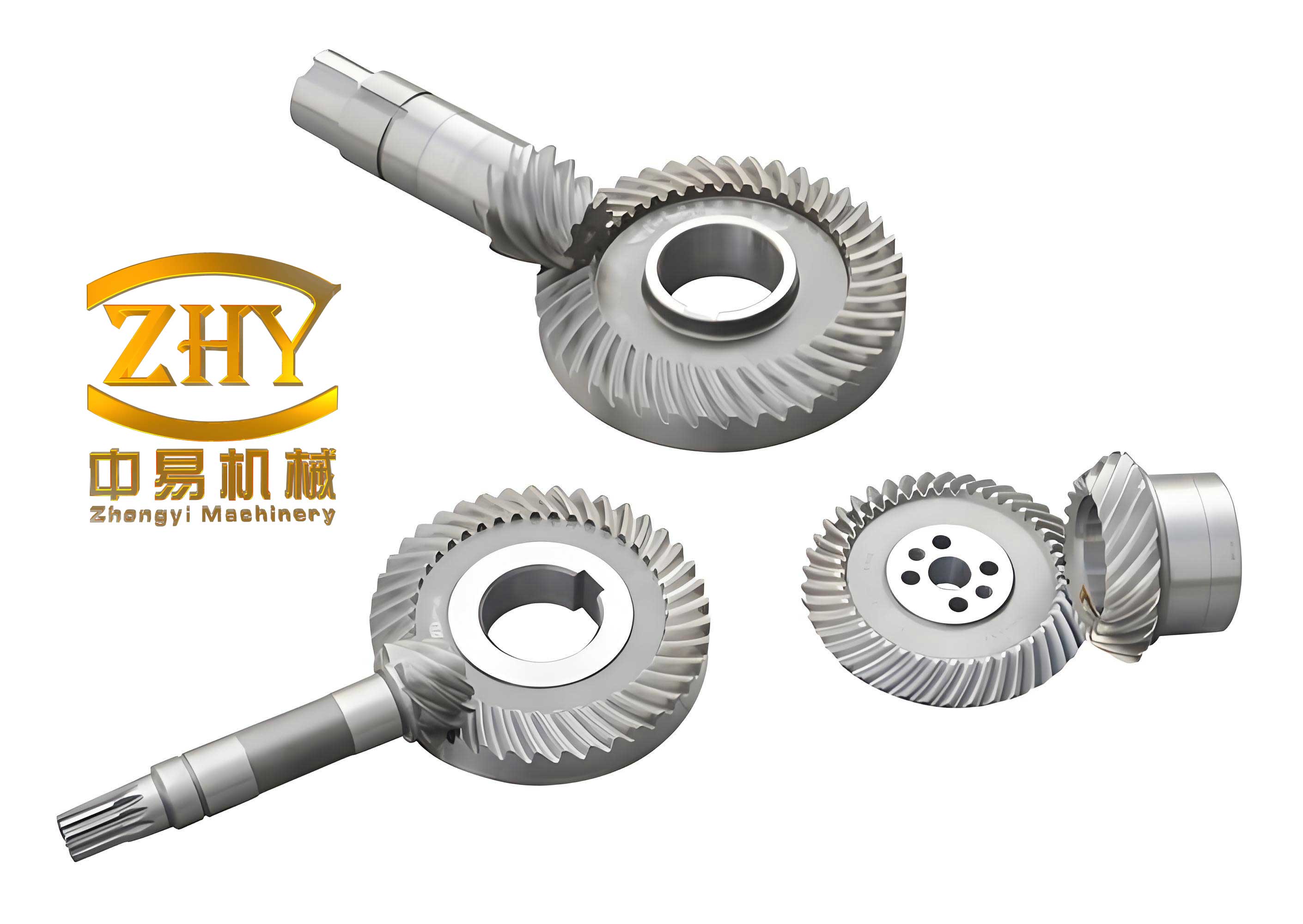
The lapping process for hypoid gears is a controlled abrasive finishing operation where the pinion and gear are run in mesh under a specified load with a slurry of abrasive particles. The primary objective is not significant metal removal but the localized micro-correction of the tooth flanks to achieve an optimal bearing contact and desired motion characteristics. The core mechanism involves the relative sliding motion between the conjugate tooth surfaces, which drives the abrasive grains to perform micro-cutting, thereby reducing surface roughness and harmonizing deviations. The critical control parameters in this process are the spatial relative positions between the pinion and the gear, typically defined by three orthogonal adjustments: the vertical offset (V), the horizontal offset (H), and the axial displacement of the pinion (J). These adjustments directly govern the location and motion trajectory of the contact point—or the “lapping point”—across the tooth surface during the cycle. A conceptual model of the lapping setup is shown in the figure above, illustrating the relative positioning of the gear axes. Precise command over these parameters is essential to steer the contact zone to desired areas for corrective lapping or to ensure uniform material removal across the entire active profile for final finishing.
The kinematics of the lapping process for hypoid gears can be described by establishing the mathematical relationship between the machine settings (V, H, J) and the instantaneous point of contact on the tooth surfaces. Consider a spatial coordinate system where the pinion and gear rotate about their respective axes. Let the unit vectors along the pinion and gear axes be denoted by $\mathbf{y}_1$ and $\mathbf{z}_2$, respectively. For a standard 90-degree shaft angle configuration common in hypoid gears, the unit vector along the common perpendicular (line of shortest distance) is $\mathbf{x} = (\mathbf{y}_1 \times \mathbf{z}_2) / \sin \Gamma$, where $\Gamma = 90^\circ$. The nominal offset distance, or hypoid offset E, is represented by V. Points $C_1$ and $C_2$ are the intersections of the pinion and gear axes with the X-axis. The theoretical mounting points (cross points) are $O_1$ and $O_2$, which coincide with $C_1$ and $C_2$ at the theoretical assembly. Adjustments H and J represent the displacements of these cross points along the $\mathbf{y}_1$ and $\mathbf{z}_2$ directions, respectively (positive direction signifies moving away).
For a point M on the tooth surface to be in contact during lapping, two fundamental sets of conditions must be satisfied simultaneously: the position vector condition and the surface normal vector condition. These are expressed mathematically as follows.
1. Position Vector Equality: The position vector of the contact point M from the fixed reference frame must be the same whether calculated via the pinion or the gear.
$$ \mathbf{r}_f^{(2)} + J \mathbf{z}_2 = \mathbf{r}_f^{(1)} + V \mathbf{x} + H \mathbf{y}_1 $$
Here, $\mathbf{r}_f^{(1)}$ and $\mathbf{r}_f^{(2)}$ are the position vectors of point M in the coordinate systems rigidly connected to the pinion and gear, respectively, expressed in the fixed frame.
2. Surface Normal Vector Equality: The unit normal vectors to the tooth surfaces at the contact point must be collinear.
$$ \mathbf{n}_f^{(1)}(u_1, \theta_1, \phi_1) = \mathbf{n}_f^{(2)}(u_2, \theta_2, \phi_2) $$
The parameters $u$ and $\theta$ are the surface parameters defining the tooth flank geometry, while $\phi$ is the rotational angle of the gear during mesh.
3. The Meshing (Contact) Equation: This equation ensures the conjugacy condition is met, meaning the relative velocity at the contact point has no component along the common normal. This is a scalar equation derived from the dot product.
$$ \mathbf{n}_f^{(2)} \cdot \mathbf{v}_f^{(12)} = f(u_1, \theta_1, \phi_1, u_2, \theta_2, \phi_2, V, H, J) = 0 $$
where $\mathbf{v}_f^{(12)}$ is the relative velocity vector of the pinion with respect to the gear at the contact point.
For a controlled lapping process, it is also imperative to maintain approximately equal flank clearance (backlash) and tip clearance during the adjustment. This imposes a kinematic constraint between the H and J adjustments:
$$ J = -H \tan \delta_1 $$
where $\delta_1$ is the pinion pitch cone angle.
The vector equations (Position and Normal) can be decomposed into their scalar components in the fixed coordinate frame. Together with the scalar meshing equation and the H-J constraint, this system provides the necessary equations to solve for the relationship between adjustments and contact point location. Typically, if the adjustment parameters (V, H, J) are given, one can solve for the seven unknowns ($u_1, \theta_1, \phi_1, u_2, \theta_2, \phi_2$, and the confirmation of contact) to predict the contact path. However, for lapping process planning, the inverse problem is more critical: given a desired target lapping point on the tooth surface, determine the required machine adjustments (V, H, J).
To solve this, we define the target point $M^*$ on the gear tooth surface (convex side is used as an example). Let $M$ be the original design reference point, usually at the center of the tooth flank. The objective is to shift the nominal contact point to $M^*$ by adjustments. The shift is defined by two components on the tooth surface projection: $s_1$ along the profile length (from toe to heel) and $s_2$ along the profile height (from root to top). Using the known tooth geometry, the coordinates $(X_2^*, Y_2^*)$ of $M^*$ in the gear’s axial plane coordinate system can be determined. The relationship between these coordinates and the gear’s own surface parameters is:
$$ x_2 = X_2^* $$
$$ y_2^2 + z_2^2 = (Y_2^*)^2 $$
where $(x_2, y_2, z_2)$ are components of the gear tooth surface equation $\mathbf{r}^{(2)}(u_2, \theta_2)$. From these two equations, the corresponding surface parameters $u_2$ and $\theta_2$ for point $M^*$ can be solved. Subsequently, by plugging these values along with the pinion’s conjugate point condition into the system of equations comprising the Position, Normal, Meshing, and H-J constraint equations, the unique set of adjustment parameters $(V, H, J)$ required to bring $M^*$ into contact as the new nominal point can be calculated. This completes the mathematical model for controlling the hypoid gears lapping process.
To validate the established kinematics model, a case study was performed on a representative pair of hypoid gears. The basic gear data is summarized in the following table.
| Parameter | Pinion | Gear |
|---|---|---|
| Number of Teeth | 9 | 41 |
| Face Width (b) | – | 34.0 mm |
| Hypoid Offset (E=V) | 31.7 mm | |
| Gear Pitch Diameter | – | 205 mm |
| Mean Spiral Angle | 52.5° (LH) | – |
| Mean Pressure Angle | 19.0° | – |
Using Tooth Contact Analysis (TCA) software implemented with the described model, the contact pattern for the gear convex side at the theoretical mounting position (V=31.7 mm, H=0, J=0) was simulated. The result showed a centered contact pattern. The model was then tested for its predictive control capability. Four different target lapping point shifts were commanded: moving the contact zone towards the toe, heel, heel-and-top, and toe-and-root. For each commanded shift ($s_1$, $s_2$), the model calculated the required V, H, and J adjustments. The TCA was then run again with these new adjustments to simulate the resulting contact pattern. The results are summarized in the table below, which also includes the measured flank clearance $c_c$ from subsequent physical tests.
| Target Shift | Calculated Adjustments | Simulated Contact Shift | Measured Flank Clearance, $c_c$ (mm) | |||
|---|---|---|---|---|---|---|
| $s_1$ | $s_2$ | V (mm) | H (mm) | J (mm) | (Qualitative) | |
| -0.25b | 0 | 0.2102 | -0.3485 | 0.0694 | Toe-ward | 0.163 |
| +0.25b | 0 | -0.2700 | 0.3391 | -0.0609 | Heel-ward | 0.170 |
| +0.20b | +0.20h | -0.1958 | 0.3271 | -0.0654 | Heel & Top | 0.170 |
| -0.20b | -0.20h | 0.1641 | -0.3383 | 0.0715 | Toe & Root | 0.168 |
| Theoretical mounting position backlash: 0.174 mm. ‘b’ is face width, ‘h’ is total tooth depth. | ||||||
The TCA simulation results clearly demonstrated that the contact pattern could be predictably shifted according to the commanded $s_1$ and $s_2$ values by applying the model-calculated V/H/J adjustments. To further corroborate the model’s accuracy, physical rolling tests were conducted on a Y9550 rolling tester. The gears were mounted with the calculated adjustment values from the model, and the contact patterns were obtained using marking compound. The physical patterns closely matched their corresponding TCA simulations, confirming the model’s efficacy in controlling the lapping point location. Furthermore, the measured flank clearances ($c_c$) remained consistent and close to the original design value across all adjustments, validating the $J = -H \tan \delta_1$ constraint for maintaining stable backlash during the lapping process for these hypoid gears.
The mathematical model developed in this study provides a rigorous theoretical foundation for the lapping process of hypoid gears. It successfully bridges the gap between machine tool adjustments (V, H, J) and the resulting kinematic behavior of the tooth contact. The key achievement is the ability to perform inverse kinematics: calculating the precise machine settings needed to position the lapping contact at any desired location on the tooth flank. This capability is fundamental for two main lapping strategies: corrective lapping, where the contact zone is deliberately moved to under-lapped or error-prone areas, and uniform finishing lapping, where a controlled sequence of adjustments ensures even material removal across the entire active profile. The validation through both numerical TCA simulation and physical rolling tests on a pair of hypoid gears confirms the model’s accuracy and practical utility. It proves that the model can precisely control not only the position but also the direction of motion of the lapping point, while simultaneously managing the critical parameter of flank clearance. This research moves the finishing of hypoid gears from a realm dominated by empirical skill to one guided by predictable engineering science. The established model serves as a core algorithm for the development of advanced, CNC-based hypoid gear lapping machines, enabling automated, precise, and repeatable finishing processes that are essential for meeting the ever-increasing quality demands in high-performance gear applications.
The implications of this work extend beyond the lapping process itself. The precise kinematic model enhances the overall understanding of the sensitivity of hypoid gears‘ contact conditions to assembly variations. It can be integrated into a closed-loop manufacturing system where feedback from in-process or post-process inspection of the contact pattern is used to automatically calculate and implement corrective lapping cycles. Future work may involve extending the model to account for dynamic effects during lapping, such as the influence of abrasive slurry rheology and variable loading conditions, and optimizing the lapping cycle paths (sequences of V/H/J changes over time) for maximum efficiency and surface integrity. Nevertheless, the present model marks a significant step towards the intelligent and automated finishing of hypoid gears, a critical component in modern precision drivetrains.