
In the field of mechanical transmission systems, the dynamic behavior of helical gears plays a critical role in determining performance, noise, and longevity. As an engineer specializing in gear dynamics, I have extensively researched the transmission error in helical gears, which arises from manufacturing inaccuracies and assembly misalignments. This error is a primary source of vibration and noise in gear systems, impacting applications ranging from high-speed turbines to heavy-duty machinery. In this article, I delve into the mathematical modeling of transmission error, employing stochastic methods like Monte Carlo simulation to account for randomness in gear imperfections. By developing a coupled bending-torsion-axial dynamics model for helical gear pairs, I analyze how dynamic transmission error, maximum meshing force, and acceleration evolve during operation. My findings underscore that error excitation dominates in high-speed helical gears, while stiffness excitation is pivotal in heavily-loaded helical gears. Through this work, I aim to provide insights for optimizing helical gear design, reducing dynamic responses, and enhancing reliability in diverse engineering contexts.
The transmission error in helical gears is defined as the deviation between the actual and theoretical positions of meshing teeth along the contact line. It stems from two main sources: manufacturing errors and assembly errors. For helical gears, these errors are distributed along the time-varying contact line, making their analysis complex. To capture this variability, I model the transmission error as a stochastic process. The manufacturing error component, denoted as $T’$, combines tangential composite error $F’_i$ and tooth-to-tooth tangential composite error $f’_i$. It is expressed as:
$$ T’ = \frac{1}{2} (F’_i – f’_i) \sin \theta + \frac{1}{2} f’_i \sin z \theta $$
Here, $\theta$ represents the phase angle, uniformly distributed in $[0, 2\pi]$, and $z$ is the number of teeth. The terms $\frac{1}{2} (F’_i – f’_i)$ and $\frac{1}{2} f’_i$ follow independent Rayleigh distributions, reflecting the random nature of gear production. Assembly errors, denoted as $T”$, arise from gaps between gear bores and shafts, shaft runout, and bearing radial clearances. They are given by:
$$ T” = \sum_{i=1}^{3} e_i \sin \theta_i $$
where $e_i$ are clearance values and $\theta_i$ are uniformly distributed phase angles. The total error for a single helical gear is $T_i = T’ + T”$. These errors vary along the contact line of helical gears, influencing meshing stiffness and dynamic response.
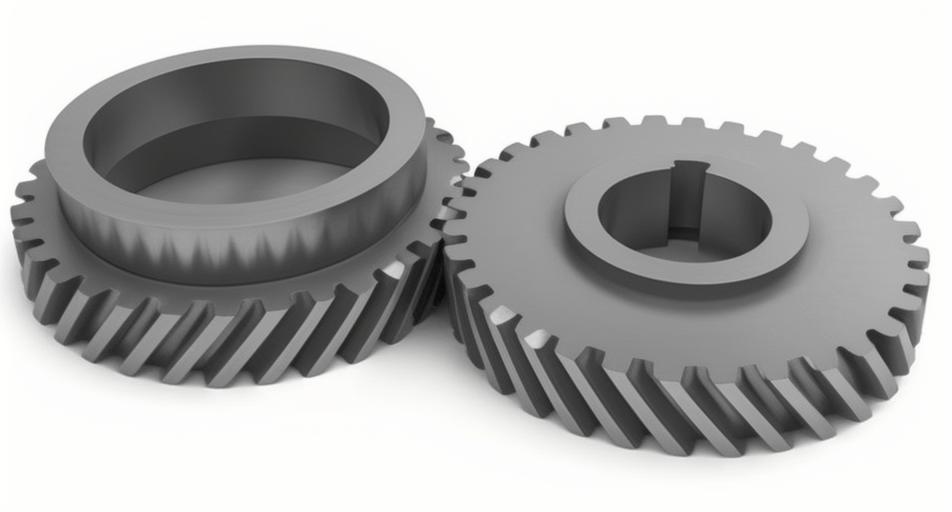
To quantify these errors, I employ the Monte Carlo method, a statistical technique that generates random samples based on probability distributions. This approach allows me to simulate the error at each meshing point along the helical gear contact line, accounting for real-world variability. For the manufacturing error, the Rayleigh distribution parameters are derived from gear tolerance grades. Specifically, the distribution parameter $\eta_1$ for $\frac{1}{2} (F’_i – f’_i)$ is:
$$ \eta_1 = \frac{F’_i – f’_i}{6} $$
and for $\frac{1}{2} f’_i$, the parameter $\eta_2$ is:
$$ \eta_2 = \frac{f’_i}{6} $$
The sampling formula for these Rayleigh-distributed variables is $X = \eta \sqrt{-2 \ln R}$, where $R$ is a random variable uniformly distributed in $[0,1]$. For assembly errors, each clearance $e_i$ follows a normal distribution with mean $\mu_i = e_i/2$ and standard deviation $\sigma_i$, sampled using:
$$ X = \mu + \sigma \sqrt{-2 \ln R_1} \sin(2\pi R_2) $$
where $R_1$ and $R_2$ are independent random variables. By generating numerous samples, I compute the error distribution along the helical gear contact line, as summarized in Table 1 for a typical helical gear pair.
| Error Type | Symbol | Value (mm) | Distribution |
|---|---|---|---|
| Tangential Composite Error | $F’_i$ | 10.8 | Rayleigh |
| Tooth-to-Tooth Tangential Error | $f’_i$ | 5.28 | Rayleigh |
| Gear-Shaft Clearance | $e_1$ | 2 | Normal |
| Shaft Runout Clearance | $e_2$ | 10 | Normal |
| Bearing Radial Clearance | $e_3$ | 5 | Normal |
Building on this error model, I develop a nonlinear dynamics model for a helical gear pair, considering six degrees of freedom: four translational ($y_1$, $z_1$, $y_2$, $z_2$) and two rotational ($\theta_1$, $\theta_2$). The generalized displacement vector is $\{q\} = \{y_1, z_1, \theta_1; y_2, z_2, \theta_2\}$. The dynamics equations incorporate time-varying meshing stiffness, damping, friction, and error excitations specific to helical gears. The equations for the driving gear are:
$$ m_1 \ddot{y}_1 + c_{1y} \dot{y}_1 + k_{1y} y_1 + \left( \sum_i k_i \right) (TE – \sum_i e_{iy}) \cos \beta_b + c_m (\dot{TE} – \sum_i \dot{e}_{iy}) \cos \beta_b – \sum_i \text{sgn}(\xi_i) \mu_i N_i \cos \beta_b = 0 $$
$$ m_1 \ddot{z}_1 + c_{1z} \dot{z}_1 + k_{1z} z_1 – \left( \sum_i k_i \right) (z_1 – TE \tan \beta_b – z_2 – \sum_i e_{iz}) \sin \beta_b – c_m (\dot{z}_1 – \dot{TE} \tan \beta_b – \dot{z}_2 – \sum_i \dot{e}_{iz}) \sin \beta_b + \sum_i \text{sgn}(\xi_i) \mu_i N_i \sin \beta_b = 0 $$
For the driven helical gear:
$$ m_2 \ddot{y}_2 + c_{2y} \dot{y}_2 + k_{2y} y_2 – \left( \sum_i k_i \right) (TE – \sum_i e_{iy}) \cos \beta_b – c_m (\dot{TE} – \sum_i \dot{e}_{iy}) \cos \beta_b + \sum_i \text{sgn}(\xi_i) \mu_i N_i \cos \beta_b = 0 $$
$$ m_2 \ddot{z}_2 + c_{2z} \dot{z}_2 + k_{2z} z_2 + \left( \sum_i k_i \right) (z_1 – TE \tan \beta_b – z_2 – \sum_i e_{iz}) \sin \beta_b + c_m (\dot{z}_1 – \dot{TE} \tan \beta_b – \dot{z}_2 – \sum_i \dot{e}_{iz}) \sin \beta_b – \sum_i \text{sgn}(\xi_i) \mu_i N_i \sin \beta_b = 0 $$
The rotational dynamics are governed by:
$$ I_1 \ddot{\theta}_1 = -T_1 – F_y r_{b1} + \sum_i \text{sgn}(\xi_i) \mu_i N_i l_i $$
$$ I_2 \ddot{\theta}_2 = T_2 – F_y r_{b2} + \sum_i \text{sgn}(\xi_i) \mu_i N_i (D – l_i) $$
In these equations, $m_1$ and $m_2$ are equivalent masses, $I_1$ and $I_2$ are moments of inertia, $T_1$ and $T_2$ are input and output torques, $c$ and $k$ represent damping and stiffness coefficients, $\beta_b$ is the base helix angle, $\mu_i$ is the friction coefficient (taken as 0.1), $N_i$ is the normal force at meshing point $i$, $l_i$ is the force arm, and $D = (r_{b1} + r_{b2}) \tan \phi$. The sign function $\text{sgn}(\xi_i)$ accounts for friction direction relative to the pitch point. The transmission error $TE$ is defined as:
$$ TE = r_{b1} \theta_1 – r_{b2} \theta_2 + y_1 – y_2 $$
and the equivalent meshing force equation is:
$$ m_{eq} \ddot{x} = -F_t – \cos \beta_b \left[ \left( \sum_i k_i \right) (TE – \sum_i e_{iy}) + c_m (\dot{TE} – \sum_i \dot{e}_{iy}) \right] + \sum_i \text{sgn}(\xi_i) \mu_i N_i = 0 $$
where $m_{eq} = \frac{I_1 I_2}{I_1 r_{b2}^2 + I_2 r_{b1}^2}$ and $x = r_{b1} \theta_1 + r_{b2} \theta_2$. This model captures the coupled dynamics of helical gears, essential for analyzing vibration and noise.
To solve these equations, I use the perturbation method, which provides approximate solutions for nonlinear systems. By applying Monte Carlo-generated error data along the helical gear contact line, I simulate the dynamic response. The helical gear parameters used in my analysis are listed in Table 2, which includes key geometric and operational details.
| Parameter | Driving Gear | Driven Gear |
|---|---|---|
| Number of Teeth ($z$) | 29 | 104 |
| Normal Module ($m_n$, mm) | 4 | |
| Normal Pressure Angle ($\alpha_n$, °) | 20 | |
| Helix Angle ($\beta$, °) | 26 | |
| Base Helix Angle ($\beta_b$, °) | Calculated from $\beta$ | |
| Torque ($T$, N·m) | 1000 (Input) | Output |
| Mass ($m$, kg) | 2.5 | 8.0 |
| Moment of Inertia ($I$, kg·m²) | 0.05 | 0.15 |
| Stiffness ($k$, N/m) | 1e8 | 1e8 |
| Damping ($c$, N·s/m) | 500 | 500 |
The results reveal significant insights into helical gear behavior. Figure 1 shows the distribution of meshing error along the contact line, derived from Monte Carlo simulation. The error varies stochastically, with higher values near the ends of the contact line due to edge effects in helical gears. This distribution directly impacts the dynamic transmission error, which I compute over a meshing cycle. As shown in Figure 2, the maximum transmission error decreases with increasing load, indicating that error excitation becomes less dominant in heavily-loaded helical gears. Conversely, for high-speed helical gears, error excitation amplifies dynamic responses.
The maximum meshing force and acceleration are critical indicators of helical gear performance. In Figure 3, I plot the maximum meshing force versus time. During initial engagement, a sharp spike occurs due to impact forces, characteristic of helical gear meshing. As the system stabilizes, the force oscillates around a mean value, influenced by time-varying stiffness and error. Similarly, Figure 4 displays the maximum acceleration of the driving helical gear. The acceleration peaks at engagement, correlating with noise and vibration levels. These trends emphasize the importance of error control in helical gears, especially for high-speed applications where dynamic effects are pronounced.
To further analyze the influence of parameters, I summarize key findings in Table 3, comparing error and stiffness excitations across different operational conditions for helical gears.
| Condition | Dominant Excitation | Effect on Dynamic Transmission Error | Recommendation for Helical Gears |
|---|---|---|---|
| High Speed | Error Excitation | Increases amplitude | Improve manufacturing accuracy |
| Heavy Load | Stiffness Excitation | Decreases amplitude | Optimize tooth profile modification |
| Moderate Operation | Combined | Stable with minor fluctuations | Balance tolerances and stiffness |
The mathematical analysis supports these observations. The dynamic transmission error $TE(t)$ can be expressed as a function of stiffness $k(t)$ and error $e(t)$:
$$ TE(t) = \frac{F_t}{\sum_i k_i(t)} + \sum_i e_i(t) + \delta(t) $$
where $\delta(t)$ represents higher-order terms from nonlinearities. For helical gears, the time-varying stiffness $\sum_i k_i(t)$ is derived from the contact ratio and tooth deflection, often modeled as:
$$ k_i(t) = k_0 + \Delta k \sin(\omega_m t + \phi_i) $$
with $k_0$ as mean stiffness, $\Delta k$ as variation amplitude, $\omega_m$ as meshing frequency, and $\phi_i$ as phase angle. The error term $\sum_i e_i(t)$ from Monte Carlo simulation adds randomness, leading to complex dynamics.
In conclusion, my study on helical gear transmission error highlights the interplay between manufacturing imperfections and dynamic response. Through stochastic modeling and nonlinear dynamics analysis, I demonstrate that error excitation is crucial for high-speed helical gears, while stiffness excitation governs heavily-loaded helical gears. This understanding aids in designing helical gears with reduced vibration and noise, by tailoring tolerance grades and tooth modifications. Future work could explore advanced materials or real-time monitoring for helical gears in extreme environments. The methodologies developed here provide a framework for enhancing helical gear performance across industries, from aerospace to automotive systems.
Ultimately, the helical gear remains a cornerstone of mechanical transmission, and its optimization requires a deep grasp of error dynamics. By integrating Monte Carlo simulations with coupled dynamics models, engineers can predict and mitigate undesirable effects, ensuring reliable and efficient helical gear operations. As I continue to research helical gears, I emphasize the need for holistic approaches that account for both random errors and systematic stiffness variations in these complex systems.