
Full-face hard rock tunnel boring machines (TBM), or shield machines, are critical equipment in underground engineering. Their main bearing drive systems, primarily composed of involute straight cylindrical gear pairs, operate under extremely harsh conditions characterized by low rotational speeds and immense, fluctuating loads. The geological environment subjects the cutterhead to severe impacts and overloads, which are transmitted directly to the driving gears. This frequently leads to failures such as tooth breakage and surface pitting in the cylindrical gear transmission system, resulting in costly construction halts. While extensive research exists on gear modification for high-speed, light-load applications, the behavior of large-scale cylindrical gears under low-speed, heavy-load, and biased-load conditions requires deeper investigation. This work focuses on enhancing the meshing smoothness and load-bearing capacity of the main bearing drive gears in a shield machine through systematic tooth profile and tooth alignment modification analysis.
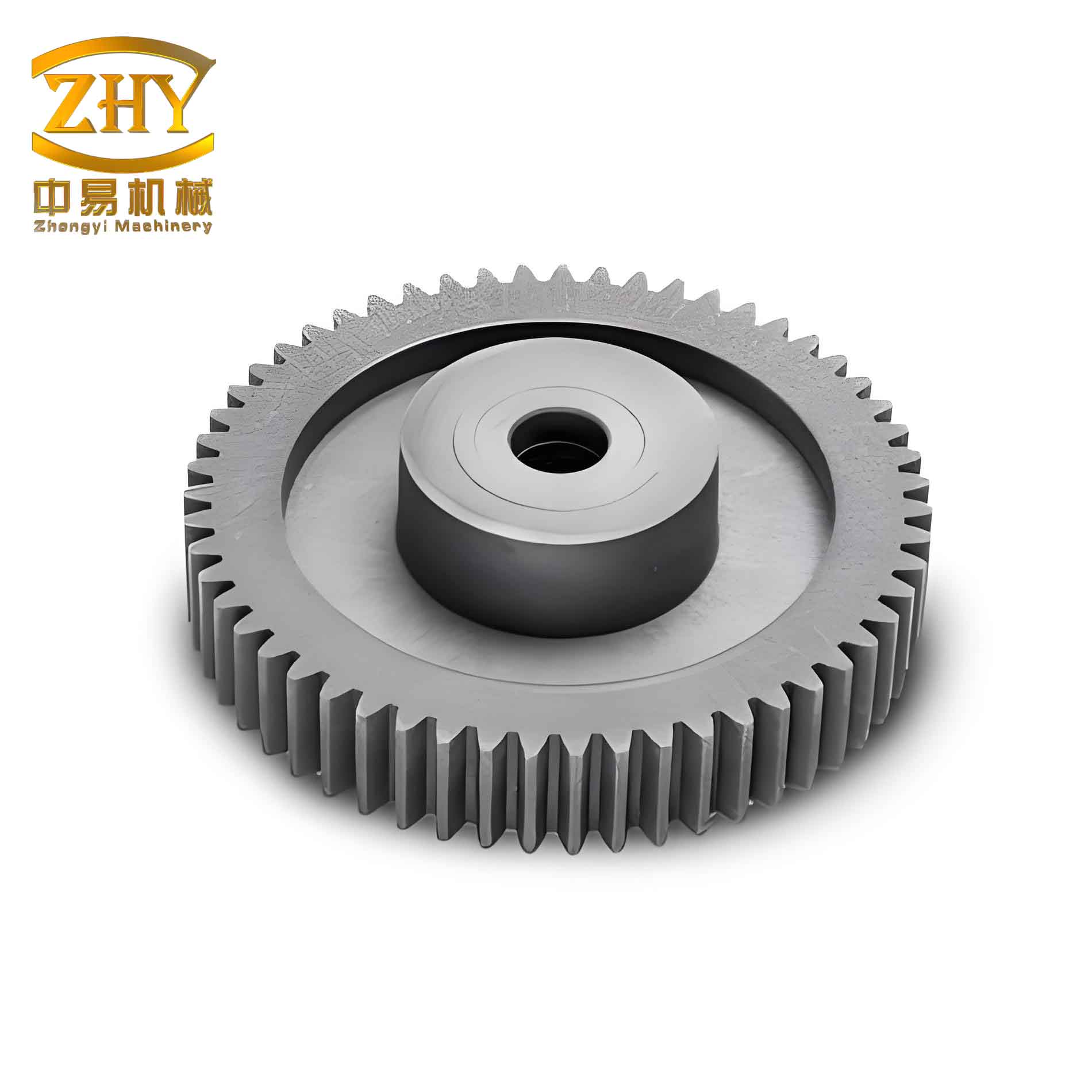
Theoretical Basis for Gear Modification
The fundamental goal of gear modification is to compensate for undesirable effects caused by elastic deformation, manufacturing errors, and assembly misalignments under load, thereby improving transmission performance.
Tooth Profile Modification Theory
For a pair of correctly meshing standard involute cylindrical gears, the theoretical load on a single tooth should jump instantaneously from a shared load in the double-tooth contact zone to the full load in the single-tooth contact zone, and vice versa, as shown by the theoretical load line AFGHIKLD. In reality, due to elastic deformation, the transition is smoother, as shown by curve AMNHIOPD. However, sudden load changes at points B and C still generate dynamic loads and impact. Furthermore, any deviation from perfect base pitch equality ($P_{b1} = P_{b2}$) due to errors causes a time-varying transmission error (TE), leading to vibration and noise. Tooth profile modification involves removing a small amount of material from the tip, root, or both regions of the tooth flank to alleviate these issues by smoothing the load transition and minimizing TE fluctuations.
Key Design Parameters for Profile Modification
The design involves determining the maximum modification amount $\Delta_{max}$, the length of the modified zone $L$, the distribution of modification between mating gears, and the modification curve shape.
Maximum Modification Amount: Several empirical formulas exist for initial estimation. For low-speed, heavy-load conditions applicable to the studied cylindrical gear, relevant formulas include:
- ISO Formula: $$ \Delta_{max} = \frac{K_A F_t}{b} \cdot \frac{\epsilon_{\alpha}}{C_{\gamma}} $$ where $K_A$ is the application factor, $F_t$ is the tangential force, $b$ is the face width, $\epsilon_{\alpha}$ is the transverse contact ratio, and $C_{\gamma}$ is the mesh stiffness.
- H.sigg Formulas: For pinion tip: $$ \Delta_{max1} = 0.05 + \frac{F_t}{4b} \pm 4 \quad [mm] $$ For gear tip: $$ \Delta_{max2} = 0.05 + \frac{F_t}{11.5b} \pm 3.5 \quad [mm] $$
- Ideal Maximum Modification: $$ \Delta_{max} = \delta + \delta_{\theta} + \delta_m $$ where $\delta$ is the elastic deflection under load, $\delta_{\theta}$ is thermal deformation, and $\delta_m$ is the manufacturing error.
Modification Length and Curve: For heavy-load gears, “long modification” is preferred, starting from the start/end of the active profile (points B1/B2) to the beginning/end of the single-pair contact zone (points C/D). The length is $L = (1 – \epsilon_{\alpha}) P_b$ or $L = (\epsilon_{\alpha} – 1) P_b / 2$ for long modification. Common curve types include:
- Linear: $$ \Delta(x) = \Delta_{max} \left( \frac{x}{L} \right) $$
- Parabolic/Power Law: $$ \Delta(x) = \Delta_{max} \left( \frac{x}{L} \right)^n $$ where $n$ is typically between 1 and 2 (e.g., 1.5 for Walker’s curve).
- Circular Arc.
Given the cost of machining the large internal ring gear, modification is applied only to the pinion in this study.
Tooth Alignment Modification Theory
Axial misalignment ($f_{\Sigma\beta}$, $f_{\Sigma\delta}$) caused by shaft deflection under heavy loads or installation errors leads to uneven load distribution across the face width, concentrating stress at one end of the cylindrical gear teeth. Tooth alignment modification aims to counteract this by deliberately altering the tooth flank along its width.
The primary method for significant misalignment is crowned lead modification, which combines a helix slope modification ($C_h$) with a crowning amount ($C_C$). The crowning amount can be estimated by formulas such as the Taylor Hobson company’s: $$ C_C = 0.7 \times 10^{-3} \frac{F_m}{b} $$ where $F_m$ is the tangential force at the pitch circle. The helix slope modification is calculated based on the effective misalignment: $$ C_h = F_{\beta\gamma} – \frac{F_m}{C_{\gamma} b} $$ where $F_{\beta\gamma}$ is the mesh misalignment.
Calculation of Axis Misalignment for Bias Load Simulation
To simulate the biased loading condition realistically, the axis parallelism error is derived. The total mesh misalignment $F_{\beta\gamma}$ is influenced by geometric factors (e.g., lead error $f_p$) and stiffness factors (e.g., deflection $f_{sh}$). It can be expressed as: $$ F_{\beta\gamma} = F_{\beta x} – y_{\beta} = (f_{sh} + f_p) – 0.15 F_{\beta x} $$ where $f_{sh} = W_m \cdot f_{sh0}$ and $f_p = \sqrt{f_{pI}^2 + f_{pII}^2}$ accounts for misalignment in vertical and horizontal planes. Based on the derived $F_{\beta\gamma}$, the axis inclination error $f_{\Sigma\beta}$ and axis offset error $f_{\Sigma\delta}$ per ISO guidelines are: $$ f_{\Sigma\beta} = 0.5 \left( \frac{L}{b} \right) F_{\beta\gamma}, \quad f_{\Sigma\delta} = 2 f_{\Sigma\beta} $$ For the specific 3m-class TBM gear studied, calculations yielded $f_{\Sigma\beta} = 168.979 \mu m$ and $f_{\Sigma\delta} = 337.958 \mu m$, establishing the baseline misalignment for all subsequent analyses.
Quasi-Static Contact Analysis of Low-Speed Heavy-Doad Straight Cylindrical Gears
The analysis is conducted using specialized gear design software capable of performing quasi-static contact analysis based on Weber’s slice theory, which is computationally efficient for evaluating meshing performance under load.
Gear Pair Modeling and Analysis Setup
The basic parameters of the main drive cylindrical gear pair are as follows:
| Parameter | Pinion | Internal Gear |
|---|---|---|
| Module $m_n$ (mm) | 22 | |
| Number of Teeth $z$ | 15 | -105 |
| Face Width $b$ (mm) | 250 | 240 |
| Pressure Angle $\alpha$ (°) | 20 | |
| Helix Angle $\beta$ (°) | 0 | |
| Profile Shift Coefficient $x$ | 0.5 | 0 |
The material for the pinion is 18CrNiMo7-6 (case-hardened) and for the internal gear is 42CrMo4. The most severe load case from the operational spectrum is used: torque $T = 173.5 \text{ kN·m}$ and speed $n = 1.8 \text{ rpm}$.
Performance of Unmodified Gear Pair
Under the defined misalignment and heavy load, the unmodified cylindrical gear pair shows critical performance issues:
| Evaluation Metric | Value | Comment |
|---|---|---|
| Safety Factor, Bending $S_F$ | 0.901 | Below allowable limit (1.1) |
| Safety Factor, Contact $S_H$ | 1.032 | Below allowable limit (1.2) |
| Transmission Error Peak-to-Peak $\Delta TE$ | 122.65 $\mu m$ | Indicates significant meshing impact |
| Maximum Contact Stress $\sigma_{Hmax}$ | 2439.0 MPa | High stress level |
| Maximum Line Load $w_{max}$ | 7371.0 N/mm | Load concentrated at one tooth end |
The contact stress and line load distribution plots confirm severe edge-loading and non-uniform stress distribution across the face width of the cylindrical gear teeth, validating the need for modification.
Optimization of Profile Modification
Four profile modification strategies for the pinion were evaluated using a combinatorial approach over a range of modification amounts derived from empirical formulas:
- Linear tip relief.
- Circular arc tip relief.
- Linear tip relief + Circular arc root relief.
- Circular arc tip relief + Circular arc root relief.
The evaluation was based on multiple objectives: minimizing Transmission Error (TE) amplitude, minimizing maximum contact temperature, maximizing safety against scuffing ($S_B$), and controlling root bending stress.
The results from the quasi-static contact analysis for the different schemes are summarized below. The combined linear tip and circular arc root modification (Scheme 3) yielded the most balanced improvement.
| Modification Scheme | Optimal Parameters ($C_a$ / $C_f$) | $\Delta TE$ ($\mu m$) | $S_B$ | Max Contact Temp. (°C) |
|---|---|---|---|---|
| Unmodified | – | 122.65 | 8.19 | 102.62 |
| 1. Linear Tip | 152.6 $\mu m$ / – | >122.65 | 9.55 | 98.40 |
| 2. Arc Tip | 298.5 $\mu m$ / – | >122.65 | 9.98 | 97.60 |
| 3. Lin. Tip + Arc Root | 285.6 / 95 $\mu m$ | 63.84 | 10.40 | 97.63 |
| 4. Arc Tip + Arc Root | 285.6 / 133.1 $\mu m$ | 105.80 | 9.50 | ~98.0 |
Scheme 3 reduced the TE amplitude by 47.9% and the sum of the first four TE harmonics by 64%, significantly smoothing the meshing process. It also provided the highest scuffing safety factor and lower contact temperature.
Optimization of Tooth Alignment Modification
For tooth alignment, a crowned lead modification was applied. A series of crowning amounts $C_C$ were evaluated in combination with a fixed helix slope modification $C_h = -275.5 \mu m$, calculated to compensate for the initial misalignment.
The primary evaluation criteria were the distribution of line load and contact stress across the face width. The results demonstrated that an appropriate crowning amount ($C_C = 86.6 \mu m$) effectively centralized the load and stress. The severe edge-loading observed in the unmodified cylindrical gear was eliminated, and the maximum contact stress was reduced. The load transition became uniform from the center to the ends of the tooth.
Determination of Comprehensive Modification Scheme and Dynamic Performance Analysis
Comprehensive Modification Schemes
Based on the optimal single-factor modifications, three comprehensive schemes combining both profile and alignment modifications were formulated and compared.
| Scheme | Profile Modification | Alignment Modification | ||
|---|---|---|---|---|
| $C_a$ / Curve | $C_f$ / Curve | $C_C$ ($\mu m$) | $C_h$ ($\mu m$) | |
| I (Optimal) | 285.6 / Linear | 95 / Circular Arc | 86.6 | -275.5 |
| II | 285.6 / Linear | 164.5 / Circular Arc | 86.6 | -275.5 |
| III | 285.6 / Linear | 310.1 / Circular Arc | 86.6 | -275.5 |
A multi-objective comparison confirmed Comprehensive Scheme I as the best. It achieved a 19.2% reduction in TE amplitude, a smooth transition at the pitch point, a 30.8% reduction in maximum contact stress (from 2439.0 MPa to 1688.4 MPa), and a completely uniform load distribution across the face width of the cylindrical gear teeth.
Strength Verification
The safety factors for the comprehensively modified cylindrical gear pair (Scheme I) under bias load were recalculated:
| Safety Factor | Unmodified | Modified (Scheme I) | Improvement |
|---|---|---|---|
| Bending $S_F$ | 0.901 | 1.163 | +29.1% |
| Contact $S_H$ | 1.032 | 1.211 | +17.3% |
| Scuffing (Flash Temp.) | 3.927 | 5.334 | +35.8% |
All safety factors now meet or exceed the required limits, confirming the design’s reliability for the extreme operating condition.
Transient Dynamics Analysis
To evaluate dynamic performance, transient dynamic simulations of both unmodified and modified (Scheme I) cylindrical gear pairs were performed using Finite Element Analysis (FEA) with an implicit integration scheme. The governing equation is: $$ [M]\{\ddot{x}\} + [C]\{\dot{x}\} + [K]\{x\} = \{F(t)\} $$ where $[M]$, $[C]$, and $[K]$ are mass, damping, and stiffness matrices, and $\{x\}$ is the displacement vector.
The results showed that the modified gear pair exhibited superior dynamic characteristics:
- Maximum Dynamic Mesh Stress: Reduced from ~2387 MPa (unmodified) to ~1571 MPa (modified), a decrease of 34.2%.
- Vibration Acceleration: The acceleration-time history for the modified gear stabilized much faster and showed significantly lower peak values and smoother fluctuations compared to the unmodified gear, indicating improved transmission smoothness.
These dynamic results corroborate the findings from the quasi-static analysis, validating the effectiveness of the comprehensive modification.
Establishment of Scaled Model and Experimental Strain Validation
Full-scale testing of large heavy-duty gears is prohibitive. Therefore, a scaled model was developed based on similarity theory to experimentally validate the modification effect.
Derivation of Similarity Criterion
Using Buckingham’s $\pi$ theorem (Similarity Second Theorem) and dimensional analysis, a similarity criterion for root bending stress in spur cylindrical gears was derived. The root bending stress $\sigma_F$ is a function of module $m$, torque $T$, and face width $b$. The fundamental dimensions are Force $[F]$ and Length $[L]$.
The dimensional matrix leads to two dimensionless $\pi$ terms:
$$ \pi_1 = \sigma_F \cdot m^3 \cdot T^{-1}, \quad \pi_2 = b \cdot m^{-1} $$
For similarity between prototype (p) and model (m), $\pi_{1m} = \pi_{1p}$ and $\pi_{2m} = \pi_{2p}$. Choosing scale factors $\lambda_m = m_p/m_m = 2.75$ and $\lambda_b = b_p/b_m = 2.75$, the stress scale factor is derived as $\lambda_{\sigma} = \sigma_{Fp}/\sigma_{Fm} = \lambda_T / \lambda_m^3$. Setting $\lambda_T = T_p/T_m = 31.195$ yields $\lambda_{\sigma} = 1.5$.
Model Verification and Experimental Setup
Scaled gears were designed and manufactured based on the scaling factors. The nominal root stresses were calculated for verification:
| Component | Prototype Stress $\sigma_{F0}$ (MPa) | Scaled Model Stress $\sigma_{F0}’$ (MPa) | Ratio $\sigma_{F0}/\sigma_{F0}’$ |
|---|---|---|---|
| Pinion | 577.29 | 383.54 | 1.505 |
| Internal Gear | 515.51 | 342.49 | 1.505 |
The stress ratio of 1.505 is very close to the theoretical similarity factor of 1.5, confirming the model’s validity.
A gear test rig was constructed. Both unmodified and modified (according to Scheme I parameters) scaled pinions were manufactured. Strain gauges were attached at the 30° tangent point of the tooth root fillet. Tests were conducted under scaled load ($T_m = 4860 \text{ N·m}$) and speed.
Experimental Results and Analysis
The strain data was acquired using a static signal test system. The measured maximum root strain values were:
- Unmodified Scaled Gear: $\epsilon_{max} = 3.002 \times 10^{-3}$
- Modified Scaled Gear: $\epsilon_{max} = 2.765 \times 10^{-3}$
Using Hooke’s law $\sigma = E \epsilon$ with $E = 206 \text{ GPa}$, the corresponding root stresses can be estimated. The modified gear shows a clear reduction in root strain (approximately 7.9% lower), experimentally verifying that the comprehensive modification effectively reduces stress concentration at the tooth root of the cylindrical gear. The results are consistent with the trend predicted by the simulation, validating the proposed modification strategy.
Conclusions and Outlook
This study systematically investigated the modification of low-speed, heavy-load involute straight cylindrical gears for shield machine main bearing drives. The theoretical analysis defined key parameters for profile and alignment modification tailored to the harsh operating conditions. Quasi-static contact analysis identified an optimal combined profile modification (linear tip relief and circular arc root relief for the pinion) that significantly improved meshing smoothness by reducing transmission error amplitude by 47.9% and increasing scuffing safety. The optimal crowned lead alignment modification effectively eliminated edge-loading, ensuring uniform stress distribution.
The comprehensive modification scheme (Scheme I) synergistically combined these optimizations. Subsequent strength verification confirmed all safety factors were met. Transient dynamic FEA demonstrated that the modified cylindrical gear pair exhibited lower dynamic mesh stress and vibration acceleration, indicating enhanced dynamic performance. Finally, the establishment of a scaled model based on derived similarity criteria and the subsequent strain test provided experimental validation, showing a measurable reduction in tooth root strain for the modified gear.
Future work could involve analyzing the modification effects under more complex error conditions that closely mimic reality. More comprehensive transient dynamic analysis of the full gear pair with refined meshing is recommended. Furthermore, experimental validation of vibration and noise reduction would strengthen the conclusions. This research provides a valuable theoretical and practical foundation for the micro-modification design of large-scale, heavy-duty cylindrical gear transmissions in demanding applications.