
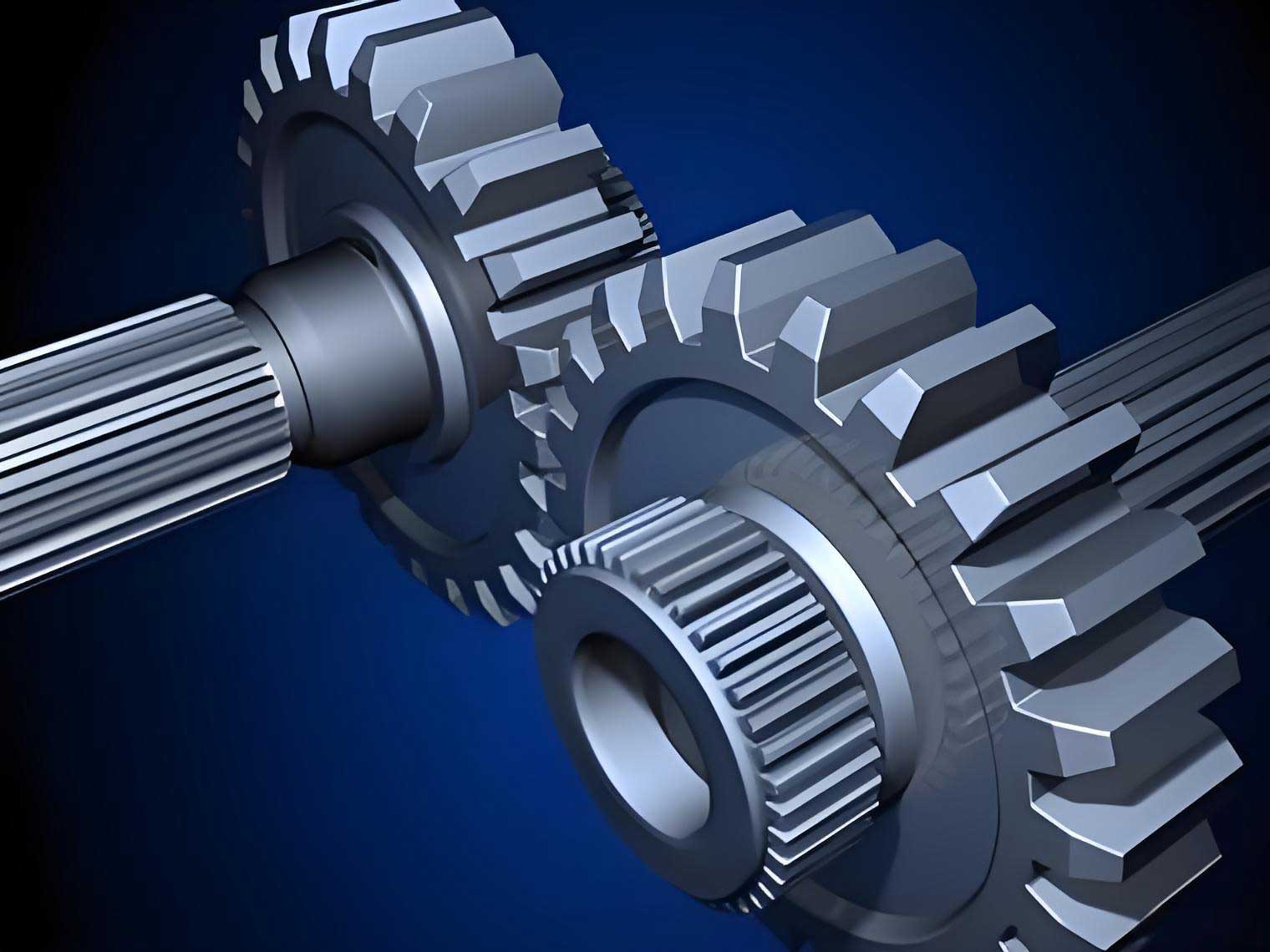
The reliable and efficient transmission of power in modern machinery is heavily reliant on gear systems. Among these, spur gears represent one of the most fundamental and widely used configurations due to their straightforward design and manufacturing process. However, the very nature of their operation, involving concurrent rolling and sliding contact between meshing teeth, makes them inherently susceptible to surface degradation mechanisms, with wear being a primary concern throughout their service life. While often operating under lubricated conditions, the surfaces of spur gears are not perfectly smooth. Consequently, the lubricant film thickness and the composite surface roughness of the contacting teeth are frequently of the same order of magnitude. This leads to a state of mixed elastohydrodynamic lubrication (mixed-EHL), where the load is shared between a thin, pressurized fluid film and the contacting asperities of the surfaces. It is this direct metal-to-metal contact at the asperity level that initiates and propagates wear. Therefore, a deep understanding of the wear behavior of spur gears under mixed-EHL conditions is crucial. This involves elucidating the wear evolution process, the influencing factors, and the underlying mechanisms to develop strategies that mitigate wear and extend the operational lifespan of gear transmissions.
This article presents a comprehensive numerical study on the wear of spur gears operating under mixed elastohydrodynamic lubrication. A predictive wear model is developed that integrates several critical aspects of the gear meshing physics: the transient lubrication conditions, the associated thermal effects due to friction, and the dynamic changes in load distribution resulting from progressive tooth surface wear. The model is employed to calculate the evolution of wear depth, contact pressure, and surface flash temperature along the path of contact. The interrelationship between wear progression and changes in contact parameters is analyzed in detail. Furthermore, the influence of key operational and design parameters—such as surface roughness, input torque, and rotational speed—on the wear characteristics and effective service life of spur gears is systematically investigated.
1. Modeling Framework for Worn Spur Gears
1.1 Load Distribution Model Considering Wear
During the meshing cycle of a pair of spur gears, the contact alternates between single-tooth-pair and double-tooth-pair engagement regions. In the double-tooth-pair zone, the total transmitted load is shared between two concurrent contact lines. Neglecting manufacturing errors, this load sharing is governed primarily by the mesh stiffness of the respective tooth pairs. The system can be analogized to two parallel springs.
Let \( W_t \) be the total normal load along the line of action. For a given meshing position \( i \) within a double-tooth-pair zone, the loads carried by the first (\( W_1 \)) and second (\( W_2 \)) contacting pairs are given by:
$$
W_1(i) = \frac{k_1(i) [W_t + k_2(i) \delta_t(i)]}{k_1(i) + k_2(i)}
$$
$$
W_2(i) = \frac{k_2(i) [W_t + k_1(i) \delta_t(i)]}{k_1(i) + k_2(i)}
$$
where \( k_1(i) \) and \( k_2(i) \) are the mesh stiffness values for the first and second tooth pairs at position \( i \), respectively. The term \( \delta_t(i) \) represents the difference in the geometric separation, or “backlash,” between the two pairs, defined as \( \delta_t(i) = \delta_1(i) – \delta_2(i) \).
The critical factor introduced by wear is its modification of the tooth profile, which directly alters \( \delta_t(i) \). If \( h_p(x) \) and \( h_g(x) \) denote the wear depths on the pinion and gear tooth profiles at a distance \( x \) along the line of action from the pitch point, the geometric separation changes. For a pinion, during the first period of double-tooth contact (entering phase), the change is:
$$
\delta_t(x) = [h_p(x + p_b) + h_g(x + p_b)] – [h_p(x) + h_g(x)]
$$
During the second period (exiting phase), it becomes:
$$
\delta_t(x) = [h_p(x) + h_g(x)] – [h_p(x – p_b) + h_g(x – p_b)]
$$
where \( p_b \) is the base pitch. This coupling between wear depth and load distribution is essential for accurately modeling the evolution of wear over time.
1.2 Contact Mechanics for Spur Gears
The contact between two spur gear teeth at any instant can be modeled as the contact between two equivalent cylinders with radii equal to the radii of curvature of the tooth profiles at that contact point. According to Hertzian theory for line contact, the semi-half-width \( a_h \) of the rectangular contact zone and the maximum Hertzian pressure \( p_{max} \) are given by:
$$
a_h = \sqrt{ \frac{8 F_N R_{eq}}{\pi b E_{eq}} }
$$
$$
p_{max} = \sqrt{ \frac{F_N E_{eq}}{2 \pi b R_{eq}} }
$$
The mean contact pressure \( \bar{p} \) is related to the maximum pressure by \( \bar{p} = (\pi/4) p_{max} \). The equivalent radius \( R_{eq} \) and equivalent elastic modulus \( E_{eq} \) are defined as:
$$
\frac{1}{R_{eq}} = \frac{1}{R_p} \pm \frac{1}{R_g} \quad \text{(sign for external contact)}
$$
$$
\frac{1}{E_{eq}} = \frac{1 – \nu_p^2}{E_p} + \frac{1 – \nu_g^2}{E_g}
$$
where \( F_N \) is the normal load at the contact point, \( b \) is the face width, \( R_p \) and \( R_g \) are the radii of curvature, \( E_p, E_g \) are Young’s moduli, and \( \nu_p, \nu_g \) are Poisson’s ratios for the pinion and gear materials, respectively.
1.3 Mixed Elastohydrodynamic Lubrication (Mixed-EHL) Model
Under mixed-EHL conditions, the total pressure \( p_t \) at the contact is borne partly by the lubricant film (\( p_h \)) and partly by the contacting asperities (\( p_r \)):
$$
p_t = p_h + p_r
$$
To characterize this state, two key dimensionless parameters are used: the minimum film thickness (\( H_{min} \)) and the asperity load ratio (\( L_a \)), which is the percentage of the total load carried by the asperities. Based on extensive numerical simulations for rough surface line contacts, the following empirical relations are widely adopted:
$$
H_{min} = 1.652 W^{-0.077} U^{0.716} G^{0.695} \left[ 1 + 0.026 \sigma^{1.120} V^{0.185} W^{-0.312} U^{-0.809} G^{-0.977} \right]
$$
$$
L_a = 0.005 W^{-0.408} U^{-0.088} G^{0.103} \ln \left[ 1 + 4470 \sigma^{6.015} V^{1.168} W^{0.485} U^{-3.741} G^{-2.898} \right]
$$
The dimensionless parameters in these equations are defined as follows:
$$
W = \frac{w}{E_{eq} R_{eq}}, \quad U = \frac{\mu_0 u_r}{E_{eq} R_{eq}}, \quad G = \alpha E_{eq}, \quad V = \frac{H_s}{E_{eq}}, \quad \sigma = \frac{\sigma_s}{R_{eq}}
$$
where:
\( w = F_N/b \) is the load per unit length.
\( \mu_0 \) is the lubricant viscosity at ambient pressure.
\( u_r = (u_p + u_g)/2 \) is the entrainment (rolling) speed.
\( \alpha \) is the pressure-viscosity coefficient of the lubricant.
\( H_s \) is the hardness of the softer material.
\( \sigma_s \) is the composite root-mean-square surface roughness.
The pressures are then partitioned as:
$$
p_r = p_t \times (L_a / 100)
$$
$$
p_h = p_t \times (1 – L_a / 100)
$$
The condition for mixed lubrication is typically given by a film thickness ratio \( \lambda = h_{min} / \sigma_s \) in the range of 1 to 3. A value below 1 indicates severe boundary lubrication, while above 3 suggests full-film EHL.
1.4 Wear Model for Lubricated Spur Gears
The classical Archard wear model, while effective for dry contact, requires modification for lubricated conditions. The modified form used here accounts for the probability of metal-to-metal contact within the lubricated interface:
$$
h(x) = \int_0^s k \, p_r(x) \, \psi(x) \, ds
$$
where:
\( h(x) \) is the wear depth at location \( x \) along the path of contact.
\( k \) is the dimensionless wear coefficient (specific to material pair and lubrication condition).
\( p_r(x) \) is the asperity contact pressure at \( x \).
\( \psi(x) \) is the “oil film deficiency” factor, representing the probability of direct contact.
\( s \) is the sliding distance accumulated over the wear cycle.
The oil film deficiency factor \( \psi \) is modeled as:
$$
\psi = 1 – \exp\left\{ -\left[ \chi v_s t_0 \exp\left( -\frac{E_a}{R_g T_c} \right) \right] \right\}
$$
where \( \chi \) is the diameter of an adsorbed lubricant molecule, \( v_s \) is the sliding velocity, \( t_0 \) is the basic vibration time of an adsorbed molecule, \( E_a \) is the adsorption energy of the lubricant, \( R_g \) is the universal gas constant, and \( T_c \) is the instantaneous contact temperature. This factor increases with sliding speed and contact temperature, promoting wear when the protective boundary film is likely to break down.
The sliding distance for a contact with semi-width \( a_h \) is different for the two mating gears. For the pinion and gear, the incremental sliding distances \( \Delta s_p \) and \( \Delta s_g \) during one meshing event are:
$$
\Delta s_p = 2 a_h \frac{|u_p – u_g|}{u_p} \quad \text{and} \quad \Delta s_g = 2 a_h \frac{|u_g – u_p|}{u_g}
$$
1.5 Contact Temperature Calculation
The surface contact temperature \( T_c \) is a critical parameter influencing lubricant performance, surface properties, and the wear coefficient \( k \). It consists of the bulk temperature \( T_b \) and the flash temperature \( T_f \):
$$
T_c = T_b + T_f
$$
The bulk temperature \( T_b \) stabilizes at a steady-state value determined by the overall heat balance of the gear system. The flash temperature \( T_f \) is the instantaneous temperature rise at the contact interface due to frictional heating. For a line contact modeled as a moving band heat source, the formula is:
$$
T_f = \frac{2 a_h q_m}{\pi (k_p \sqrt{1+P_{e_p}} + k_g \sqrt{1+P_{e_g}} )}
$$
where \( k_p, k_g \) are the thermal conductivities of the pinion and gear materials. \( P_{e_p} = \rho_p c_p u_p a_h / (2 k_p) \) and \( P_{e_g} = \rho_g c_g u_g a_h / (2 k_g) \) are the Peclet numbers, with \( \rho \) being density and \( c \) specific heat capacity.
The total heat flux density \( q_m \) is the sum of the heat generated by asperity friction (\( q_r \)) and viscous shear in the lubricant film (\( q_h \)):
$$
q_m = q_r + q_h = \mu \, p_r \, v_s + \Lambda_{lim} \, p_h \, v_s
$$
where \( \mu \) is the boundary friction coefficient and \( \Lambda_{lim} \) is the limiting shear stress coefficient of the lubricant.
1.6 Numerical Calculation Procedure for Spur Gear Wear Evolution
The calculation of wear depth evolution is an iterative process that couples all the aforementioned models. The path of contact is discretized into a series of points. The procedure is as follows:
- Initialization: Input initial gear geometry, material properties, lubrication parameters, and operating conditions (torque, speed).
- Static Analysis: For the initial unworn profile, calculate the load distribution \( W(i) \), Hertzian pressure \( p_t(i) \), radii of curvature \( R_{eq}(i) \), and entrainment/sliding velocities for all discretized contact points \( i \) along the meshing line.
- Lubrication Analysis: For each point \( i \), calculate the minimum film thickness \( H_{min}(i) \) and asperity load ratio \( L_a(i) \) using the mixed-EHL formulas. Determine the asperity pressure \( p_r(i) \).
- Thermal & Wear Analysis: Calculate the contact temperature \( T_c(i) \), the oil deficiency factor \( \psi(i) \), and the sliding distance \( \Delta s(i) \). Compute the wear depth increment \( \Delta h(i) \) for one meshing cycle using the modified Archard law.
- Profile Update: Accumulate the wear depth \( \Delta h(i) \) to the respective tooth profiles (pinion and gear) at the corresponding locations.
- Convergence Check: Compare the maximum wear depth \( h_{max} \) across the profile to a predefined small threshold \( \xi \) (e.g., 1-3 μm). If \( h_{max} < \xi \), multiply the single-cycle wear increments by a large number \( N \) (representing \( N \) cycles) until the accumulated wear just exceeds \( \xi \).
- Loop: Update the tooth profiles with the new wear depths. With the modified geometry, recalculate the load distribution (which now accounts for the changed \( \delta_t \) due to wear), and repeat steps 2-6. This loop continues until the maximum wear depth reaches a final failure threshold \( \xi_t \) (e.g., 12-20 μm).
This methodology captures the dynamic interaction between wear-induced profile changes and the evolving contact conditions in spur gears.
2. Analysis of Wear Evolution in Spur Gears
The following analysis is based on a standard spur gear pair. The primary parameters are summarized in Table 1.
| Parameter | Symbol | Value | Unit |
|---|---|---|---|
| Number of Teeth (Pinion/Gear) | \( z_p / z_g \) | 23 / 50 | – |
| Module | \( m_n \) | 5 | mm |
| Pressure Angle | \( \alpha \) | 20 | ° |
| Face Width | \( b \) | 46 | mm |
| Young’s Modulus | \( E \) | 228 | GPa |
| Poisson’s Ratio | \( \nu \) | 0.3 | – |
| Surface Hardness | \( H \) | 2.5 | GPa |
| Composite Roughness | \( \sigma_s \) | 0.5 | μm |
| Input Torque | \( T_{in} \) | 280 | Nm |
| Input Speed (Pinion) | \( n_p \) | 1500 | rpm |
| Lubricant Viscosity (@40°C) | \( \mu_0 \) | 0.08 | Pa·s |
| Pressure-Viscosity Coefficient | \( \alpha \) | 1.8e-8 | Pa⁻¹ |
| Wear Coefficient | \( k \) | 5.0e-9 | – |
2.1 Wear Depth Distribution
The calculated wear depth distribution along the path of contact for the pinion, after several profile update iterations, is shown conceptually in the results. The key findings are:
- Maximum Wear at the Start of Active Profile (SAP): The highest wear depth consistently occurs near the pinion root/gear tip region, which corresponds to the beginning of the meshing engagement (the “mesh-in” point). This is attributed to the high sliding velocity and significant asperity contact pressure at this location, coupled with a relatively thin lubricant film.
- Non-linear Variation: Wear depth decreases non-linearly from the mesh-in point towards the pitch point.
- Minimum Wear at the Pitch Point: The wear depth reaches its minimum at or very near the pitch point. This is expected as the sliding velocity theoretically becomes zero at the pitch point (pure rolling), eliminating one of the primary drivers in the wear equation (\( v_s \rightarrow 0 \)).
- Discontinuities at Single/Double Pair Boundaries: Abrupt changes in wear depth are observed at the transitions between the double-tooth-pair contact (DTC) and single-tooth-pair contact (STC) zones. This is a direct consequence of the sudden change in the load per tooth when entering or leaving the STC region. In the DTC zone, the load is shared, leading to lower \( p_r \) and thus lower wear rate. In the STC zone, a single tooth pair carries the full load, resulting in a higher \( p_r \) and a corresponding step-increase in wear rate.
The wear on the driven gear follows a similar pattern but is generally lower in magnitude than on the driving pinion for symmetric gear pairs, primarily because the pinion teeth undergo more contact cycles per revolution.
2.2 Effect of Wear Evolution on Contact Parameters
The progressive wear of spur gears alters the tooth profile, which in turn modifies the contact mechanics. Analyzing the asperity contact pressure \( p_r \) and flash temperature \( T_f \) at different stages of wear life reveals a feedback mechanism.
Asperity Contact Pressure Evolution:
As wear accumulates, particularly in the high-wear region near the mesh-in point, the local material removal effectively “relieves” the contact. The initial sharp pressure peak in this region diminishes over time. Consequently, the load is redistributed along the path of contact. This often leads to a slight increase in asperity pressure in the adjacent regions, such as near the end of the single-tooth contact zone. The pressure in the middle of the single-tooth contact region remains largely unchanged as there is no load sharing to alter. This dynamic redistribution highlights that wear is a self-moderating process to some extent; it acts to smoothen pressure concentrations.
Contact Temperature Evolution:
The flash temperature \( T_f \) is strongly correlated with the product of asperity pressure and sliding velocity (\( p_r \cdot v_s \)). Therefore, the changes in \( p_r \) directly influence \( T_f \). The reduction in \( p_r \) at the mesh-in point due to wear causes a corresponding decrease in the local flash temperature. Conversely, areas where \( p_r \) increases may experience a slight rise in temperature. Lower contact temperatures can improve the stability of boundary lubricant films (increasing \( \psi \)), potentially further reducing the wear rate in subsequent cycles. This establishes a coupled thermo-mechanical-wear interaction loop in operating spur gears.
2.3 Parametric Study on Wear of Spur Gears
The influence of key design and operational parameters on the wear life of spur gears is investigated by comparing the number of meshing cycles required to reach a critical maximum wear depth (e.g., 12 μm). The results are summarized in Table 2.
| Parameter | Variation | Effect on Wear Life | Primary Mechanism |
|---|---|---|---|
| Face Width (b) | Increase | Significantly Increases | Reduces unit line load (\( w = F_N/b \)), leading to lower Hertzian and asperity pressures (\( p_t, p_r \propto \sqrt{w} \)). |
| Surface Roughness (\(\sigma_s\)) | Increase | Sharply Decreases | Increases asperity load ratio \( L_a \), directing more load through direct metal contact. Also reduces the effective film thickness ratio \( \lambda \). |
| Input Torque (\(T_{in}\)) | Increase | Sharply Decreases | Increases normal load \( F_N \), raising \( p_t \) and \( p_r \). Also increases flash temperature, potentially degrading lubrication. |
| Rotational Speed (\(n\)) | Increase | Moderately Increases | Increases entrainment speed \( u_r \), promoting thicker EHL films (lower \( L_a \)). Sliding distance per cycle increases, but the reduction in \( p_r \) dominates, lowering the wear rate per cycle. |
The wear rate (depth per cycle) is not constant. For all cases, the instantaneous wear rate at a given point, such as the initial mesh-in point, tends to decrease over time. This is a direct result of the aforementioned self-relieving effect: as wear occurs, the contact pressure at that point drops, which in turn reduces the factor \( p_r \) in the wear equation for subsequent cycles.
3. Conclusion
This study presents an integrated numerical model to investigate the wear evolution of spur gears operating under mixed elastohydrodynamic lubrication conditions. The model successfully couples time-varying load distribution, mixed-EHL analysis, frictional heating, and a modified Archard wear law that accounts for lubricant film effects.
The key conclusions for spur gears are:
- Wear Profile: The maximum wear depth in spur gears consistently occurs at the start of the active profile (mesh-in point), decreasing non-linearly to a minimum at the pitch point. Distinct discontinuities in wear depth manifest at the transitions between single and double tooth contact zones due to abrupt load-sharing changes.
- Self-Moderating Process: Wear progression induces a favorable change in contact conditions. The initial high wear at the mesh-in point reduces the local asperity contact pressure and flash temperature. This leads to a decreasing wear rate at that location over time, demonstrating a self-adjusting mechanism in the system.
- Critical Failure Zones: The regions most prone to wear-induced failure are the root area of the driving pinion and the tip area of the driven gear. These areas demand careful attention during design and material selection.
- Parameter Sensitivity: Spur gear wear life is highly sensitive to surface roughness and transmitted torque, both of which dramatically shorten life by increasing asperity loads. Increasing face width is a very effective design measure to combat wear by reducing surface pressures. Interestingly, higher rotational speeds can be beneficial within typical operational ranges by enhancing the formation of a protective fluid film.
The proposed methodology and findings provide a valuable theoretical framework for predicting the wear life of spur gears and for guiding their design towards improved durability and reliability in applications dominated by mixed lubrication regimes.