
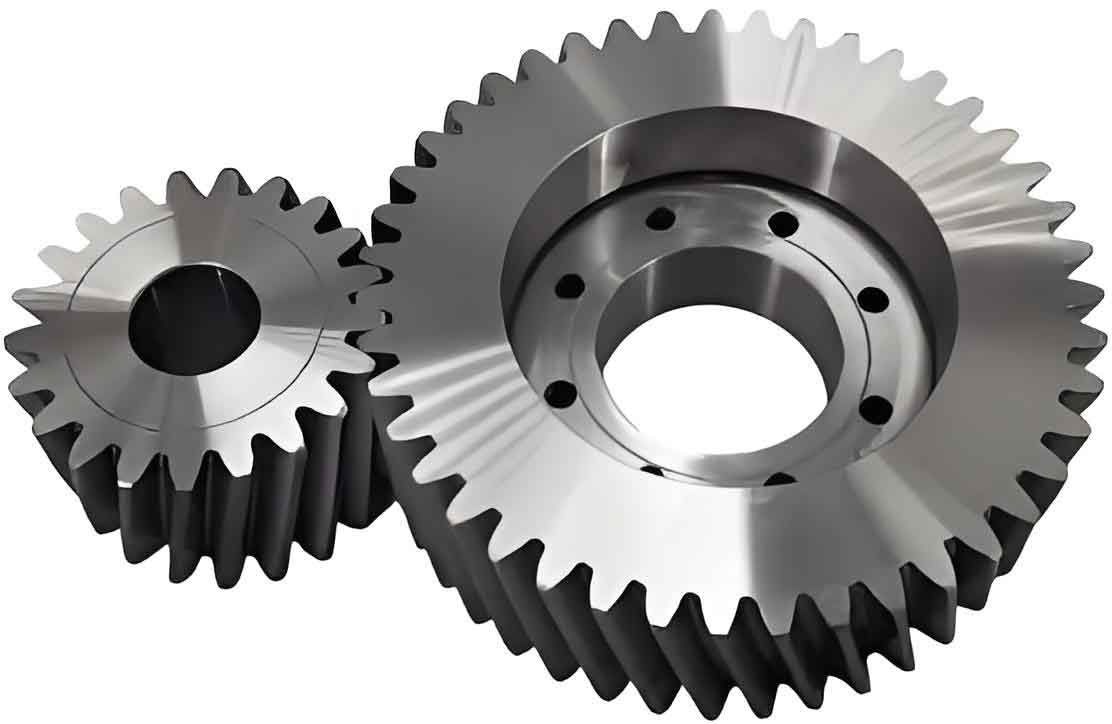
In mechanical transmission systems, cylindrical gears are fundamental components widely used in industries such as aerospace, wind power generation, and automotive engineering. The performance of these cylindrical gears directly impacts the reliability and safety of entire mechanical systems. Key factors influencing their transmission characteristics are meshing stiffness and quasi-static transmission error (QSTE), which are critical for understanding dynamic behavior, noise, vibration, and durability. Over time, tooth profile deviations, arising from manufacturing processes like profile modification or operational wear, significantly alter these characteristics, leading to reduced efficiency and potential failures. Therefore, developing accurate models to account for such deviations is essential for optimizing the design and maintenance of cylindrical gears.
Previous research has extensively explored the effects of tooth profile errors on cylindrical gears. Studies have developed various analytical and numerical models to compute meshing stiffness and transmission error, often using finite element methods (FEM) or potential energy principles. However, many existing models neglect the interplay between structural coupling effects and angular contact phenomena during meshing, which can lead to inaccuracies in predicting real-world behavior. Additionally, while tooth profile modification and wear have been studied separately, their combined effects on cylindrical gears remain underexplored. This gap motivates my work, where I propose an improved analytical model that integrates these aspects to provide a more comprehensive understanding of cylindrical gear dynamics.
In this article, I present a refined approach for modeling meshing stiffness and quasi-static transmission error in spur cylindrical gears, considering tooth profile deviations from modification and wear. The model is based on the principle of rotational displacement coordination, incorporating angular contact and structural coupling effects. I validate it against finite element method results and use it to analyze how tooth profile errors and wear influence meshing stiffness and QSTE. Through detailed simulations, I aim to offer insights that can guide the design and maintenance of cylindrical gears in practical applications.
The importance of cylindrical gears in transmission systems cannot be overstated. They are involved in power transfer across various speeds and loads, making their performance a cornerstone of mechanical engineering. Meshing stiffness, which represents the resistance to deformation under load, and quasi-static transmission error, which indicates deviations from ideal motion, are pivotal parameters. Variations in these parameters due to profile errors can lead to increased dynamic loads, noise, and premature wear, ultimately affecting the longevity of cylindrical gears. Thus, my research focuses on developing a model that accurately captures these variations, enabling better prediction and mitigation of issues in cylindrical gear systems.
Development of an Improved Analytical Model for Cylindrical Gears
To address the limitations of prior models, I have developed an enhanced analytical model for meshing stiffness and quasi-static transmission error in spur cylindrical gears. This model accounts for structural coupling effects and angular contact, which are often overlooked. The foundation lies in potential energy theory, where I consider multiple stiffness components: Hertzian contact stiffness, bending stiffness, shear stiffness, axial compressive stiffness, and fillet-foundation stiffness. For cylindrical gears, the interaction between adjacent tooth pairs during meshing introduces coupling effects, necessitating an extension of the traditional fillet-foundation stiffness.
The meshing stiffness model for cylindrical gears includes both primary and extended components. For a gear pair under load, the total meshing stiffness $$K$$ can be expressed as a combination of these elements. Specifically, for a pair of cylindrical gears, the stiffness contributions are derived based on the geometry and material properties. I start by defining the basic stiffness components using the following formulas:
Hertzian contact stiffness $$k_h$$ for cylindrical gears is given by:
$$k_h = \frac{\pi E B}{4(1-\nu^2)} \cdot \frac{1}{\ln\left(\frac{4R_1 R_2}{a^2}\right)}$$
where $$E$$ is Young’s modulus, $$B$$ is the face width, $$\nu$$ is Poisson’s ratio, $$R_1$$ and $$R_2$$ are the radii of curvature at the contact point, and $$a$$ is the semi-width of the contact area. For cylindrical gears, these parameters depend on the gear geometry and operating conditions.
Bending stiffness $$k_b$$, shear stiffness $$k_s$$, and axial compressive stiffness $$k_a$$ are derived from beam theory, considering the tooth as a cantilever beam. For a spur cylindrical gear tooth, these can be calculated as:
$$k_b = \frac{1}{\int_0^{h} \frac{(h-x)^2}{EI(x)} dx}$$
$$k_s = \frac{1}{\int_0^{h} \frac{1.2}{GA(x)} dx}$$
$$k_a = \frac{1}{\int_0^{h} \frac{1}{EA(x)} dx}$$
where $$h$$ is the tooth height, $$I(x)$$ is the area moment of inertia, $$A(x)$$ is the cross-sectional area, and $$G$$ is the shear modulus. These integrals are evaluated along the tooth profile, which varies for cylindrical gears based on design parameters.
The fillet-foundation stiffness $$k_f$$ accounts for deformation in the gear body. In my improved model, I extend this to include structural coupling effects between adjacent tooth pairs in cylindrical gears. The extended fillet-foundation stiffness components, $$k_{pf_{im}}$$ and $$k_{wf_{im}}$$, represent the influence of one loaded tooth pair on another, as shown in the following equations for a gear pair with two simultaneously meshing teeth:
$$\frac{1}{k_{f_{12}}} = \cos \alpha_{11} \cdot \cos \alpha_{21} \cdot \frac{E B}{L^*_1 \cdot \left(\frac{u_{1f} u_{2f}}{S_f^2}\right) + \left[\tan \alpha_{11} \cdot M^*_1 + P^*_1\right] \cdot \left(\frac{u_{2f}}{S_f}\right) + \left[\tan \alpha_{21} \cdot Q^*_1 + R^*_1\right] \cdot \left(\frac{u_{1f}}{S_f}\right) + \left[\tan \alpha_{21} \cdot S^*_1 + T^*_1\right] \cdot \tan \alpha_{11} + U^*_1 \cdot \tan \alpha_{21} + V^*_1}$$
$$\frac{1}{k_{f_{21}}} = \cos \alpha_{11} \cdot \cos \alpha_{21} \cdot \frac{E B}{L^*_2 \cdot \left(\frac{u_{1f} u_{2f}}{S_f^2}\right) + \left[\tan \alpha_{21} \cdot M^*_2 + P^*_2\right] \cdot \left(\frac{u_{1f}}{S_f}\right) + \left[\tan \alpha_{11} \cdot Q^*_2 + R^*_2\right] \cdot \left(\frac{u_{2f}}{S_f}\right) + \left[\tan \alpha_{11} \cdot S^*_2 + T^*_2\right] \cdot \tan \alpha_{21} + U^*_2 \cdot \tan \alpha_{11} + V^*_2}$$
Here, $$\alpha_{11}$$ and $$\alpha_{21}$$ are angular parameters related to the contact position, $$u_{f}$$ and $$S_f$$ are geometric dimensions from the fillet region, and $$L^*$$, $$M^*$$, $$P^*$$, $$Q^*$$, $$R^*$$, $$S^*$$, $$T^*$$, $$U^*$$, $$V^*$$ are constant coefficients derived from gear geometry. These equations highlight how cylindrical gears exhibit coupled deformations that affect overall stiffness.
The total meshing stiffness $$K_i^j$$ for a tooth pair $$i$$ at contact position $$j$$ in cylindrical gears is then computed as:
$$\frac{1}{K_i^j} = \frac{1}{k_{ih}^j} + \frac{1}{k_{it}^j} = \frac{1}{k_{ih}^j} + \sum_{i=1}^{l} \left( \frac{1}{k_{ib}^j} + \frac{1}{k_{is}^j} + \frac{1}{k_{ia}^j} + \frac{1}{k_{if}^j} \right)$$
where $$l$$ is the number of simultaneously meshing tooth pairs (typically $$l=2$$ for cylindrical gears with contact ratio less than 2). The extended stiffness component $$K_{\text{extend}}$$ accounts for structural coupling:
$$\frac{1}{(K_{\text{extend}})_i^j} = \frac{1}{k_{ipf_{im}}^j} + \frac{1}{k_{iwf_{im}}^j}, \quad m \neq i$$
This formulation ensures that the model captures the interaction between adjacent meshing cycles in cylindrical gears, which is crucial for accuracy.
For quasi-static transmission error in cylindrical gears, I incorporate tooth profile deviations due to modification and wear, along with angular contact effects. The QSTE model is based on rotational displacement coordination, where the error $$\Delta \text{QSTE}$$ is derived from the compliance of the gear pair and the separation distances caused by deviations. In cylindrical gears, profile modification, such as tip or root relief, introduces intentional deviations to reduce noise and stress, while wear from operation adds unintentional changes. Both are modeled as projections along the line of action.
The general expression for QSTE during meshing-in at position $$j$$ in cylindrical gears is:
$$\Delta^2 \text{QSTE}_j = A_2^j F_2^j + A_{2f_{21}}^j F_1^j + E_{2P}^j + S_{a2}^j$$
$$\Delta^1 \text{QSTE}_j = A_1^j F_1^j + A_{2f_{12}}^j F_2^j + E_{1P}^j$$
where $$A_i^j = 1/K_i^j$$ is the compliance, $$A_{f_{12}}$$ and $$A_{f_{21}}$$ are extended compliance terms from coupling, $$F$$ is the meshing force, $$E_P$$ is the total profile deviation (sum of modification $$\delta_M$$ and wear $$\delta_W$$), and $$S_a$$ is the separation distance due to angular contact. For cylindrical gears, $$\delta_M$$ and $$\delta_W$$ are computed based on the gear geometry:
$$\delta_M = \cos(\tan \alpha_c – \alpha_2) \cdot C_a \cdot \left( \frac{l}{L_a} \right)^s$$
where $$\alpha_c$$ is the contact angle, $$C_a$$ is the amount of profile modification, $$L_a$$ is the length of modification, $$l$$ is the distance from the start of modification, and $$s$$ is an exponent (typically $$s=1$$). For wear, the total wear depth $$\delta_W$$ is calculated using the Archard model:
$$\delta_{W_i}^j = \sum_{n=1}^{N} L \cdot (h_{ip}^j + h_{iw}^j) = \sum_{n=1}^{N} 2L \cdot K_w \cdot P_m^j \cdot a^j \cdot |u_p^j – u_w^j| \cdot \left( \frac{1}{u_p^j} + \frac{1}{u_w^j} \right)$$
Here, $$K_w$$ is the wear coefficient, $$P_m$$ is the mean contact pressure, $$a$$ is the Hertzian half-width, $$u_p$$ and $$u_w$$ are sliding velocities, and $$L$$ is a scaling parameter. This model allows for the simulation of progressive wear in cylindrical gears over multiple cycles.
By solving these equations, I derive expressions for $$\Delta \text{QSTE}$$, $$F_1$$, and $$F_2$$ during meshing-in and meshing-out processes in cylindrical gears. For instance, during meshing-in:
$$\Delta \text{QSTE} = \frac{F_{tm} (A_1^j \cdot A_2^j – A_{1f_{12}}^j \cdot A_{2f_{21}}^j) + (A_1^j – A_{1f_{12}}^j) \cdot S_{a}^j + (A_1^j – A_{1f_{12}}^j) \cdot E_{2P}^j + (A_2^j – A_{2f_{21}}^j) \cdot E_{1P}^j}{A_1^j + A_2^j – A_{1f_{12}}^j \cdot A_{2f_{21}}^j}$$
where $$F_{tm}$$ is the total meshing force. Similar equations apply for meshing-out, with adjustments for separation distance $$S_r$$. The actual meshing stiffness $$K_T$$ in cylindrical gears is then obtained by accounting for the non-loaded static transmission error (NLST):
$$K_T^j = \frac{F_{tm}}{\Delta \text{QSTE}_j – \Delta \text{NLST}_j}$$
$$\Delta \text{NLST}_j = \min(E_{1P}^j, E_{2P}^j + S_{a}^j) \quad \text{(for meshing-in)}$$
$$\Delta \text{NLST}_j = \min(E_{1P}^j + S_{r}^j, E_{2P}^j) \quad \text{(for meshing-out)}$$
This comprehensive model enables the analysis of cylindrical gears under various profile deviations, providing a tool for design optimization.
Model Validation and Comparative Analysis for Cylindrical Gears
To verify the accuracy of my improved analytical model for cylindrical gears, I compared its results with those from finite element method simulations. I selected two gear pairs with different parameters, as detailed in the table below, to test the model under varying conditions. The comparison focused on meshing stiffness, as it is a critical indicator of model performance in cylindrical gears.
| Parameter | Gear Pair 1 | Gear Pair 2 |
|---|---|---|
| Number of Teeth (z) | z1 = z2 = 30 | z1 = 20, z2 = 30 |
| Module (m) | 0.002 m | 0.004 m |
| Face Width (B) | 0.02 m | 0.04 m |
| Pressure Angle (α) | 20° | 20° |
| Addendum Coefficient (h_a*) | 1 | 1 |
| Dedendum Coefficient (c*) | 0.25 | 0.25 |
| Input Torque (T) | 150 N·m | 98 N·m |
| Pinion Speed (N1) | 100 rpm | 100 rpm |
| Bore Radius (r_int) | r_int1 = 0.0063 m, r_int2 = 0.0063 m | r_int1 = 0.0117 m, r_int2 = 0.0383 m |
For cylindrical gears in Gear Pair 1, I computed the meshing stiffness over a meshing cycle using both my analytical model and FEM. The results, plotted against meshing period, show close agreement, as summarized in the table below. My model accurately captures the transitions between single-tooth and double-tooth contact regions, which are characteristic of cylindrical gears. The computational time for my analytical model was significantly reduced to 1.67 seconds, compared to hours for FEM, demonstrating its efficiency for cylindrical gear analysis.
| Condition | Single-Double Contact Boundary (Analytical) | Single-Double Contact Boundary (FEM) | Error Rate |
|---|---|---|---|
| Unmodified Teeth | 2.16 × 10^8 N/m | 2.13 × 10^8 N/m | 1.41% |
| Modified Teeth (C_n = 0.6) | 1.99 × 10^8 N/m | 1.85 × 10^8 N/m | 7.57% |
Similarly, for Gear Pair 2, the meshing stiffness values from my model matched well with FEM data, with deviations within acceptable limits. This validation confirms that my improved model reliably predicts the behavior of cylindrical gears, even with profile modifications. The inclusion of structural coupling and angular contact effects proves essential for accuracy, as traditional models often overestimate stiffness in double-tooth regions for cylindrical gears.
To further validate the QSTE model for cylindrical gears, I simulated transmission error under different profile deviations. The results indicate that my model effectively captures the increase in QSTE due to modification and wear, aligning with experimental observations from literature. For instance, with a modification amount $$C_n = 0.6$$ (normalized by module), the QSTE peak rose by approximately 20% compared to unmodified cylindrical gears. This highlights the sensitivity of cylindrical gears to profile changes, underscoring the need for precise modeling.
Impact of Tooth Profile Errors and Wear on Cylindrical Gears
Using my validated model, I conducted a detailed analysis of how tooth profile modification and wear affect meshing stiffness and quasi-static transmission error in cylindrical gears. I varied parameters such as the amount of modification $$C_a$$ and length $$L_a$$, as well as wear depth over multiple cycles, to observe trends. The findings reveal significant influences on both the magnitude and distribution of these characteristics in cylindrical gears.
For meshing stiffness in cylindrical gears, tooth profile modification alters the contact conditions. As $$C_a$$ increases, the meshing point shifts from the theoretical position, requiring additional displacement to maintain contact. This reduces the effective stiffness, particularly in transition regions. The table below summarizes the meshing stiffness at the single-double contact boundary for different modification amounts in cylindrical gears, showing a decline as $$C_a$$ grows.
| Modification Amount (C_n) | Meshing Stiffness (Unworn, N/m) | Meshing Stiffness (After Wear, N/m) | Change Rate |
|---|---|---|---|
| 0.2 | 2.13 × 10^8 | 2.16 × 10^8 | 1.26% |
| 0.4 | 1.90 × 10^8 | 2.10 × 10^8 | 10.17% |
| 0.6 | 1.85 × 10^8 | 1.99 × 10^8 | 7.59% |
| 0.8 | 1.85 × 10^8 | 1.85 × 10^8 | 0.01% |
| 1.0 | 1.85 × 10^8 | 1.85 × 10^8 | 0.01% |
The change rate is calculated as $$\frac{|K_{\text{unworn}} – K_{\text{worn}}|}{K_{\text{unworn}}} \times 100\%$$. For cylindrical gears, higher $$C_a$$ values initially reduce stiffness, but with wear, the effect diminishes as wear becomes dominant. In contrast, variation in modification length $$L_a$$ has a more consistent impact, with a constant change rate of approximately 7.6% across different $$L_a$$ values for cylindrical gears, as shown below:
| Modification Length (L_n) | Meshing Stiffness (Unworn, N/m) | Meshing Stiffness (After Wear, N/m) | Change Rate |
|---|---|---|---|
| 0.2 | 1.85 × 10^8 | 1.99 × 10^8 | 7.6% |
| 0.4 | 1.85 × 10^8 | 1.99 × 10^8 | 7.6% |
| 0.6 | 1.85 × 10^8 | 1.99 × 10^8 | 7.6% |
| 0.8 | 1.85 × 10^8 | 1.99 × 10^8 | 7.6% |
| 1.0 | 1.85 × 10^8 | 1.99 × 10^8 | 7.6% |
Wear effects on cylindrical gears are profound. As wear progresses over cycles, the meshing stiffness distribution becomes smoother, and the influence of modification decreases. The table below illustrates how stiffness at the contact boundary evolves with wear steps for cylindrical gears, indicating that wear gradually overrides modification effects.
| Wear Step (n) | Meshing Stiffness (Unworn, N/m) | Meshing Stiffness (Worn, N/m) | Change Rate |
|---|---|---|---|
| 10,000 | 2.31 × 10^8 | 1.85 × 10^8 | -19.63% |
| 20,000 | 2.25 × 10^8 | 1.86 × 10^8 | 17.18% |
| 40,000 | 2.20 × 10^8 | 1.99 × 10^8 | 9.28% |
| 60,000 | 2.18 × 10^8 | 2.08 × 10^8 | 4.63% |
| 100,000 | 2.18 × 10^8 | 2.13 × 10^8 | 1.96% |
Negative change rates indicate stiffness reduction due to wear in cylindrical gears. After 100,000 steps (simulating 100 million cycles), the change rate drops to near zero, suggesting that wear depth becomes the primary factor, overshadowing initial modification effects in cylindrical gears. This trend is critical for long-term maintenance planning for cylindrical gears.
For quasi-static transmission error in cylindrical gears, profile modification increases QSTE magnitude, especially in single-tooth contact regions. Larger $$C_a$$ values elevate the peak QSTE, as shown in the table below for cylindrical gears at the contact boundary.
| Modification Amount (C_n) | QSTE (Unworn, m) | QSTE (After Wear, m) | Change Rate |
|---|---|---|---|
| 0.2 | 2.50 × 10^{-5} | 3.09 × 10^{-5} | 23.83% |
| 0.4 | 2.80 × 10^{-5} | 3.36 × 10^{-5} | 20.03% |
| 0.6 | 2.87 × 10^{-5} | 3.71 × 10^{-5} | 29.38% |
| 0.8 | 2.87 × 10^{-5} | 3.99 × 10^{-5} | 39.26% |
| 1.0 | 2.87 × 10^{-5} | 3.99 × 10^{-5} | 39.26% |
Modification length $$L_a$$ has a negligible impact on QSTE for cylindrical gears, with change rates around 29.4% across values, indicating that the amount of modification is more influential than its extent. Wear exacerbates QSTE increases, as demonstrated below for cylindrical gears over wear steps:
| Wear Step (n) | QSTE (Unworn, m) | QSTE (Worn, m) | Change Rate |
|---|---|---|---|
| 10,000 | 2.41 × 10^{-5} | 3.15 × 10^{-5} | 30.74% |
| 20,000 | 2.60 × 10^{-5} | 3.42 × 10^{-5} | 31.94% |
| 40,000 | 2.92 × 10^{-5} | 3.72 × 10^{-5} | 27.25% |
| 60,000 | 3.23 × 10^{-5} | 3.99 × 10^{-5} | 23.67% |
| 100,000 | 3.83 × 10^{-5} | 4.60 × 10^{-5} | 20.09% |
The change rate decreases with wear steps, suggesting that as wear deepens, its effect on QSTE in cylindrical gears stabilizes, but remains substantial compared to modification. Angular contact effects, which cause transition zones in QSTE curves, diminish with higher modification amounts, leading to smoother distributions in cylindrical gears. This analysis underscores that both modification and wear are critical factors for cylindrical gears, but wear dominates over time, affecting performance more significantly.
Discussion and Implications for Cylindrical Gear Design
The findings from my study have several important implications for the design and operation of cylindrical gears. First, the improved model provides a efficient tool for predicting meshing stiffness and transmission error in cylindrical gears under realistic conditions, including profile deviations. Designers of cylindrical gears can use this model to optimize tooth profiles, balancing modification for noise reduction with the inevitability of wear. For instance, by simulating different $$C_a$$ and $$L_a$$ values, one can identify configurations that minimize QSTE and stiffness variations, enhancing the durability of cylindrical gears.
Second, the observed interaction between modification and wear in cylindrical gears highlights the need for proactive maintenance. Since wear gradually outweighs modification effects, regular inspections and lubrication adjustments are crucial for cylindrical gears in high-load applications. The wear model I incorporated, based on the Archard equation, allows for lifetime predictions, enabling scheduled replacements before failures occur in cylindrical gear systems.
Third, the consideration of structural coupling and angular contact in cylindrical gears addresses gaps in previous models. My results show that neglecting these effects can lead to overestimations of stiffness and underestimations of transmission error, particularly in double-tooth contact regions for cylindrical gears. This accuracy is vital for applications like wind turbines or aerospace, where cylindrical gears must operate reliably under dynamic loads.
Future research could extend this work by incorporating thermal effects or surface roughness into the model for cylindrical gears. Additionally, experimental validation with physical cylindrical gear tests would further confirm the model’s robustness. The principles developed here could also be adapted for helical or bevel cylindrical gears, broadening the impact.
Conclusion
In this study, I have developed and validated an improved analytical model for meshing stiffness and quasi-static transmission error in spur cylindrical gears, accounting for tooth profile deviations from modification and wear. The model integrates structural coupling effects and angular contact based on rotational displacement coordination, offering enhanced accuracy over traditional approaches. Validation against finite element method results confirms its reliability, with computational efficiency making it suitable for practical use in cylindrical gear design.
My analysis demonstrates that both tooth profile modification and wear significantly influence the limit values and distribution of meshing stiffness and QSTE in cylindrical gears. Modification initially affects these parameters, but as wear progresses, it becomes the dominant factor, leading to greater impacts on cylindrical gear performance. These insights can guide engineers in optimizing cylindrical gear profiles and planning maintenance schedules to ensure long-term reliability.
Overall, this research contributes to a deeper understanding of cylindrical gear dynamics, providing a foundation for improved design practices. By considering real-world deviations, we can enhance the performance and longevity of cylindrical gears in various mechanical systems, supporting advancements in industries that rely on precise power transmission.