
In the realm of automotive transmissions, the pursuit of efficiency and durability has driven continuous innovation in component design and manufacturing. Among these components, spiral gears hold a pivotal role due to their ability to transmit power smoothly and quietly under high loads. However, the demanding performance requirements for spiral gears, including geometric precision and fatigue resistance, pose significant challenges for traditional manufacturing methods. Powder metallurgy (PM) emerges as a cost-effective solution for producing complex shapes like spiral gears with minimal material waste, yet the inherent porosity of PM parts often limits their mechanical strength, particularly in fatigue-critical applications such as tooth root bending. To address this, surface densification techniques, especially gear rolling, have been developed to selectively enhance the density and performance of spiral gear surfaces. This article delves into the principles, processes, and outcomes of surface densification for spiral gears, leveraging first-hand insights and experimental data to underscore its viability. Through detailed analysis, we explore how surface densification can elevate spiral gear quality to meet stringent standards like DIN, ISO, and AGMA, while improving fatigue life through tailored material properties. The focus remains on spiral gears, as their helical tooth geometry introduces unique considerations for densification and performance optimization. By integrating tables and formulas, we summarize key findings and provide a comprehensive guide for advancing spiral gear technology in automotive and industrial applications.
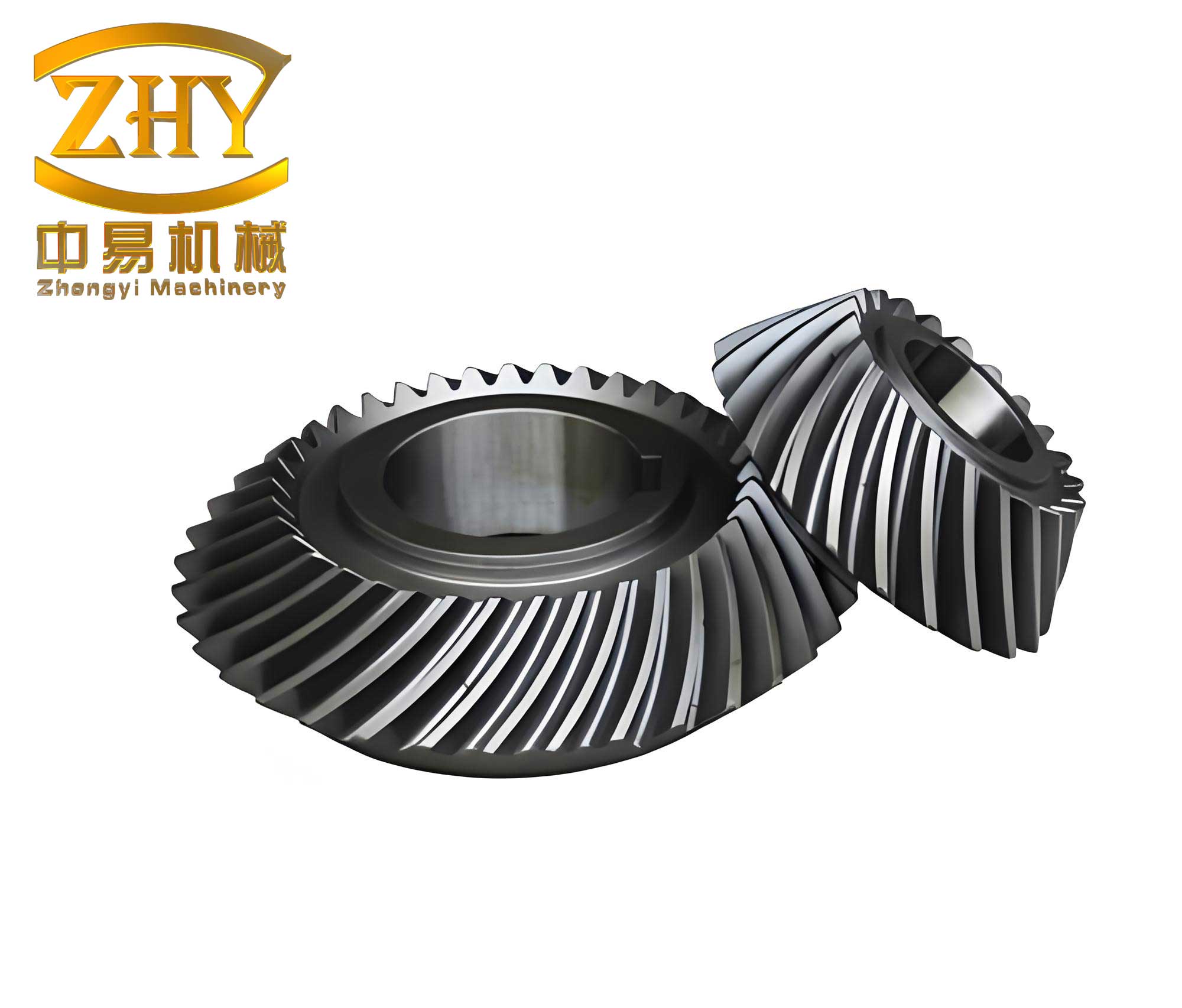
The concept of surface densification revolves around the selective compression of a component’s surface layer to eliminate porosity and increase density, thereby enhancing mechanical properties such as hardness, wear resistance, and fatigue strength. For spiral gears, this is particularly crucial because the tooth flank and root regions experience high cyclic stresses during operation. Gear rolling, a common densification method, involves pressing the spiral gear between precision dies to plastically deform the surface, achieving near-full density in critical areas. The process not only closes pores but also introduces beneficial compressive residual stresses that counteract tensile stresses under load. The effectiveness of surface densification for spiral gears can be quantified through parameters like densification depth, which is defined as the distance from the surface to where porosity exceeds a threshold, typically 2%. This depth is influenced by material properties, rolling force, and the geometry of the spiral gear. Mathematically, the densification depth $d$ can be modeled using a simplified equation derived from plasticity theory:
$$ d = C \cdot \sqrt{\frac{P}{\sigma_y \cdot A}} $$
where $P$ is the applied rolling force, $\sigma_y$ is the yield strength of the PM material, $A$ is the contact area between the die and spiral gear tooth, and $C$ is a constant that accounts for material strain hardening and friction. This formula highlights how optimizing process parameters can tailor densification for spiral gears, ensuring that high-stress zones like the tooth root receive adequate compression. Furthermore, the helical angle of spiral gears complicates stress distribution during rolling, necessitating specialized die designs to achieve uniform densification across the tooth profile. The interplay between densification and subsequent heat treatment also plays a vital role in final performance, as it affects microstructure evolution and residual stress states. In essence, surface densification transforms porous PM spiral gears into high-integrity components capable of rivaling wrought steel gears in demanding applications.
To implement surface densification for spiral gears, a systematic process route is essential, encompassing powder selection, compaction, sintering, rolling, and heat treatment. We begin with the material foundation: two iron-based powder mixes are commonly used for spiral gears, such as Astaloy 85Mo (Fe-0.85Mo) and Astaloy CrLTM (Fe-1.5Cr-0.2Mo), both blended with small amounts of graphite for carburizing potential. The chemical compositions after sintering are critical for achieving desired mechanical properties, as summarized in Table 1. These materials offer a balance of hardenability and cost-effectiveness for spiral gear production.
| Material Designation | Carbon (C) | Molybdenum (Mo) | Chromium (Cr) | Iron (Fe) | Typical Application |
|---|---|---|---|---|---|
| Astaloy 85Mo | 0.28% | 0.85% | 0% | Balance | High-strength spiral gears |
| Astaloy CrLTM | 0.28% | 0.20% | 1.50% | Balance | Corrosion-resistant spiral gears |
The manufacturing sequence starts with compacting the powder into cylindrical blanks at pressures ranging from 600 to 800 MPa, achieving green densities of approximately 7.1 to 7.2 g/cm³. These blanks are then sintered in a controlled atmosphere, such as 90% N₂ and 10% H₂, at temperatures around 1120°C for 30 minutes to foster diffusion bonding and reduce porosity. Post-sintering, the spiral gear blanks are machined to a near-net shape via turning and hobbing, with intentional material allowances to accommodate densification during rolling. The gear rolling process employs a dedicated machine, like the HC20CN model, where the spiral gear is pressed between two dies that mimic the tooth geometry. The rolling cycle consists of engagement, loading to a preset center distance, and unloading, typically completing within 8-15 seconds per spiral gear. The force-displacement relationship during rolling can be expressed as:
$$ F = k \cdot \Delta x^n $$
where $F$ is the rolling force, $\Delta x$ is the displacement, $k$ is a stiffness coefficient dependent on the spiral gear material and die design, and $n$ is an exponent reflecting plastic deformation behavior. After rolling, the spiral gears undergo heat treatment, such as gas or vacuum carburizing followed by quenching and tempering, to achieve surface hardness profiles tailored for fatigue resistance. The case depth, defined as the depth to 550 HV0.1, is controlled by carburizing time and temperature, often targeting 0.3-0.5 mm for spiral gears in transmission systems. This integrated approach ensures that surface densification synergizes with metallurgical strengthening to boost spiral gear performance.
Experimental evaluation of surface-densified spiral gears reveals significant improvements in both geometric quality and mechanical properties. Densification depth measurements, obtained through metallographic analysis, show that the tooth root region of spiral gears can achieve depths up to 0.5 mm, while the tooth flank reaches about 0.2 mm, as illustrated in Table 2. This asymmetry stems from stress concentrations in the root during rolling, which is beneficial since the root is critical for bending fatigue. The density gradient from surface to core can be modeled using an exponential decay function:
$$ \rho(x) = \rho_c + (\rho_s – \rho_c) \cdot e^{-\lambda x} $$
where $\rho(x)$ is the density at depth $x$, $\rho_c$ is the core density (around 7.1 g/cm³), $\rho_s$ is the surface density (near 7.8 g/cm³, i.e., full density), and $\lambda$ is a decay constant influenced by rolling parameters. For spiral gears, achieving consistent densification across the helical teeth is challenging but attainable with optimized dies.
| Gear Type | Material | Densification Depth on Tooth Flank (mm) | Densification Depth on Tooth Root (mm) | Surface Hardness (HV0.1) | Case Depth (mm) |
|---|---|---|---|---|---|
| Spiral Gear (Helical) | Astaloy 85Mo | 0.18-0.22 | 0.45-0.52 | 830-860 | 0.35-0.40 |
| Spiral Gear (Helical) | Astaloy CrLTM | 0.20-0.25 | 0.40-0.48 | 750-780 | 0.45-0.55 |
Gear quality assessment using 3D coordinate measuring machines indicates that surface-densified spiral gears can meet DIN grade 8 or better for parameters like profile deviation and helix error. Key metrics are summarized in Table 3, demonstrating that rolling not only densifies but also refines the geometry of spiral gears. The stability of the process is evidenced by reduced scatter in ball diameter measurements post-rolling, with standard deviations dropping from 0.0225 mm to 0.0031 mm for spiral gears. This consistency is vital for mass production of reliable spiral gears.
| Quality Parameter | Symbol | Typical Value (μm) | Achieved DIN Grade | Importance for Spiral Gears |
|---|---|---|---|---|
| Total Profile Deviation | F_α | 7-9 | 7-8 | Affects noise and load distribution in spiral gears |
| Total Helix Deviation | f_β | 6-8 | 6-8 | Critical for smooth meshing of helical spiral gears |
| Cumulative Pitch Error | F_p | 4-6 | 4-6 | Ensures uniform motion transmission in spiral gears |
| Tooth Thickness Deviation | R_s | 3-5 | 3-5 | Influences backlash and efficiency of spiral gears |
Fatigue performance is a cornerstone of spiral gear validation, with tooth root bending tests conducted on servo-hydraulic machines. For surface-densified spiral gears made from Astaloy 85Mo, the endurance limit at 10⁷ cycles reaches 9.4 kN, comparable to conventional steel spiral gears at 10 kN. The relationship between fatigue strength $\sigma_f$ and densification parameters can be expressed as:
$$ \sigma_f = \sigma_0 + \alpha \cdot d \cdot H_s^{1/2} $$
where $\sigma_0$ is the base fatigue strength of the porous material, $\alpha$ is a constant, $d$ is densification depth, and $H_s$ is surface hardness. This formula underscores how surface densification amplifies the fatigue resistance of spiral gears by enhancing both density and hardness. Additionally, residual stress measurements via X-ray diffraction show compressive stresses of up to -300 MPa in the densified layer of spiral gears, which inhibits crack initiation and propagation. The fatigue life $N_f$ under cyclic stress $\sigma_a$ can be modeled using a modified Basquin equation:
$$ N_f = C \cdot (\sigma_a – \sigma_{th})^{-b} $$
where $C$ and $b$ are material constants, and $\sigma_{th}$ is the threshold stress increased by densification. For spiral gears, this translates to extended service life in high-load applications like automotive transmissions. Moreover, microstructural analysis reveals a refined grain structure in the densified zone of spiral gears, contributing to toughness and resistance to pitting on tooth flanks.
The discussion of surface densification for spiral gears extends beyond immediate benefits to address challenges and optimization strategies. One key aspect is the interaction between densification and heat treatment: for spiral gears, carburizing after rolling must be carefully controlled to prevent distortion and ensure uniform case depth. The helical geometry of spiral gears can lead to uneven carbon diffusion, but vacuum carburizing mitigates this by providing better atmosphere uniformity. Another consideration is the economic feasibility of adding densification to PM spiral gear production. The incremental cost is low relative to the performance gain, making spiral gears competitive with machined counterparts. Process optimization involves finite element analysis (FEA) to simulate rolling stresses for spiral gears, with the von Mises stress $\sigma_{vm}$ given by:
$$ \sigma_{vm} = \sqrt{\frac{(\sigma_1 – \sigma_2)^2 + (\sigma_2 – \sigma_3)^2 + (\sigma_3 – \sigma_1)^2}{2}} $$
where $\sigma_1, \sigma_2, \sigma_3$ are principal stresses during rolling. By tuning die profiles and forces, uniform densification across spiral gear teeth can be achieved. Furthermore, material development focuses on alloy designs that enhance densification response; for instance, adding chromium in Astaloy CrLTM improves hardenability but may require special sintering atmospheres for spiral gears. The environmental advantage of PM spiral gears—reduced material waste and elimination of cutting fluids—is amplified by surface densification, as it extends component life and reduces resource consumption. Looking ahead, advancements in additive manufacturing could enable hybrid approaches where spiral gears are printed with graded densities, but rolling remains a robust method for mass production.
In conclusion, surface densification via gear rolling is a transformative technique for elevating the performance of powder metallurgy spiral gears. It selectively enhances density in critical regions like tooth roots and flanks, leading to superior gear quality, fatigue resistance, and durability that meet automotive standards. The process is cost-effective and scalable, with demonstrated stability in producing high-precision spiral gears. Key formulas and tables summarized here provide a framework for optimizing densification for spiral gears, emphasizing parameters such as depth, hardness, and geometric accuracy. Future research should explore advanced materials and real-time monitoring to further refine spiral gear manufacturing. As the demand for efficient and reliable transmissions grows, surface-densified spiral gears will play an increasingly vital role in pushing the boundaries of engineering innovation.