
1. Introduction
Hypoid gear, characterized by their crossed-axis configuration and high torque transmission efficiency, are pivotal in modern mechanical systems requiring compact design and high power density. Among these, High-Reduction Hypoid Gear (HRH) stand out due to their ultra-high reduction ratios (e.g., 3:60) and lightweight structures. However, their complex spatial tooth surfaces pose significant challenges in machining parameter calculation and meshing quality control. Traditional methods like the Hypoid Format Tilt (HFT) or Hypoid Generating Modified (HGM) methods often fail to address the curvature correction requirements of High-Reduction Hypoid Gear, especially when tooth counts are minimal (e.g., 3–5 teeth). This study proposes a surface synthesis approach integrating modified cutter profiles, ease-off gradient control, and dynamic meshing simulation to resolve these challenges.
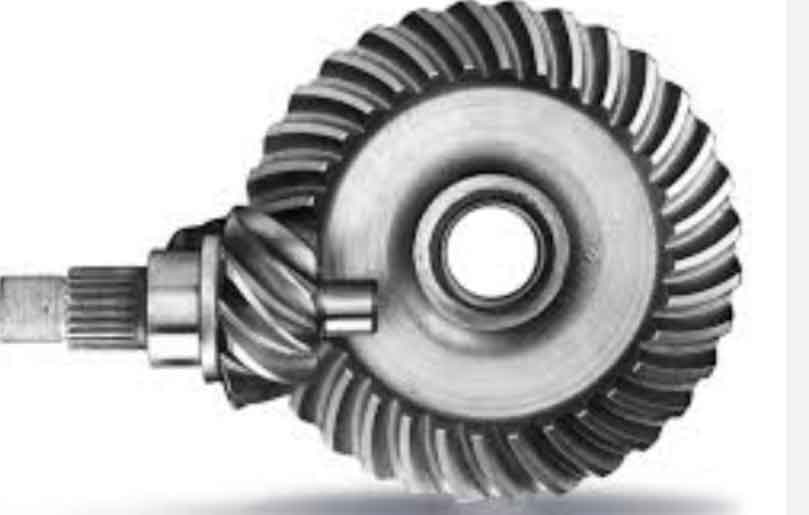
2. Mathematical Framework for Hypoid Gear Meshing
2.1 Coordinate System and Meshing Equation
The spatial meshing of hypoid gear involves two rotating bodies (pinion and gear) with crossed axes. Let’s define the coordinate systems (Figure 1):
- S1, S2: Body-fixed frames for the pinion and gear.
- S0: Global frame where the z0-axis aligns with the gear’s rotation axis.
- Sd, Sp: Intermediate frames accounting for offsets E, G, P, and tilt γ.
The meshing equation for spatial gears is derived as:f(u,v,φ)=n⋅v(12)=0(1)
where n is the surface normal, v(12) is the relative velocity, and φ represents angular parameters. For constant-axis rotation, Equation (1) simplifies to:cos(φ2+ε)=U2+V2W,tanε=UV(2)
Here, U, V, and W are functions of geometric parameters (e.g., E, γ, G) and surface coordinates.
2.2 Curvature Correction via Cutter Profiling
Conventional straight-edged cutters produce insufficient tooth curvature for High-Reduction Hypoid Gear. To address this, a parabolic modification is applied to the cutter profile (Figure 3):
- Transverse Modification:w=0.5a1(u−u0)2,α2(u2)=α0+arctan(a1(u−u0))(3)
- Longitudinal Modification:L=0.5a2(θ−θ0)2,θ2(θ)=θ0+arctan(a2(θ−θ0))(4)
These modifications adjust the local curvature of the gear surface, ensuring conjugate meshing.
3. Surface Synthesis for Hypoid Gear Machining
3.1 Ease-Off Gradient Control
The ease-off surface represents the deviation between the theoretical and actual tooth surfaces. Its gradient is governed by an elliptical function:a2xa2+b2xb2=41(5)
where a, b, and λ control the contact ellipse’s size and orientation. The curvature difference is:Δka=a28δ,Δkb=b28δ(6)
This ensures controlled load distribution and stress minimization.
3.2 Machining Parameter Calculation
The pinion’s tooth surface is synthesized by solving the nonlinear system:mini=1∑15fi2(X),X=[Sr1,q1,Em1,Xg1,mp1,u1(i),θ1(i)]T(7)
Key parameters for a 3:60 High-Reduction Hypoid Gear is summarized in Table 1.
Table 1: Machining Parameters for HRH Gears
| Parameter | Pinion (Concave) | Pinion (Convex) | Gear |
|---|---|---|---|
| Blank Angle (°) | 10.9919 | 10.9919 | 74.7639 |
| Machine Center (mm) | -1.5253 | -1.5400 | 0 |
| Vertical Offset (mm) | 39.8843 | 40.2278 | 0 |
| Horizontal Offset (mm) | -0.3367 | -0.9467 | 5.3428 |
| Cutter Angle (°) | 75.8424 | 81.5262 | 42.2143 |
| Radial Setting (mm) | 52.0862 | 51.6782 | 53.1513 |
| Ratio m12 | 20.0152 | 19.7476 | — |
| Cutter Radius (mm) | 77.725 | 72.644 | 37.3 / 38.9 |
| Pressure Angle (°) | 20.0 | 28.0 | 21.0 |
4. Contact Simulation and Dynamic Analysis
4.1 Ease-Off Topography
The synthesized ease-off surface (Figure 7) shows a gradient extending radially from the base point M0, with maximum deviations of 34–196 µm. The contact path (Figure 8a) and transmission error (Figure 8b) confirm a high contact ratio (>5) and smooth load transition.
Key Observations:
- Contact lines exhibit minimal edge-loading due to parabolic ease-off.
- Transmission error (TE) remains below 1 arcmin under 200 N·m load.
4.2 Vibration Performance
Dynamic testing (Figures 11–13) reveals:
- Dominant frequencies: Meshing frequency (fm) and shaft harmonics (fd).
- Axial vibration acceleration <3.11 m/s², indicating stable meshing.
- High loads reduce stiffness variation, enhancing stability.
Table 2: Vibration Peaks at 1,410 rpm
| Load (N·m) | Axial Acceleration (m/s²) | Dominant Frequency (Hz) |
|---|---|---|
| 50 | 2.15 | 3fm, 4fd |
| 200 | 1.78 | fm, 2fd |
5. Experimental Validation
5.1 Contact Pattern Analysis
Rolling tests (Figure 9) confirm elliptical contact spots aligned with ease-off predictions. No edge contacts or stress concentrations were observed.
5.2 Dynamic Transmission Efficiency
The High-Reduction Hypoid Gear achieved >98% efficiency under 200 N·m load, validating the surface synthesis approach.
6. Conclusion
This study resolves the long-standing challenge of machining parameter calculation and meshing quality control for high-reduction hypoid gear. By integrating cutter profiling, ease-off gradient design, and surface synthesis, we achieved:
- Precise curvature correction for ultra-high reduction ratios.
- A 5.2 contact ratio, ensuring smooth torque transmission.
- Vibration levels compatible with “quiet” industrial applications.