
In modern heavy machinery transmission systems, such as those used in energy equipment, large ships, and aerospace applications, the herringbone gear plays a critical role due to its high load-bearing capacity, smooth transmission, and minimal axial load. However, the stability, reliability, and vibration noise requirements for these systems are increasingly stringent, driving the development of herringbone gears toward higher precision and longer service life. A key challenge in achieving this is the symmetry error introduced during manufacturing, which refers to the misalignment between the left and right helical gears of a herringbone gear pair. This error can severely degrade meshing performance, leading to uneven load distribution, increased axial vibration, and reduced dynamic characteristics. In this study, I investigate the impact of symmetry error on the meshing behavior of herringbone gears and propose a coupling compensation method using axial assembly error to mitigate these effects. By developing a loaded tooth contact analysis model that incorporates symmetry error and analyzing its influence on contact stress, axial displacement, and axial force, I aim to provide insights into optimizing herringbone gear transmission for enhanced stability.
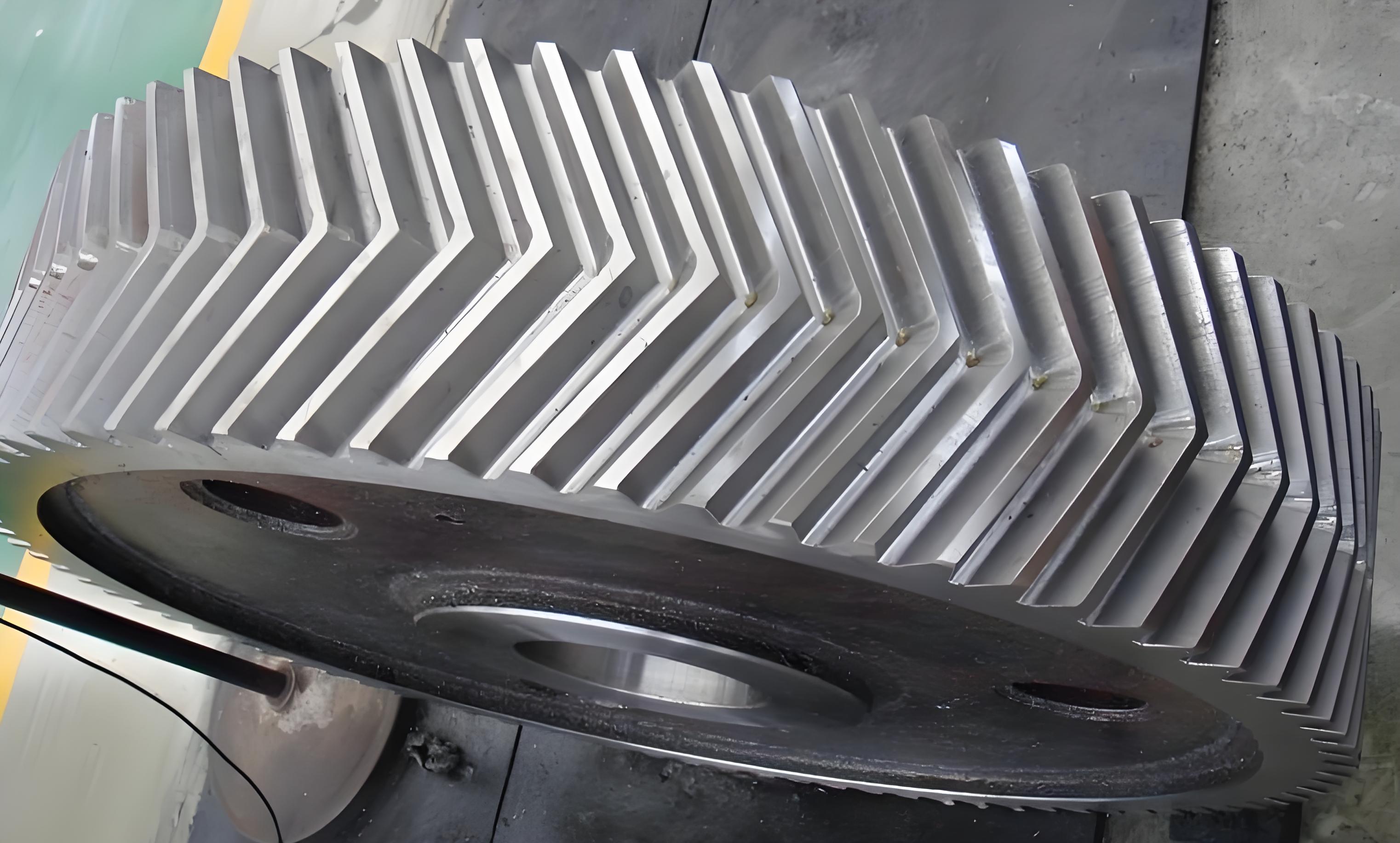
The herringbone gear consists of two mirrored helical gears, and any asymmetry between them—known as symmetry error—can disrupt the balance of forces during meshing. This error arises from limitations in machining processes and manual operations, often resulting in a deviation where the tooth trace extensions of the left and right helical gears do not align perfectly. To quantify this, I define the symmetry error, denoted as $\zeta$, as the vertical distance between the extended tooth lines on a reference plane. Understanding its effects requires a robust analytical framework. Therefore, I begin by establishing a loaded tooth contact analysis model for herringbone gears that accounts for symmetry error, based on geometric contact principles and elastic deformation theory.
In my model, I treat the herringbone gear pair as two parallel helical gear contacts. The tooth contact is simplified to a line contact along the major axis of the instantaneous contact ellipse, discretized into $n$ points to capture local deformations. For a herringbone gear with symmetry error, the initial gap at a discrete point $k$ on the tooth surface before loading is influenced by the error. Let $\zeta_s$ represent half of the symmetry error in the normal meshing direction. For two contacting tooth pairs, I and II, the initial gaps are given by:
$$ w_{kI} = \delta + b_{kI} + \zeta_s $$
$$ w_{kII} = \delta + b_{kII} – \zeta_s $$
Here, $\delta$ is the transmission error, and $b_{k}$ is the spacing at point $k$. The displacement coordination equation for the herringbone gear system, considering elastic deformation, contact compliance, and axial float, is expressed as:
$$ [S]_t \{F\}_t + \{U\}_t + \{w\}_t = \{Z\} + \{d\}_t $$
where $t$ denotes tooth pair I or II, $[S]$ is the bending-shear flexibility matrix, $\{F\}$ is the load vector at discrete points, $\{U\}$ is the contact deformation vector, $\{w\}$ is the initial gap vector, $\{Z\}$ is the normal displacement vector, and $\{d\}$ is the residual gap vector. The contact conditions must satisfy no embedding, meaning $d_{kt} = 0$ when $F_{kt} > 0$, and $d_{kt} > 0$ when $F_{kt} = 0$. Due to symmetry error, the left and right tooth faces experience different loads, generating an axial force. To balance this, I introduce a force equilibrium constraint:
$$ \sum_{k=1}^{n} F_{kI} = \sum_{k=1}^{n} F_{kII} $$
Additionally, axial float $\sigma$ is incorporated to allow small axial movements of the pinion, converting it into a normal direction vector $\{\sigma_s\}$. The complete loaded contact equation, solved using a two-layer iterative method with the golden section algorithm, is:
$$
\begin{cases}
-[S]_t \{F\}_t – \{U\}_t + \{Z\} + \{d\}_t + \{\sigma_s\}_t = \{w\}_t \\
\sum_{k=1}^{n} F_{kI} = \sum_{k=1}^{n} F_{kII} \\
\left| \sum_{k=1}^{n} \sigma_{sK I} \right| + \left| \sum_{k=1}^{n} \sigma_{sK II} \right| = 0 \\
d_{kt} = 0, F_{kt} > 0; \quad d_{kt} > 0, F_{kt} = 0 \quad \text{for } t = \text{I, II}
\end{cases}
$$
To validate this model, I conducted a finite element analysis using ANSYS. A herringbone gear pair was modeled with parameters as listed in Table 1, setting a symmetry error of 0.02 mm for the gear. The mesh consisted of 400,480 nodes and 134,864 hexahedral elements. Boundary conditions included a revolute joint for the gear and a cylindrical joint for the pinion to allow axial float. The results, comparing axial displacement and loaded transmission error, showed good agreement with my analytical model, confirming its accuracy. The finite element analysis captured nonlinearities like contact and friction, leading to periodic fluctuations due to tooth pair alternation, but the overall trends aligned, as summarized in Table 2.
| Parameter | Pinion | Gear |
|---|---|---|
| Number of teeth, $z$ | 34 | 30 |
| Module, $m$ (mm) | 5 | 5 |
| Pressure angle, $\alpha$ (degrees) | 20 | 20 |
| Helix angle, $\beta$ (degrees) | 35 | 35 |
| Total face width, $b$ (mm) | 160 | 160 |
| Relief groove width, $b_d$ (mm) | 24 | 24 |
| Relief groove depth, $d$ (mm) | 5 | 4 |
| Symmetry error, $\zeta$ (mm) | 0 | 0.02 |
| Rotational speed, $n$ (r/min) | 2000 | 6000 |
| Load torque, $T$ (N·m) | 6,000 | — |
| Parameter | Analytical Model | Finite Element Analysis |
|---|---|---|
| Axial displacement amplitude (mm) | ~0.018 | ~0.017-0.019 |
| Loaded transmission error (rad) | ~ -0.174 | ~ -0.170 to -0.178 |
| Oscillation frequency (Hz) | — | ~999 |
Next, I analyzed the impact of varying symmetry errors on the meshing characteristics of the herringbone gear. Based on precision standards, symmetry error in herringbone gears is typically controlled within Grade 8 or worse due to manufacturing constraints. I simulated errors of 0.05 mm, 0.1 mm, 0.15 mm, and 0.2 mm using finite element analysis. The contact stress distribution, as shown in the simulations, revealed asymmetric loading. For instance, with a symmetry error of 0.2 mm, the contact stress concentrated on one side, increasing the risk of tooth surface failure. The maximum contact stress values across different errors are summarized in Table 3, highlighting the trend of stress escalation with larger errors.
| Symmetry Error, $\zeta$ (mm) | Maximum Contact Stress (MPa) | Load Bias Ratio |
|---|---|---|
| 0.05 | 450 | 1.2:1 |
| 0.10 | 520 | 1.5:1 |
| 0.15 | 600 | 1.8:1 |
| 0.20 | 680 | 2.1:1 |
The axial displacement and axial force responses were also critically affected. I divided the transmission process into three stages: startup, loading, and steady-speed. During startup, axial displacement is zero until contact occurs. In the loading stage, a sudden axial displacement peak appears due to impact from the biased load, followed by wide-amplitude vibrations. In the steady-speed stage, axial displacement oscillates periodically around a mean value. The data for different symmetry errors are presented in Table 4. For example, with $\zeta = 0.2$ mm, the maximum axial displacement reached 0.208 mm, and the steady-state mean was 0.186 mm, closely matching the error magnitude. This indicates that symmetry error directly dictates axial vibration levels.
| Symmetry Error, $\zeta$ (mm) | Startup Stage Duration (s) | Maximum Axial Displacement (mm) | Steady-State Mean Axial Displacement (mm) |
|---|---|---|---|
| 0.05 | 0.0034 | 0.091 | 0.051 |
| 0.10 | 0.0023 | 0.138 | 0.099 |
| 0.15 | 0.0009 | 0.176 | 0.149 |
| 0.20 | 0.0002 | 0.208 | 0.186 |
The axial force analysis further underscores the instability introduced by symmetry error. The axial force curves mirror the displacement trends, with peaks during the loading stage and periodic oscillations in steady-state. The axial force frequency aligns with the meshing frequency of approximately 999 Hz, exacerbating the time-varying stiffness impacts from changing contact ratios. Key axial force parameters are listed in Table 5. As symmetry error increases, the average and maximum axial forces rise significantly, along with greater standard deviations, indicating more chaotic and unstable transmission. For $\zeta = 0.2$ mm, the maximum axial force was 2172.76 N, and the average was 231.28 N, highlighting the severe dynamic loads imposed.
| Symmetry Error, $\zeta$ (mm) | Maximum Axial Force (N) | Average Axial Force (N) | Standard Deviation (N) | Dominant Frequency (Hz) |
|---|---|---|---|---|
| 0.05 | 970.27 | 99.38 | 322.31 | 994.02 |
| 0.10 | 1527.58 | 130.78 | 516.44 | 1002.14 |
| 0.15 | 1989.74 | 168.35 | 845.26 | 1014.57 |
| 0.20 | 2172.76 | 231.28 | 989.76 | 999.74 |
To mitigate these adverse effects, I propose a coupling compensation method that utilizes axial assembly error to offset symmetry error. This approach is cost-effective, as it involves adjusting the assembly rather than improving machining precision. By introducing an axial assembly error component $\lambda$ in the meshing direction, the initial gap equations are modified to:
$$ w_{kI} = \delta + b_{kI} + \zeta_s – \lambda $$
$$ w_{kII} = \delta + b_{kII} – \zeta_s + \lambda $$
Substituting this into the loaded contact equation allows for compensation. I simulated compensation with axial offset values of 0.05 mm, 0.1 mm, 0.15 mm, and 0.18 mm for corresponding symmetry errors. The results showed marked improvement: contact stress distribution became more symmetric, reducing load bias. The axial displacement and axial force oscillations were significantly dampened, as detailed in Tables 6 and 7. For instance, after compensating a symmetry error of 0.2 mm with a 0.18 mm offset, the maximum axial displacement dropped to 7.83 µm, and the average axial force reduced to 64.68 N, which is only about 1.82% of the uncompensated peak force. This demonstrates the efficacy of the coupling compensation in enhancing herringbone gear stability.
| Symmetry Error, $\zeta$ (mm) | Compensation Offset (mm) | Maximum Axial Displacement (µm) | Steady-State Oscillation Range (µm) |
|---|---|---|---|
| 0.05 | 0.05 | 4.93 | ±2.5 |
| 0.10 | 0.10 | 5.85 | ±3.0 |
| 0.15 | 0.15 | 5.92 | ±3.2 |
| 0.20 | 0.18 | 7.83 | ±4.0 |
| Symmetry Error, $\zeta$ (mm) | Compensation Offset (mm) | Average Axial Force (N) | Axial Force Oscillation Range (N) | Reduction in Average Force (%) |
|---|---|---|---|---|
| 0.05 | 0.05 | 56.14 | ±300 | 43.5 |
| 0.10 | 0.10 | 55.37 | ±300 | 57.7 |
| 0.15 | 0.15 | 62.98 | ±300 | 62.6 |
| 0.20 | 0.18 | 64.68 | ±300 | 72.0 |
In conclusion, my study establishes a comprehensive loaded tooth contact analysis model for herringbone gears that incorporates symmetry error, validated through finite element analysis. The analysis reveals that symmetry error in herringbone gears leads to asymmetric contact stress distribution, increased axial displacement, and higher axial forces, all of which compromise transmission stability and gear life. The severity of these effects escalates with larger errors, causing chaotic vibrations aligned with meshing frequency. To address this, I developed a coupling compensation method using axial assembly error, which effectively reduces load bias and axial vibrations by counteracting the symmetry error. This approach offers a practical and economical solution for optimizing herringbone gear systems in industrial applications, contributing to improved dynamic characteristics and longevity. Future work could explore real-time adjustment mechanisms for compensation in operating herringbone gear transmissions.
Throughout this investigation, the importance of precision in herringbone gear manufacturing and assembly has been underscored. By leveraging error coupling principles, it is possible to achieve smoother and more reliable performance even with inherent manufacturing imperfections. The herringbone gear, with its unique double-helical design, remains a vital component in high-power transmission systems, and mitigating symmetry error through compensation is key to unlocking its full potential. I hope this research provides valuable insights for engineers and designers working on advanced gear systems, fostering innovation in the field of mechanical transmission dynamics.