
Abstract
This thesis focuses on the modeling and compensation of synchronization errors in powerful gear honing based on an electronic gearbox. By delving into the fundamental principles of internal gear honing, we analyze the multi-axis synchronous control errors during the honing process. Mathematical models for tooth pitch deviation, tooth profile deviation, and spiral deviation are established. Furthermore, a cross-coupling control compensator is designed and optimized using particle swarm optimization (PSO) and artificial bee colony (ABC) algorithms. Experimental verification is conducted using a dSPACE hardware-in-the-loop simulation platform, demonstrating the effectiveness of the proposed compensation method. The research findings offer significant guidance for reducing generative processing errors in gear honing and enhancing the control performance of CNC systems.
1. Introduction
Gear honing is a crucial process in gear manufacturing, particularly for achieving high precision and surface quality. With the rapid development of industrial technology and computer science, electronic gearboxes have become increasingly important in gear honing machines. However, synchronization errors in multi-axis control systems can significantly impact the accuracy of the honed gears. Therefore, it is essential to establish accurate models for these errors and develop effective compensation methods.
2. Literature Review
Early research on gear honing mainly focused on developing honing machines and improving honing techniques. In China, research on gear honing technology began in the early 1960s, with significant advancements in the 1980s, leading to the development of internal gear honing machines. Meanwhile, the advent of electronic gearboxes has revolutionized gear manufacturing, enabling more precise control over transmission ratios and synchronization.
3. Fundamental Principles of Gear Honing
3.1 Basic Process of Gear Honing
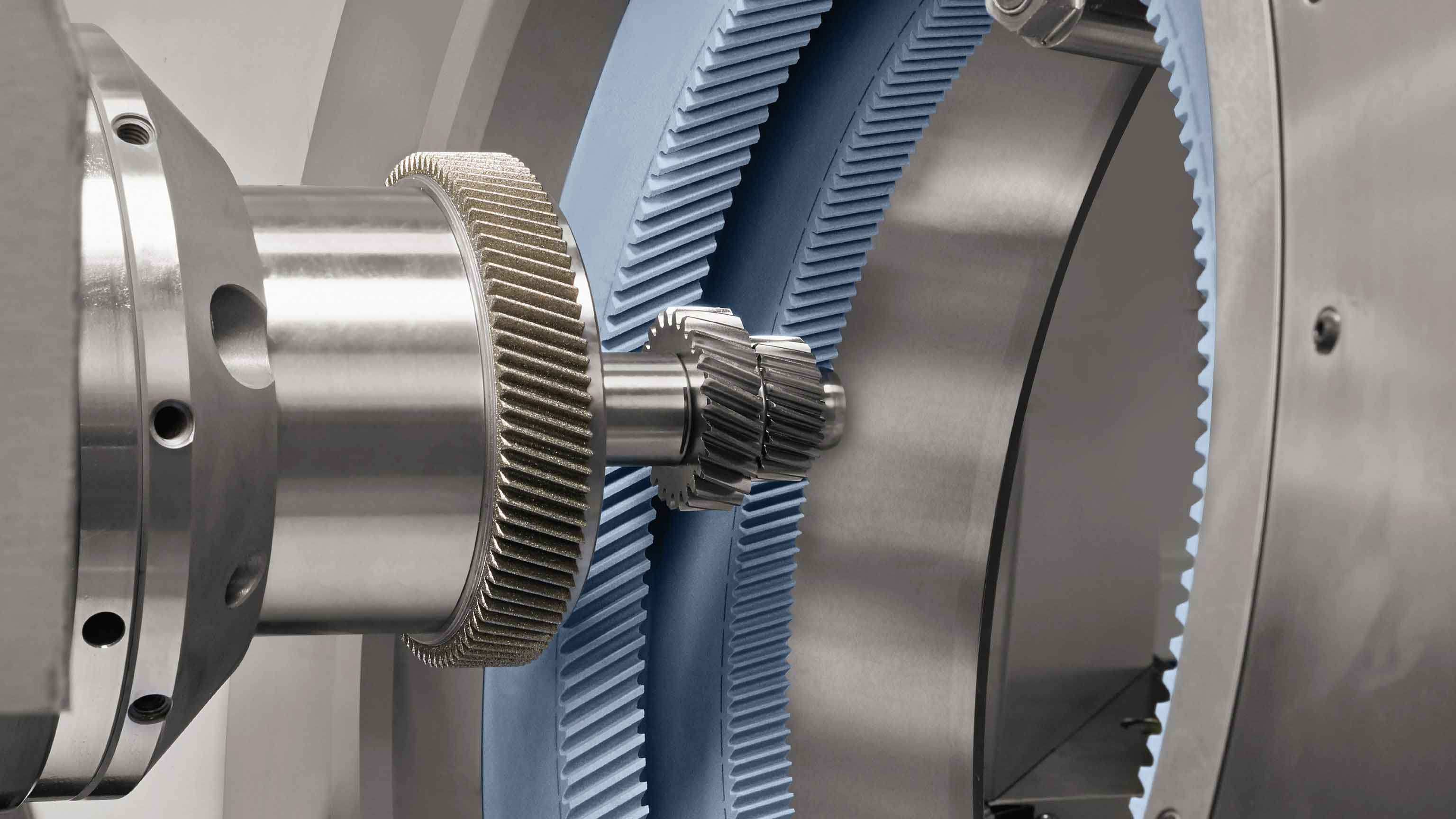
Gear honing involves using an abrasive honing wheel to finish the gear teeth surfaces, achieving high accuracy and surface quality. The honing process is typically carried out on a CNC machine, where the honing wheel and workpiece gear engage in a specific coordinated motion.
3.2 Structure and Function of the Electronic Gearbox
An electronic gearbox replaces the mechanical gear transmission with electronic control, offering flexible transmission ratios and precise synchronization. It consists of encoders to monitor the motion status of the master and slave axes, a controller to process the feedback signals, and drivers to control the motors.
4. Modeling of Synchronization Errors in Gear Honing
4.1 Multi-axis Synchronous Control Errors
During gear honing, synchronization errors may arise due to various factors, including mechanical inaccuracies, control system dynamics, and external disturbances. These errors can be categorized into tooth pitch deviation, tooth profile deviation, and spiral deviation.
4.2 Mathematical Models for Deviations
- Tooth Pitch Deviation Model
The tooth pitch deviation is modeled as a function of the positional errors of the various motion axes.
Δp=f(eC2,eZ1,eX,…)
Where Δp represents the tooth pitch deviation, and eC2, eZ1, eX are the positional errors of different axes.
- Tooth Profile Deviation Model
The tooth profile deviation is influenced by the radial feed and axial feed errors.
Δf=g(eR,eA,…)
Where Δf is the tooth profile deviation, and eR, eA are the radial and axial feed errors, respectively.
- Spiral Deviation Model
The spiral deviation is modeled considering the helical motion of the gear teeth.
Δβ=h(eC2,eθ,…)
Where Δβ represents the spiral deviation, and eC2, eθ are the positional errors related to the helical motion.
5. Compensation for Synchronization Errors
5.1 Cross-coupling Control Compensator Design
A cross-coupling control compensator is designed to compensate for synchronization errors by adjusting the control signals of the various motion axes. The compensator integrates error signals from multiple axes and generates corrective control signals to minimize synchronization errors.
5.2 Optimization of PID Control Parameters
The PID control parameters of the electronic gearbox are optimized using PSO and ABC algorithms to enhance the control performance. These algorithms search for the optimal PID parameters that minimize the synchronization errors.
Table 1. Comparison of PSO and ABC Optimization Results
| Optimization Algorithm | PID Parameters | Synchronization Error (μm) |
|---|---|---|
| PSO | Kp, Ki, Kd | ΔpPSO, ΔfPSO, ΔβPSO |
| ABC | Kp, Ki, Kd | ΔpABC, ΔfABC, ΔβABC |
6. Experimental Verification
6.1 Experimental Setup
The proposed cross-coupling control compensator is implemented on a dSPACE hardware-in-the-loop simulation platform. The experimental setup includes a gear honing machine equipped with an electronic gearbox, encoders for feedback, and a dSPACE controller for real-time control.
6.2 Experimental Results
Experimental results demonstrate the effectiveness of the proposed compensation method. Before compensation, significant synchronization errors are observed in the tooth pitch, tooth profile, and spiral deviations. After applying the cross-coupling control compensator, these errors are significantly reduced.
Table 2. Comparison of Control Performance Before and After Compensation
| Performance Indicator | Before Compensation (μm) | After Compensation (μm) |
|---|---|---|
| Tooth Pitch Deviation (MAX) | Δpmax,before | Δpmax,after |
| Tooth Pitch Deviation (RMS) | ΔpRMS,before | ΔpRMS,after |
| Tooth Profile Deviation (MAX) | Δfmax,before | Δfmax,after |
| Tooth Profile Deviation (RMS) | ΔfRMS,before | ΔfRMS,after |
| Spiral Deviation (MAX) | Δβmax,before | Δβmax,after |
| Spiral Deviation (RMS) | ΔβRMS,before | ΔβRMS,after |
7. Conclusion
This thesis presents a comprehensive study on the modeling and compensation of synchronization errors in powerful gear honing based on an electronic gearbox. By establishing mathematical models for tooth pitch deviation, tooth profile deviation, and spiral deviation, and designing a cross-coupling control compensator, we have demonstrated significant improvements in synchronization accuracy. The proposed method has been experimentally verified using a dSPACE hardware-in-the-loop simulation platform, showcasing its effectiveness in reducing generative processing errors and enhancing the control performance of CNC gear honing machines.