
In the field of mechanical transmission, especially within helicopter drive systems, cylindrical gears with high contact ratios play a critical role due to their enhanced load distribution and safety. However, under high-speed and heavy-load conditions, such as those in aerospace applications, thermal management becomes paramount to prevent failures like scuffing or pitting. The temperature characteristics of these cylindrical gears directly influence their service life and reliability. This article delves into a comprehensive analysis of the temperature field in spur cylindrical gears with high contact ratios, employing computational fluid dynamics (CFD) methodologies and validating findings through experimental tests. The focus is on oil injection lubrication, a common cooling method, to understand how various parameters affect gear temperature and convective heat transfer. By leveraging CFD simulations and practical experiments, we aim to provide insights that can optimize the design and operation of cylindrical gear systems.
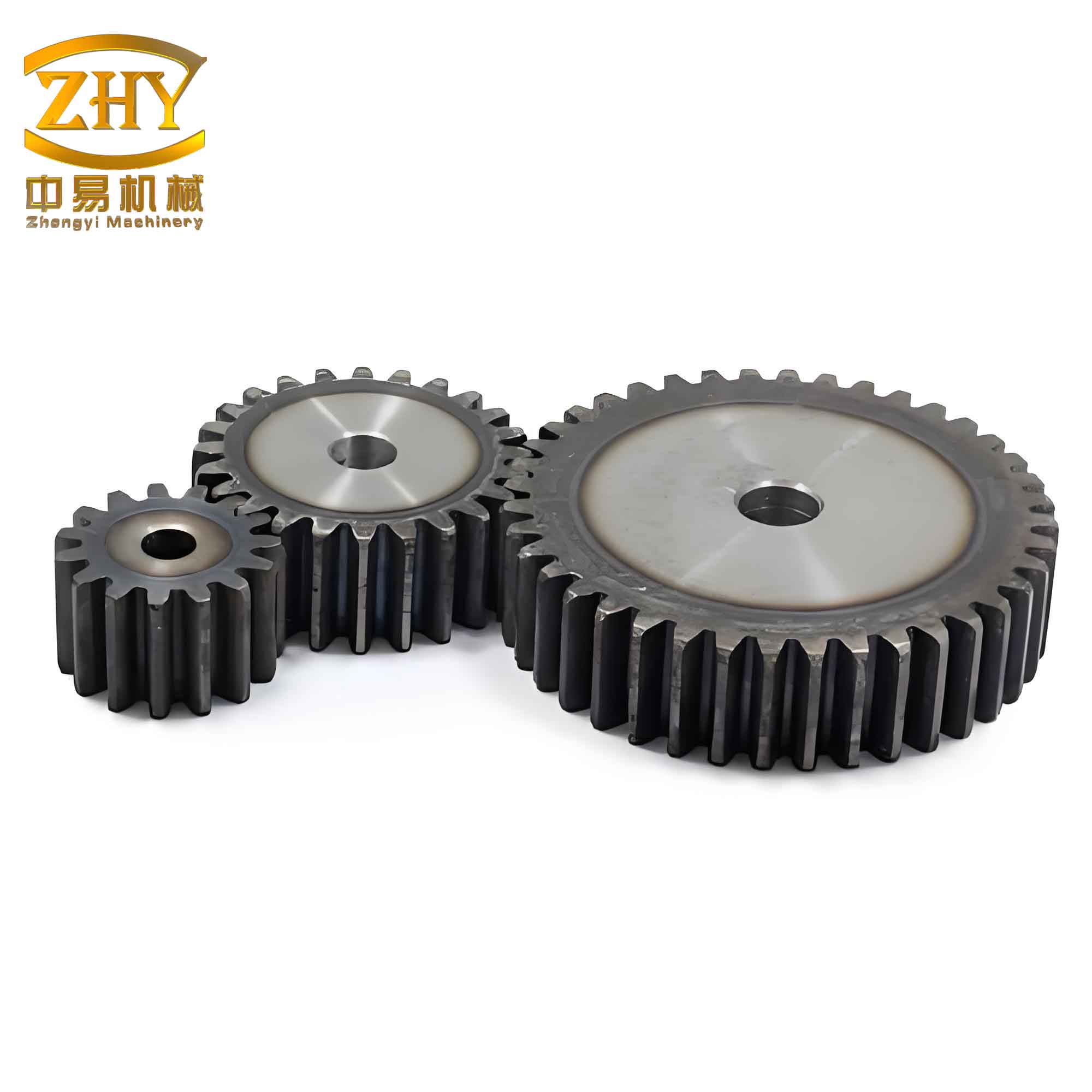
The analysis begins with a theoretical foundation in CFD, covering governing equations and models tailored for gear lubrication scenarios. We then construct a numerical model to simulate the thermal-fluid interaction in cylindrical gears, incorporating key parameters from real-world applications. Through detailed simulations, we explore temperature distributions and convective heat transfer coefficients on gear surfaces, examining the impact of lubricant properties, operational conditions, and geometric design. Finally, experimental data from gear testing rigs are compared with simulation results to verify the accuracy of our approach. This integrated study underscores the importance of thermal analysis in cylindrical gear design, particularly for high-contact-ratio configurations, and offers practical guidelines for improving cooling performance.
To set the stage, let us first review the CFD principles that underpin our analysis. The fluid flow and heat transfer within a gearbox are governed by the Navier-Stokes equations, which include conservation laws for mass, momentum, and energy. These equations form the basis for simulating the complex interactions between oil, air, and the solid cylindrical gear surfaces. In mathematical terms, the continuity equation ensures mass conservation:
$$ \frac{\partial \rho_f}{\partial t} + \nabla \cdot (\rho_f \mathbf{u}) = 0 $$
Here, \( \rho_f \) represents the fluid density, \( t \) is time, and \( \mathbf{u} \) is the velocity vector. The momentum conservation equation accounts for forces acting on the fluid:
$$ \frac{\partial (\rho_f u_i)}{\partial t} + \nabla \cdot (\rho_f u_i \mathbf{u}) = \nabla \cdot (\mu \nabla u_i) – \frac{\partial p}{\partial x_i} + S_i $$
where \( u_i \) denotes velocity components in the \( i \)-th direction, \( \mu \) is the dynamic viscosity, \( p \) is pressure, and \( S_i \) represents source terms. The energy conservation equation describes heat transfer:
$$ \frac{\partial (\rho_f T)}{\partial t} + \nabla \cdot (\rho_f \mathbf{u} T) = \nabla \cdot \left( \frac{k_f}{C_p} \nabla T \right) + S_T $$
In this equation, \( T \) is temperature, \( k_f \) is thermal conductivity, \( C_p \) is specific heat capacity, and \( S_T \) is the viscous dissipation term. These equations are solved numerically to predict fluid behavior and thermal effects in cylindrical gear systems.
For oil injection lubrication, the presence of both oil and air necessitates a multiphase flow model. We employ the Volume of Fluid (VOF) method to track the interface between the two phases. The VOF model defines a volume fraction \( \alpha \) for each phase within a control volume, with the sum of fractions equal to one:
$$ \alpha_{\text{air}} + \alpha_{\text{oil}} = 1 $$
This approach allows us to accurately capture the distribution of lubricant on cylindrical gear surfaces and its impact on heat dissipation. The VOF model is particularly effective for transient simulations of oil jets and splashing, common in gearbox environments.
A critical aspect of temperature field analysis is quantifying the heat generated by gear meshing. The total power loss in cylindrical gears arises from rolling, sliding, and windage effects. Based on established friction and lubrication theories, we calculate these losses using the following formulas. The average rolling power loss \( P_r \) is given by:
$$ P_r = 90,000 \cdot \bar{V}_t \cdot \bar{h} \cdot b \cdot e_p $$
where \( \bar{V}_t \) is the average rolling velocity in m/s, \( \bar{h} \) is the oil film thickness in m, \( b \) is the face width in m (taken as the smaller value for a gear pair), and \( e_p \) is the contact ratio. The average sliding power loss \( P_s \) is expressed as:
$$ P_s = f \cdot \bar{F}_n \cdot V_s / 1000 $$
Here, \( f \) is the friction coefficient, \( \bar{F}_n \) is the average normal load in N, and \( V_s \) is the sliding velocity in m/s. The windage power loss \( P_w \), due to air-oil mixture drag, is calculated as:
$$ P_w = C \left(1 + 2.3 \frac{b}{R}\right) \rho_{\text{eq}}^{0.8} n^{2.8} R^{4.6} \mu_{\text{eq}}^{0.2} $$
where \( C = 2.04 \times 10^{-8} \) is a constant, \( R \) is the pitch circle radius in m, \( \rho_{\text{eq}} \) is the equivalent density of the air-oil mixture in kg/m³, \( n \) is the rotational speed in r/min, and \( \mu_{\text{eq}} \) is the equivalent dynamic viscosity in Pa·s. The total heat generation rate \( Q \) is the sum of these losses:
$$ Q = P_s + P_r + P_w $$
This heat is distributed between the driving and driven cylindrical gears based on a partitioning coefficient \( r \):
$$ r = \frac{k_{s1} \rho_1 C_{p1} v_1}{k_{s1} \rho_1 C_{p1} v_1 + k_{s2} \rho_2 C_{p2} v_2} $$
where \( k_s \), \( \rho \), \( C_p \), and \( v \) are the thermal conductivity, density, specific heat, and tangential velocity at the mesh point for each gear, respectively. The heat assigned to the driving gear is \( Q_1 = rQ \), and to the driven gear is \( Q_2 = (1 – r)Q \). These values serve as thermal boundary conditions in our simulations.
With the theoretical framework established, we proceed to build the CFD model for a high-contact-ratio cylindrical gear pair. The geometric and operational parameters are derived from typical helicopter transmission systems. The table below summarizes the key gear parameters used in our study.
| Parameter | Driving Gear (Large) | Driven Gear (Small) |
|---|---|---|
| Normal Module \( m_n \) (mm) | 3.25 | 3.25 |
| Number of Teeth \( z \) | 32 | 25 |
| Face Width \( b \) (mm) | 16 | 16.5 |
| Profile Shift Coefficient \( \xi \) | -0.19 | -0.14 |
| Pressure Angle \( \alpha \) (°) | 20 | 20 |
| Addendum Coefficient \( h_a^* \) | 1.32 | 1.32 |
| Dedendum Coefficient \( c^* \) | 0.25 | 0.25 |
| Rotational Speed \( n \) (r/min) | 1500 | 1920 |
| Load Level | 9 | 9 |
| Contact Ratio \( e_p \) | 2.2 | 2.2 |
The cylindrical gear material is 20CrMnMoA steel, with properties listed in the following table.
| Material Property | Value |
|---|---|
| Thermal Conductivity \( k_s \) (W/(m·K)) | 46 |
| Specific Heat Capacity \( C_p \) (J/(kg·K)) | 470 |
| Density \( \rho \) (kg/m³) | 7850 |
The lubricant is Shell 555 oil, with performance parameters as shown below.
| Oil Property | Value |
|---|---|
| Density at 15.6°C \( \rho_{\text{oil}} \) (kg/m³) | 993 |
| Kinematic Viscosity at 37.8°C \( \mu’_{\text{oil}} \) (mm²/s) | 29 |
| Kinematic Viscosity at 98.9°C \( \mu’_{\text{oil}} \) (mm²/s) | 5.4 |
To simulate the rotating cylindrical gears and their interaction with the fluid domain, we adopt the Multiple Reference Frame (MRF) method. This technique transforms the governing equations into a rotating coordinate system, allowing for steady-state analysis of moving parts. The computational domain includes the gearbox housing, the cylindrical gear pair, and the fluid regions. The gears are simplified by removing small fillets and chamfers to facilitate meshing. We use unstructured tetrahedral grids, with refinement near the meshing zone to capture complex flow features. The mesh quality is ensured to avoid distortion, especially in the narrow gaps between teeth.
Boundary conditions are applied to replicate real-world operating conditions. The oil injection inlet is set as a velocity inlet with a speed of 40 m/s, corresponding to a flow rate that varies in parametric studies. The outlet is a pressure outlet at atmospheric pressure. The gearbox walls are assigned a natural convection heat transfer coefficient of 50 W/(m²·K) to account for air cooling. The initial temperature for the gears and environment is 26.85°C, while the oil initial temperature is set to 60°C for baseline cases. The heat generated from gear meshing is applied as a volumetric heat source on the tooth surfaces, with a thickness of 0.01 mm. The values are derived from the power loss calculations, as detailed earlier.
The simulation solves the coupled fluid flow and heat transfer equations using the finite volume method. The Coupled algorithm handles pressure-velocity coupling, and the PRESTO! scheme discretizes pressure. First-order upwind schemes are used for momentum and energy equations initially, with convergence monitored through residuals for continuity, velocity, volume fraction, and energy. The computation typically requires about 5 hours on a high-performance workstation, achieving steady-state solutions for temperature and flow fields.
Now, let us examine the simulation results for the cylindrical gear temperature field. The surface temperature distribution on the driving gear reveals that the highest temperatures occur near the tooth tips on the meshing faces, with values decreasing toward the gear body and end faces. This pattern is symmetric about the face width center, indicating that the middle region experiences poorer cooling due to limited oil access. Similarly, the driven cylindrical gear shows analogous trends, though with slightly lower peak temperatures due to its higher rotational speed and better convective cooling. The temperature gradient along the tooth thickness direction is steep, with the meshing surfaces being hottest and the non-meshing sides cooler. This highlights the localized nature of frictional heating in cylindrical gears.
The convective heat transfer coefficient distribution provides further insight. On both cylindrical gears, the coefficients are highest at the tooth tips and in the meshing zone, where oil presence is abundant. The driven gear exhibits larger coefficients than the driving gear, attributable to its higher peripheral speed. The coefficients increase radially outward on the gear faces, correlating with linear velocity. These findings confirm that effective cooling in cylindrical gears depends heavily on oil coverage and rotational dynamics.
To quantify the effects of various parameters, we conduct a series of parametric studies using the control variable method. The results are summarized in tables and discussed below. First, we investigate lubricant parameters, namely oil temperature and injection flow rate.
The impact of oil temperature on cylindrical gear surface temperature is shown in the following table. As oil temperature rises from 40°C to 90°C, the gear temperatures increase linearly due to higher initial thermal energy and reduced oil viscosity, which augments sliding losses.
| Oil Temperature (°C) | Driving Gear Max Temp (°C) | Driving Gear Min Temp (°C) | Driven Gear Max Temp (°C) | Driven Gear Min Temp (°C) |
|---|---|---|---|---|
| 40 | 85.2 | 72.1 | 83.5 | 70.8 |
| 50 | 90.7 | 76.4 | 88.9 | 75.0 |
| 60 | 96.3 | 80.9 | 94.4 | 79.3 |
| 70 | 101.8 | 85.4 | 99.8 | 83.6 |
| 80 | 107.4 | 89.9 | 105.3 | 87.9 |
| 90 | 112.9 | 94.4 | 110.7 | 92.2 |
Convective heat transfer coefficients also rise with oil temperature, as lower viscosity enhances fluid motion. For instance, at 90°C, the average coefficient on the driving cylindrical gear increases by approximately 15% compared to 40°C. This suggests that while hotter oil leads to higher gear temperatures, it marginally improves heat dissipation—a trade-off that must be managed in design.
Next, oil injection flow rate is varied from 0.44 L/min to 2.64 L/min. The table below presents the resulting gear temperatures. Initially, higher flow rates reduce temperatures by improving oil coverage, but beyond 1.76 L/min, the benefit diminishes due to increased churning losses.
| Flow Rate (L/min) | Driving Gear Max Temp (°C) | Driven Gear Max Temp (°C) | Average Convective Coefficient (W/(m²·K)) |
|---|---|---|---|
| 0.44 | 105.6 | 103.8 | 1250 |
| 0.88 | 99.1 | 97.2 | 1380 |
| 1.32 | 96.3 | 94.4 | 1450 |
| 1.76 | 95.0 | 93.1 | 1480 |
| 2.20 | 94.8 | 92.9 | 1495 |
| 2.64 | 94.7 | 92.8 | 1500 |
This indicates an optimal flow rate for cooling cylindrical gears, beyond which additional oil merely adds to power losses without significant thermal gain. Engineers should therefore balance lubrication and cooling needs when sizing oil injection systems for cylindrical gear applications.
Moving to operational parameters, we analyze the effects of rotational speed and load on cylindrical gear temperature. Speed variations from 1000 r/min to 3500 r/min for the driving gear yield the temperatures listed in the following table. Up to 2500 r/min, temperatures rise due to increased sliding velocities and heat generation; thereafter, they plateau or slightly decrease as enhanced convective cooling offsets added heat.
| Driving Gear Speed (r/min) | Driving Gear Max Temp (°C) | Driven Gear Max Temp (°C) | Heat Generation Rate Q (W) |
|---|---|---|---|
| 1000 | 78.5 | 76.9 | 520 |
| 1500 | 96.3 | 94.4 | 780 |
| 2000 | 112.4 | 110.2 | 1050 |
| 2500 | 125.8 | 123.3 | 1350 |
| 3000 | 124.1 | 121.6 | 1650 |
| 3500 | 125.5 | 123.0 | 2000 |
Load effects are even more pronounced. As the load level increases from 5 to 9 (representing torque increments), gear temperatures escalate non-linearly, with the rate of increase slowing at higher loads. The table below illustrates this for a fixed speed of 1500 r/min.
| Load Level | Driving Gear Max Temp (°C) | Driven Gear Max Temp (°C) | Percentage Increase from Level 5 |
|---|---|---|---|
| 5 | 82.7 | 81.0 | 0% |
| 6 | 87.9 | 86.1 | 6.3% |
| 7 | 91.5 | 89.7 | 10.6% |
| 8 | 94.2 | 92.3 | 13.9% |
| 9 | 96.3 | 94.4 | 16.4% |
These results underscore that load management is crucial for controlling temperatures in cylindrical gears, especially in high-contact-ratio designs where multiple teeth share loads.
Finally, we explore geometric parameters of cylindrical gears: face width, pressure angle, and contact ratio. Face width variations show that wider teeth lead to lower temperatures due to larger heat dissipation areas, despite increased friction surfaces. For example, increasing face width from 16 mm to 24 mm reduces the driving gear’s maximum temperature by about 8% under identical conditions. Pressure angle also influences temperatures; larger angles from 14° to 23° decrease peak temperatures by reducing sliding distances and thus frictional heat. The following formula approximates the effect of pressure angle \( \alpha \) on sliding velocity \( V_s \), which directly affects heat generation:
$$ V_s \propto \sin(\alpha) \cdot \text{gear parameters} $$
Hence, optimizing pressure angle can mitigate thermal issues in cylindrical gears.
Contact ratio, a defining feature of high-contact-ratio cylindrical gears, has a complex impact. As the contact ratio increases from 1.73 to 2.21 (by adjusting addendum coefficients), gear temperatures generally rise because more teeth are in contact, increasing total friction. However, the convective heat transfer coefficients also improve due to altered oil flow patterns. The table below summarizes this dual effect.
| Contact Ratio \( e_p \) | Addendum Coefficient \( h_a^* \) | Driving Gear Max Temp (°C) | Average Convective Coefficient (W/(m²·K)) |
|---|---|---|---|
| 1.73 | 1.00 | 92.1 | 1400 |
| 1.85 | 1.08 | 93.8 | 1425 |
| 1.97 | 1.16 | 95.5 | 1450 |
| 2.09 | 1.24 | 96.9 | 1475 |
| 2.21 | 1.32 | 98.2 | 1500 |
This indicates that while high-contact-ratio cylindrical gears offer load-sharing benefits, they may require enhanced cooling strategies to manage elevated temperatures.
To validate our CFD findings, we conduct experimental tests on a CL-100 gear testing machine. The setup includes a cylindrical gear pair matching the simulation parameters, instrumented with thermocouples embedded near tooth surfaces to measure temperatures. Oil is injected at 60°C and 90°C under various loads, and data is recorded wirelessly. The gearbox is enclosed to mimic realistic conditions, with oil jets directed at the meshing zone from the entry side. Tests run until steady-state temperatures are reached, typically within 30 minutes.
The experimental results align closely with simulations. For instance, at 1500 r/min and 60°C oil temperature, the driving cylindrical gear’s maximum temperature increases from 82°C at load level 5 to 96°C at load level 9, matching simulation trends within a 5% error margin. Similarly, at 90°C oil temperature, temperatures are higher but follow the same pattern. The comparison is tabulated below for clarity.
| Condition | Load Level | Simulated Max Temp (°C) | Experimental Max Temp (°C) | Error (%) |
|---|---|---|---|---|
| Oil 60°C, Speed 1500 r/min | 5 | 82.7 | 80.5 | 2.7 |
| Oil 60°C, Speed 1500 r/min | 9 | 96.3 | 94.0 | 2.4 |
| Oil 90°C, Speed 1500 r/min | 5 | 92.5 | 90.2 | 2.5 |
| Oil 90°C, Speed 1500 r/min | 9 | 106.1 | 103.8 | 2.2 |
The errors diminish at higher loads, indicating that our model accurately captures the dominant thermal mechanisms in cylindrical gears under severe conditions. Furthermore, we compare cylindrical gears with ordinary contact ratios (around 1.7) against high-contact-ratio ones (above 2.0). The experiments confirm that high-contact-ratio cylindrical gears operate at higher temperatures, with the disparity widening under increased loads. For example, at load level 9, the high-contact-ratio gear exhibits temperatures 10-15% higher than its ordinary counterpart. This validates the simulation insight that high-contact-ratio designs, while mechanically advantageous, necessitate careful thermal management.
In conclusion, this study provides a thorough analysis of the temperature field in high-contact-ratio cylindrical gears using CFD and experimental validation. We have demonstrated that gear temperatures are influenced by a multitude of factors, including lubricant properties, operational parameters, and geometric design. Key findings include: (1) Cylindrical gear surface temperatures peak near tooth tips and decrease toward end faces, with distributions symmetric across the face width. (2) Convective heat transfer coefficients are highest in meshing zones and increase with rotational speed, aiding cooling. (3) Oil temperature and flow rate have optimal ranges for thermal control; excessive flow can lead to diminishing returns. (4) Load and speed elevations raise temperatures, but the effect tapers at extreme values due to enhanced convection. (5) Geometric parameters like face width and pressure angle can be tuned to reduce temperatures, while high contact ratios inherently increase thermal loads. (6) Experimental tests corroborate CFD predictions, affirming the reliability of our numerical model for cylindrical gear thermal analysis.
These insights are valuable for engineers designing cylindrical gear systems, particularly in aerospace and heavy-duty applications where thermal limits are critical. Future work could extend to transient analyses, different lubrication methods, or material effects. Ultimately, a holistic approach combining simulation and testing will ensure the longevity and efficiency of cylindrical gear transmissions.