
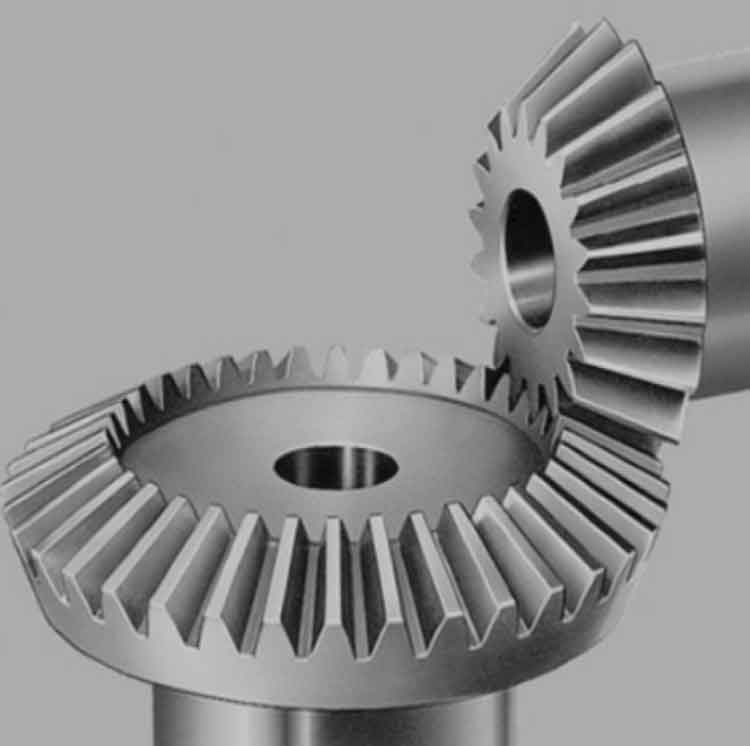
Abstract: Straight bevel gears are widely used in aerospace products due to their high manufacturing maturity, relatively low cost, and simpler processing compared to spiral bevel gears. This paper takes the straight bevel gear used in the angular variable-speed reducer of an aerial high-lift system as the research object. The gear was processed using the disc milling cutter upper and lower cutter position generating method on the Gleason PHOENIX II CNC bevel gear milling machine. Detailed analysis is conducted from aspects such as processing, measurement, and software application. This provides a good reference for improving the processing quality and efficiency of straight bevel gears.
Keywords: gear milling; straight bevel gear; closed-loop processing solution
1. Development of Straight Bevel Gear Processing Methods
Compared to the rapid development of spiral bevel gear processing technology, the development of straight bevel gear processing technology has been relatively slow. Commonly used processing methods for straight bevel gears include disc modulus milling, round broach pulling, paired planing, and double-disc milling. Among these, the planing process is applied more frequently. Planing is based on the hobbing principle, using two straight-edged planing tools as cutting tools to process the straight bevel gear. However, this method has relatively low processing efficiency and is challenging to ensure the processing requirements for crowned tooth surfaces of straight bevel gears. The double-disc generating milling method involves using two paired disc milling cutters to simultaneously cut both sides of a certain tooth slot of the tooth blank in one process to complete the processing of the straight bevel gear. The PHOENIX II CNC milling machine adopts a new process method using a single-disc milling cutter for milling straight bevel gears, which can significantly shorten the time required for the straight bevel gear processing cycle. Compared with mechanical machines, this method offers higher efficiency.
| Processing Method | Characteristics | Advantages and Disadvantages |
|---|---|---|
| Planing | Mechanical transmission chain, two straight-edged planing tools | Low processing efficiency, challenging to ensure crowned tooth surface processing requirements |
| Double-Disc Milling | Two paired disc milling cutters cut both sides of a tooth slot simultaneously | Higher efficiency than planing, but still limited by mechanical transmission chains |
| Single-Disc Milling | PHOENIX II CNC machine, single-disc milling cutter | High efficiency, can significantly shorten processing cycle, suitable for small batches, multiple varieties, and highly discrete bevel gear products |
2. Gear Milling Tools for Straight Bevel Gears
2.1 Forms of Milling Tools
The Gleason PHOENIX II CNC milling machine uses Coniflex monolithic tool discs and Coniflex Plus tools equipped with Pentac carbide tool strips for processing straight bevel gears.
| Tool Form | Material | Characteristics |
|---|---|---|
| Monolithic Tool Disc | Powder Metallurgy | High rigidity, suitable for heavy-duty cutting |
| Carbide Tool Strip | Pentac Carbide | High hardness, wear resistance, suitable for high-speed cutting, long tool life |
2.2 Structural Characteristics of Milling Tools
The main parameters of the tools include:
- Tool Pressure Angle: Related to the dish angle of the tool. The spindle angle of the PHOENIX II CNC milling machine 275HC is a fixed value of 23°, which equals the sum of the tool pressure angle and the dish angle. The dish angle is the concave angle of the main cutting edge of the disc milling cutter. This angle affects the crowned amount when the disc milling cutter generates the tooth surface, which in turn influences the size of the contact area of the bevel gear.
- Tool Tip Radius: Usually calculated and generated by bevel gear parameter software. The gear hobbing motion results in a tooth root fillet of the machined part slightly larger than the tool tip radius. Therefore, the design nominal value of the tool tip radius should be equal to or slightly larger than the minimum fillet radius specified in the drawing.
- Tool Offset Distance: Determined by the width at the large end tooth space bottom (La) and the width at the small end tooth space bottom (Li) of the gear being processed. The tool offset distance must simultaneously satisfy conditions of being greater than half of La and less than Li. Incorrect tool offset distance can lead to undercutting at the small end or residue at the large end.
The calculation of the maximum tool offset distance is as follows:
<img src=”https://example.com/max_tool_offset_formula.png” />
WLi=Ao−FWAo×(Ton−2×Bo×tan(ϕ))−0.038
WT,max=WL,i−Stock_allowance
Where:
- Ton is the large-end arc tooth thickness of the mating gear.
- Bo is the large-end tooth root height.
- ϕ is the pressure angle.
- FW is the tooth face width.
- Ao is the outer cone distance.
- Stock_allowance is the machining allowance.
| Tool Parameter | Description |
|---|---|
| Tool Pressure Angle | Affects crowned amount and contact area size of bevel gear, calculated by software |
| Tool Tip Radius | Designed based on gear parameters, prevents overcutting |
| Tool Offset Distance | Determines by gear tooth space width, affects cutting quality |
2.3 Tool Material for Gear Milling
Common materials for monolithic disc milling tools for straight bevel gears include ASP2023 and ASP2030, with coatings such as TiN and TiAlN. For a straight bevel gear part made of 18Cr2Ni4WA, a high-strength medium-alloy carburizing steel, the use of ASP2030 material with TiAlN coating results in slightly better cutting quality compared to ASP2023 material with TiN coating. Aerospace materials are characterized by high hardness, high strength, and high toughness, posing challenges such as poor machinability, high processing difficulty, low processing efficiency, and high tool costs. This places higher demands on cutting tools. The promotion and use of carbide tools not only optimize the processing scheme, solve issues such as work hardening and deformation, but also improve tool lifespan and ensure consistency in mass processing results. In straight bevel gear milling, Coniflex Plus tools equipped with Pentac carbide tool strips are gradually replacing Coniflex monolithic tool discs made of powder metallurgy, pushing the processing of straight bevel gears towards higher speeds.
| Tool Material | Characteristics | Application Example |
|---|---|---|
| ASP2023 | High hardness, wear resistance, suitable for various cutting conditions | Widely used in gear milling operations |
| ASP2030 | Better cutting quality with TiAlN coating for high-strength, medium-alloy steel such as 18Cr2Ni4WA | Preferred for challenging materials |
Conclusion
The application of gear milling technology for straight bevel gears, represented by the Gleason PHOENIX II CNC milling machine, has significantly improved processing efficiency and accuracy compared to traditional methods such as planing. The use of advanced carbide tool materials and optimized tool parameters further enhances the cutting performance and lifespan, enabling high-quality and efficient mass production of straight bevel gears. This technology not only meets the demands of aerospace products with small batches, multiple varieties, and high discreteness but also provides valuable references for the development of gear milling technology in other industries.
By leveraging the advantages of CNC technology, closed-loop processing solutions, and advanced tool materials, the gear milling of straight bevel gears has achieved remarkable progress, pushing the boundaries of manufacturing capabilities and efficiency.