
In the modern automotive industry, the drive towards greater efficiency, durability, and cost-effectiveness has made precision forging a cornerstone for manufacturing critical drivetrain components. Among these, straight bevel gears, especially those used in automotive differentials such as the miter gear pairs in a differential cage, are prime candidates for this near-net-shape manufacturing process. The transition from traditional machining to precision forging presents significant challenges in both design and tooling fabrication. This article details my firsthand experience and methodology in leveraging a CAD/CAM integrated workflow, centered on PTC Pro/ENGINEER (Pro/E) and Delcam PowerMILL, to overcome these challenges in the production of precision-forged differential gears. The process encompasses the complete chain from theoretical design and 3D modeling of the gear, its forging die electrode, inspection fixtures, and master gears, to the generation of efficient and collision-free CNC toolpaths for their manufacture.
The fundamental advantage of precision forging for bevel gears lies in the improved grain flow and material strength, along with significant material savings. However, the complexity of a bevel gear’s geometry—defined by its conical pitch surface and progressively changing tooth profile from the toe to the heel—makes the design and machining of the forging die exceptionally difficult. Traditional methods reliant on specialized gear planers are often inadequate for creating the precise, complex electrodes required for Electrical Discharge Machining (EDM) of the forging die cavities. This is where a robust CAD/CAM system becomes indispensable. For a miter gear, where the shaft angles are typically 90 degrees and the gear ratio is 1:1, precision in tooth geometry and alignment is paramount for smooth power transmission and minimal noise.
Foundations of Bevel Gear Design for Forging
The journey begins not in the software, but with a deep understanding of the product drawing and the underlying gear theory. A precision forging process requires designing not just the final machined gear, but the forged gear blank, the EDM electrode to sink the die, a checking master gear, and often a fixture electrode for machining the forged blank. All these derivatives stem from the basic gear geometry.
For a straight bevel gear, the key design parameters extend beyond the basic module, number of teeth, and pressure angle. Critical derived parameters must be calculated to accurately define the tooth space in three dimensions. These include:
- Height Shift Coefficient (x): Modifies the addendum and dedendum to avoid undercut and improve strength.
- Tangential Shift Coefficient (xS): Adjusts the tooth thickness, crucial for setting the correct backlash when the gear pair is assembled.
- Base Circle Radius (r_b): The foundation for generating the involute tooth profile. For a bevel gear, this is calculated on the back cone, leading to the concept of the “virtual” or “form” spur gear. $$ r_b = \frac{m_n Z_v}{2} \cos(\alpha_n) $$ where $m_n$ is the normal module, $\alpha_n$ is the normal pressure angle, and $Z_v$ is the virtual number of teeth.
- Virtual Number of Teeth (Z_v): This is the number of teeth of an equivalent spur gear whose radius equals the back cone distance. It is essential for applying standard spur gear calculations to the bevel gear’s profile at a given section. For a miter gear with a 1:1 ratio and 90-degree shaft angle, if both gears have the same number of teeth (N), the pitch cone angle is 45 degrees, and the virtual number of teeth is: $$ Z_v = \frac{Z}{\cos(\delta)} = \frac{N}{\cos(45^\circ)} \approx 1.414N $$ where $\delta$ is the pitch cone angle.
The following table summarizes the key input and calculated parameters for a typical differential bevel gear design process:
| Parameter Type | Symbol | Description | Source/Calculation |
|---|---|---|---|
| Basic Inputs | $Z$, $m_n$, $\alpha_n$ | Number of teeth, Normal Module, Normal Pressure Angle | Product Drawing |
| Geometric Inputs | $\delta$, $R_e$ | Pitch Cone Angle, Outer Cone Distance | Product Drawing / Assembly |
| $b$ | Face Width | Product Drawing | |
| Calculated Parameters | $Z_v$ | Virtual Number of Teeth | $Z_v = Z / \cos(\delta)$ |
| $d_e$ | Outer Pitch Diameter | $d_e = m_n Z$ | |
| $r_b$ | Base Circle Radius (at back cone) | $r_b = (m_n Z_v \cos(\alpha_n))/2$ | |
| $x$, $x_s$ | Height & Tangential Shift Coefficients | Gear Design Handbook / Optimization |
Parametric 3D Modeling in Pro/ENGINEER
With the theoretical parameters defined, the next step is to translate them into an accurate, parametric 3D solid model. Pro/E’s robust feature-based and parametric modeling capabilities are ideal for this task. The modeling strategy for a bevel gear, its die electrode, and a master miter gear follows a logical, feature-driven sequence.
1. Curve Creation: The Involute Foundation. The core of the gear model is the involute tooth profile. Since the tooth profile changes from the heel (large end) to the toe (small end), we must generate an involute curve for at least these two key sections. This is achieved using the ‘Curve from Equation’ feature. A coordinate system is defined, and the following parametric equations are input to generate the basic involute shape. The equations are based on the parametric form of an involute:
$$
\begin{aligned}
r_0 &= r_b \\
t_0 &= t \times 60 \quad \text{(scaling the parameter)} \\
x_0 &= (\cos(t_0) + t_0 \times \pi/180 \times \sin(t_0)) \times r_0 \\
y_0 &= (\sin(t_0) – t_0 \times \pi/180 \times \cos(t_0)) \times r_0 \\
\theta &= -(\tan(\alpha) – \alpha \times \pi/180) \times 180/\pi – 90/Z_v \quad \text{(rotation for symmetry)} \\
x &= x_0 \times \cos(\theta) – y_0 \times \sin(\theta) \\
y &= x_0 \times \sin(\theta) + y_0 \times \cos(\theta) \\
z &= 0
\end{aligned}
$$
In these equations, $t$ is the driving parameter (typically from 0 to 1), $\alpha$ is the pressure angle, $r_b$ is the base radius calculated for the specific section (large or small end), and $Z_v$ is the corresponding virtual number of teeth. Executing this feature creates a precise 3D datum curve representing one flank of a single tooth at a specific gear cross-section.
2. Constructing the Tooth Space Surface. The generated involute curve is mirrored about the tooth centerline plane to create the profile for the opposite flank. Using ‘Sketch’ tools, the complete tooth boundary—including the tip circle, root fillet, and the two involute segments—is drawn for both the large and small ends of the gear. These two closed loops become the foundational sketches. The powerful ‘Boundary Blend’ surface feature is then employed. By selecting the large-end sketch and the small-end sketch as the defining curves in two directions, Pro/E creates a smooth, lofted surface that accurately represents the 3D tooth space. This surface is the critical digital representation of the void where metal will flow during forging.
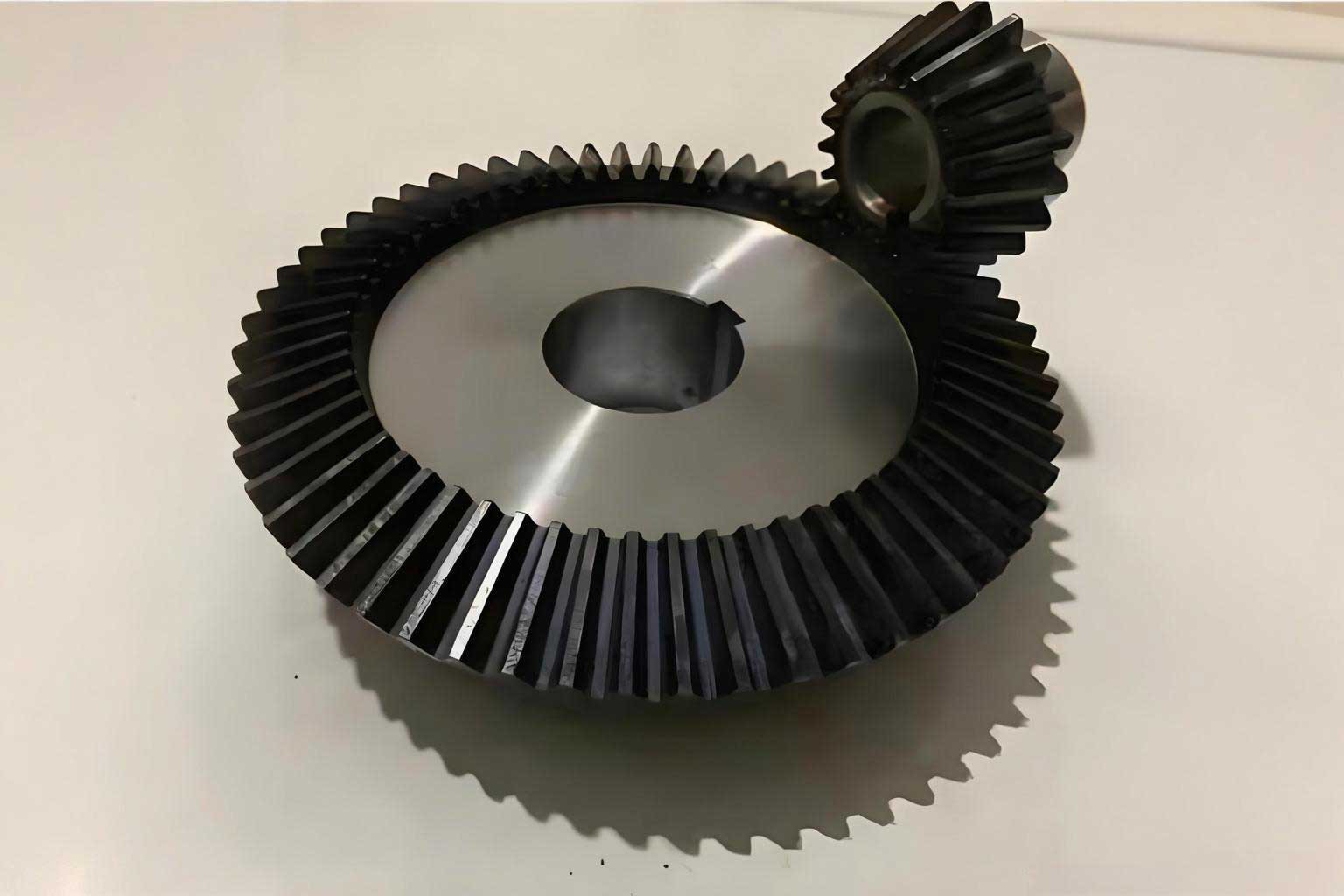
3. Completing the Solid Model. The single tooth space surface is then solidified (if it’s a cavity) or used to cut a solid body (if it’s the gear itself). This single-tooth geometry is patterned around the gear axis using a polar array, with the number of instances equal to the number of teeth, $Z$. This completes the core gear body. Additional features like the hub, bore, back face, and chamfers are added using standard protrusion and cut features. The resulting model is fully parametric; changing a fundamental parameter like the number of teeth ($Z$) or module ($m_n$) will correctly and automatically regenerate the entire gear geometry.
4. Deriving Tooling Components. The same modeling principles are applied to create the necessary tooling:
- Die Electrode: Modeled as the positive of the gear tooth space, but with necessary EDM overburn allowances (spark gaps) and appropriate mounting features.
- Fixture Electrode: Used to machine a locating fixture for the forged blank. It is essentially a precise negative of the gear’s functional tooth surfaces to ensure accurate positioning during subsequent machining operations.
- Master Gear (Standard Wheel): A highly precise physical replica of the ideal gear, used for checking the meshing quality and backlash of the forged and machined production gears. For a differential set, a master miter gear pair is essential for quality control.
Kinematic Simulation and Verification in Pro/MECHANISM
Before committing to expensive tooling manufacturing, it is prudent to verify the kinematic correctness of the gear design. Pro/E’s Mechanism Design extension (Pro/MECHANISM) allows for this virtual validation. The assembly of the pinion (e.g., a differential side gear) and the ring gear (or another side gear in a miter gear pair) is created using appropriate connection definitions, typically a ‘gear pair’ connection which defines the pitch circles and gear ratio.
A servo motor (rotational driver) is applied to one gear, and the mechanism is run through a motion analysis. The ‘Results’ and ‘Playback’ features enable us to visualize the motion, check for continuous contact, and, most importantly, run a global interference check. This analysis can reveal potential collisions in tooth tips or roots that were not apparent in a static model. Furthermore, by measuring the minimum distance between mating tooth flanks throughout the cycle, a virtual assessment of backlash can be performed. This digital prototyping step significantly de-risks the design, ensuring that the forged gear will mesh correctly in the final assembly.
CNC Programming for Tooling Manufacture with PowerMILL
With verified 3D models of the electrodes and master gears, the next phase is generating efficient and safe CNC toolpaths. PowerMILL excels in this domain, particularly for complex 3D shapes, thanks to its reliable gouge avoidance and robust toolpath calculation engines.
1. Data Transfer and Setup. The Pro/E models are exported in a neutral format like IGES or STEP and imported into PowerMILL. The first step is defining the stock (raw material block) from which the component will be machined. PowerMILL allows for flexible stock definition based on a bounding box or a custom shape.
2. Process Planning and Strategy Selection. A typical machining sequence for a complex electrode or master miter gear involves:
- Roughing: To rapidly remove the bulk of material. The ‘Model Area Clearance’ strategy is highly effective, as it calculates offsets from the 3D model and uses a zig-zag or offset pattern with a flat-end mill. The key parameters here are the stepdown (axial depth of cut) and the stepover (radial engagement).
- Semi-Finishing: To leave a uniform stock allowance for the final finish pass. ‘Raster’ or ‘Offset’ strategies with a ball-nose end mill are common. The goal is to machine away the cusps left by the roughing tool.
- Finishing: To achieve the final surface geometry and tolerance. For the vertical walls and steep surfaces of a bevel gear tooth, the ‘Z-level (Best Fit)’ finishing strategy is ideal. It creates a series of horizontal cuts (contours) around the model, perfectly suited for the conical form. The stepdown here is very fine, directly determining the final surface finish. For shallow areas or the fillets at the tooth root, a ‘3D Offset’ or ‘Swarf’ machining strategy might be employed.
- Corner Clearing (Pencil Milling): A dedicated operation to machine the tight radii in the tooth root fillets, which are often inaccessible by the larger finishing ball mill.
The selection of cutting tools, feed rates, and spindle speeds is critical. A tool database within PowerMILL helps manage this information. Crucially, the software allows for full tool assembly definition (holder, collet, and cutter), enabling reliable collision checking during toolpath calculation.
| Operation | Strategy | Tool Type | Key Parameters | Objective |
|---|---|---|---|---|
| Roughing | Model Area Clearance | Flat End Mill (e.g., Ø10mm) | Stepdown: 1.0mm, Stepover: 50% of tool diameter, Tolerance: 0.1mm | Remove >90% of stock material rapidly. |
| Semi-Finishing | Raster / Offset | Ball Nose End Mill (e.g., Ø6mm) | Stepdown: 0.5mm, Stepover: 0.3mm, Tolerance: 0.05mm | Leave uniform 0.1-0.2mm stock for finishing. |
| Finishing (Steep) | Z-Level Best Fit | Ball Nose End Mill (e.g., Ø4mm) | Stepdown: 0.05mm, Tolerance: 0.01mm | Machine final tooth flank surfaces. |
| Finishing (Shallow) | 3D Offset | Ball Nose End Mill (e.g., Ø4mm) | Stepover: 0.08mm, Tolerance: 0.01mm | Machine top lands and root transitions. |
| Corner Clearing | Pencil Milling | Small Ball Nose End Mill (e.g., Ø1mm) | Tolerance: 0.005mm | Clean out remaining material in root fillets. |
3. Toolpath Simulation and Verification. PowerMILL’s integrated viewer and simulation tools are invaluable. The ‘View Mill’ simulator shows a solid material removal process, while the ‘Collision Check’ feature rigorously tests the defined tool assembly against both the in-process stock and the final model. Any potential gouges or collisions are flagged, allowing for correction before any physical machining occurs. This step is non-negotiable for expensive graphite or copper electrode materials.
4. Post-Processing. Once the toolpaths are verified, a post-processor—specific to the target CNC machine tool (e.g., a 5-axis milling center)—translates the generic toolpath data (CL data) into machine-specific G-code. This program (often a .NC or .TAP file) is then transferred to the machine controller for execution.
Inspection and Results
The final validation of the CAD/CAM process lies in the physical measurement of the manufactured components. The master gears and electrodes are inspected on precision gear measuring equipment, such as a gear checking center or a coordinate measuring machine (CMM). Critical parameters inspected include:
- Tooth profile deviation (involute error).
- Lead (tooth alignment) deviation.
- Pitch error (single pitch and cumulative).
- Runout.
- For a master miter gear pair, the composite error and backlash under a specified mounting distance are measured.
In successful applications, this workflow has consistently produced forging die electrodes and master gears that meet or exceed AGMA (American Gear Manufacturers Association) quality level 9 or ISO 4-5级精度 (equivalent to AGMA 10-11), which is a remarkable achievement for a forged component and its associated tooling. The precision of the master gear directly translates to reliable quality control for the mass-produced forged gears.
Extended Applications and Economic Impact
The methodology described is not limited to a single gear design. Once the core parametric gear model and machining templates are established in Pro/E and PowerMILL, they can be rapidly adapted to new gear designs. For instance, applying this process to a different axle model’s differential gears requires primarily updating the basic parameters in the Pro/E model; the downstream CAM programming can often be automated using PowerMILL’s template and macro functions. This drastically reduces lead time for new product introductions.
The economic benefits are substantial. The precision forging process itself reduces material waste by up to 30-40% compared to machining from a solid blank. The CAD/CAM integration ensures first-time-right tooling, eliminating costly and time-consuming trial-and-error on the shop floor. The high quality of the forged gears leads to better performance, lower noise, and higher durability in the final vehicle, enhancing brand reputation. The ability to digitally simulate and verify the meshing of a miter gear pair before any metal is cut represents a significant competitive advantage in today’s fast-paced automotive industry.
In conclusion, the integration of Pro/ENGINEER for advanced parametric design and kinematic analysis with PowerMILL for high-reliability, multi-axis CNC programming creates a formidable digital manufacturing pipeline for precision forged bevel gears. This end-to-end digital thread, from theoretical parameter to physical G-code, ensures geometric accuracy, functional performance, and manufacturing efficiency. It transforms the production of complex components like differential gears from a craft-dependent challenge into a repeatable, science-driven engineering process, solidifying the role of precision forging as a key technology for advanced automotive drivetrains.