
From my extensive experience in automotive engineering and maintenance, I have come to understand that the proper lubrication of hyperbolic gears is not merely a recommendation but an absolute necessity for their longevity and performance. These components, often found in the final drives of vehicles demanding high torque and smooth operation, represent a pinnacle of gear design. Their unique geometry, where the axes of the pinion and ring gear do not intersect, creates a combination of rolling and sliding action that is exceptionally efficient but also imposes severe demands on the lubricant film. The incorrect application of oil can lead to catastrophic failure within a shockingly short period, rendering an otherwise robust drivetrain component useless. This guide consolidates practical knowledge on selecting, using, and maintaining the correct lubricant for hyperbolic gears.
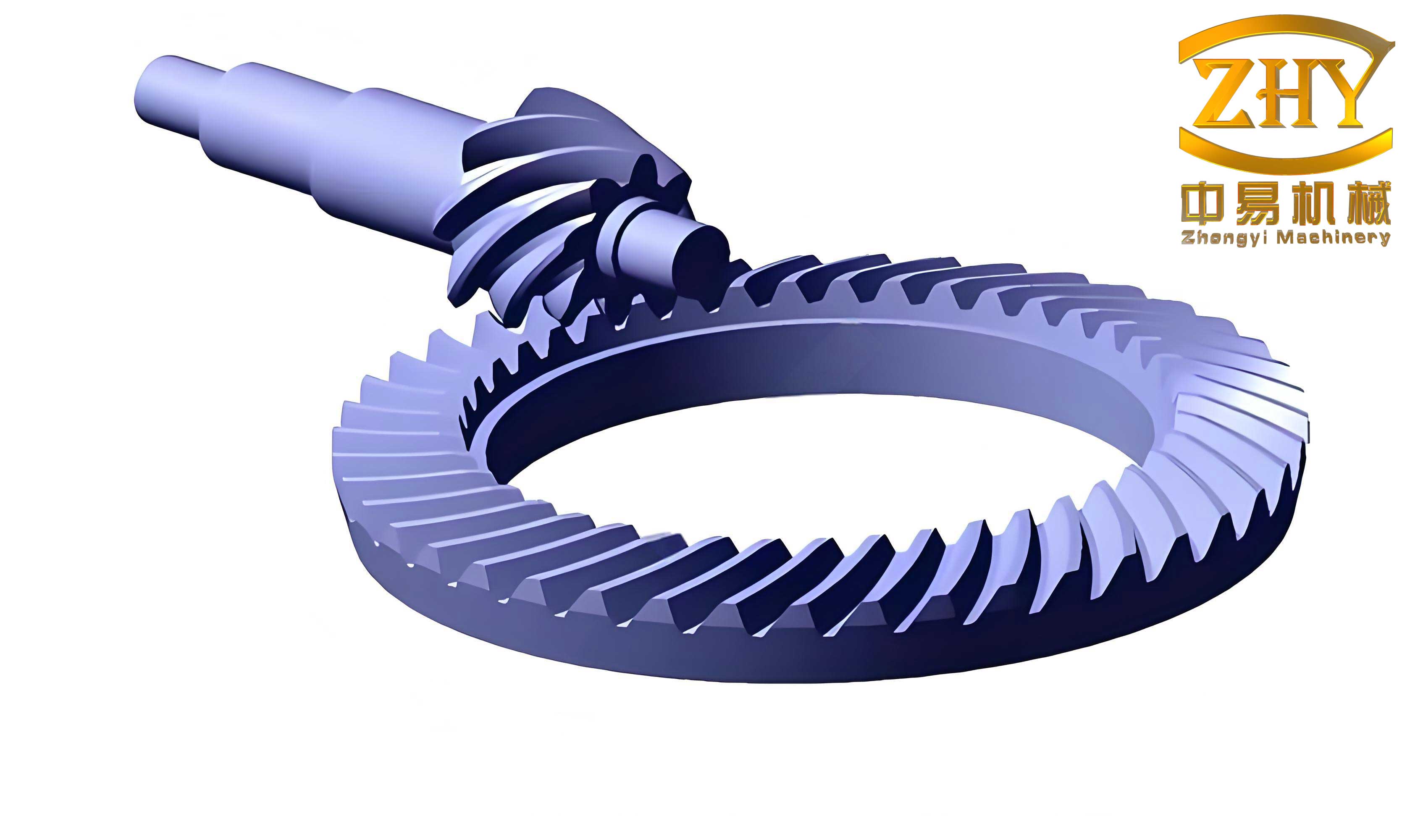
The fundamental principle that cannot be overstated is that hyperbolic gears require a dedicated lubricant. The extreme pressure (EP) conditions at the tooth contact point are far more intense than in common parallel-axis gears. Standard gear oils or universal tractor fluids lack the specific additive chemistry to cope with this. The correct lubricant contains special EP additives, typically sulfur-phosphorus compounds, which react chemically with the metal surfaces under high pressure and temperature to form a sacrificial, low-shear-strength layer. This layer prevents direct metal-to-metal contact, welding, and pitting. The lubricant’s role can be conceptualized by considering the minimum film thickness, $h_{min}$, which must be maintained to separate the surfaces. A simplified estimation can be derived from the Dowson-Higginson equation:
$$ h_{min} \approx 2.65 \frac{R^{0.43} (\eta_0 u)^{0.7}}{E’^{0.03} W^{0.13}} $$
Where $R$ is the reduced radius of curvature, $\eta_0$ is the dynamic viscosity at atmospheric pressure, $u$ is the entraining velocity, $E’$ is the reduced elastic modulus, and $W$ is the load per unit width. For hyperbolic gears, the sliding component increases the effective $u$ and the high contact stress dramatically increases $W$, making the maintenance of $h_{min}$ entirely dependent on $\eta_0$ and the EP additive’s ability to function when $h_{min} \rightarrow 0$ (boundary lubrication).
Selecting the correct lubricant involves understanding viscosity grades and service classifications. The most common specifications are based on the API GL (Gear Lubricant) categories, with GL-5 being the standard for high-duty hyperbolic gears in automotive axles. Modern, high-quality lubricants are formulated from highly refined base oils (hydrotreated or synthetic) with optimized additive packages, offering superior thermal stability, oxidation resistance, and shear stability compared to older, residual-based oils. The following table summarizes the key specifications and typical applications:
| API Category | Primary Use | EP Additive Level | Suitable for Hypoid/Hyperbolic Gears? |
|---|---|---|---|
| GL-4 | Moderate-duty manual transmissions, spiral-bevel gears | Medium | No, for moderate conditions only |
| GL-5 | High-duty hypoid/hyperbolic gears in axles, high-torque applications | High | Yes, the standard requirement |
| GL-6 (Obsolete) | Older specifications for very high offset gears | Very High | |
| MT-1 | Complementary spec for non-synchronized manual transmissions (often combined with GL-5 in multi-grade oils) | N/A | Part of a multi-functional lubricant |
Furthermore, viscosity must be matched to the operating temperature range. The SAE J306 standard defines viscosity grades for gear oils. A common recommendation for hyperbolic gear axles is to use a multi-grade oil for broad temperature coverage.
| SAE Viscosity Grade | Typical Ambient Temperature Range | Application Advice |
|---|---|---|
| 75W-90 | Very cold to moderate climates (-40°C to +35°C) | Excellent cold-start protection, common factory fill. |
| 80W-90 | Moderate climates (-25°C to +35°C) | Widely available, good all-round performance. |
| 85W-140 | Warm to hot climates, high-load/high-temperature service (-15°C to +45°C+) | Provides thicker film under severe conditions, may increase fuel consumption slightly. |
The actual service life and change interval for the lubricant in hyperbolic gears depend on a multitude of factors: vehicle load, driving cycle (stop-and-start vs. highway), environmental contamination, and the oil’s own quality. While manufacturers provide a conservative initial change interval (e.g., first 5,000 km for run-in, then every 30,000-50,000 km), a more scientific approach is to monitor the oil’s condition. The degradation of the additive package and the increase in total acid number (TAN) are key indicators. The rate of additive depletion can be modeled as a first-order reaction in some simplified cases:
$$ C = C_0 e^{-kt} $$
Where $C$ is the active additive concentration at time $t$, $C_0$ is the initial concentration, and $k$ is a degradation rate constant dependent on temperature (Arrhenius relationship) and mechanical shear. For a typical GL-5 oil in a hyperbolic gear unit, the critical $C$ level for effective protection is often reached before viscosity changes become significant. Therefore, oil analysis is the best tool for determining the optimal drain interval for severe service. The table below contrasts typical change practices:
| Change Basis | Typical Interval/Directive | Pros & Cons |
|---|---|---|
| Fixed Distance/Time (OEM) | e.g., 50,000 km or 2 years | Simple, safe for normal service. Can be wasteful or insufficient for severe duty. |
| Condition Monitoring (Oil Analysis) | Based on measured TAN, viscosity, wear metals, additive residuals. | Optimal, cost-effective, prevents failures. Requires investment in analysis. |
| Severe Service Schedule | Reduce fixed interval by 50% (e.g., 25,000 km) for towing, dusty, or stop-go use. | Practical compromise to offset harsh conditions without analysis. |
The procedure for changing the lubricant in a hyperbolic gear axle is critical. It is a process where cutting corners guarantees reduced component life. First, operate the unit to warm the oil, making it less viscous and ensuring contaminants are suspended. Drain the oil completely while hot. This is the most crucial step—incomplete drainage leaves abrasive wear particles and depleted oil to contaminate the new charge. Following this, the housing should be flushed with a light flushing oil or even a portion of the new gear oil to dislodge any sludge or sediment. Some technicians advocate for this, especially if there is evidence of prior contamination or unknown lubricant history. After flushing and draining thoroughly, reinstall the drain plug with a new washer. Refill with the exact specified grade and quantity of GL-5 lubricant for hyperbolic gears. Overfilling can cause churning losses, overheating, and seal leakage; underfilling leads to inadequate lubrication and immediate failure. The fill level is often just below the bottom of the filler hole.
A particularly dangerous and misguided practice, especially in cold climates, is the dilution of hyperbolic gear oil with kerosene or diesel fuel to lower its viscosity for winter starting. This practice destroys the lubricant’s load-carrying capacity. The EP additives require a specific oil film to function; excessive thinning raises the shear rate dramatically, preventing the formation of a stable film. More critically, dilution disrupts the additive chemistry. The effective concentration of EP agents is reduced, and the carrier fluid’s altered properties can prevent the necessary chemical reactions on the gear teeth. The result is a rapid transition to boundary lubrication without protection, leading to instantaneous scoring, pitting, and tooth breakage. The correct approach for cold-weather operation is to use a properly formulated multi-grade oil like 75W-90, which has the necessary low-temperature flow characteristics (defined by its Brookfield viscosity) without compromising the high-temperature film strength.
Finally, compatibility and storage are essential. Never mix different brands or types of gear oil, even if they claim the same API rating. Additive packages can be incompatible, leading to gelation or precipitation. Used oil drained from hyperbolic gears should be stored separately from other waste oils like engine oil or coolant, as it is often processed differently for recycling due to its high metal and additive content. In summary, the longevity of a hyperbolic gear set is directly proportional to the care taken in its lubrication. By using a dedicated GL-5 oil of the correct viscosity, adhering to a disciplined change procedure that emphasizes complete drainage, and avoiding harmful shortcuts like dilution, one can ensure these sophisticated components deliver their full potential in terms of durability, efficiency, and quiet operation for hundreds of thousands of kilometers.