
Gears are fundamental power transmission components, and their load-bearing capacity is intrinsically linked to the base material and, more critically, the subsequent heat treatment processes they undergo. Among the various performance metrics, bending fatigue strength stands as a primary indicator of a gear’s durability and operational limits. Case-hardening followed by quenching of alloy steels represents the pinnacle of hard-faced gear technology, offering the highest strength and most widespread application. However, within this broad category, the specific parameters of the quenching process—such as cooling rates, intermediate tempering steps, and reheat cycles—can vary significantly. These variations are not merely procedural; they directly influence the final microstructure, which governs mechanical properties. Suboptimal parameters can lead to various heat treatment defects such as excessive retained austenite, non-martensitic transformation products, grain boundary oxidation, or undesirable carbide networks, all of which are detrimental to fatigue life. While international standards may suggest certain practices, there is a notable absence of publicly available, direct correlation data between specific heat treatment process parameters and quantifiable gear transmission capacity metrics like bending fatigue limit. This gap in empirical knowledge makes it difficult for designers to optimize processes beyond generic guidelines. This study, therefore, was conducted to systematically investigate this relationship, providing experimental evidence to guide manufacturing decisions.
The core objective was to evaluate how different case-hardening and quenching methodologies affect the bending fatigue strength of a commonly used high-quality gear steel. The research was structured to move from standardized testing to microstructural analysis, linking macroscopic performance to microscopic origins, particularly those rooted in heat treatment defects.
1. Experimental Methodology and Material Specifications
The entire experimental program was designed to ensure comparability and isolate the heat treatment variable as the primary factor influencing performance.
1.1 Material Selection and Gear Geometry
The gear steel selected for this investigation is a mainstream alloy steel specifically designated for heavy-duty gears. To eliminate material-based variability, all test specimens were fabricated from the same melt and forging batch. The chemical composition and initial mechanical properties conformed to the stringent requirements for high-grade gear forgings. The quality level for material and heat treatment was controlled to the highest class (e.g., Class 4 in relevant standards), aiming to minimize inherent material heat treatment defects related to segregation or inclusion bands.
The test gears were designed as spur cylindrical gears according to the specifications of the standard bending fatigue test method (e.g., analogous to ISO 6336-5). Their key parameters are summarized below:
| Parameter | Symbol | Value | Unit |
|---|---|---|---|
| Module | mn | 8 | mm |
| Number of Teeth | z | 20 | – |
| Face Width | b | 25 | mm |
| Case Depth (Effective) | CHD | 1.6 – 1.8 | mm |
| Pressure Angle | α | 20 | ° |
1.2 Defined Heat Treatment Protocols
Three distinct heat treatment cycles were applied to separate batches of identical test gears. These processes were labeled for reference as Process A, Process B, and Process C. The goal was to represent common industrial practices ranging from a simple direct quench to more complex cycles involving intermediate treatments.
| Process ID | Description | Intended Purpose / Potential Impact on Defects |
|---|---|---|
| Process A (Direct Quench) | Carburize, then cool directly from the carburizing temperature to the quenching temperature (~850°C), hold, then oil quench. Followed by a single low-temperature temper. | Simplest and most cost-effective. High risk of excessive retained austenite and larger martensite plate size due to direct cooling from high temperature, which can be a significant heat treatment defect for fatigue. |
| Process B (Single Reheat Quench) | Carburize, cool to quenching temperature and oil quench. Then, re-carburize (or carbon restore), cool to ambient temperature. Reheat in a salt bath to 830°C, hold, and perform a second oil quench. Followed by a single low-temperature temper. | The intermediate cooling and reheating aim to refine the austenite grain size before the final quench, potentially reducing retained austenite and improving toughness, thereby mitigating some heat treatment defects associated with direct quenching. |
| Process C (High-Temp Tempering + Quench) | Carburize, cool from carburizing temperature to ~650°C, hold, then air cool to room temperature. Perform a high-temperature tempering (e.g., ~650°C). Subsequently, reheat in a salt bath to 810°C, hold, and oil quench. Followed by a single low-temperature temper. | The most complex cycle. The high-temperature tempering after carburizing aims to transform most of the microstructure, reducing stresses and allowing for a very controlled final austenitization from a uniform structure. This is designed to minimize all forms of heat treatment defects: it refines grain structure, minimizes retained austenite, and promotes a uniform, fine martensitic case. |
1.3 Fatigue Testing Procedures
Bending fatigue testing was conducted on a resonant-type pulsating testing machine. The setup employed a special fixture with automatic load-equalizing features, ensuring that the load was uniformly distributed between two simultaneously loaded teeth and across the tooth face width, eliminating bending moment errors and misalignment-induced stress concentrations. The loading frequency was approximately 100 Hz. Two complementary testing strategies were employed to robustly characterize the fatigue performance:
- Stepwise Load Increase (Staircase or “Up-and-Down”) Method: This method is efficient for estimating the fatigue limit. A sequence of gears from each process group is tested at progressively higher load levels. The test at a given load continues until failure or until a predetermined high number of cycles (e.g., 5×10⁶ cycles, considered a run-out) is reached. The load level at which failure consistently occurs provides a comparative measure of the fatigue strength.
- Constant Load Amplitude (Group Testing) Method: This method evaluates fatigue life (S-N behavior) at specific stress levels. Multiple gears from each group are tested to failure at two distinct, constant load amplitudes. The number of cycles to failure at each load is recorded, allowing for a direct comparison of the fatigue life between the different heat treatments under identical loading conditions.
The primary measured parameter was the total load applied across two teeth (F2t). The nominal tooth root bending stress (σF) can be derived using the Lewis formula with a correction factor for the test gear geometry:
$$ \sigma_F = \frac{F_{2t}}{b \cdot m_n} \cdot Y_F \cdot Y_S $$
where YF is the tooth form factor and YS is the stress correction factor. For the purpose of this comparative study, the direct load value (F2t) serves as a valid proxy for stress.
2. Experimental Results and Data Analysis
2.1 Fatigue Performance from Stepwise Load Increase Testing
The results from the staircase method clearly ranked the three processes. The highest load level sustained without failure (or causing failure after a high number of cycles) was observed for Process C gears, followed by Process B, with Process A gears failing at the lowest load levels. A simplified representation of the outcome is:
| Process | Comparative Fatigue Strength Ranking | Approximate Fatigue Limit (Relative Load F2t,lim) |
|---|---|---|
| Process C | Highest | 1.00 (Reference) |
| Process B | Intermediate | ~0.92 – 0.95 |
| Process A | Lowest | ~0.85 – 0.90 |
This trend immediately suggests that the more complex processes involving intermediate thermal cycles (B and especially C) impart a superior resistance to crack initiation under cyclic bending stresses, likely by alleviating specific heat treatment defects.
2.2 Fatigue Life at Constant Load Amplitudes
The group testing data provided a more granular view. At both elevated load levels tested, the median and characteristic lives (e.g., L10 or L50) of the gears followed the same hierarchy: Process C >> Process B > Process A. The scatter in life data was also notably lower for Process C, indicating more consistent material properties and fewer random heat treatment defects. The data can be modeled by a power-law relationship (Basquin’s equation):
$$ F_{2t}^k \cdot N = C $$
or in stress terms:
$$ \sigma_F^m \cdot N = \text{constant} $$
where m is the fatigue exponent and N is the cycles to failure. The constant C is significantly higher for Process C than for Process A, reflecting its superior fatigue strength. Sample data at a high load level is summarized below:
| Process | Load F2t (kN) | Cycles to Failure, N (Sample of 3 tests) | Mean Life (cycles) | Standard Deviation |
|---|---|---|---|---|
| A | 85 | 142,500; 155,000; 168,200 | 155,233 | 12,859 |
| B | 85 | 285,400; 301,100; 265,800 | 284,100 | 17,658 |
| C | 85 | >500,000; 482,300; 510,500* | >497,267 | Low |
*Test stopped at run-out (5×10⁵ cycles). The dramatic increase in life for Process C is evident.
2.3 Failure Analysis and Fractography
All failures were classical bending fatigue failures. The fracture origin was consistently located at the point of maximum tensile stress on the root fillet surface. The fracture surfaces exhibited clear regions: a smooth, often semicircular fatigue crack propagation zone with beach marks, and a final, rough instantaneous fracture zone. The uniformity in failure origin across all samples confirms that the testing methodology was sound and that the differences in life are attributable to the material’s resistance to crack initiation and early growth, not to extrinsic factors.
2.4 Metallographic and Microhardness Analysis
This is the critical link between process and performance. Transverse sections through the tooth, including the critical root region, were prepared for microscopic examination. All processes met the general hardness and case depth specifications. However, profound differences in microstructure were observed:
- Process A (Direct Quench): The case microstructure showed a coarse, plate-like high-carbon martensite with a significant volume fraction of retained austenite (typically 20-30%). This retained austenite is a soft, metastable phase that can transform under stress, but its presence in high amounts reduces the yield strength and can lead to dimensional instability. It is considered a primary heat treatment defect for high-stress applications. The core showed a mix of low-carbon martensite and some ferrite.
- Process B (Single Reheat Quench): The martensitic structure in the case was noticeably finer than in Process A. The amount of retained austenite was reduced (typically 10-15%). The grain refinement from the reheating step contributed to this improvement, directly addressing one of the key heat treatment defects of the direct quench process.
- Process C (High-Temp Tempering + Quench): This process yielded the most optimal microstructure. The case consisted of a very fine, homogeneous, and dense martensite with a minimal amount of retained austenite (less than 5-8%). The prior high-temperature tempering allowed for a complete breakdown of the initial structure, leading to a fine, recrystallized grain structure upon final austenitization. This process effectively eliminated the major heat treatment defects—excessive retained austenite and coarse martensite.
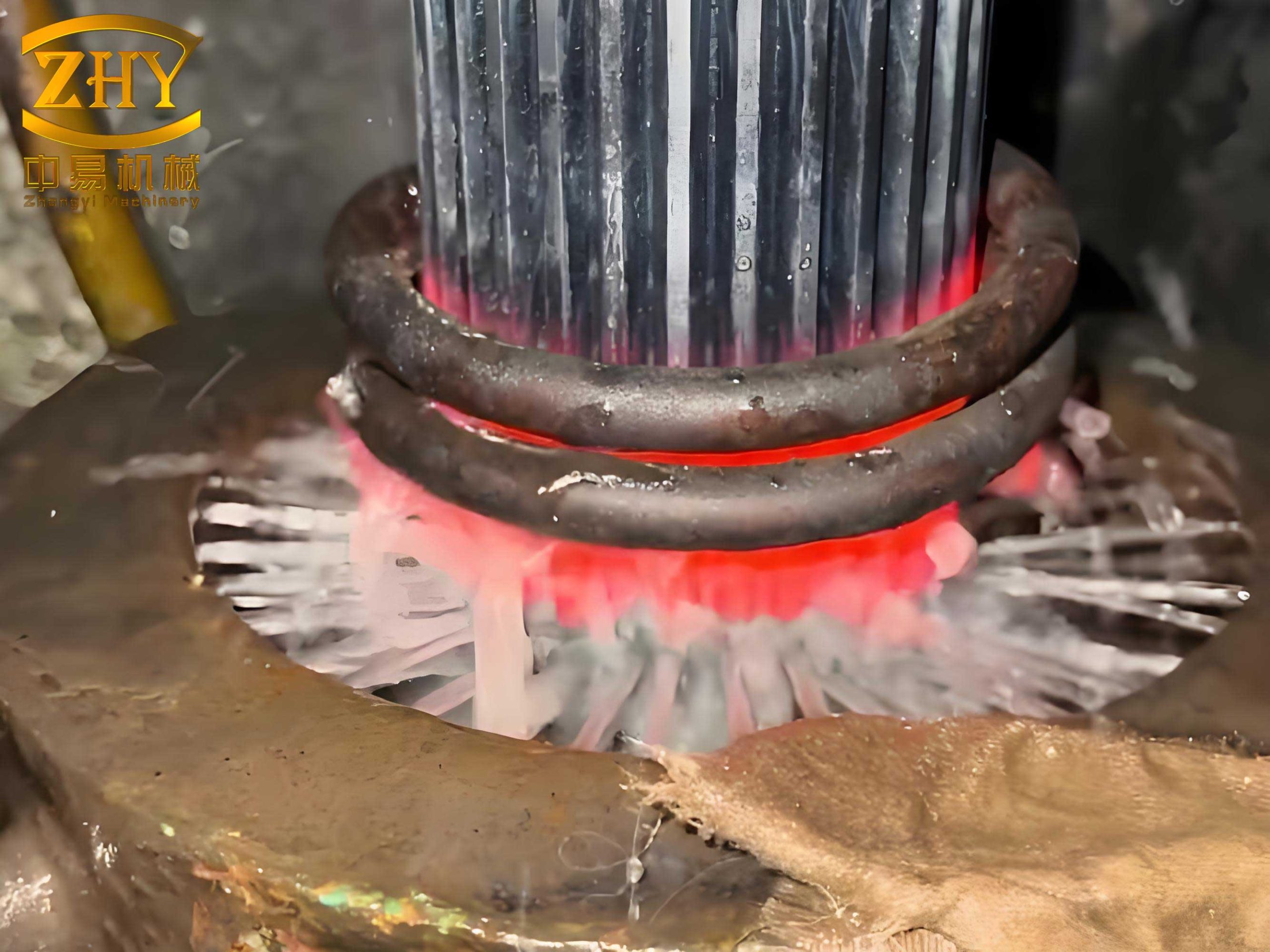
The image above provides a visual reference for the types of microstructural anomalies that can arise from suboptimal heat treatment. While not from the specific test samples, it illustrates concepts like microcracks, abnormal grain growth, and non-uniform hardening, all of which fall under the umbrella of heat treatment defects that the more refined Processes B and C were designed to avoid.
Microhardness traverses from the surface to the core showed similar effective case depths but different surface hardness and hardness gradients. Process C exhibited the highest surface hardness and the most gradual transition, supporting its superior performance.
3. In-Depth Discussion: Linking Process, Microstructure, Defects, and Performance
The experimental results unequivocally demonstrate that the bending fatigue strength of case-hardened gears is not a fixed material property but a direct function of the applied heat treatment cycle. The performance hierarchy (C > B > A) can be fully explained by the corresponding microstructures and the mitigation of specific heat treatment defects.
The fatigue process in high-strength steels is typically divided into crack initiation (often at micro-notches or inclusions) and crack propagation. For high-quality, clean gear steels, the initiation phase is heavily influenced by the matrix’s strength and its ability to resist slip and microplasticity. A coarse martensitic structure or one with high levels of soft retained austenite provides easier paths for slip localization. This can be conceptualized by considering the resistance to dislocation motion. The Hall-Petch relationship suggests that yield strength (σy) increases with finer grain size (d):
$$ \sigma_y = \sigma_0 + \frac{k_y}{\sqrt{d}} $$
Process C, with its refined prior austenite grains, achieves a higher σ0. Furthermore, retained austenite, while sometimes credited with enhancing toughness through transformation-induced plasticity (TRIP), is generally detrimental for contact fatigue and high-cycle bending fatigue where stresses are primarily elastic. Its lower hardness and potential for strain-induced transformation can act as a site for early crack initiation, a critical heat treatment defect.
Process A, the direct quench, is most susceptible to this heat treatment defect. Quenching from a high austenitizing temperature results in a coarse prior austenite grain size, which transforms to coarse martensite. The high carbon content in the case, combined with the high quench start temperature, suppresses the martensite finish (Mf) temperature, leaving a large fraction of austenite untransformed. This microstructure has lower strength and, under cyclic loading, the retained austenite may transform to brittle, untempered martensite, creating localized stress concentrations that nucleate cracks.
Process B introduces an intermediate refinement step. The reheating from room temperature to a lower austenitizing temperature (830°C vs. the initial carburizing temperature >900°C) promotes the formation of new, finer austenite grains. This refinement increases strength via the Hall-Petch mechanism and also allows for a more complete transformation to martensite upon the final quench, reducing retained austenite. It partially corrects the heat treatment defects inherent to Process A.
Process C is the most comprehensive solution. The high-temperature tempering after carburizing completely decomposes the initial austenitic structure into ferrite and carbides. This creates a uniform, fine-grained starting condition for the final austenitization. The final quench from a relatively low temperature (810°C) then produces an extremely fine and homogeneous martensite with minimal retained austenite. This process virtually eliminates the common heat treatment defects of coarse grains and high retained austenite, resulting in the highest possible strength, a smooth hardness gradient, and consequently, the best resistance to fatigue crack initiation. The fatigue crack propagation rate (da/dN) is also influenced by microstructure, often described by the Paris Law:
$$ \frac{da}{dN} = C (\Delta K)^m $$
where ΔK is the stress intensity factor range. A finer, tougher microstructure (as in Process C) can reduce the crack growth rate constant C, contributing to longer total life even after initiation.
The implications for gear design and manufacturing are significant. Simply specifying “case-hardened to HRC 58-62” is insufficient. The specific heat treatment route must be defined and controlled. For critical applications where weight, size, or reliability are paramount (e.g., aerospace, high-performance automotive, wind turbine gearboxes), the additional cost and cycle time of a Process C-type treatment are justified by the substantial gain in performance and reduction in the risk of failure due to heat treatment defects. For less demanding applications, Process B or even a very well-controlled Process A might be economically viable, but with a recognized derating in the calculated load capacity.
4. Conclusions and Engineering Recommendations
This systematic investigation provides clear, empirical evidence that the bending fatigue strength of alloy steel case-hardened gears is profoundly dependent on the specific details of the post-carburizing heat treatment cycle. The study successfully correlates process parameters with performance through microstructure analysis.
- Hierarchy of Performance: A process involving high-temperature tempering followed by re-austenitization and quenching (Process C) delivers the highest bending fatigue strength and longest fatigue life. A single reheat quenching process (Process B) offers intermediate improvement, while a direct quenching process (Process A) results in the lowest fatigue performance among the three.
- Root Cause – Microstructure: The performance differences are directly attributable to the resulting microstructures. Superior fatigue resistance is associated with a fine, homogeneous high-carbon martensite with minimal retained austenite in the case-hardened layer. Conversely, the presence of coarse martensite plates and a high volume fraction of retained austenite—both classic heat treatment defects—act as microstructural stress concentrators that facilitate early crack initiation under cyclic loading.
- Mechanistic Link: The more complex thermal cycles (Processes B and C) improve fatigue strength primarily by refining the prior austenite grain size and promoting a more complete martensitic transformation, thereby mitigating the key heat treatment defects inherent in the simpler direct quench method.
- Design and Manufacturing Guidance: Gear design standards and calculation methods (e.g., ISO 6336, AGMA 2001) incorporate life factors (YNT, ZNT) that are often based on material and hardness. This work suggests that these factors should be further differentiated based on the heat treatment methodology. For critical designs, specifying not just the final hardness but the detailed heat treatment cycle (e.g., “Case-hardened per Process C with ≤10% retained austenite in the case”) is essential for achieving predictable and reliable performance.
In essence, controlling heat treatment defects is not merely a quality assurance step but a fundamental design lever for enhancing gear power density and reliability. The data presented here provides a quantitative foundation for making informed choices between cost, complexity, and performance in gear transmission design.