
In the field of mechanical power transmission, the accurate replication of existing gear components without prior design documentation—a process known as reverse engineering—is a critical and challenging task. This is especially true for helical gear pairs found in modern automotive transmissions, where performance, noise, and compactness are paramount. These components are defined by a complex set of interrelated geometrical parameters: number of teeth (z), normal module (mn), normal pressure angle (αn), helix angle (β), and profile shift coefficients (x). While the tooth count is easily ascertained, determining the remaining fundamental parameters requires a systematic approach based on precise physical measurements and rigorous mathematical analysis. This article details a proven, practical methodology for the reverse engineering of helical gears, emphasizing the use of precise dimension over balls (or pins) measurements combined with computational solvers to accurately back-calculate all essential design parameters.
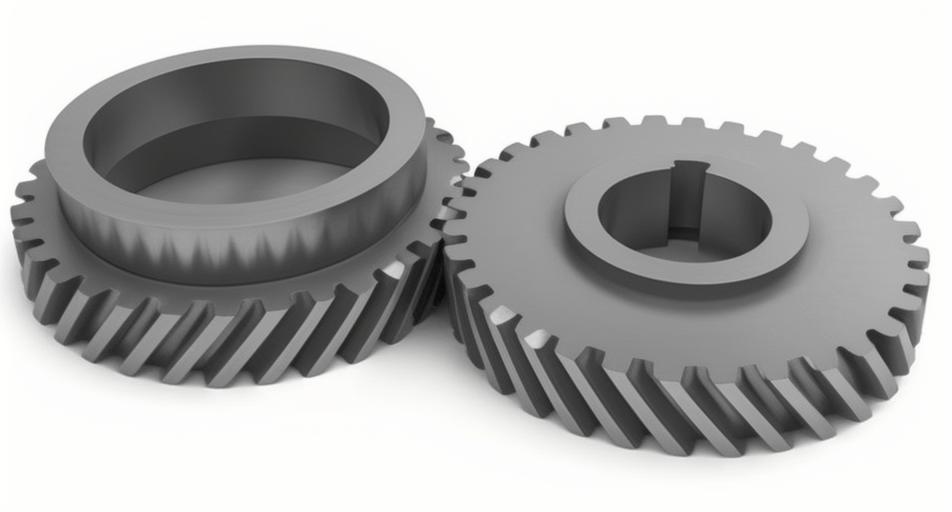
The cornerstone of this method lies in moving away from less reliable measurements, such as tip diameter, which is susceptible to manufacturing tolerances like chamfers or tip rounding. Instead, we focus on measurements that directly relate to the fundamental geometry of the involute helicoid: the base pitch and the working tooth thickness. The most reliable way to access these properties is through the measurement of spans over balls (for external gears). This approach is remarkably robust, insensitive to tip diameter variations, and highly accurate even for narrow-faced helical gears where measuring traditional features like base tangent length (span measurement) might be impractical.
Phase 1: Comprehensive Geometrical Measurement
The first phase involves the meticulous collection of physical data from the gear pair. Accuracy at this stage is paramount, as it forms the input for all subsequent calculations. The required measurements are summarized in the table below.
| Measurement | Symbol | Method/Tool | Notes |
|---|---|---|---|
| Number of Teeth | z1, z2 | Direct count | For pinion (1) and gear (2). |
| Face Width | b1, b2 | Calipers | Measured at multiple points. |
| Operating Center Distance | aw | CMM / Precision Bore Gages | Critical for backlash determination. Measure from housing bearing bores. |
| Dimension over Two Balls (Pinion) | M11, M12 | Ball Micrometer / Calipers with pins | Use two different ball diameters (dp1, dp2). Take multiple readings around the gear. |
| Dimension over Two Balls (Gear) | M2 | Ball Micrometer / Calipers with pins | Use one suitable ball diameter. Multiple readings. |
| Base Tangent Length (if accessible) | Wk, Wk+1 | Span Micrometer / Precision Calipers | Measure over k and k+1 teeth. Useful for initial estimate. |
For the dimension over balls measurement, selecting ball diameters that contact the flanks near the pitch circle is ideal. The ball should not bottom in the tooth space nor contact the tip radius. The measurement “M” is the distance between the outer-most points of two balls placed in opposite tooth spaces. Using two different ball sizes on the pinion provides the two independent data points needed to solve for the unknown base pitch, as will be shown.
Phase 2: Analytical Parameter Determination
With precise measurements in hand, the next phase involves the mathematical reconstruction of the original design parameters. This process leverages the fundamental relationships of involute helical gear geometry.
2.1 Determining the Normal Base Pitch (pbn)
The normal base pitch is the fundamental distance between adjacent, parallel involute tooth surfaces in the transverse plane. It can be estimated from the difference between two span measurements: $$ p_{bn} \approx W_{k+1} – W_{k} $$. However, a more accurate and robust determination uses the two dimension-over-balls measurements from the pinion. The relationship is derived from the geometry of the ball contacting the involute flank.
The pressure angle at the ball center, αMt, is found from the involute function:
$$ \text{inv}(\alpha_{Mt}) = \frac{d_p}{d_b \cos \beta_b} + \text{inv}(\alpha_t) + \frac{2\pi}{z} \cdot n – \frac{s_{bn}}{d_b} $$
Where \(d_b\) is the base diameter, \(\beta_b\) is the base helix angle, \(\alpha_t\) is the transverse pressure angle, \(n\) is the number of spaces between balls (for M measurement over opposite teeth, relevant terms simplify), and \(s_{bn}\) is the normal base tooth thickness.
For a measurement M over two balls of diameter \(d_p\), the relationship is:
$$ M = \frac{d_b}{\cos \beta_b \cdot \cos(\alpha_{Mt})} + d_p $$
For the same gear measured with two different ball diameters \(d_{p1}\) and \(d_{p2}\), giving measurements \(M_{11}\) and \(M_{12}\), we can eliminate the unknown base tooth thickness term. Combining and rearranging the equations leads to a transcendental equation where the only unknown is the base pitch \(p_{bn}\), since \(d_b = \frac{z \cdot p_{bn}}{\pi}\) and \(\cos \beta_b = \sqrt{1 – \sin^2 \beta \cdot \cos^2 \alpha_n}\) which also relates to \(p_{bn}\). The equation is of the form:
$$ \frac{M_{11} – d_{p1}}{\cos(\beta_b)} = \frac{z \cdot p_{bn}}{\pi \cdot \cos(\alpha_{Mt1})} \quad \text{and} \quad \frac{M_{12} – d_{p2}}{\cos(\beta_b)} = \frac{z \cdot p_{bn}}{\pi \cdot \cos(\alpha_{Mt2})} $$
with \(\text{inv}(\alpha_{Mt})\) being a function of \(p_{bn}\). This is efficiently solved using a numerical root-finding function in computational software like Mathcad, MATLAB, or Python. The solved \(p_{bn}\) value is highly accurate.
2.2 Determining Normal Module (mn) and Pressure Angle (αn)
The normal base pitch is directly linked to the module and pressure angle by the fundamental equation:
$$ p_{bn} = \pi \cdot m_n \cdot \cos(\alpha_n) $$
$$ \text{Therefore:} \quad m_n \cdot \cos(\alpha_n) = \frac{p_{bn}}{\pi} $$
Since standard values exist for both \(m_n\) and \(\alpha_n\), we create a comparison table. For automotive helical gears, common pressure angles are 14.5°, 15°, 16°, 17.5°, 18°, 18.5°, 20°, 21°, 22°, 22.5°, and 25°. Modules are often preferred values but can be non-standard.
| Normal Pressure Angle αn (°) | cos(αn) | Candidate Normal Module mn (mm) = pbn / (π * cos(αn)) |
|---|---|---|
| 17.5 | 0.9537 | pbn / 2.996 |
| 18.0 | 0.9511 | pbn / 2.988 |
| 18.5 | 0.9483 | pbn / 2.979 |
| 20.0 | 0.9397 | pbn / 2.952 |
| 21.0 | 0.9336 | pbn / 2.933 |
| 22.0 | 0.9272 | pbn / 2.913 |
| 22.5 | 0.9239 | pbn / 2.902 |
The correct pair (mn, αn) is chosen based on which calculated mn value is closest to a standard or commonly used module, and which matches typical practice for the gear’s application (e.g., a higher pressure angle for a lower gear in a transmission for strength). The pair must be the same for both meshing gears.
2.3 Determining the Helix Angle (β)
Once mn and αn are known, the helix angle can be derived from the same two-ball measurement data. From the geometry, the transverse base pitch pbt is related to the normal base pitch by the base helix angle: $$ p_{bt} = \frac{p_{bn}}{\sin(\beta_b)} $$. The transverse base pitch can also be related to the difference in the involute angles from the two ball measurements. A direct formula can be derived:
$$ \beta = \arcsin\left( \frac{\sin\left[ \arccos\left( \frac{d_{p1} – d_{p2}}{2 \cdot r_b \cdot (\text{inv}\alpha_{Mt1} – \text{inv}\alpha_{Mt2})} \right) \right]}{\cos(\alpha_n)} \right) $$
Where \(r_b\) is the base radius, now known from \(r_b = \frac{z \cdot m_n \cdot \cos(\alpha_n)}{2 \cos(\beta)}\) (which requires iterative solution). In practice, using computational software, β is solved simultaneously or iteratively within the framework established in section 2.1. The solver finds the β value that satisfies the two-ball measurement equations for M11 and M12 given the now-known mn and αn. The result is typically rounded to a sensible decimal place (e.g., 0.1° or 0.01°).
2.4 Determining Profile Shift Coefficients (x1, x2)
With mn, αn, β, and z known, the standard (reference) geometry is defined. The actual tooth thickness, reflected in the dimension over balls M, indicates the presence of profile shift. The working (manufacturing) profile shift coefficient xE for each gear is calculated from its dimension over balls measurement (using a single ball size). The formula is:
$$ x_E = \frac{ \left[ z \cdot (\text{inv}\alpha_{Mt} – \text{inv}\alpha_t) + \frac{\pi}{2} \right] – \frac{d_p}{m_n \cos \alpha_n} }{2 \tan(\alpha_n)} $$
Where:
- αMt is calculated from the measured M value: $$ \cos(\alpha_{Mt}) = \frac{d_b}{(M – d_p) \cdot \cos \beta_b} $$
- αt is the transverse pressure angle: $$ \tan(\alpha_t) = \frac{\tan(\alpha_n)}{\cos(\beta)} $$
This xE represents the tool shift used to cut the gear. The type of modification (angle vs. height) is determined by comparing the measured operating center distance aw to the standard center distance a = mn(z1+z2)/(2 cos β). If aw ≠ a, it is an angle modification. The sum of the operating profile shift coefficients (x1 + x2) can then be found from the center distance and the operating transverse pressure angle αwt:
$$ \text{inv}(\alpha_{wt}) = \frac{2 \tan(\alpha_n) (x_1 + x_2)}{z_1 + z_2} + \text{inv}(\alpha_t) $$
$$ \text{and} \quad a_w \cdot \cos(\alpha_{wt}) = a \cdot \cos(\alpha_t) $$
The individual operating coefficients (x1, x2) are often derived by allocating the measured tooth thinning (backlash) relative to the theoretical xE values.
2.5 Determining the Operating Backlash
The normal operating backlash jbn is a result of the designed tooth thickness reduction and center distance tolerance. It can be calculated from the difference between the calculated no-backlash tooth thickness (from xE) and the tooth thickness implied by the actual meshing at center distance aw.
$$ j_{bn} = \left[ \frac{(z_1 + z_2) \cdot (\text{inv}\alpha_{wt} – \text{inv}\alpha_t)}{2 \tan(\alpha_n)} – (x_{E1} + x_{E2}) \right] \cdot 2 m_n \sin(\alpha_n) $$
The transverse backlash jwt and radial backlash jr follow:
$$ j_{wt} = \frac{j_{bn}}{\cos(\alpha_{wt}) \cdot \cos(\beta_b)} $$
$$ j_{r} = \frac{j_{wt}}{2 \tan(\alpha_{wt})} $$
Phase 3: Verification and Practical Application
The final step is to validate the derived parameters. The calculated values for mn, αn, β, x1, x2, tip diameter, and root diameter are input into a gear inspection machine (e.g., a gear measuring center) or detailed CAD model. The software generates the theoretical tooth form, which is then compared to the physical gear via scanning or probing. Close agreement in profile, helix, and pitch measurements confirms the success of the reverse engineering process. A summary table of the final determined parameters for a helical gear pair would look like this:
| Parameter | Symbol | Pinion (Gear 1) | Wheel (Gear 2) |
|---|---|---|---|
| Number of Teeth | z | 16 | 44 |
| Normal Module | mn (mm) | 2.4 | |
| Normal Pressure Angle | αn (°) | 20.0 | |
| Helix Angle (Hand) | β | 28.0° (LH) | 28.0° (RH) |
| Working Profile Shift Coeff. | xE | +0.390 | -0.277 |
| Reference Center Distance | a (mm) | 81.585 | |
| Operating Center Distance | aw (mm) | 82.500 | |
| Normal Operating Backlash | jbn (mm) | 0.134 | |
Conclusion
The methodology presented provides a rigorous and reliable framework for the reverse engineering of helical gears. By prioritizing the precise measurement of dimension over balls—a feature intrinsically linked to the base pitch and tooth thickness—and employing numerical methods to solve the resulting system of geometric equations, it is possible to accurately recover the fundamental design parameters of an unknown helical gear pair. This approach minimizes errors introduced by measuring secondary features like tip diameters and is applicable even to narrow-face-width gears. While the calculations are best performed with engineering software, the underlying principles are rooted in the invariant laws of involute gearing. This method is equally potent for reverse engineering involute splines, demonstrating its broad utility in the field of power transmission component analysis and replication. Success, however, always depends on the meticulousness of the initial measurement phase and the engineer’s informed judgment in selecting among standard parameter values.