
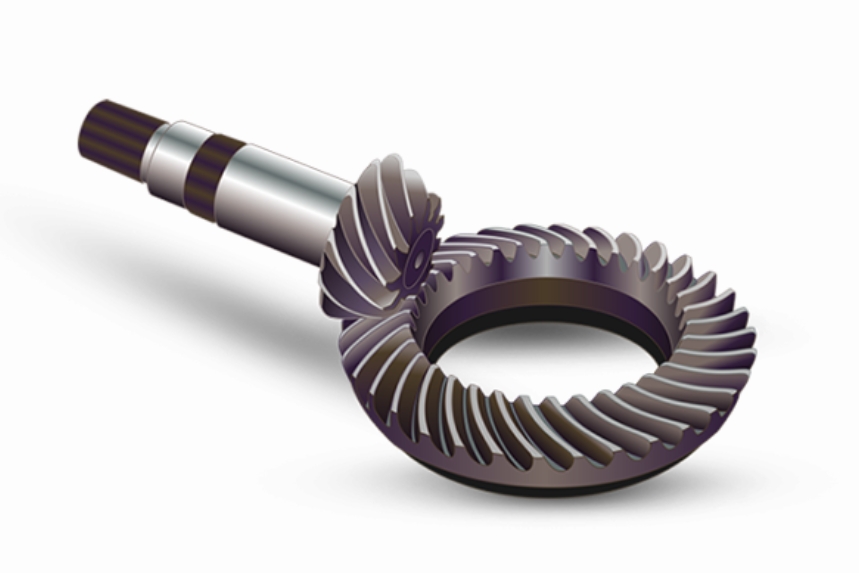
The analysis of dynamic behavior in geared power transmission systems is fundamental to ensuring reliability, efficiency, and quiet operation, especially in demanding applications like aerospace propulsion and helicopter main rotor drives. Among various gear types, spiral bevel gears are particularly crucial due to their ability to transmit power between intersecting shafts smoothly and with high load capacity. However, their dynamic response is inherently complex. Under high-speed and heavy-load operating conditions, the contact point between meshing teeth, the direction of the contact force, and the number of tooth pairs in simultaneous contact continuously change. This results in a significant periodic variation in the mesh stiffness, a primary parameter governing the system’s dynamic characteristics. Consequently, the vibration of spiral bevel gears can be fundamentally characterized as a parametric vibration problem, excited by this time-varying mesh stiffness.
Accurate determination of the time-varying mesh stiffness function is therefore the cornerstone of any rigorous dynamic study of spiral bevel gears. Simplifying this stiffness as a square wave or a simple harmonic function, often acceptable for spur or helical gears, is inadequate for the complex geometry of spiral bevel gears. The curvature of the tooth surfaces, the varying contact path, and the load-sharing among multiple teeth necessitate a more sophisticated numerical approach. This work focuses on establishing a precise numerical model for the time-varying mesh stiffness of aerospace-grade spiral bevel gears and subsequently investigating its influence on the parametric stability of the geared system across its operational speed range.
1. Numerical Modeling of Time-Varying Mesh Stiffness
1.1 Acquisition of Tooth Contact Information
The foundation for calculating instantaneous mesh stiffness lies in obtaining precise geometric and load distribution data from tooth contact analysis. For spiral bevel gears, this is achieved through two established computational techniques: Tooth Contact Analysis (TCA) and Loaded Tooth Contact Analysis (LTCA). TCA simulates the kinematic motion and unloaded contact pattern, identifying the potential contact points and transmission error under negligible load. LTCA extends this by solving the elastic deformation problem, determining the actual contact ellipse, pressure distribution, and loaded transmission error when the gear pair is subjected to a specified torque.
The contact points identified by TCA and LTCA are initially defined in a two-dimensional coordinate system $S_1(O_1, X, Y)$ attached to the gear blank’s axial section. Point $O_1$ is located at the midpoint of the gear root cone element. The $X$-axis aligns with this root cone element, and the $Y$-axis passes through the tooth face midpoint $M$ and is perpendicular to $X$. For any contact point $m$, its coordinates $(X_m, Y_m)$ can be expressed relative to the known coordinates of the face midpoint $M (R_M, L_M)$ and other basic gear design parameters. Let $R_m$ and $L_m$ be the distance from point $m$ to the gear axis and along the gear axis to the crossing point, respectively. $\Gamma$ is the gear pitch angle, and $Z_f$ is the distance from the gear root cone apex to the axis crossing point. The transformation is given by:
$$ X_m = R_m \sin\Gamma + L_m \cos\Gamma – R_M \sin\Gamma – L_M \cos\Gamma $$
$$ Y_m = R_m \cos\Gamma – (L_m + Z_f) \sin\Gamma $$
However, for stiffness calculation, a three-dimensional global coordinate system $S_2(O_2, x, y, z)$ is more convenient. Here, $O_2$ is the axis intersection point. The $x$-axis coincides with the pinion axis, and the $y$-axis is perpendicular to the gear axis. In this system, the coordinates of point $m$ are:
$$ x_m = R_m \cos\gamma $$
$$ y_m = R_m \sin\gamma $$
$$ z_m = -L_m $$
where $\gamma$ is the instantaneous rotation angle of the gear blank at the contact point, obtained from the LTCA solution. By solving the system of equations from (1) and (2), the complete three-dimensional contact information (position and associated load vector) for any meshing instant is determined.
1.2 Numerical Stiffness Model Formulation
The meshing action between a pair of gear teeth can be modeled as a linear spring at the instantaneous point of contact, with a stiffness $k(t)$. For a given contact instant, the scalar relation holds:
$$ F = k \cdot \delta $$
where $F$ is the magnitude of the contact force, $k$ is the instantaneous mesh stiffness at that point, and $\delta$ is the total deflection along the line of action caused by the force.
Using the results from TCA (unloaded) and LTCA (loaded), we can compute this stiffness. In the global coordinate system $S_2$, let $\boldsymbol{\mu}_1$ and $\boldsymbol{F}_1$ represent the position vector and force vector for the unloaded contact point $K_1$, and $\boldsymbol{\mu}_2$ and $\boldsymbol{F}_2$ represent those for the loaded contact point $K_2$. The deflection $\delta$ along the line of action is the projection of the displacement vector between the loaded and unloaded contact points onto the direction of the net force change:
$$ \delta = \frac{\boldsymbol{F}_2 – \boldsymbol{F}_1}{|\boldsymbol{F}_2 – \boldsymbol{F}_1|} \cdot (\boldsymbol{\mu}_2 – \boldsymbol{\mu}_1) $$
Consequently, the instantaneous mesh stiffness for that tooth pair at that specific angular position is:
$$ k = \frac{|\boldsymbol{F}_2 – \boldsymbol{F}_1|}{\delta} = \frac{|\boldsymbol{F}_2 – \boldsymbol{F}_1|^2}{(\boldsymbol{F}_2 – \boldsymbol{F}_1) \cdot (\boldsymbol{\mu}_2 – \boldsymbol{\mu}_1)} $$
Standard LTCA procedures typically discretize one mesh cycle into a finite number of intervals (e.g., 10 intervals). Equation (5) is applied to compute the stiffness for a single tooth pair at each discrete angular position or “slice” of the mesh cycle. To obtain the total effective mesh stiffness $k_{total}(t)$, the contributions from all tooth pairs in simultaneous contact must be combined. For high-contact-ratio spiral bevel gears, up to three tooth pairs may share the load. The total mesh stiffness is the sum of the individual stiffnesses of all contacting pairs at that instant:
$$ k_{total}(\theta) = \sum_{i=1}^{N_{cp}(\theta)} k_i(\theta) $$
where $N_{cp}(\theta)$ is the number of contacting pairs at mesh position $\theta$, and $k_i(\theta)$ is the stiffness of the $i$-th pair computed via Eq. (5). By evaluating this over a full mesh cycle, a numerical model of the periodic time-varying mesh stiffness $k_m(t)$ is constructed.
2. Stability Analysis of Parametrically Excited Systems with Time-Varying Stiffness
The equation of motion for a gear pair model considering time-varying mesh stiffness and damping can be expressed in matrix form for free vibration as:
$$ \mathbf{M} \ddot{\mathbf{x}}(t) + \mathbf{C}(t) \dot{\mathbf{x}}(t) + \mathbf{K}(t) \mathbf{x}(t) = 0 $$
where $\mathbf{M}$ is the mass matrix, $\mathbf{C}(t)$ is the periodic damping matrix, $\mathbf{K}(t)$ is the periodic stiffness matrix, and $\mathbf{x}(t)$ is the displacement vector. For analysis of parametric stability, the focus is on the homogeneous system. The periodic nature of $\mathbf{K}(t)$ (with period $T$ equal to the mesh period) makes this a linear system with periodic coefficients.
2.1 Floquet Theory and State Transition Matrix
Floquet theory provides the fundamental framework for analyzing the stability of such systems. The general state-space form of a periodic system is:
$$ \dot{\mathbf{d}}(t) = \mathbf{A}(t) \mathbf{d}(t) + \mathbf{f}(t), \quad \mathbf{A}(t+T) = \mathbf{A}(t) $$
where $\mathbf{d}(t) = [\mathbf{x}(t), \dot{\mathbf{x}}(t)]^T$ is the state vector and $\mathbf{f}(t)$ is the excitation vector. The solution at any time $t$ can be written in terms of the state transition matrix $\mathbf{\Phi}(t, 0)$:
$$ \mathbf{d}(t) = \mathbf{\Phi}(t, 0) \mathbf{d}(0) + \int_{0}^{t} \mathbf{\Phi}(t, \tau) \mathbf{f}(\tau) d\tau $$
The stability of the system is determined by the eigenvalues $\lambda_i$ of the monodromy matrix $\mathbf{\Phi}(T, 0)$, known as the Floquet multipliers. If the magnitude of any Floquet multiplier exceeds unity ($|\lambda_i| > 1$), the system is unstable, indicating unbounded growth of the response for that specific combination of parameters.
2.2 Analytical State Transition Matrix for Piecewise-Linear Stiffness
To make the problem tractable, the time-varying mesh stiffness $k_m(t)$ over one mesh period $T$ is approximated as a piecewise linear (or piecewise constant) function. The period $T$ is divided into $n$ intervals where the stiffness is assumed constant. The monodromy matrix can then be synthesized as the product of state transition matrices for each sub-interval:
$$ \mathbf{\Phi}(T, 0) = \mathbf{\Phi}(T, t_{n-1}) \mathbf{\Phi}(t_{n-1}, t_{n-2}) \dots \mathbf{\Phi}(t_1, 0) $$
Within any sub-interval $(t_k, 0)$ where the system matrices are constant, the dynamics are time-invariant. The free vibration response in modal coordinates $\mathbf{q}$ is given by:
$$ q_j(t) = e^{-\zeta_j \omega_j t} (h_j \cos(\omega_{dj} t) + k_j \sin(\omega_{dj} t)) $$
where $\zeta_j$ is the damping ratio, $\omega_j$ is the undamped natural frequency, and $\omega_{dj} = \omega_j \sqrt{1-\zeta_j^2}$ is the damped natural frequency for the $j$-th mode. Let $e_j = e^{-\zeta_j \omega_j t}$, $c_j = \cos(\omega_{dj} t)$, and $s_j = \sin(\omega_{dj} t)$.
Using modal superposition with the modal matrix $\mathbf{U}$, where $\mathbf{x} = \mathbf{U} \mathbf{q}$, the response in physical coordinates is:
$$ \mathbf{x}(t) = \sum_{j=1}^{N} \mathbf{U}_j (h_j c_j + k_j s_j) e_j $$
$$ \dot{\mathbf{x}}(t) = \sum_{j=1}^{N} \mathbf{U}_j [(-h_j \omega_{dj} s_j + k_j \omega_{dj} c_j) + (h_j c_j + k_j s_j)(-\zeta_j \omega_j)] e_j $$
Relating the state at time $t$ to the initial state via $\mathbf{d}(t) = \mathbf{\Phi}(t, 0) \mathbf{d}(0)$ allows for the derivation of an analytical expression for the sub-interval state transition matrix. Defining diagonal matrices $\mathbf{P} = [\omega_{dj}^{-1}]$, $\mathbf{Q} = [\zeta_j \omega_j]$, and $\mathbf{B} = \mathbf{U}^T \mathbf{M}$, the matrix $\mathbf{\Phi}(t, 0)$ can be compactly written in block form:
$$ \mathbf{\Phi}(t, 0) = \begin{bmatrix}
\mathbf{\Phi}_{11} & \mathbf{\Phi}_{12} \\
\mathbf{\Phi}_{21} & \mathbf{\Phi}_{22}
\end{bmatrix} $$
where the sub-matrices are:
$$ \mathbf{\Phi}_{11} = \mathbf{U} [ e_j c_j ] \mathbf{B} + \mathbf{U} [ e_j s_j ] \mathbf{P} \mathbf{Q} \mathbf{B} $$
$$ \mathbf{\Phi}_{12} = \mathbf{U} [ e_j s_j ] \mathbf{P} \mathbf{B} $$
$$ \mathbf{\Phi}_{21} = \mathbf{U} [ -e_j \omega_{dj} s_j ] \mathbf{B} + \mathbf{U} [ -\zeta_j \omega_j e_j c_j ] \mathbf{B} + \mathbf{U} [ e_j \omega_{dj} c_j ] \mathbf{P} \mathbf{Q} \mathbf{B} + \mathbf{U} [ -\zeta_j \omega_j e_j s_j ] \mathbf{P} \mathbf{Q} \mathbf{B} $$
$$ \mathbf{\Phi}_{22} = \mathbf{U} [ e_j \omega_{dj} c_j ] \mathbf{P} \mathbf{B} + \mathbf{U} [ -\zeta_j \omega_j e_j s_j ] \mathbf{P} \mathbf{B} $$
By calculating $\mathbf{\Phi}(t_i, t_{i-1})$ for each of the $n$ constant-stiffness intervals using Eq. (14) and then applying the product formula in Eq. (9), the monodromy matrix $\mathbf{\Phi}(T, 0)$ is obtained. The magnitudes of its eigenvalues (Floquet multipliers) are then computed across a range of operating speeds to identify regions of parametric instability for the spiral bevel gear system.
3. Case Study: Performance Comparison of Different Tooth Contact Designs
To demonstrate the application of the developed methodology, a case study of an aero-engine central drive spiral bevel gear pair is analyzed. The basic design parameters are summarized in Table 1.
| Design Parameter | Pinion | Gear |
|---|---|---|
| Number of Teeth | 35 | 47 |
| Shaft Angle | 90° | |
| Mean Spiral Angle | 35° | 35° |
| Hand of Spiral | Left | Right |
| Whole Depth (mm) | 7.32 | 7.32 |
| Module (mm) | 3.875 | |
| Face Width (mm) | 21 | 21 |
| Pitch Angle | 36°40′ | 53°20′ |
Three distinct tooth contact patterns are generated by adjusting the pinion machine tool settings on the concave side, as detailed in Table 2. All analyses are performed under a constant pinion torque of 400 Nm.
| Machine Setting | Setting A | Setting B | Setting C |
|---|---|---|---|
| Cutter Radius (mm) | 102.74 | 101.98 | 101.60 |
| Pressure Angle (°) | 18 | 18 | 18 |
| Radial Setting (mm) | 101.51 | 100.57 | 93.96 |
| Angular Setting (°) | 60.46 | 60.70 | 61.01 |
| Sliding Base (mm) | 2.00 | -0.16 | -3.21 |
| Machine Center to Back (mm) | 11.35 | 9.76 | 4.94 |
| Blank Offset (mm) | -6.63 | -5.70 | -2.89 |
| Machine Ratio | 1.83 | 1.80 | 1.68 |
3.1 Loaded Contact Pattern and Transmission Error
The loaded contact paths for the three settings reveal high-contact-ratio designs with significant bias. The paths are inclined at approximately 77° (Setting A) and 76° (Settings B & C) relative to the root line. While the paths near the toe are very similar, Setting C maintains the closest proximity to the edges. Near the heel, the path for Setting C is almost straight and remains farthest from the edge, whereas paths for A and B show more curvature. The working contact ratio increases progressively from Setting A to Setting C.
The unloaded (geometric) transmission error curves become wider and their peak-to-peak amplitude decreases from Setting A to C, all exhibiting a roughly symmetric parabolic shape. The loaded transmission error, which includes the effects of tooth compliance, shows a similar trend: the fluctuation amplitude (difference between maximum and minimum) decreases, with Setting C exhibiting about a 7% lower amplitude than Setting A.
The load-sharing percentage carried by the middle tooth pair in the three-tooth contact region decreases from Setting A to Setting C. This indicates a more uniform distribution of load among the contacting pairs for Settings B and C. Consequently, the maximum surface contact stress (Hertzian stress) also decreases: 1579 MPa for A, 1476 MPa for B, and 1386 MPa for C—a reduction of approximately 12% for Setting C compared to Setting A.
3.2 Computed Time-Varying Mesh Stiffness
The total mesh stiffness functions $k_m(t)$ for the three settings under 400 Nm are calculated using the numerical model described in Section 1. The results, plotted over one mesh cycle, show distinct characteristics:
- Setting A: The stiffness curve is the smoothest and most平稳, with the highest mean value of approximately 14,261 N/mm.
- Setting B: The stiffness variation is the most severe, exhibiting a large step-change near the pitch point. It has the lowest mean stiffness of about 12,903 N/mm.
- Setting C: The stiffness variation is also significant, featuring two distinct peaks. Its mean stiffness is 13,311 N/mm, which is between that of A and B.
These values are consistent in order of magnitude with results from other methods, such as finite element analysis reported in literature for similar spiral bevel gears under comparable loads.
3.3 Parametric Stability Analysis Results
The computed stiffness functions are incorporated into a classic two-degree-of-freedom lateral-torsional dynamic model of a gear pair. Applying the Floquet theory procedure with piecewise-constant stiffness approximation, the Floquet multipliers are calculated across the gear’s operational speed range (approximately 10,192 to 16,744 rpm). Instability occurs when the magnitude of the dominant multiplier exceeds 1.
The analysis reveals a clear influence of the mesh stiffness characteristic on stability:
- Setting A: Exhibits two narrow unstable speed ranges, accounting for only about 0.6% of the total operational speed interval.
- Setting B: Shows four unstable regions, covering approximately 2.9% of the speed range.
- Setting C: Also exhibits four unstable regions, covering about 2.4% of the speed range.
This indicates that Setting A, with its smoother and higher-mean mesh stiffness, provides the best parametric stability margin. The primary unstable zones for this setting are located near gear speeds of 13,396 rpm and 15,093 rpm.
4. Discussion and Design Implications
The findings from this integrated analysis of spiral bevel gears highlight several critical points for dynamic design:
1. Dominant Influence of Mesh Stiffness Characteristic: The parametric stability of the system is highly sensitive to the nature of the time-varying mesh stiffness. A stiffness function that is not only high in mean value but also varies smoothly over the mesh cycle (minimizing abrupt changes or deep troughs) is most effective in suppressing the onset of parametric instability. This is clearly demonstrated by the superior stability of Setting A compared to Settings B and C.
2. The Relationship Between Contact Ratio, Stiffness, and Stability: While a higher contact ratio is generally pursued to improve load capacity and smoothness of motion, its effect on dynamic stability is not straightforward. In this case study, increasing the contact ratio from Setting A to Settings B and C improved load distribution and reduced contact stress and transmission error fluctuation. However, it altered the stiffness function in a way that introduced more severe variations or a different shape, ultimately degrading the parametric stability. This underscores the need for a multi-objective design approach that balances static/dynamic load performance with dynamic stability.
3. Stability vs. Forced Vibration Response: It is crucial to distinguish between parametric instability and forced vibration amplitude. A design with good parametric stability (few/small unstable regions) may still exhibit higher forced vibration levels if its loaded transmission error (the primary kinematic excitation) is large. Setting A had the best stability but the largest transmission error fluctuation. Therefore, an optimal design must consider both the elimination of instability regions and the minimization of excitation sources. Future work should involve computing the dynamic response of the system, including both parametric and forced excitation terms, to fully assess noise and vibration levels.
4. Utility of the Analytical Floquet Approach: The methodology presented, combining a numerical LTCA-based stiffness model with an analytical Floquet stability analysis for piecewise-linear systems, provides an efficient tool for scanning operational speed ranges for potential instabilities. It avoids the computational expense of lengthy time-domain simulations while offering clear stability boundaries.
5. Conclusion
This work establishes a comprehensive framework for analyzing the parametric vibration stability of spiral bevel gears. A high-fidelity numerical model for the time-varying mesh stiffness is developed based on loaded tooth contact analysis, accurately capturing the effects of complex geometry and load sharing. By treating this stiffness as piecewise-linear over a mesh cycle, an analytical formulation for the state transition matrix is derived, enabling efficient application of Floquet theory.
The case study on an aero-engine gear pair demonstrates the practical application of this framework. It conclusively shows that the characteristic of the time-varying mesh stiffness—specifically its smoothness and mean value—is a primary determinant of parametric stability. Smoother, higher-mean stiffness promotes stability. Furthermore, the analysis reveals that traditional design goals like increasing contact ratio, while beneficial for static performance, do not automatically guarantee better dynamic stability and may even compromise it by altering the stiffness function unfavorably. Therefore, the dynamic mesh stiffness characteristic must be explicitly considered as a key design parameter alongside contact pattern, stress, and transmission error in the development of high-performance spiral bevel gear systems for critical aerospace applications.